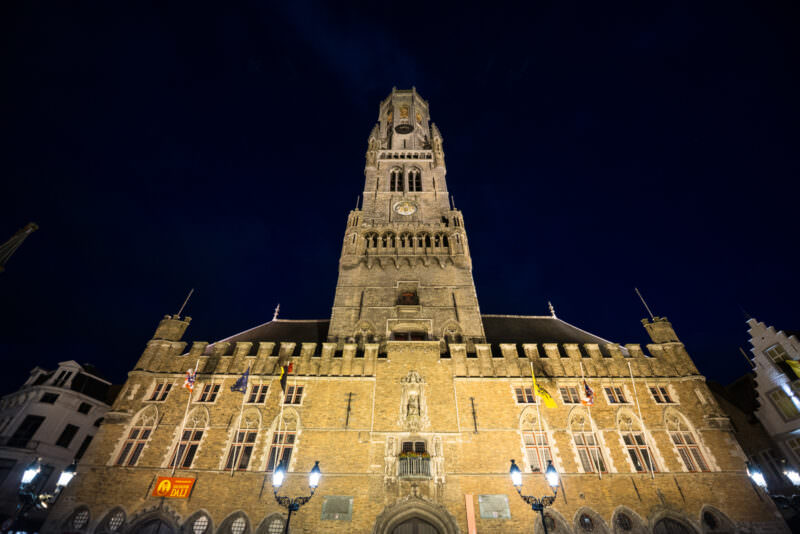
BRUGES, Belgium — The Belfry of Bruges is the most famous landmarks is this charming medieval city. But it hasn’t all been peeling bells and glorious views in its nearly 800-year history.
From the top, you can see most of Bruges. And from most of Bruges, you can see the Belfry. It has stood there, towering over the city, while the economy of Bruges boomed on Flemish textiles and trading, while the economy went bust when ships could no longer reach the ports of Bruges, and when it boomed again as tourists discovered the city’s medieval and cobblestoned charms.
Ah! The enchantment of the light and wind after so long a struggle upward in the stuffy darkness! The city of Bruges lies spread around you, a carpet of orange-red roofs and gray squares. The canals, with their broken silver, bound it on either side, and the featureless flat landscape, discolored and dim, mounts to the edge of the grayish blue sky, an empty circle. Below you — immediately below — lies the vast empty Grand Place, looking, no doubt, precisely as it looked five hundred years ago.
Edmund Gosse, “Impressions of Bruges,” The Independent, 28 June 1900
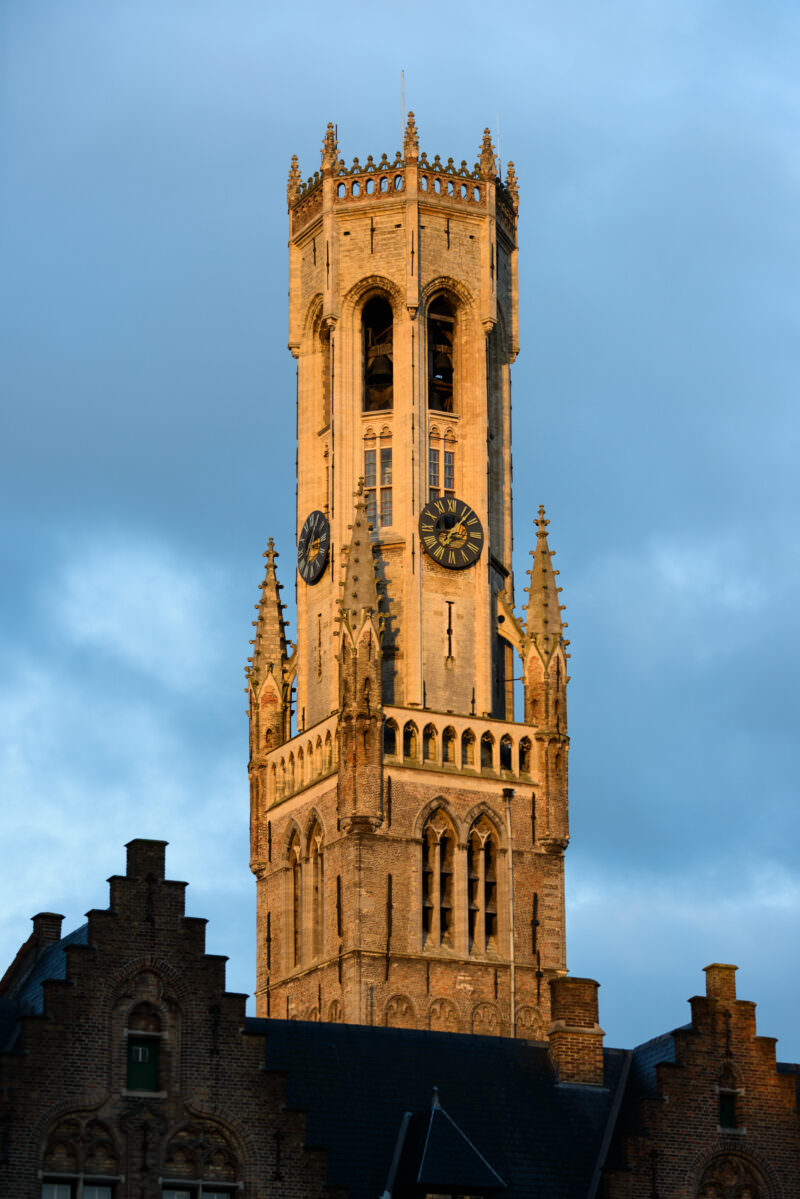
The Belfry (or Belfort, as it’s sometimes known) is probably the most famous of the several famous landmarks in Bruges.
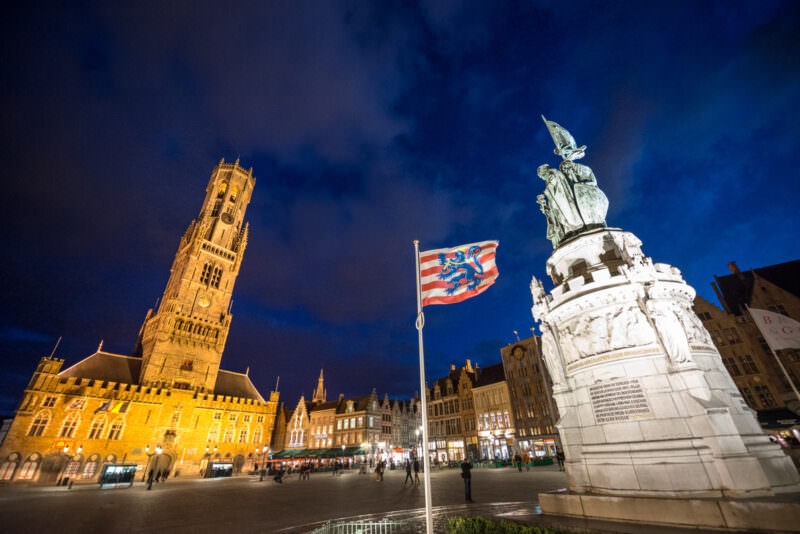
It stands 272 above the scenic medieval square below, the Markt.
It’s a clock tower. It’s a carillon, with its 47 bells peeling out telling a musical story of the day. And in an era when towns paid dearly for their own independence and protected it fiercely, it was used to store and protect the town’s charter. These days it’s one of the city’s leading tourist draws.
Have Camera Will Travel // Newsletter
Practical field notes, hands-on gear tests.
And yet, oddly, the Belfry remains unfinished.
It’s not for want of trying. But the Belfry of Bruges hasn’t been able to catch a break. Construction started in 1240, but in 1280 much of it burned down. The tower was rebuilt, and between 1483 and 1487 a new top was added. The first stage was the octagonal stone top that you can still see there. On top of that was a wooden spire decorated with a statue of Saint Michael slaying a dragon. But it turns out that as nice as Saint Michael might have looked, it also served as a lightning magnet. In 1493, one strike sparked a fire that destroyed the wooden top and damaged many of the bells. A new wooden spire was added, but it too burned — in 1741. At that point, they just gave up and decided that it looked good as is. So the Belfry that you see now is actually shorter than it used to be.
In the market-place of Bruges stands the belfry old and brown; Thrice consumed and thrice rebuilded, still it watches o’er the town.”
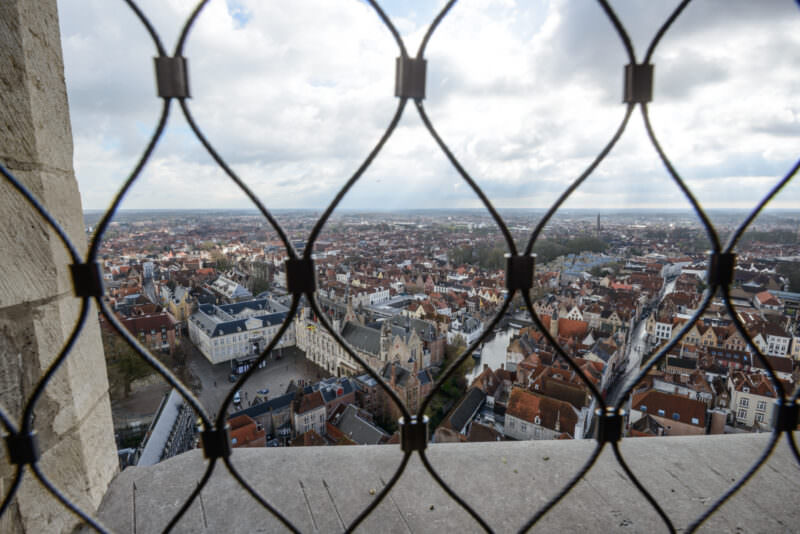
If you’ve seen the movie In Bruges, the Belfry will look very familiar. The exterior shots in the movie are real, but the interior shots were done in a studio. One of the biggest differences you’ll notice is that while the area at the top of the Belfry is indeed open to the elements, the openings are covered in chicken wire so that some of the things that happen in the movie can’t happen in real life.
Photos of the Belfry of Bruges
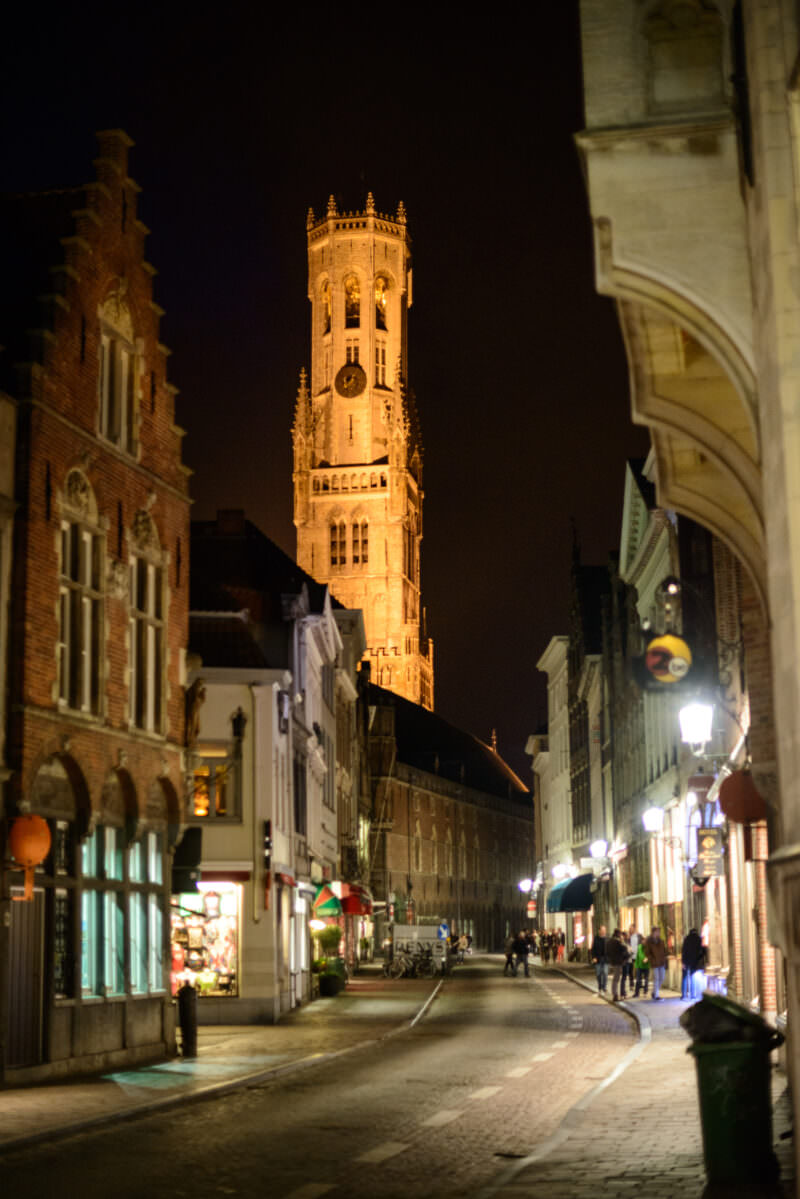
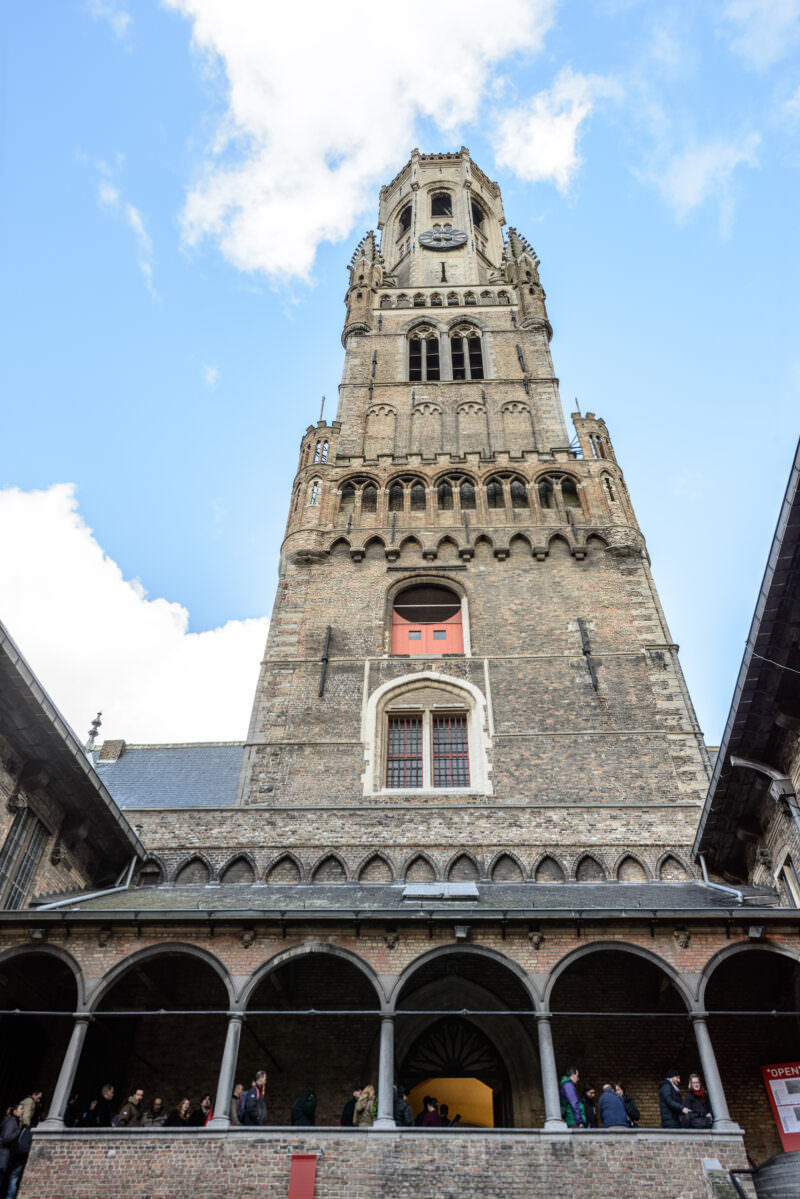
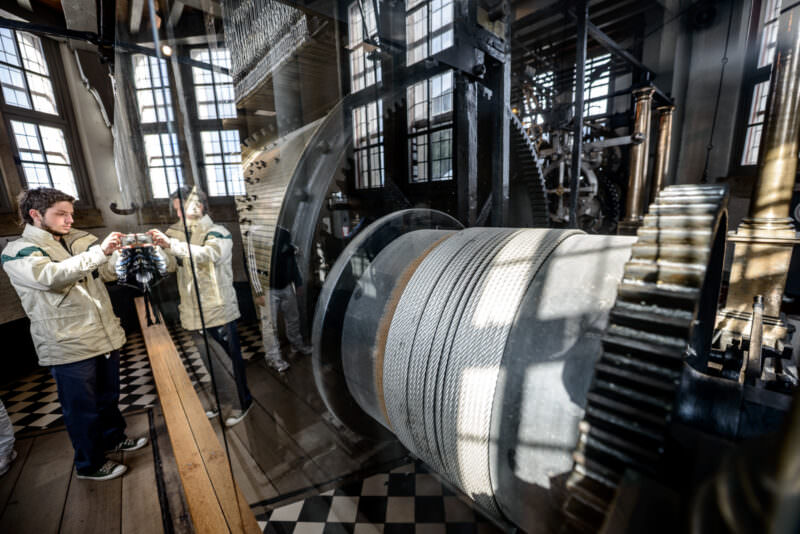
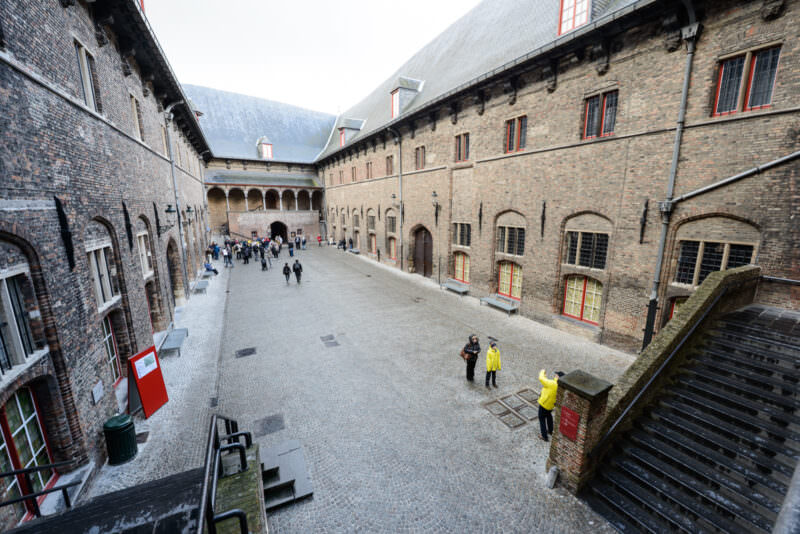
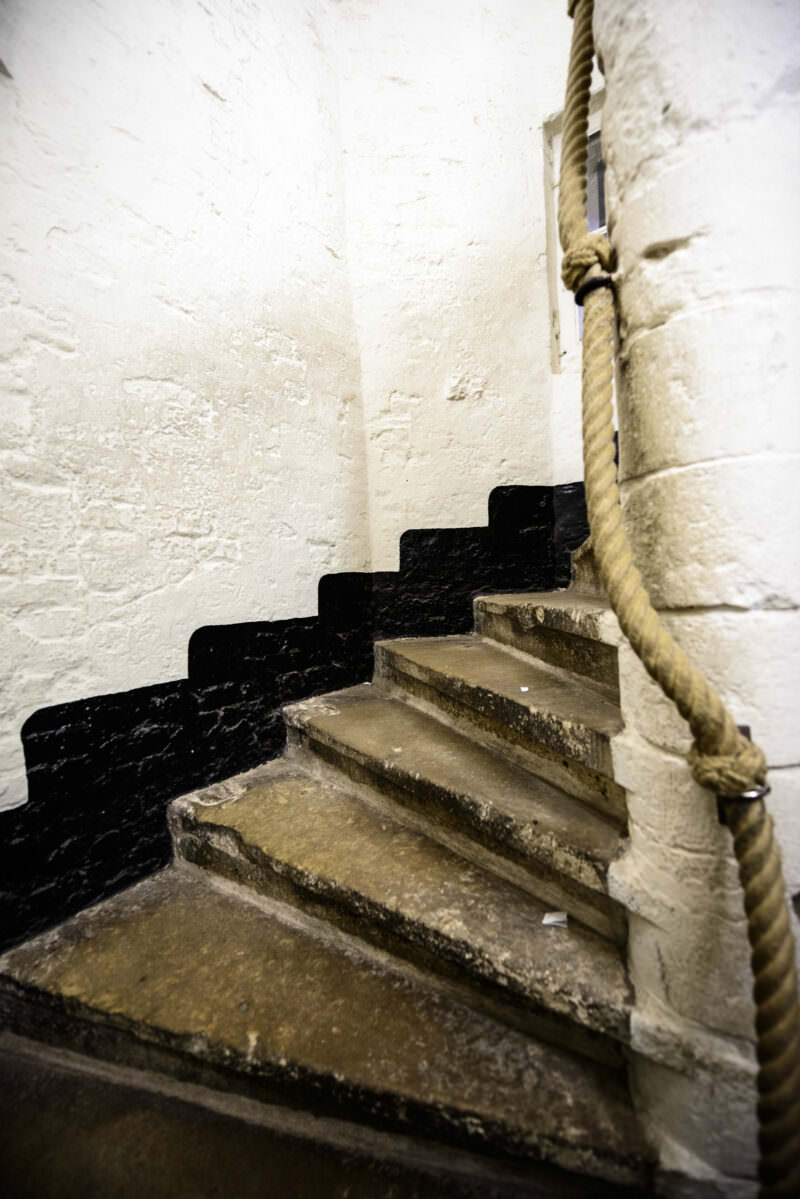
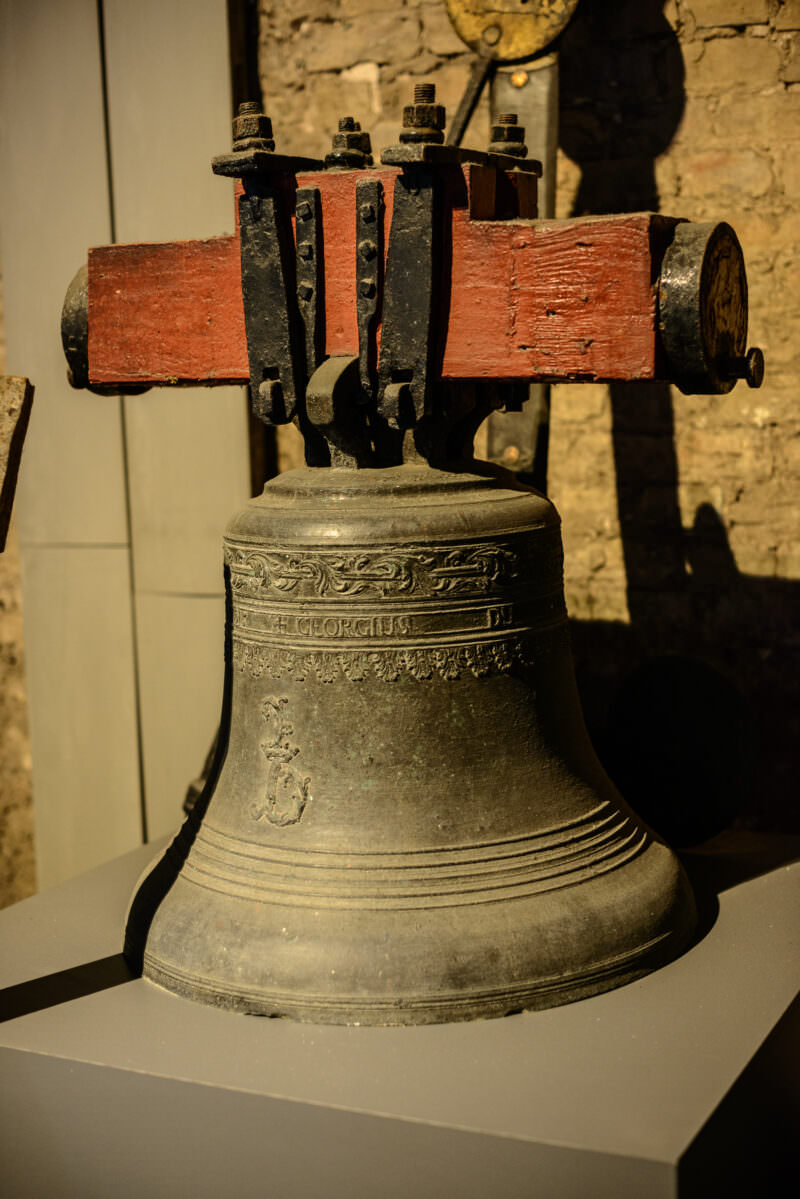
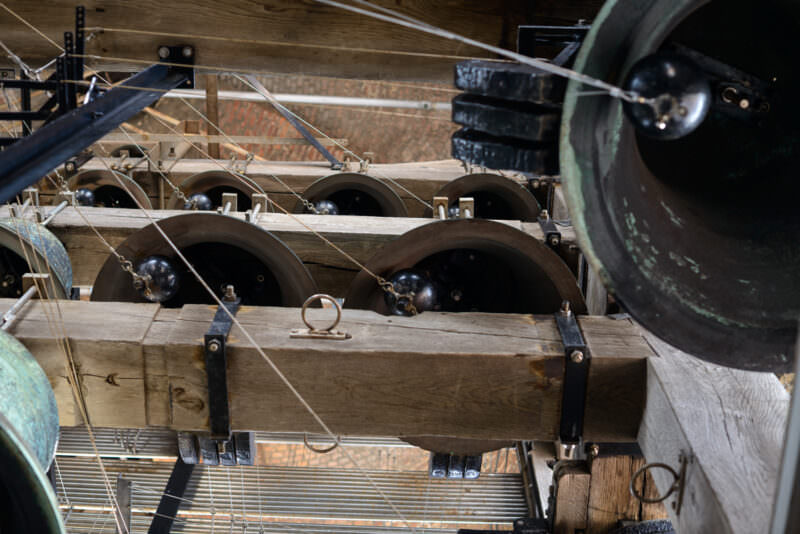
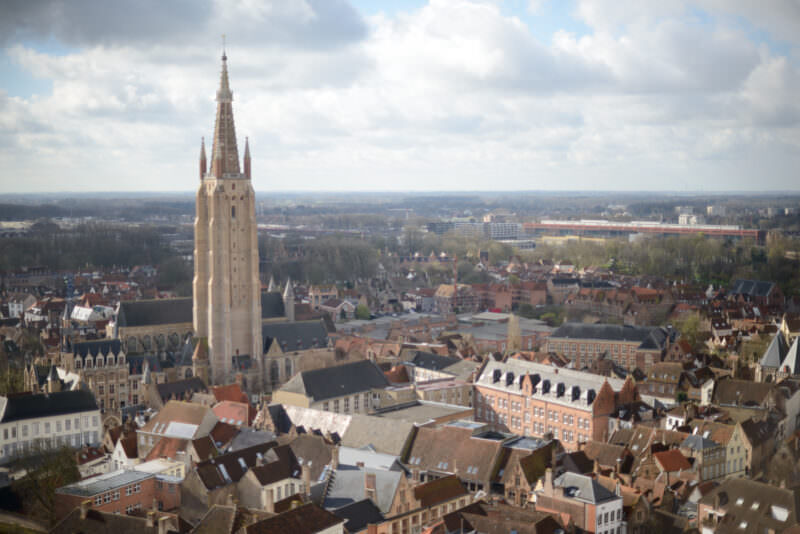
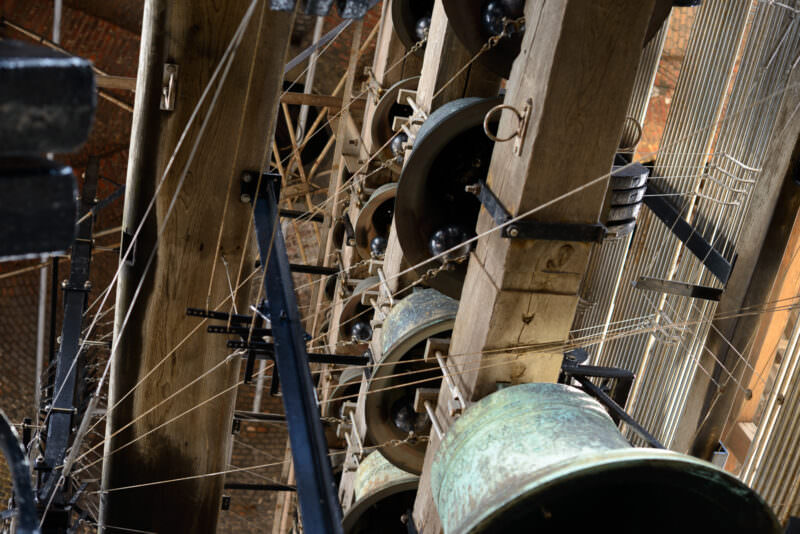
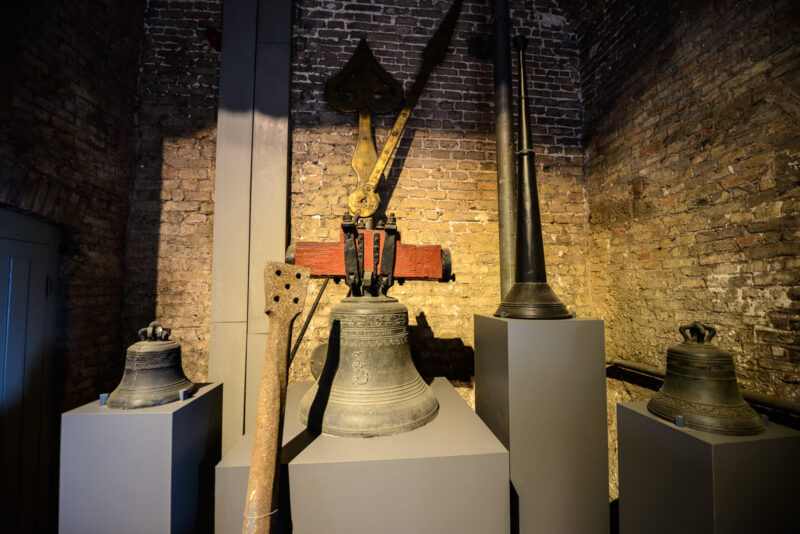
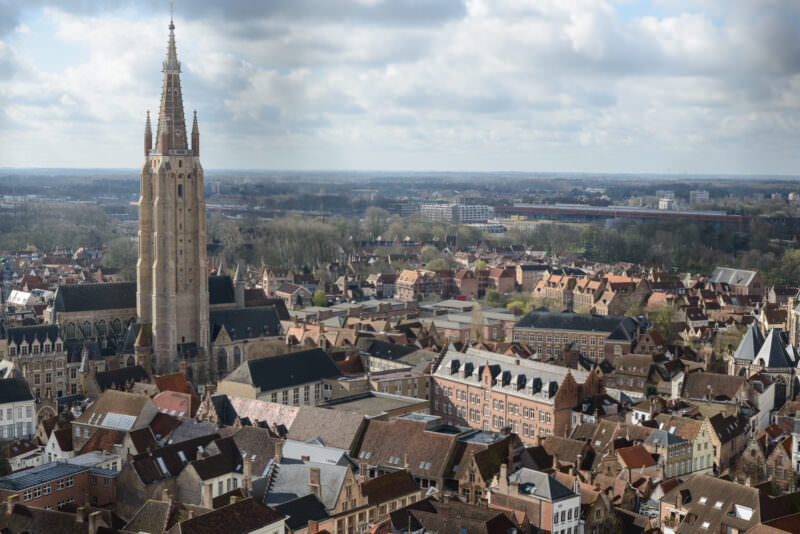
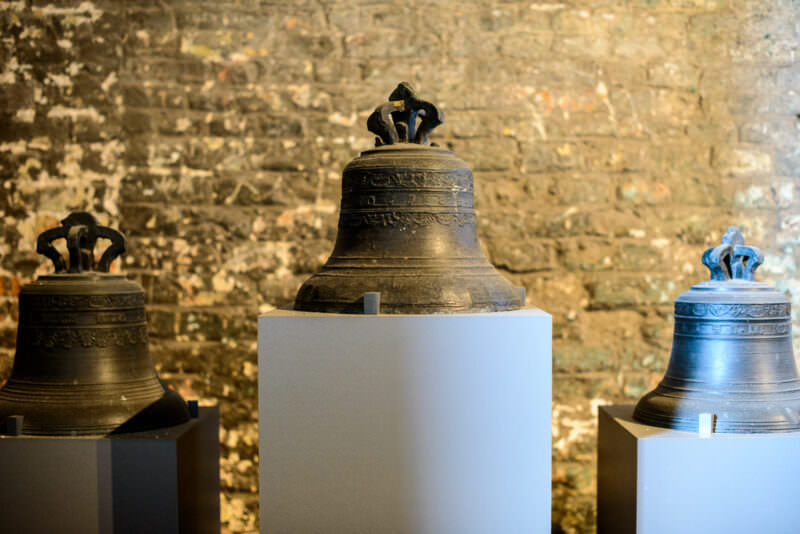
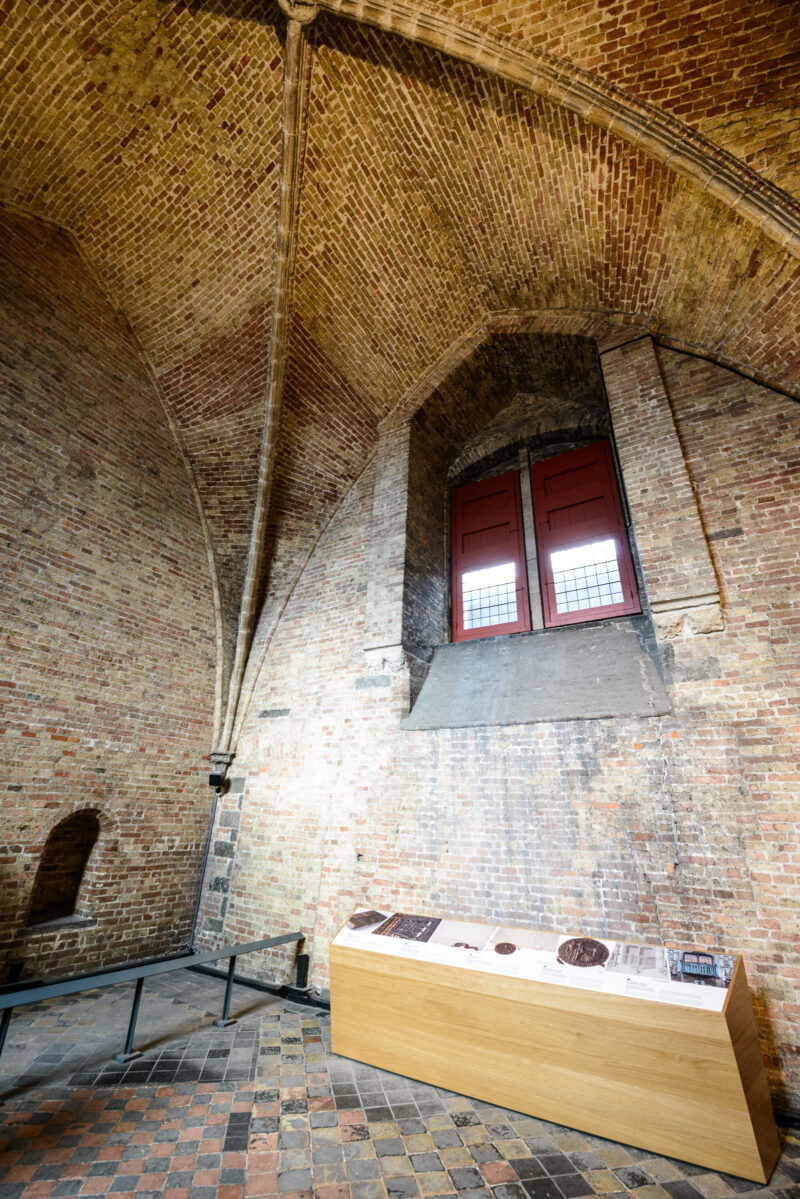
BRUGES, Belgium — The intricate mechanical drum system controlling the 47-bell carillon in the Belfry of Bruges represents centuries of evolution in automated musical engineering. The drum — roughly 19,841 pounds (9,000 kg) and about 6 feet 9 inches (206 cm) in diameter — is pierced with some 30,500 holes in 122 rows, each actuating a hammer that strikes one of the bronze bells above. The current carillon, weighing approximately 27 tonnes in total, was cast by Bruges founder Joris Dumery between 1742 and 1748, replacing an instrument destroyed when lightning struck the tower in 1741. Belgian carillon culture, of which this instrument is a leading example, was inscribed on UNESCO’s Representative List of the Intangible Cultural Heritage of Humanity in 2014. Photo by David Coleman / Have Camera Will TravelLicense this image at:DirectlyAlamyBRUGES, Belgium — Morning light illuminates the Belfry of Bruges as it rises above the Markt (Market Square), its open octagonal lantern — added in 1482 – 1486 by master masons Paul and Josse Roelens — visible against the sky. The tower’s two lower square brick stages date to the last third of the 13th century, while the octagon is built of Brabant sandstone, giving the upper stage a subtly different texture and color. Standing roughly 272 feet (83 m) tall, the belfry has been without a spire since 1741, when lightning destroyed both the timber spire and the carillon; the present flat-topped silhouette has defined the Bruges skyline ever since. The belfry forms one of the city’s three landmark towers alongside the Church of Our Lady and St. Saviour’s Cathedral, and is doubly inscribed by UNESCO. Photo by David Coleman / Have Camera Will TravelLicense this image at:DirectlyAlamyBRUGES, Belgium — A medieval street in the center of Bruges is seen at night, the illuminated Belfry rising at the far end with its open octagonal lantern — completed in 1482 – 1486 — glowing above the rooftops. The tower, roughly 272 feet (83 m) tall, has stood without a spire since 1741, when a lightning strike destroyed the timber crown and the carillon; master founder Joris Dumery recast the bells between 1742 and 1748, producing the 47-bell instrument still in use today. The belfry stands atop the Hallen on the south side of the Markt (Market Square), where it has served simultaneously as treasury, archive, watchtower, and bell chamber since the 13th century. Together with the Church of Our Lady and St. Saviour’s Cathedral, it anchors a skyline recognized under two separate UNESCO World Heritage inscriptions. Photo by David Coleman / Have Camera Will TravelLicense this image at:DirectlyAlamyBRUGES, Belgium — The rear facade of the 13th-century Belfry rises dramatically from its internal courtyard, revealing architectural details less visible from the main square. This perspective of the medieval tower shows the various construction phases, from its 1240 foundation to the 15th-century additions. The view demonstrates the sophisticated engineering and craftsmanship of medieval builders. Photo by David Coleman / Have Camera Will TravelLicense this image at:DirectlyAlamyBRUGES, Belgium — The mechanical drum system controlling the carillon of the Belfry of Bruges is a monumental feat of pre-industrial engineering. At its heart is a rotating drum weighing roughly 19,841 pounds (9,000 kg) and measuring about 6 feet 9 inches (206 cm) in diameter, pierced with some 30,500 holes arranged in 122 rows that actuate 122 hammers to strike the bells automatically. A counterweight of approximately 3,307 pounds (1,500 kg) drives the mechanism, which also incorporates a pendulum some 9.8 feet (3 m) long and weighing about 172 pounds (78 kg). The system governs a 47-bell carillon cast by Bruges founder Joris Dumery in 1742 – 1748 after lightning destroyed the previous instrument in 1741. Photo by David Coleman / Have Camera Will TravelLicense this image at:DirectlyAlamyBRUGES, Belgium — The still waters of the Reien create mirror-like reflections of the historic canal facades at dusk, with the Belfry rising behind the roofline in the distance. The Belfry — a 272-foot (83 m) tower begun in the 13th century and closely associated with the city’s mercantile wealth — anchors the most celebrated viewpoint in Bruges, at the Rozenhoedkaai (Rosary Quay), where the Dijver and Groenerei meet. The quay takes its name from rosary vendors who once traded on the bank; today it is the single most photographed spot in Flanders, framing the canal reflection against the tower’s distinctive profile. The inner canals and the civic monuments they serve were inscribed together as a UNESCO World Heritage Site on 2 December 2000. Photo by David Coleman / Have Camera Will TravelLicense this image at:DirectlyAlamyBRUGES, Belgium — The enclosed courtyard of the Hallen (market halls) at the base of the Belfry of Bruges offers a secluded view of the medieval tower’s rear facade from within the complex that anchors the south side of the Markt. The halls and belfry form a single 13th-century ensemble — the Belfort-Hallen — whose combined footprint covers roughly 36,576 square feet (3,396 sq m). Originally a covered marketplace and warehouse central to Bruges’s role as the economic capital of northern Europe, the halls still visually define the Markt today. This courtyard perspective reveals the brick fabric of the lower stages, contrasting with the Brabant sandstone of the octagonal lantern above. Photo by David Coleman / Have Camera Will TravelLicense this image at:DirectlyAlamyBRUGES, Belgium — The historic Belfry of Bruges catches the first rays of morning sunlight, its distinctive flat-topped octagonal crown rising above the Markt (Market Square). This medieval civic tower, begun in stone around 1240 and crowned by its octagonal sandstone lantern in 1482 – 1486, dominates the south side of the square from atop the Hallen market halls. The upper stage was built by master masons Paul and Josse Roelens; a wooden spire that once topped the tower was destroyed by lightning in 1741 and never rebuilt, leaving the present open crown. The structure stands roughly 83 feet — no, 272 feet (83 m) tall and is doubly inscribed by UNESCO, both as a component of the serial World Heritage property Belfries of Belgium and France and within the Historic Centre of Brugge. Photo by David Coleman / Have Camera Will TravelLicense this image at:DirectlyAlamyBRUGES, Belgium — A section of the medieval spiral staircase within the Belfry of Bruges leads visitors up 366 steps to the tower’s observation level. This historic stairway, part of the original 13th-century construction, demonstrates medieval architectural engineering. The winding stone steps have served as the main access route to the tower’s upper levels for centuries. Photo by David Coleman / Have Camera Will TravelLicense this image at:DirectlyAlamyBRUGES, Belgium — Historic bells from the Belfry’s carillon are displayed in an educational exhibition documenting the tower’s musical heritage. The display features examples of bell-casting craftsmanship spanning several centuries, including historic Dumery bells from the 1740s. These artifacts help tell the story of Bruges’ carillon tradition and bell-making technology. Photo by David Coleman / Have Camera Will TravelLicense this image at:DirectlyAlamyBRUGES, Belgium — Bells of the Belfry of Bruges carillon are seen in close detail, their bronze surfaces bearing witness to nearly three centuries of continuous use. The 47-bell instrument, weighing approximately 27 tonnes in total, was cast primarily by Bruges founder Joris Dumery in 1742 – 1748 after lightning destroyed the previous carillon. The heaviest bell in the carillon proper, donated by the Franc de Bruges, weighs approximately 11,856 pounds (5,378 kg) and sounds the tone G0. A separate hour bell, “Maria,” cast in 1680 by Melchior de Haze and measuring roughly 6 feet 9 inches (206 cm) in diameter, strikes the hours independently. Photo by David Coleman / Have Camera Will TravelLicense this image at:DirectlyAlamyBRUGES, Belgium — The view from the open bell chamber at the top of the Belfry of Bruges stretches across the medieval city center, with its dense pattern of historic rooftops and towers laid out below. Visitors reach this vantage point after ascending 366 steps through the treasury, clock room, and drum room — the layered interior of a structure begun around 1240 and still in active use today. The belfry itself stands roughly 272 feet (83 m) tall, yet the nearby Church of Our Lady’s tower soars to approximately 377 feet (115 m), making it among the tallest brick towers in Europe. No more than 52 visitors are permitted inside the tower at one time, preserving both the experience and the structure. Photo by David Coleman / Have Camera Will TravelLicense this image at:DirectlyAlamyBRUGES, Belgium — The historic carillon bells of the Bruges Belfry combine centuries of bell-casting tradition, featuring 26 18th-century Dumery bells and 21 modern Eijsbouts bells. Together, these 47 bells, weighing a total of 27 tons, create the distinctive sounds that have rung out over Bruges for generations. The massive bell chamber houses both historic and contemporary examples of bell-casting craftsmanship. Photo by David Coleman / Have Camera Will TravelLicense this image at:DirectlyAlamyBRUGES, Belgium — A panoramic view over the medieval city of Bruges from the top of the 13th-century Belfry reveals the historic urban landscape. The observation level, reached after climbing 366 steps, offers spectacular views of the well-preserved medieval city center. From this height, visitors can observe the characteristic red-tiled roofs and spires that define Bruges’ historic skyline. Photo by David Coleman / Have Camera Will TravelLicense this image at:DirectlyAlamyBRUGES, Belgium — The medieval Belfry and the Breydel-de Coninck monument anchor the Markt in the city’s historic center. The bronze statue, unveiled in 1887 with sculpture by Paul De Vigne and a Gothic Revival pedestal by Louis Delacenserie, commemorates Jan Breydel and Pieter de Coninck — leaders of the 1302 uprising against French rule that culminated in the Battle of the Golden Spurs on July 11 of that year. Across the square, the bell tower constructed in phases from the 13th to the 15th centuries housed the municipal charters and treasury these Flemish militias fought to protect. Photo by David Coleman / Have Camera Will TravelLicense this image at:DirectlyAlamyBRUGES, Belgium — Historic bells from the Belfry’s 47-bell carillon are displayed in an exhibition inside the medieval tower. The collection includes bells cast by Georgius Dumery (1742-1748) and more recent additions by Koninklike Eijsbouts (2010). The impressive set of bells, including a six-ton bourdon, demonstrates the evolution of bell casting technology across centuries. Photo by David Coleman / Have Camera Will TravelLicense this image at:DirectlyAlamyBRUGES, Belgium — A sweeping panoramic view from the top of the Belfry of Bruges reveals the remarkably preserved medieval cityscape spreading in every direction. The observation level, reached after climbing 366 steps, looks out over a sea of red-tiled roofs, church spires, and the medieval street pattern that has defined the city since its peak as the economic capital of northern Europe between 1200 and 1400. The belfry is one of three landmark towers on the Bruges skyline, alongside the Church of Our Lady — whose brick tower rises approximately 377 feet (115 m) — and St. Saviour’s Cathedral. The historic center was inscribed as a UNESCO World Heritage site in 2000, recognized for its exceptional state of preservation. Photo by David Coleman / Have Camera Will TravelLicense this image at:DirectlyAlamyBRUGES, Belgium — Historic bells from the Belfry’s carillon are displayed in an educational exhibition documenting the tower’s musical heritage. The display features examples of bell-casting craftsmanship spanning several centuries, including historic Dumery bells from the 1740s. These artifacts help tell the story of Bruges’ carillon tradition and bell-making technology. Photo by David Coleman / Have Camera Will TravelLicense this image at:DirectlyAlamyBRUGES, Belgium — A cross-ribbed vaulted chamber on the second floor of the Belfry of Bruges once served as the city’s treasury, securing its most vital documents and wealth. The keystone of the vault bears the Agnus Dei (Lamb of God), and the city’s charters of liberty, seal, and coffers were locked in iron boxes set in wall niches behind double wrought-iron gates — work attributed in the municipal accounts of 1291 – 1292 to the smith Erembald. Known as the schatkamer, this room made the belfry not merely a symbolic landmark but a practical guardian of Bruges’s communal autonomy. The municipal accounts survive almost continuously from 1281, recorded in the treasury while the city grew into one of Europe’s great medieval trading centers. Photo by David Coleman / Have Camera Will TravelLicense this image at:DirectlyAlamyBRUGES, Belgium — The medieval Belfry rises above the historic Markt under nighttime illumination. Originally begun around 1240, the 272-foot (83 m) structure functioned as both a municipal treasury and an observation post, its height making it the dominant civic landmark in a city that rose to become the economic capital of northern Europe during the Middle Ages. The tower’s distinct octagonal upper stage, completed in the late 15th century, houses a carillon of 47 bells. Photo by David Coleman / Have Camera Will TravelLicense this image at:DirectlyAlamy
What to know before you go
It’s possible to climb to the top of the Belfry — there’s a great view from up there, even if you do have to peer through the chicken wire. But know what you’re in for. It’s a long way up — 83 meters up 366 spiraling steps. And there is only one staircase, so people are coming down as you’re going up. There’s no elevator. Only 70 people can be there at once for “security” reasons (really, a translation of “safety” — it’s tight quarters), so there’s often a queue to buy tickets.
At intervals on the way up are rooms with a few exhibits on the bells. These rooms aren’t that impressive today. They do contain some brief but interesting information about the tower’s bells and provide a good opportunity for a breather on the climb up the steep winding staircase. But historically it was in these rooms that the towns’ rights and charters were kept, symbolically in a prominent position in the center of town but also secure.
Try to be at the top when the bells chime. Intricate mechanical system plays a tune at regular intervals. Different tunes signified different times of a day — the start of the work day, the end of the work day, noon, etc. – The Carillon consists of 47 bells. 26 bells were cast by Georgius Dumery between 1742 and 1748 and 21 bells were cast by Koninklike Eijsbouts in 2010. The bourdon weights 6 tons, and the bells have a combined weight of 27 tons.
The tower is actually leaning slightly to the east. It’s not enough that you can tell just by looking at it, but it is leaning.
Bruges, Belgium
Enjoyed this article? Personalize your search results.
I'm a freelance travel photographer based in Washington DC. Seven continents, up mountains, underwater, and a bunch of places in between. My images have appeared in numerous publications, and you can check out some of my gear reviews and tips here. More »