Dating back to the 12th century, Dhammayangyi Temple is the largest temple in Bagan. But that doesn’t necessarily mean that it’s the most impressive. It was never fully finished, and it hasn’t received the same restoration attention as many of the other large temples (which might be a good thing, depending on your perspective). Its tower is partially in ruins, and what remains looks much like a pyramid.
It shares many similarities with the more famous — and much more visited — Ananda Temple. Like the Ananda Temple, the base of Dhammayan-Gyi is shaped like a giant cross, with four entrance halls, each facing a cardinal direction and each of equal size. Inside, two concentric corridors run around the core, but for some reason, the inner corridor and connecting passages were permanently sealed up from the beginning — archeologists aren’t sure why — so you can only access some of the interior.
One of the pillars of the temple features an inscription that dates to 1165 which records the donations made, including bonded servants and land. It wasn’t some simple cash donation — it included female singer and dancer slaves, gardens, paddy fields, and cattle. There are a few other inscriptions throughout that date to the early 13th century.
Over the subsequent centuries, some paintings were added to the walls. They’re in various states of disrepair now and aren’t as ornate as some you’ll find in other temples. But the red brickwork is worth looking closely at — it’s especially good and renowned for the fine precision in how the bricks fit together without any visible mortar. The oft-repeated claim is that the masons were instructed to build it so that a pin could not pass between any two bricks. You’ll also find a reclining Buddha partially covered with tabs of gold leaf, a distinctive pair of Buddha statues, and in one corner of the compound are the ruins of a two-story monastery.
My shots
BAGAN, Myanmar — A white-and-red painted stone Buddha in bhumisparsha mudra sits within a barrel-vaulted brick niche at the Dhammayangyi Temple, flowers and a candle arranged at its base. This is one of the temple’s secondary shrines — only the east sanctum retains the original stone Buddha that scholars believe predates the later cement restorations visible on other figures. Photo by David Coleman / Have Camera Will TravelLicense this image at:DirectlyAlamy
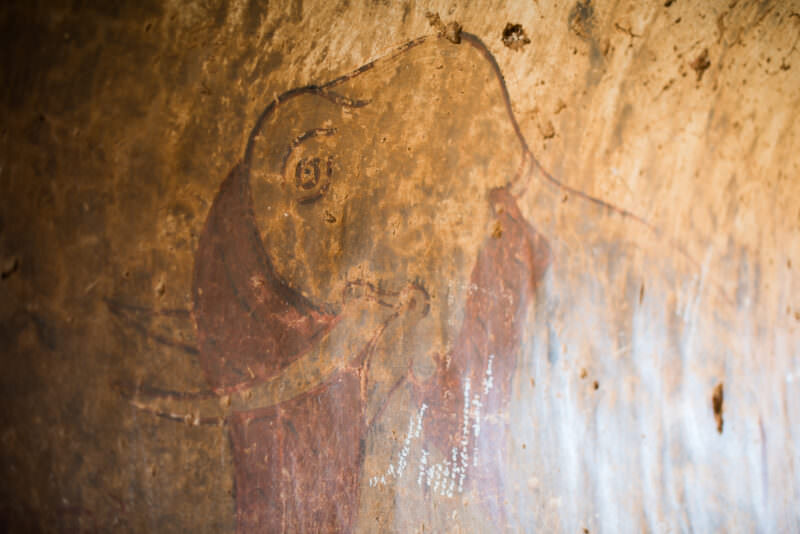
BAGAN, Myanmar — A faded elephant painted in reddish-brown pigment on the interior plaster of the Dhammayangyi Temple is one of a pair of elephants documented in a north-side window chamber, captioned in later inscriptions as the rival wives of a king-elephant from Jataka tale no. 541 — a Burmese addition scholars date to roughly the 15th or 16th century, layered over the temple’s original tan wash. Photo by David Coleman / Have Camera Will TravelLicense this image at:DirectlyAlamy
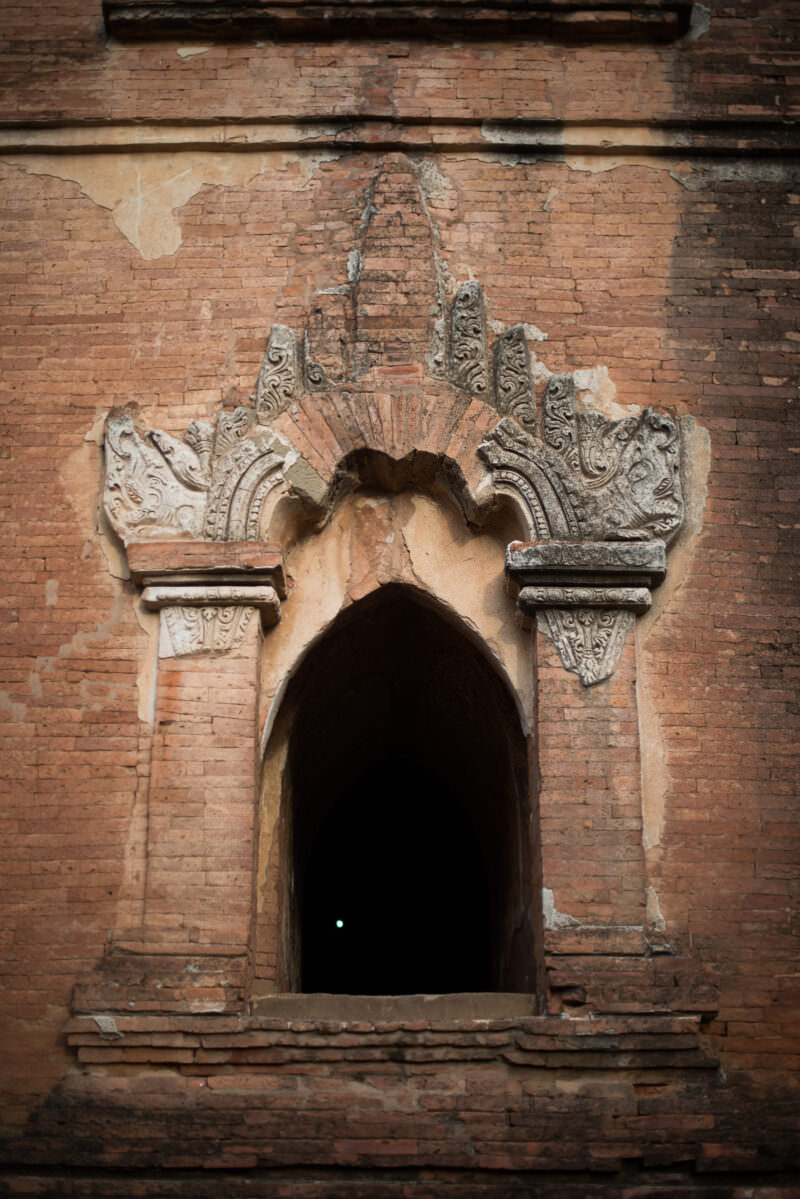
BAGAN, Myanmar — A pointed arch window framed by partially surviving stucco ornamentation — flame-like finials and cusped scroll-work — pierces the exterior of Dhammayangyi Temple, the largest monument at Bagan. Only about 10 of the temple’s original stucco survives, making this embellished surround one of the better-preserved examples of the decorative program that once covered the entire facade. Photo by David Coleman / Have Camera Will TravelLicense this image at:DirectlyAlamy
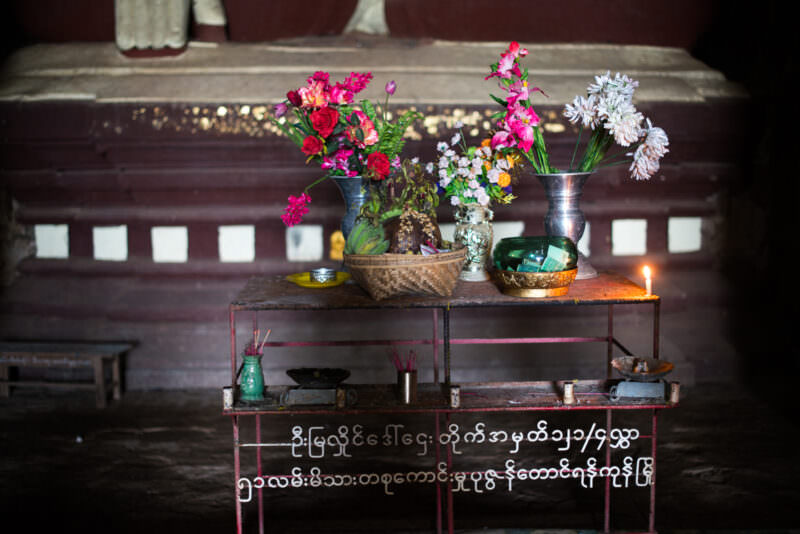
BAGAN, Myanmar — A metal offering table before a Buddha statue at the Dhammayangyi Temple carries flowers, incense, a candle, and a woven basket with fruit inside the 12th-century monument. The Burmese script painted on the altar’s frame identifies the donor or custodian, a tradition of recorded merit-making that stretches back to the 1165 inscription found in this same temple’s north hall — one of Bagan’s earliest surviving donor records. Photo by David Coleman / Have Camera Will TravelLicense this image at:DirectlyAlamy
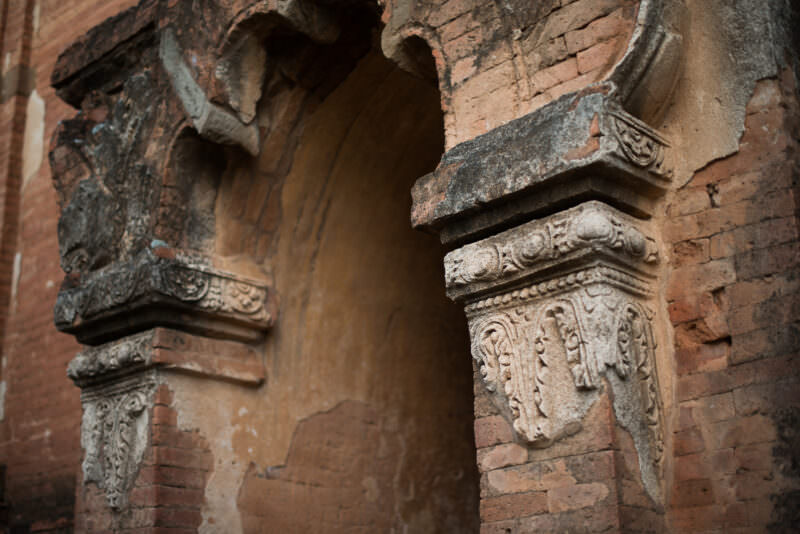
BAGAN, Myanmar — Surviving stucco capitals with foliate relief cling to the brick piers of an archway at Dhammayangyi Temple. The brickwork here — courses averaging 42 cm (16.5 in) long laid with hairline joints — gave rise to the chronicle legend that King Narathu executed masons wherever a needle could fit between the bricks, a story scholars treat as folklore: no inscription names Narathu as builder. Photo by David Coleman / Have Camera Will TravelLicense this image at:DirectlyAlamy
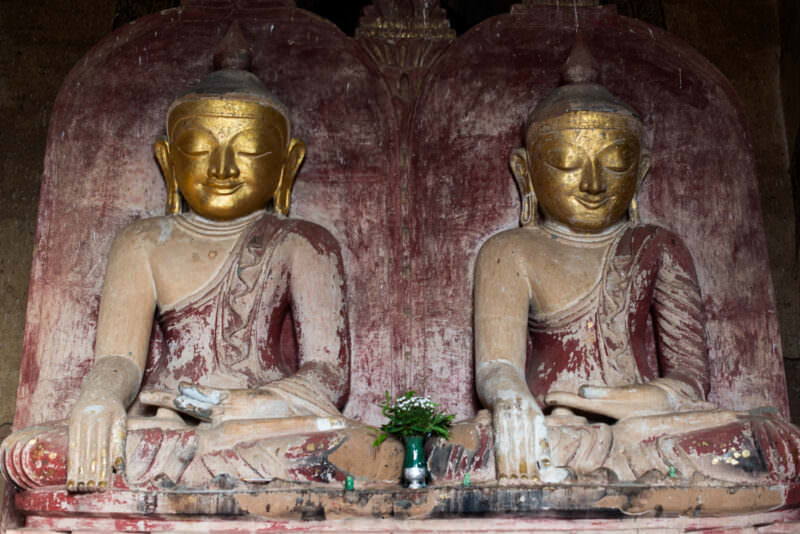
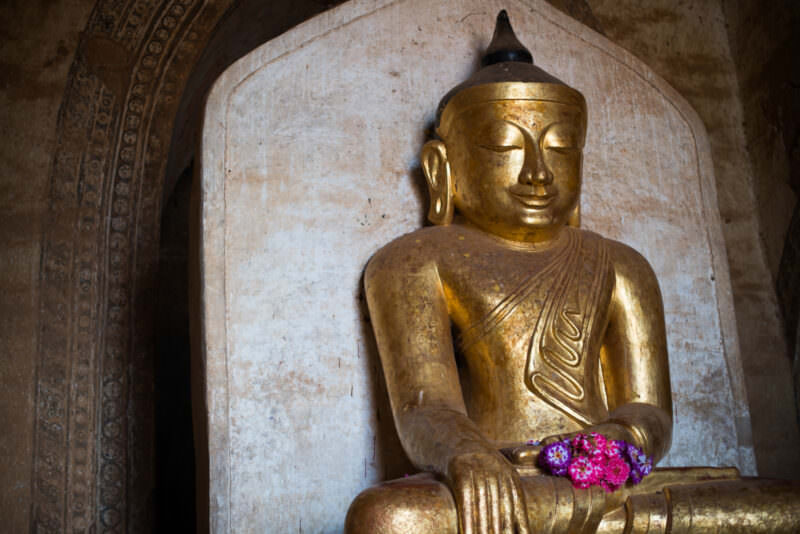
BAGAN, Myanmar — Two gilded Buddha figures in bhumisparsha mudra — the earth-touching gesture of enlightenment — sit side by side inside Dhammayangyi Temple (also known as Dhammayan-gyi), Bagan’s largest 12th-century monument. The unusual paired arrangement is widely interpreted as Gautama alongside Maitreya, the future Buddha, though chronicle tradition attributes the temple to King Narathu, who, the Burmese Glass Palace Chronicle claims, raised it in expiation for murdering his father and brother — an attribution modern scholarship cautions is not confirmed by any inscription. Photo by David Coleman / Have Camera Will TravelLicense this image at:DirectlyAlamy
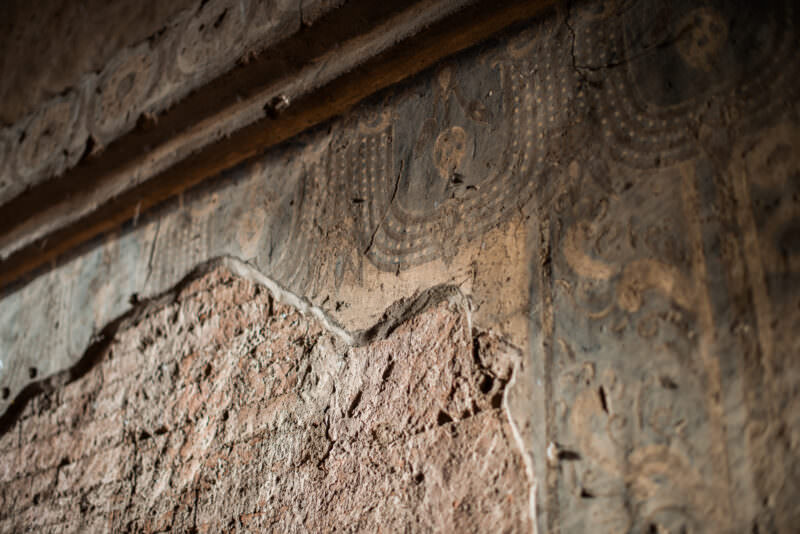
BAGAN, Myanmar — Painted plaster peels away from an interior wall of Dhammayangyi Temple (also known as Dhammayan-gyi), revealing the raw 12th-century brickwork beneath and leaving a ghost image of a Buddha figure intact on the remaining surface. The temple carries multiple layers of painting — an original tan wash overlaid by donated Buddhas and other images added from the 14th century onward — so each spalling section exposes a compressed stratigraphy of eight centuries of devotional activity. Photo by David Coleman / Have Camera Will TravelLicense this image at:DirectlyAlamy
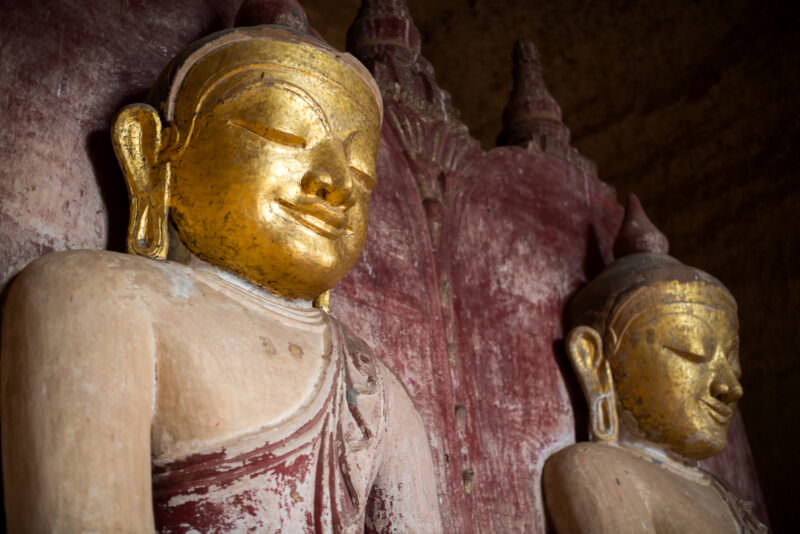
BAGAN, Myanmar — Two gilded seated Buddha figures occupy a painted brick niche inside Dhammayangyi Temple (also known as Dhammayan-gyi), their faces densely covered in gold leaf while the original painted stucco of their robes survives largely intact. The side-by-side pairing — widely read as Gautama alongside Maitreya, the future Buddha — is unusual in Bagan, where cardinal-facing niches typically hold a single image, and the juxtaposition of a regilded face against weathered original pigment captures the living tradition layered over the 12th-century fabric. Photo by David Coleman / Have Camera Will TravelLicense this image at:DirectlyAlamy
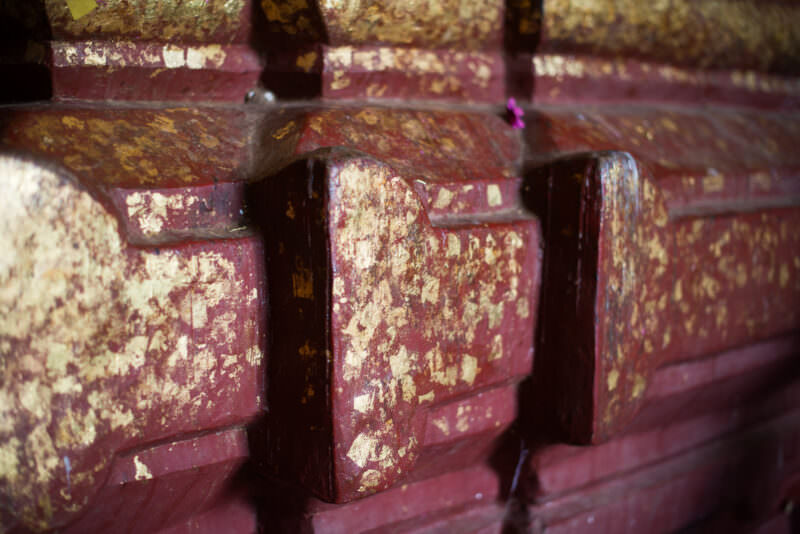
BAGAN, Myanmar — Gold leaf applied by worshippers encrusts the lacquered red moldings of a Buddha throne base inside the Dhammayangyi Temple. The practice of pressing paper-thin gold squares onto sacred surfaces is among the most common merit-making acts in Burmese Buddhism, accumulating layer upon layer over centuries across Bagan’s surviving monuments. Photo by David Coleman / Have Camera Will TravelLicense this image at:DirectlyAlamy
BAGAN, Myanmar — A gilded Buddha in bhumisparsha mudra occupies the east shrine of the 12th-century Dhammayangyi Temple, Bagan’s largest. The east sanctum is the only one of the temple’s four original shrine positions that retains its image — the inner corridor connecting the other three sides was bricked solid during construction, and scholars still cannot determine why. Photo by David Coleman / Have Camera Will TravelLicense this image at:DirectlyAlamy
What to know before you go
As with most Burmese names, you’ll see it rendered in English in different ways, including Dhammayan Gyi and Dhammayan-Gyi Phaya.
Take a flashlight (torch). It’s dark inside.
It’s close to Old Bagan and the Ananda Temple.
Mind the bats! (And take care not to come into contact with them or their droppings if at all possible.)
Enjoyed this article? Personalize your search results.
I'm a freelance travel photographer based in Washington DC. Seven continents, up mountains, underwater, and a bunch of places in between. My images have appeared in numerous publications, and you can check out some of my gear reviews and tips here. More »