The Hanoi Hilton: A Museum That Tells Two Very Different Stories
Most of Hoa Lo Prison’s museum confronts brutal French colonial torture head-on, but step into the rooms about American POWs and the tone flips into staged, propagandistic cheer. My photos and account walk through both sides of a museum that tells two very different stories under one roof.
In case you’re tempted to think you’re in a place of sweetness and light, the ominous music playing over the sound system as you walk through the rooms is a not-so-subtle hint that this place has seen some misery.
Southeast Asia is not renowned for the comfort of its prisons at the best of times, but Hoa Lo Prison in downtown Hanoi has a particularly grim history. This is a place of brutality. A place of torture. It’s the Hilton no one wants to stay in.
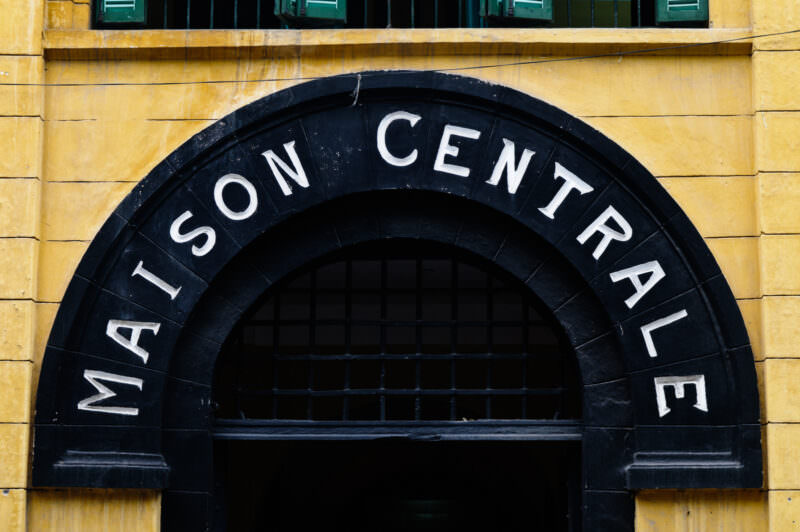
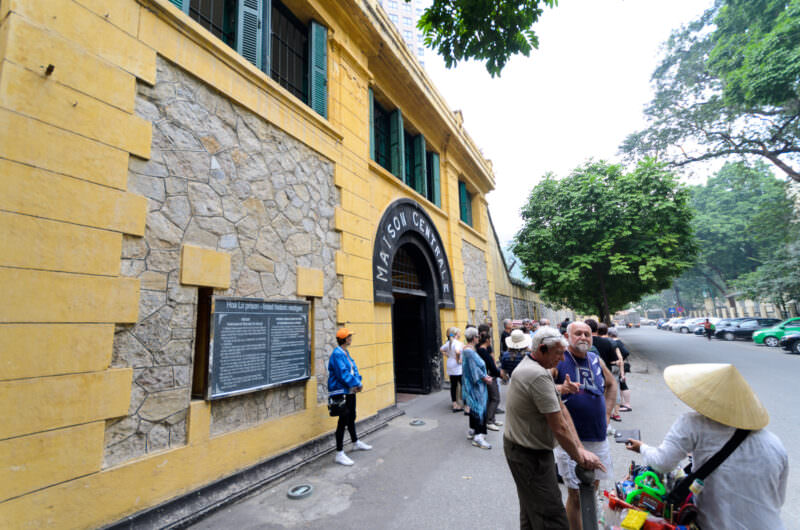
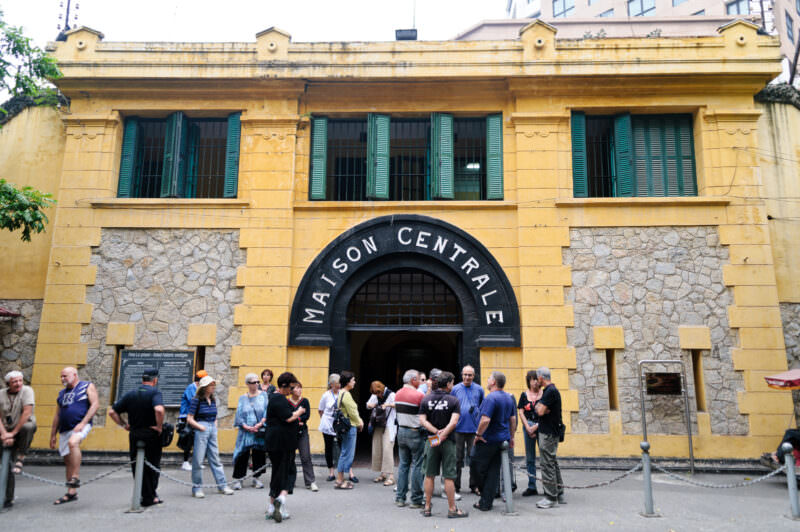
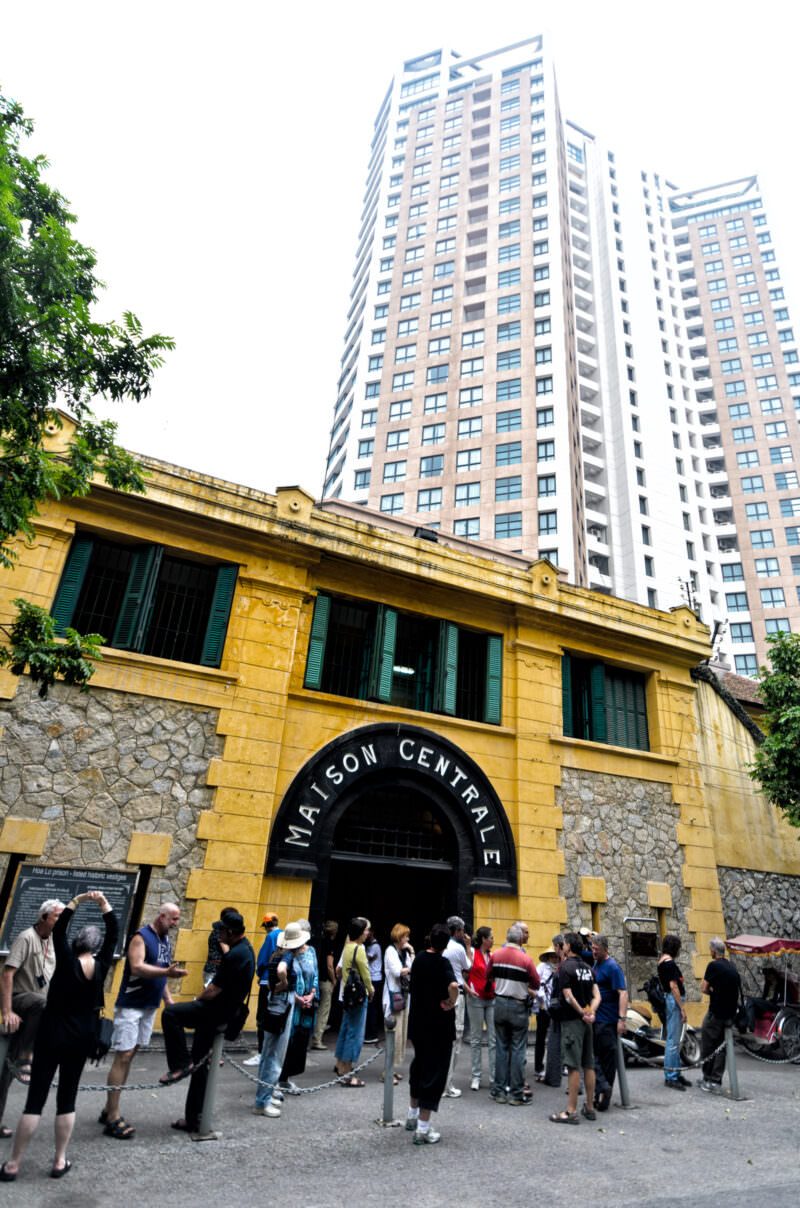
I was brought in through enormous steel gates, above which was painted the legend “Maison Centrale.” I had been shot down a short walk’s distance from the French-built prison, Hoa Lo, which the POWs had named “the Hanoi Hilton.” As the massive steel doors loudly clanked shut behind me, I felt a deeper dread than I have ever felt since. [John McCain]1
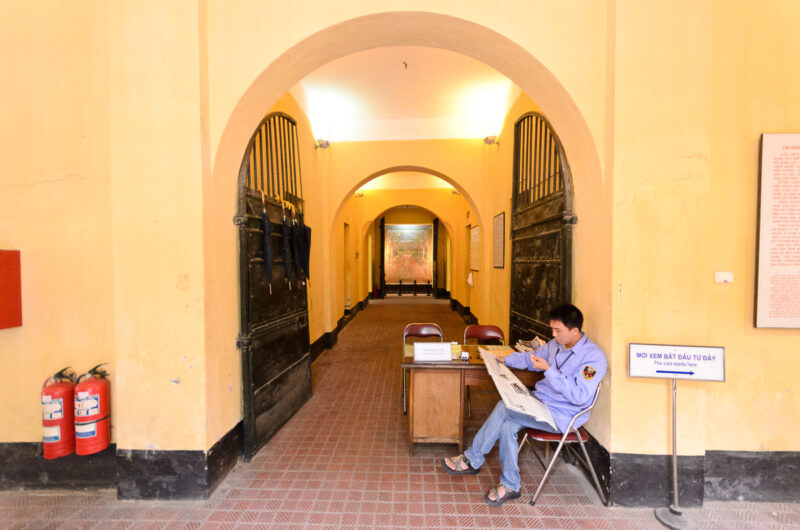
Hoa Lo Prison used to take up the whole block. In 1993, the Vietnamese government decided that this prime real estate in downtown Hanoi could be put to better use. Most of the original jail has gone, a modern skyscraper with high-end Western restaurants and boutique stores now takes up much of the space. But one corner of the original jail has been preserved as a museum. Visitors can now walk through the cells that have been the scene of so much suffering.
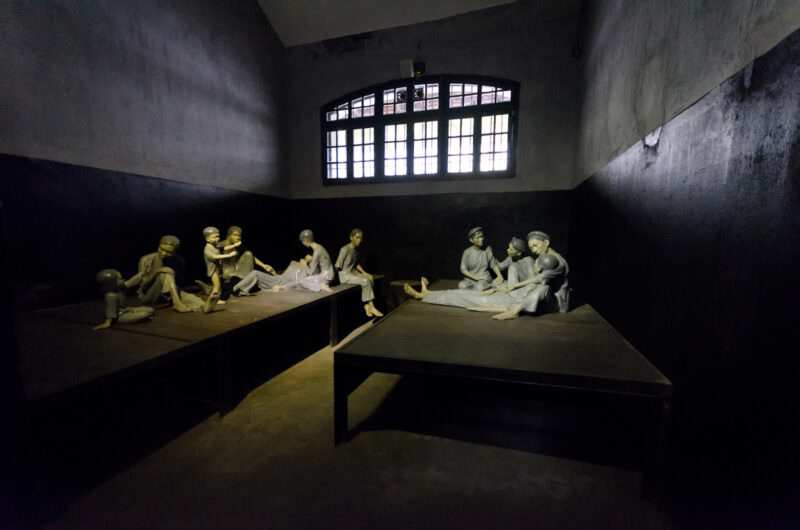
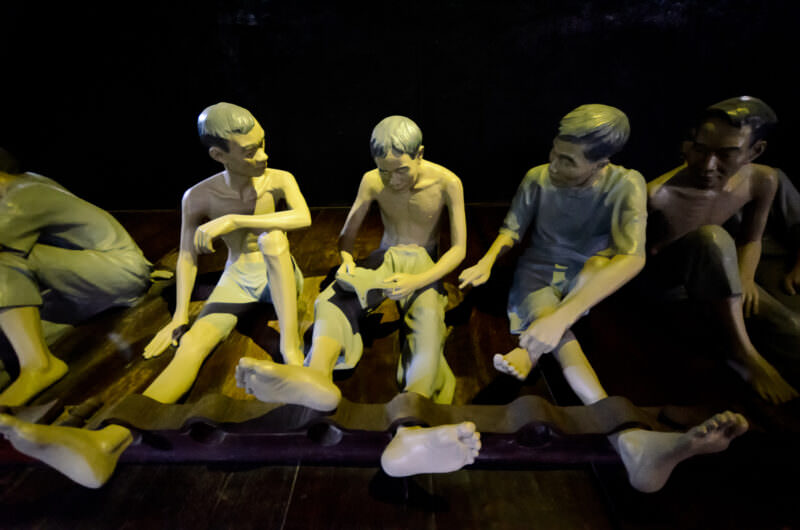
HANOI, Vietnam — Tourists view an exhibit at Hoa Lo Prison featuring life-sized sculptures of men shackled to long iron bars along raised wooden platforms. These mass holding rooms recreate the brutal conditions of the French colonial era, when the facility was known as Maison Centrale. Built from 1896 and operational by 1899, the prison primarily held Vietnamese political dissidents — including five future General Secretaries of the Communist Party of Vietnam — decades before it gained notoriety as the “Hanoi Hilton” during the Vietnam War. Photo by David Coleman / Have Camera Will TravelLicense this image at:DirectlyAlamy
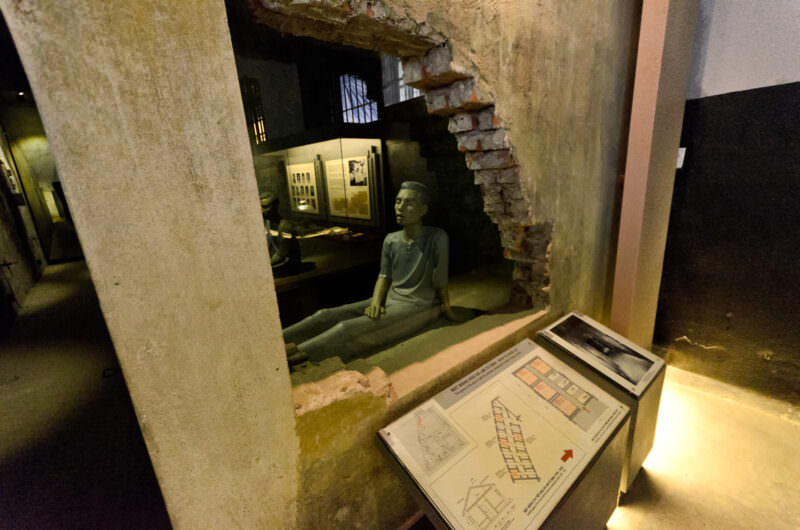
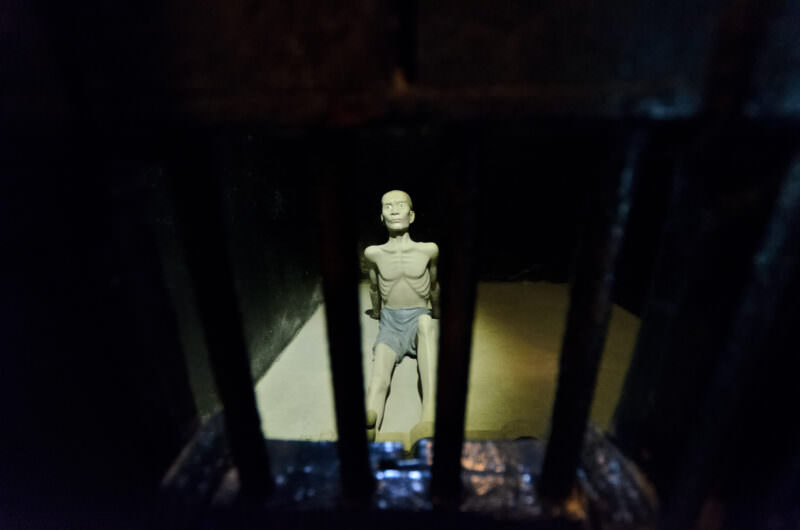
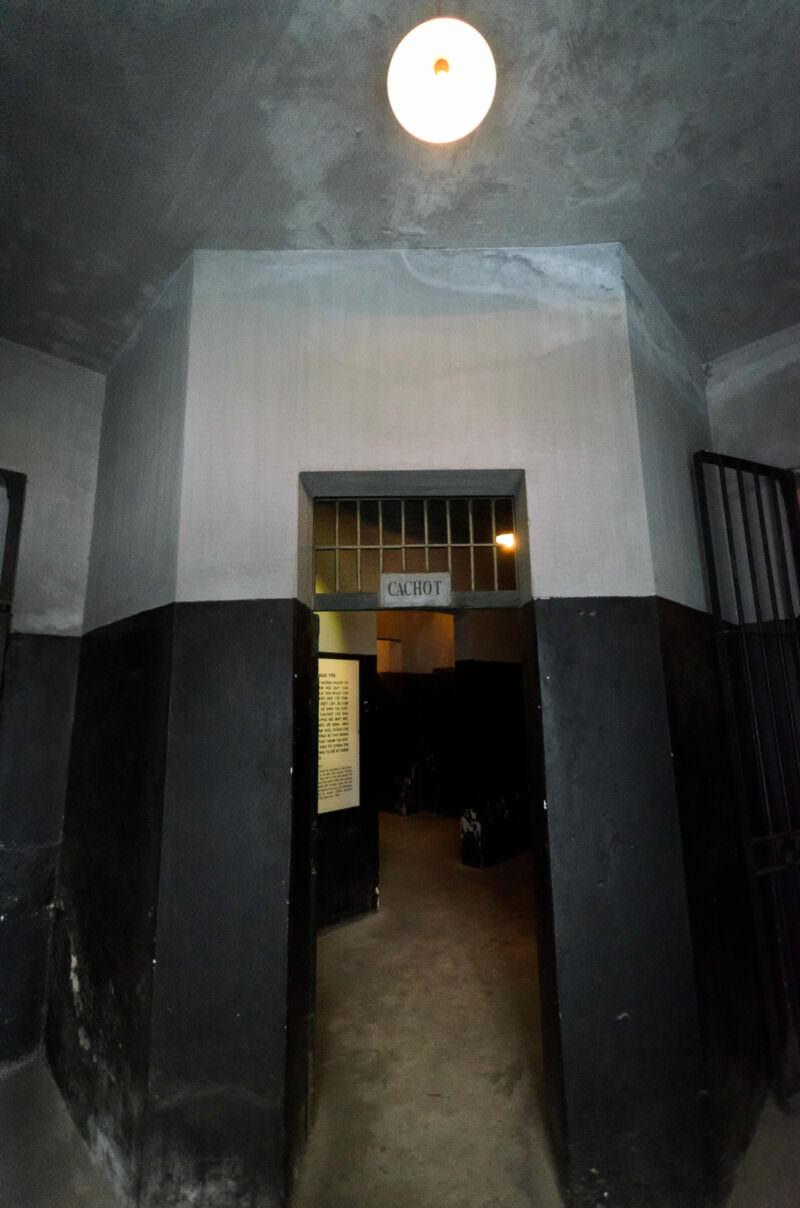
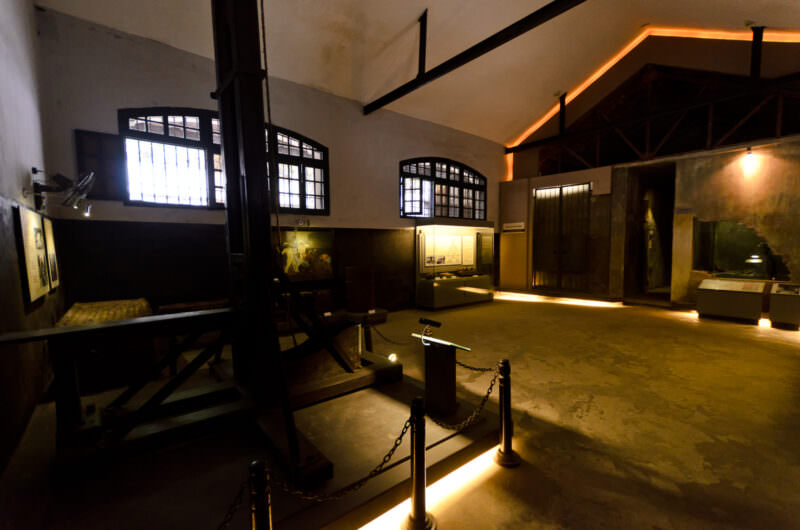
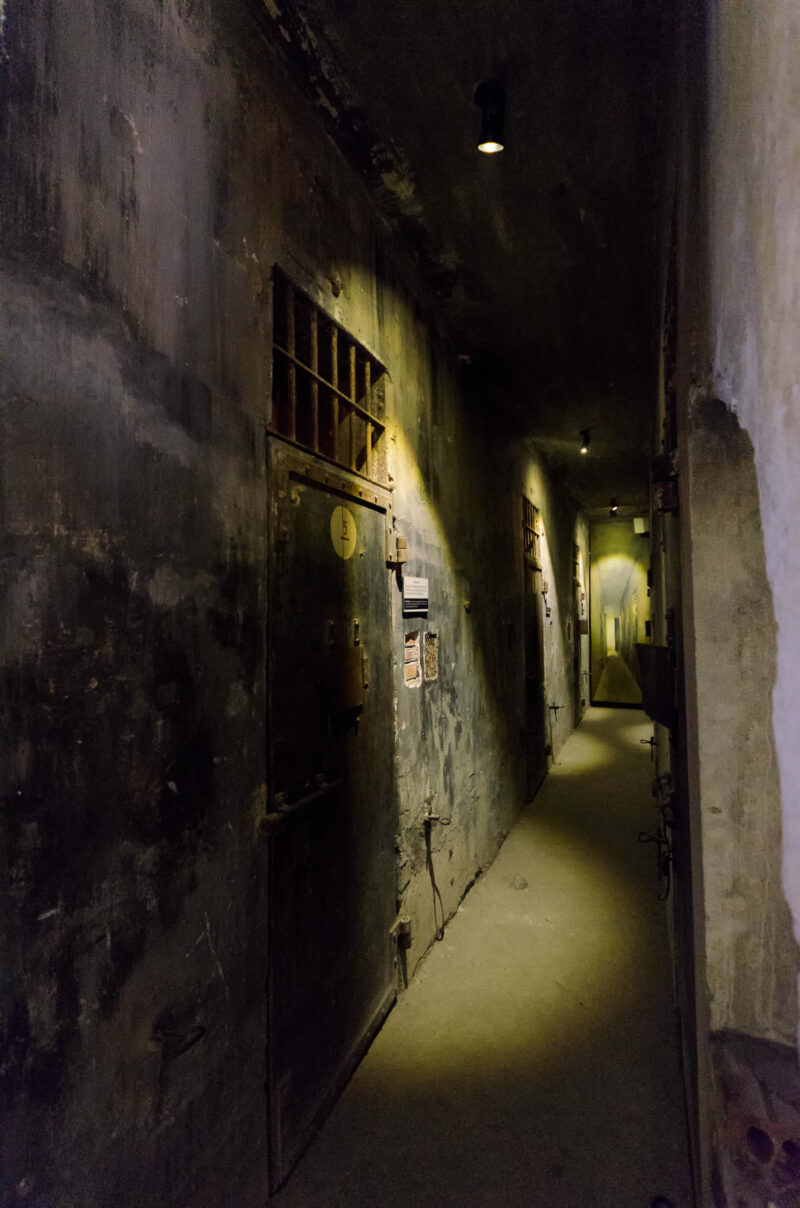
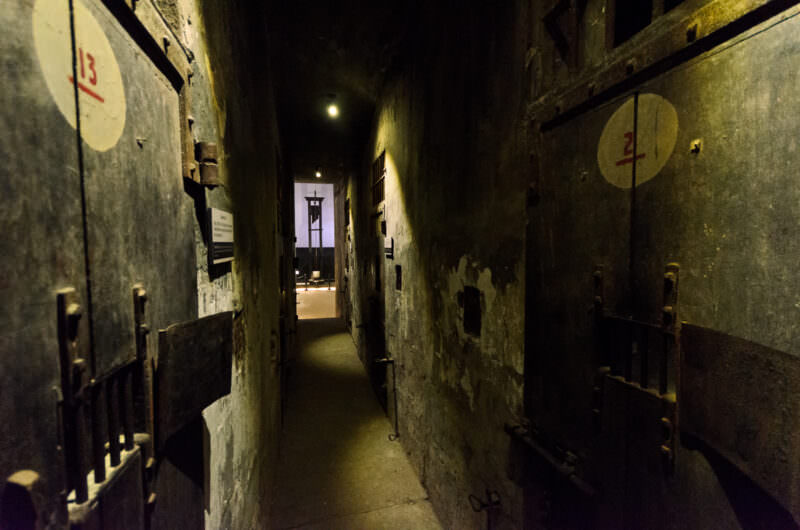
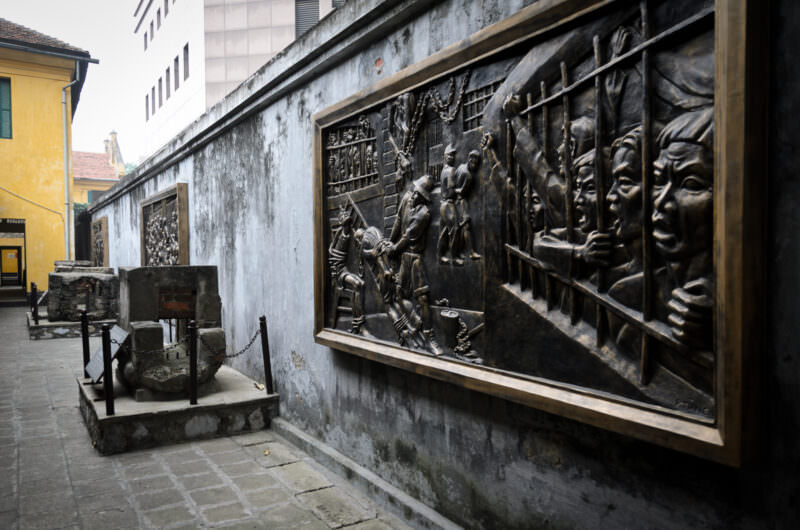
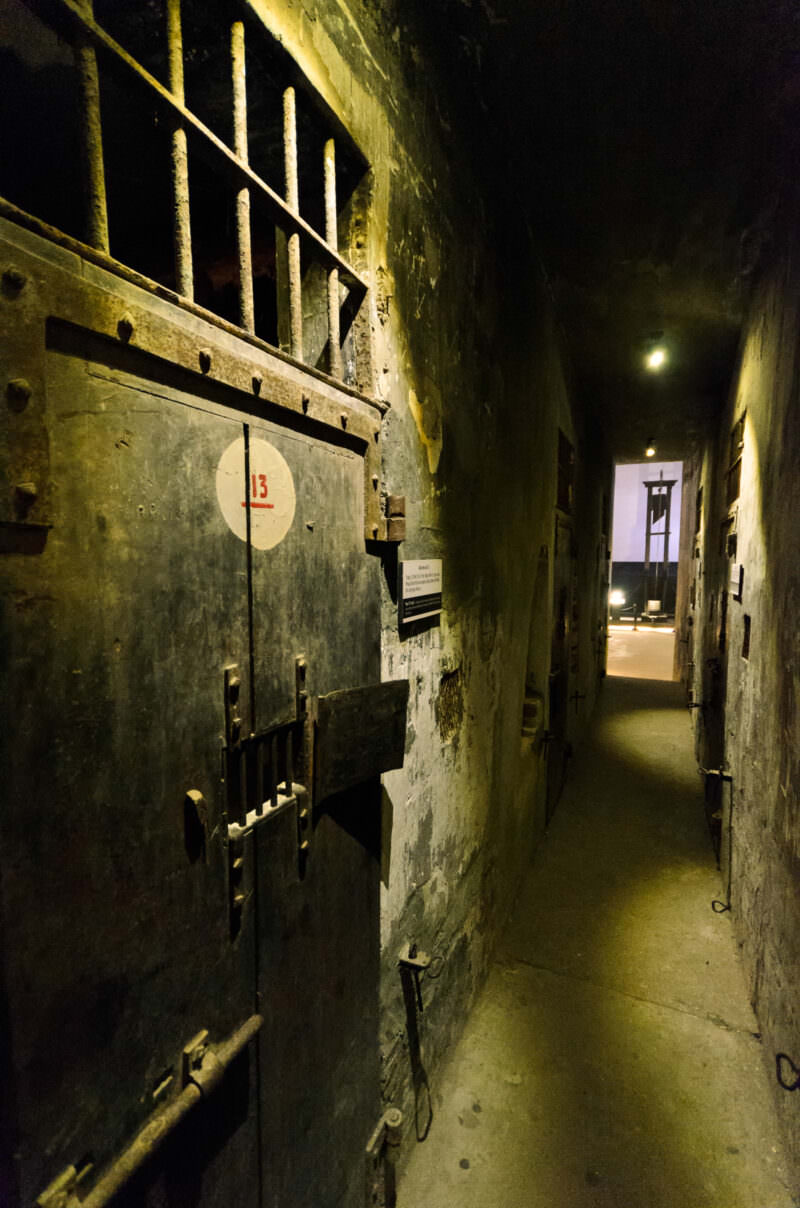
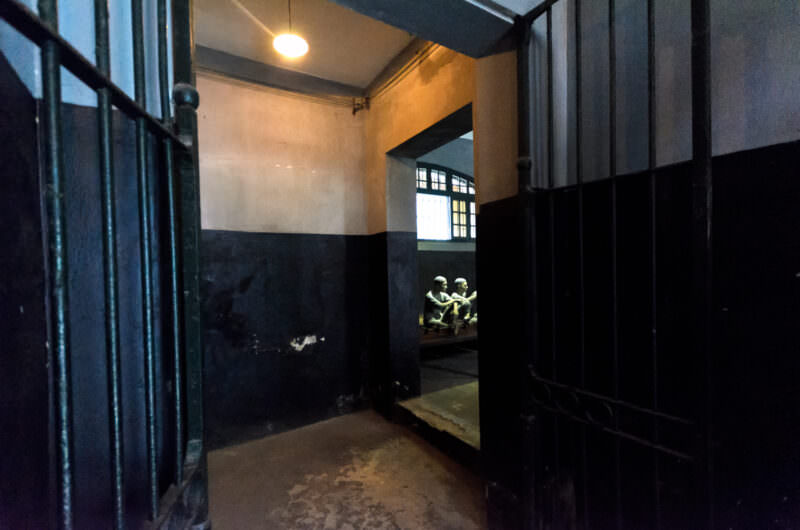
And the museum dwells on that suffering, going into great detail about torture and barbarous treatment. Life-size dummies illustrate how inmates were shackled by one leg, unable to stand or walk. The walls of some of the cells on the dark death row have been cut away and replaced with glass so that visitors can peer into the tiny, dark, and dirty solitary confinement cells used for those awaiting their execution and others being punished. The panels of text, in English, Vietnamese, and French, lay out the degrading treatment by the prison guards toward their captives and the cruelty suffered by the inmates.
All of this at first seems a bit surprising given that this is a museum run under the auspices of the Vietnamese government. The official guidebook even notes that it is approved with the required publication permit.
But the villains of the story that the museum tells are not the ones a foreign visitor might expect, especially one from the United States.
Our humanitarian policy toward American pilots is aimed at further illuminating our just cause in order to win over the American people, support our enemy proselyting operations, and win the sympathy of world opinion for our people’s resistance war against the Americans to save the nation. [North Vietnamese Politburo, 1969]2
Hanoi Hilton
Hoa Lo Prison, after all, is a place best known in the West as one of the prisons where American pilots who had been shot down and captured were kept as prisoners of war (although, technically, the North Vietnamese did not regard the pilots as “prisoners of war” in a legal sense).
Have Camera Will Travel // Newsletter
Practical field notes, hands-on gear tests.
The pilots called it, sarcastically, the “Hanoi Hilton.”
John McCain was held here at various times during his five and a half years as a POW. Some of the nearly 600 other American flyers held as POWs during the Vietnam War stayed even longer. It operated as a POW prison from August 5, 1964, to March 29, 1973.3
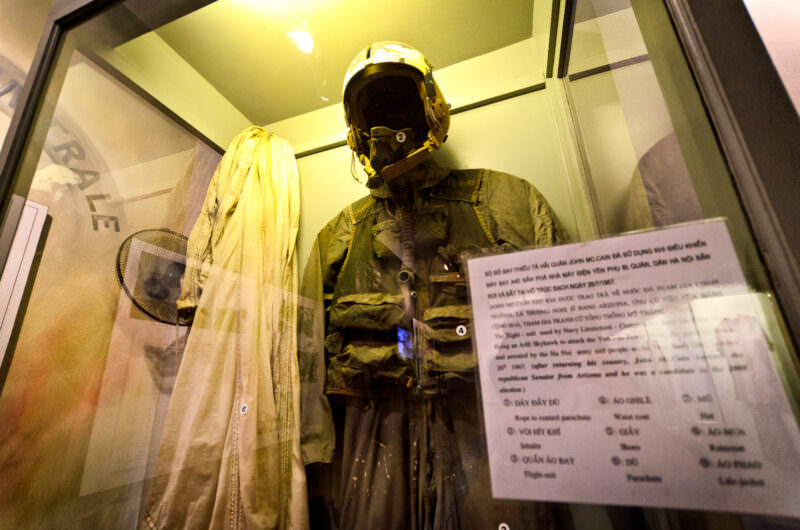
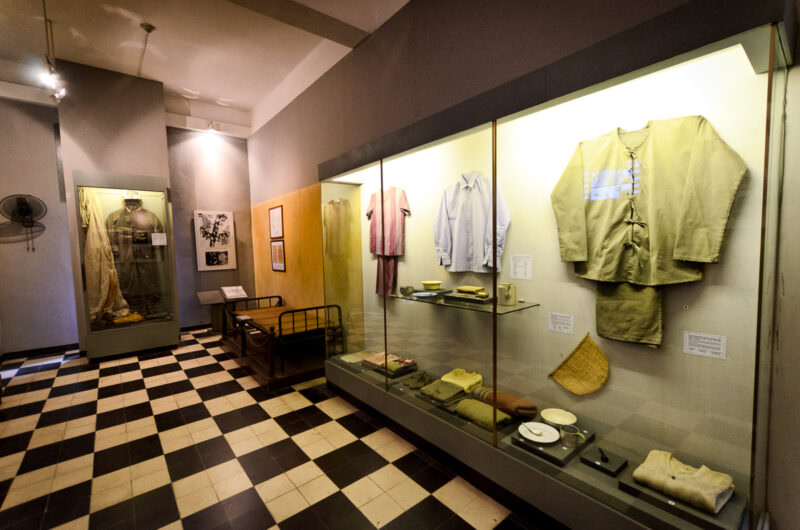
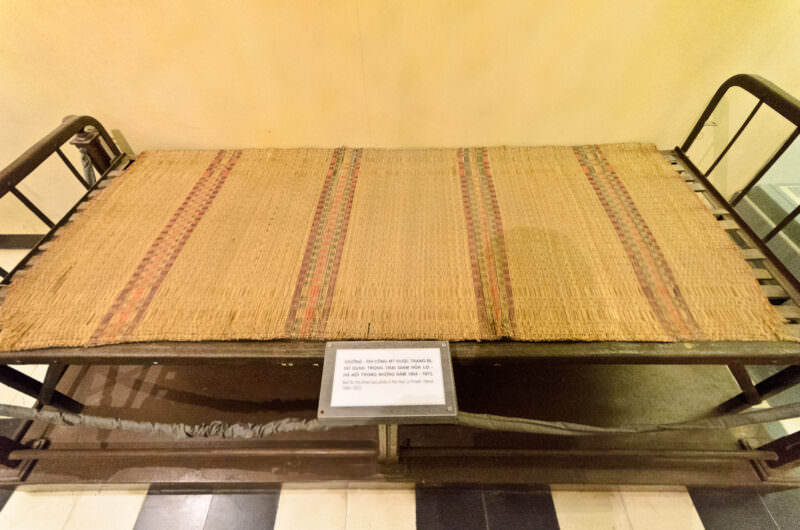
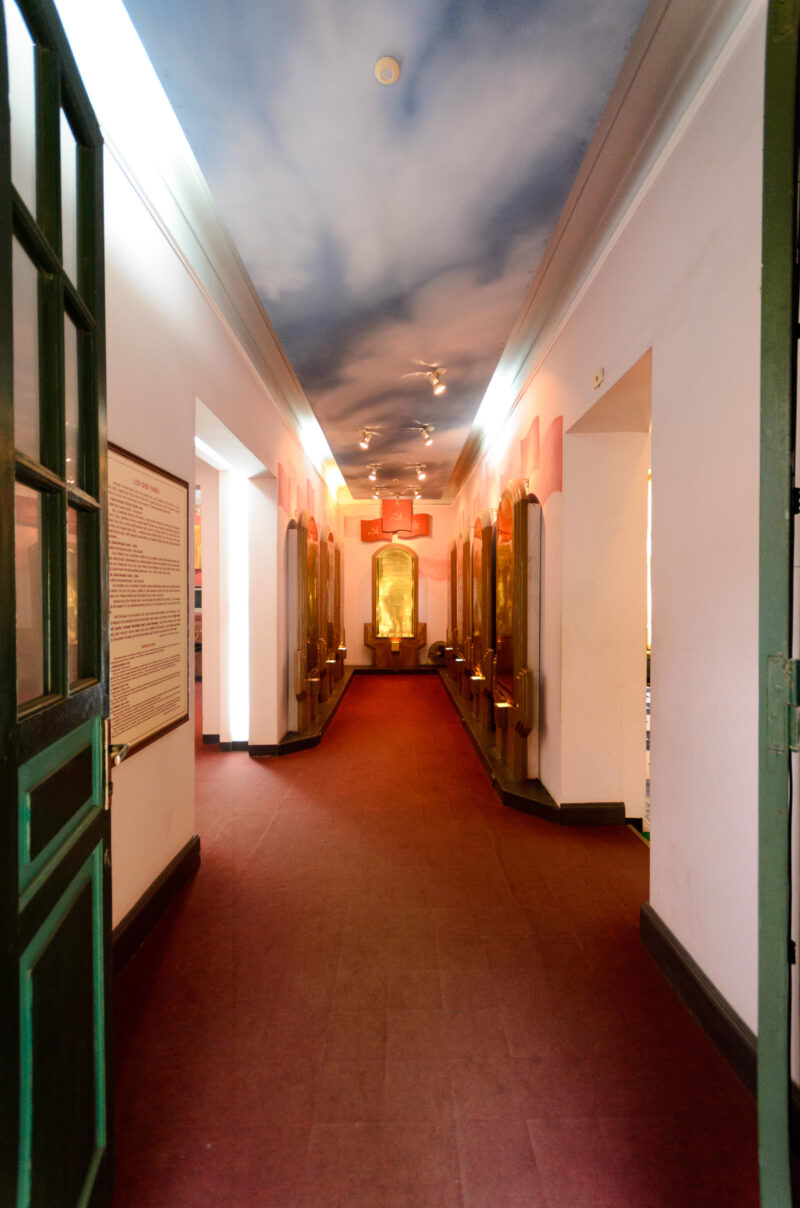
There are two rooms dedicated to the American pilot prisoners of war. The artifacts, photos, and text portray a markedly better image than the rest of the prison. There’s a bed, prisoners’ clothes, and personal effects. In that room, there’s also the flight suit and parachute that John McCain was wearing on his ill-fated bombing mission when he was shot down and fished out of Truc Bach Lake.
HANOI, Vietnam — A flight suit, helmet and parachute worn by John McCain hang in a display case at Hoa Lo Prison, the former colonial jail where he was held after being shot down in 1967. The U.S. Navy lieutenant commander’s A-4 Skyhawk was downed by a surface-to-air missile over Truc Bach Lake on his 23rd mission, and he spent roughly five and a half years as a prisoner of war before his release in 1973. Photo by David Coleman / Have Camera Will TravelLicense this image at:DirectlyAlamy
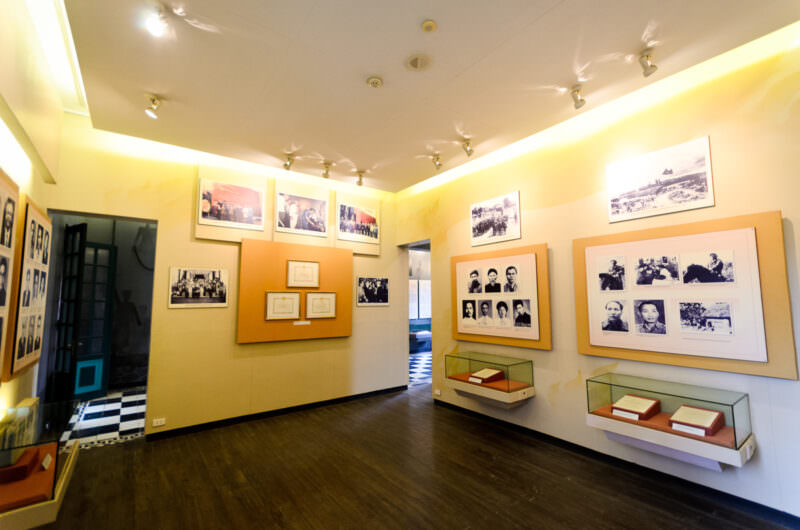
As if you didn’t get the message from that room, the other room goes further. There are photos of the American POWs celebrating Christmas, eating well, playing chess and even pool. The prisoners had freedom of religion while in the jail, the exhibit says. According to the captions, they also received good medical care, received care packages from loved ones, and were allowed access to reporters and humanitarian agencies. A video that plays on a continuous loop shows the prisoners being treated well, cooking Christmas dinner, even joking with their jailers. The prisoners should be so lucky as to be imprisoned by the Vietnamese, the narration says. And in an astonishing display of willfully missing the point, the narrator says that the POWs found their digs so comfortable that they named it after a luxury hotel chain.
If all of this sounds too good to be true, that’s because it is. It’s propaganda, pure and simple. There’s no denying that the photos and videos are effective — even though they’re staged, they’re staged well — but numerous accounts from the prisoners when they got home paint a much more abusive life in the prison, a life of beatings, rope torture, solitary confinement, deprivation, and arbitrary punishment.
Maison Centrale
Most of the museum dwells not on American prisoners, but on Vietnamese.
This was a jail built by the French colonial government; its first prisoners arrived in 1899. The French kept mainly political prisoners here, along with those awaiting sentencing at the nearby Court of Justice. It was originally built to house about 450 inmates; at a peak in the early 1950s, just before the French were defeated decisively at Dien Bien Phu and forced out of Indochina, Hoa Lo held 2,000 prisoners.
HANOI, Vietnam — The original French colonial “Maison Centrale” sign arches over the main entrance to the Hoa Lo Prison Museum. The inscription designates the facility as the central prison of Tonkin — construction began in 1896 on the expropriated site of Phu Khanh village, whose fired-clay-stove kilns gave the prison its Vietnamese name, and it was operational from 1899. Decades later, North Vietnam repurposed the complex to hold downed American pilots, who sarcastically dubbed it the “Hanoi Hilton”; today the preserved gatehouse fragment, covering roughly 2,434 square meters (about a fifth of the original grounds), operates as a memorial museum and national historical relic. Photo by David Coleman / Have Camera Will TravelLicense this image at:DirectlyAlamy
To give a sense of the tone, here’s how one of the introductory text panels puts it (I’ve preserved the original halting English):
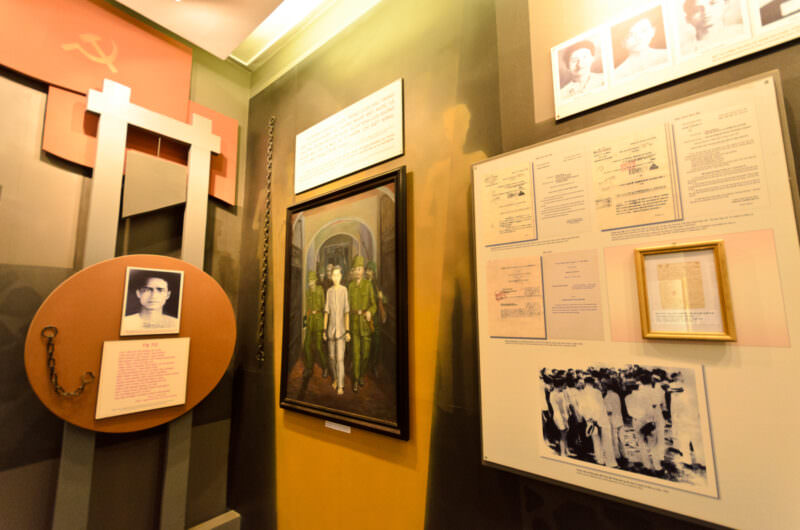
Living in the imperialistic prison, under a severe punishment and maltreated life but revolutionary patriotic soldiers still kept steady their sense of purpose and uprightness, turned the prison into the school where propagated revolutionary argument. Many soldiers ingeniously escaped from the prison to come back with the organisation, with people and made appropriate contribution to the cause of liberation of the motherland.
— Introduction on Remains of Hoa Lo Prison, text panel in the museum.
The French called the place Maison Centrale (The Central Prison), but it became much better known to locals after the village its construction displaced. It was a village that specialized in pottery of small earthen stoves; Hoa Lo means, roughly, “the village of pottery stoves.” The residents were moved, as were three pagodas that once stood here.4
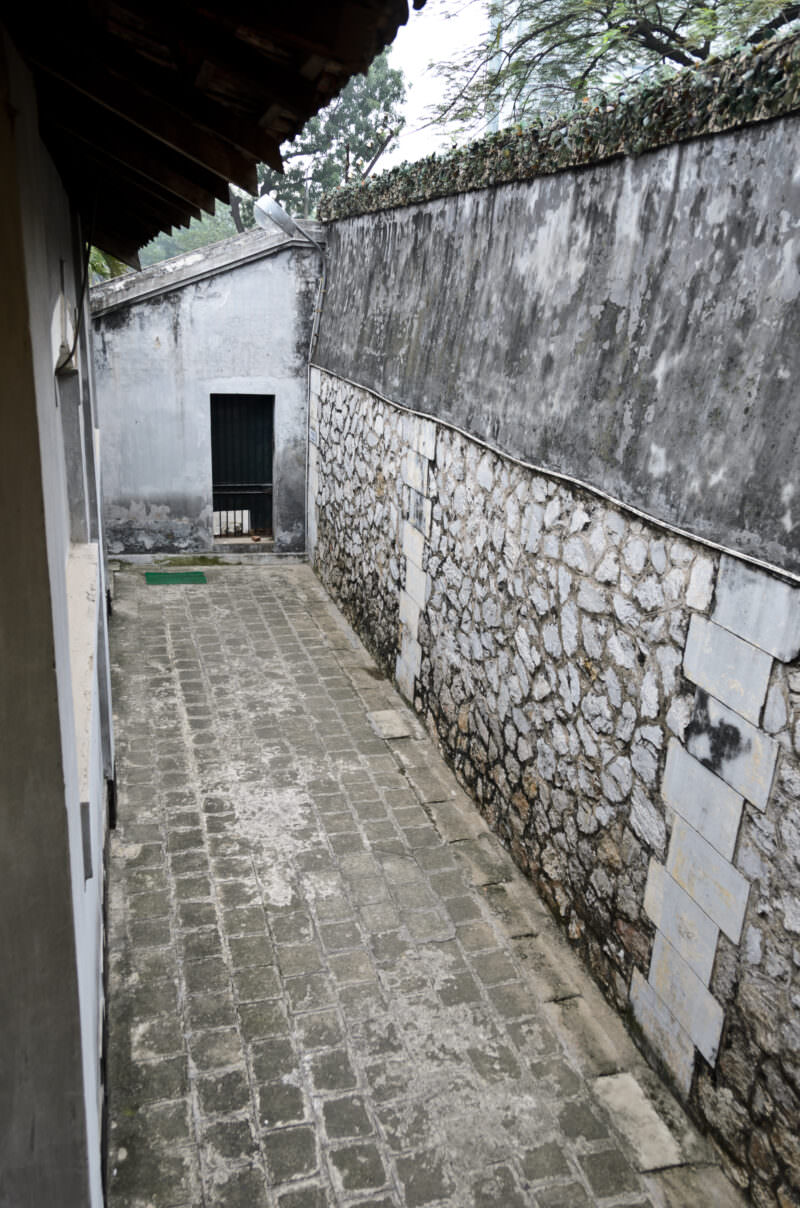
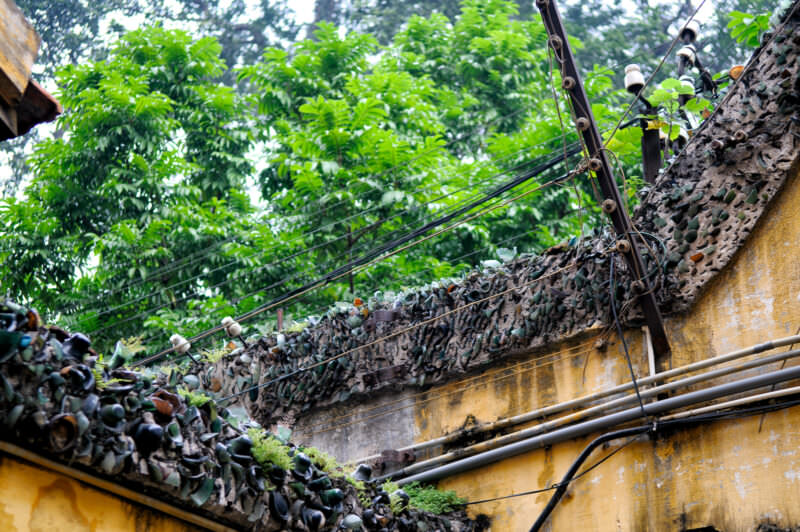
When it was built, Hoa Lo was one of the largest prisons in Indochina, covering 12,908 square meters. It was also one of the most fortified, using concrete rather than the usual local building materials. It was enclosed by solid stone walls 13 to 16 feet high and about 20 inches thick. And just in case the walls weren’t already difficult enough to breach, they were topped with shards of broken glass and barbed wire connected to high-voltage electricity. Guards watched over the outer perimeter from watchtowers. The iron doors and locks were even specially shipped over from France.5
The outer area of the complex held the administrative offices, guard headquarters, medical clinic, prisoner kitchen, and cells for European and women prisoners. The inner sanctum, with much heavier security, held the death rows and punishment cells.
Photos of Hoa Lo Prison
Here are some of the photos I’ve taken at Hoa Lo Prison.
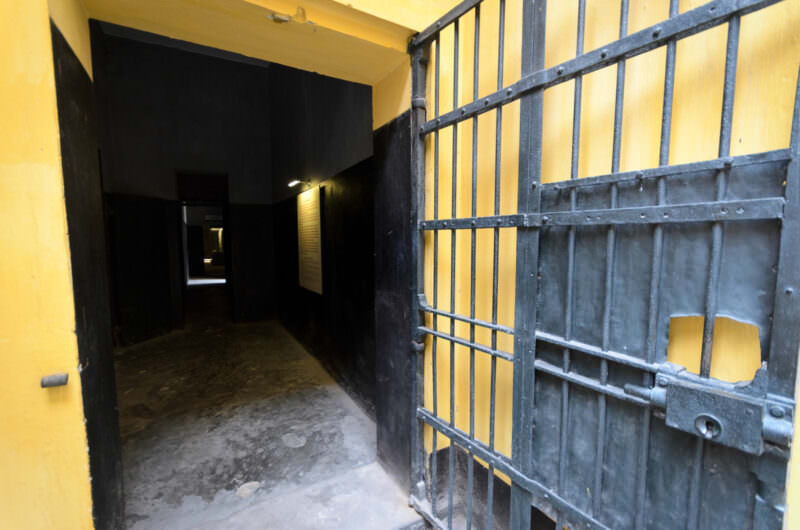
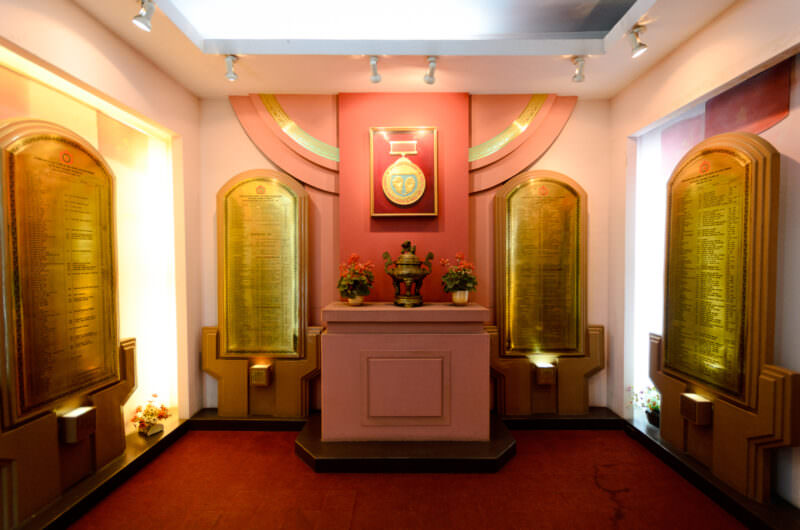
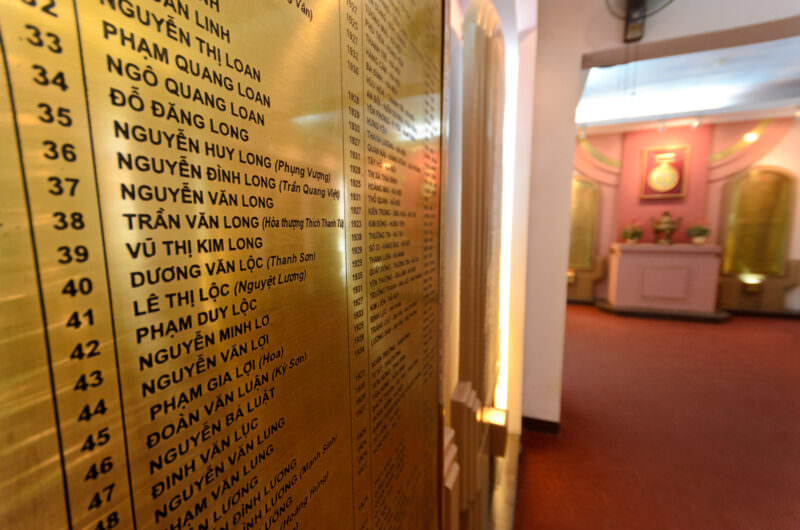
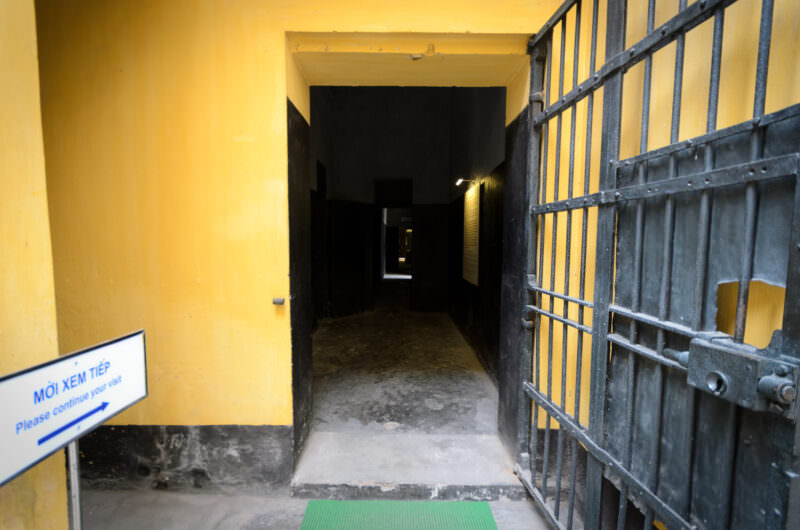
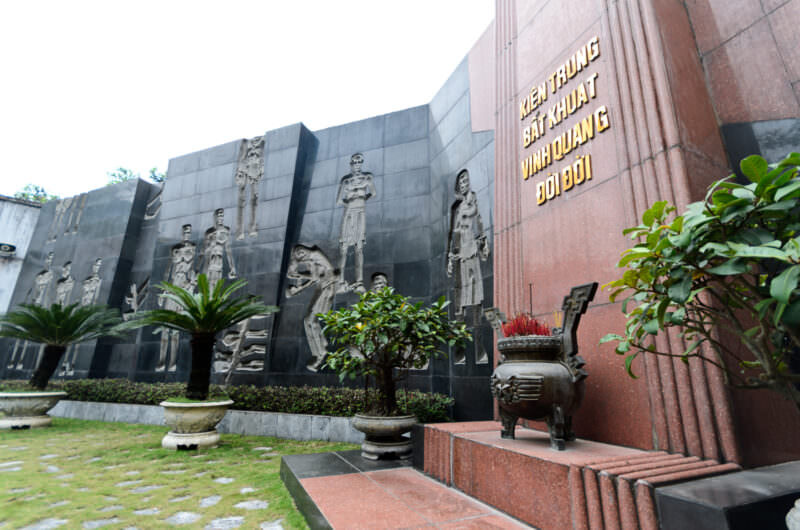
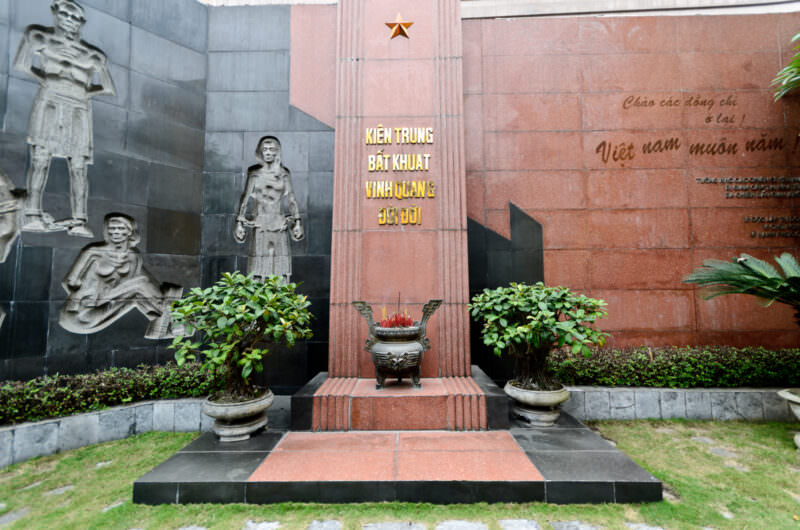
HANOI, Vietnam — A cutaway brick wall reveals a diorama of a shackled inmate inside a death row cell at Hoa Lo Prison. Built by the French from 1896 as Maison Centrale, the facility was designed to crush Vietnamese independence movements and held thousands of anti-colonial activists across five decades of colonial rule. Though famous in the West as the “Hanoi Hilton” for holding American POWs, the museum’s preserved dungeons primarily memorialize the conditions endured by those revolutionaries. Photo by David Coleman / Have Camera Will TravelLicense this image at:DirectlyAlamyHANOI, Vietnam — A reinforced iron gate opens into a darkened corridor inside Hoa Lo Prison. French colonists installed the heavy ironwork during the facility’s construction from 1896 as Maison Centrale, a detention center for Vietnamese political dissidents whose design capacity of roughly 450 to 460 was chronically and vastly exceeded. North Vietnam later repurposed these formidable cell blocks to house captured American pilots, who sarcastically dubbed the compound the “Hanoi Hilton.” Photo by David Coleman / Have Camera Will TravelLicense this image at:DirectlyAlamyHANOI, Vietnam — Glass display cases holding prisoner clothing, bedding, and dishware form part of an exhibit on American pilots at Hoa Lo Prison. Curators present the items to suggest humane treatment of detainees, a portrayal that has long been disputed by former POWs who reported systematic torture during their captivity between 1964 and Operation Homecoming in 1973. Photo by David Coleman / Have Camera Will TravelLicense this image at:DirectlyAlamyHANOI, Vietnam — Viewed through the iron bars of a cell door, a sculpture of an emaciated prisoner sits in solitary confinement at Hoa Lo Prison. The diorama depicts the brutal conditions of the cachot, the windowless dungeon used by French colonial authorities to punish Vietnamese revolutionaries. Though famous in the United States as the “Hanoi Hilton” for holding American POWs, the facility was originally built from 1896 as Maison Centrale to crush the local independence movement. Photo by David Coleman / Have Camera Will TravelLicense this image at:DirectlyAlamyHANOI, Vietnam — A rusted enameled sign marks Batiment E on a wall at Hoa Lo Prison. The French terminology points directly to the facility’s origins as Maison Centrale, constructed by colonial authorities from 1896 to incarcerate Vietnamese political dissidents. Decades before the site became the infamous “Hanoi Hilton” for downed American pilots during the Vietnam War, the complex operated as the principal instrument of French imperial control in Tonkin. Photo by David Coleman / Have Camera Will TravelLicense this image at:DirectlyAlamyHANOI, Vietnam — Sculpted figures on raised concrete platforms recreate the conditions for female political prisoners inside Hoa Lo Prison. Built by the French from 1896 as Maison Centrale, the facility used communal cells to hold and shackle Vietnamese revolutionaries, and the museum memorializes some 1,624 revolutionary detainees held there between 1899 and 1954. The modern dioramas emphasize colonial-era suffering, a primary narrative that largely overshadows the site’s later history holding American pilots during the Vietnam War. Photo by David Coleman / Have Camera Will TravelLicense this image at:DirectlyAlamyHANOI, Vietnam — A sign reading “CACHOT” marks the entrance to the solitary confinement wing inside Hoa Lo Prison. The French terminology reflects the facility’s origins as Maison Centrale, built from 1896 to hold Vietnamese political dissidents. Within these darkened cells, inmates were shackled in place, enduring severe conditions long before the site gained notoriety as the “Hanoi Hilton” for American prisoners of war. Photo by David Coleman / Have Camera Will TravelLicense this image at:DirectlyAlamyHANOI, Vietnam — A wooden guillotine dominates an exhibit room at Hoa Lo Prison, positioned near the entrance to the former death row cells. The French colonial administration maintained the device on site and used it to execute Vietnamese political prisoners who opposed French rule, among them Communist Party organizers Nguyen Duc Canh and Nguyen Hoang Ton. Though internationally famous as the “Hanoi Hilton” where American pilots were held during the Vietnam War, the facility was originally built from 1896 as Maison Centrale to suppress anti-colonial dissent. Photo by David Coleman / Have Camera Will TravelLicense this image at:DirectlyAlamyHANOI, Vietnam — A purple souvenir sign marks a gift shop entrance framed by the heavy iron bars and thick masonry of Hoa Lo Prison. The French administration of Indochina began construction in 1896 on the site of Phu Khanh craft village — whose kilns firing clay stoves gave the prison its Vietnamese name, meaning “fiery furnace” — and the facility was operational from 1899. Most of the complex was demolished in 1993-1994, leaving only this gatehouse section preserved as a museum; the nickname “Hanoi Hilton,” coined by captured American pilots held here during the Vietnam War, made the site globally known. Photo by David Coleman / Have Camera Will TravelLicense this image at:DirectlyAlamyHANOI, Vietnam — Tourists gather outside the stone and yellow stucco entrance of Hoa Lo Prison, where the arched inscription “Maison Centrale” identifies the site’s origins as the principal French colonial jail of Tonkin. Construction began in 1896 on the expropriated land of Phu Khanh village, and the prison was operational from 1899. Though later dubbed the “Hanoi Hilton” by American prisoners of war, only this gatehouse fragment — roughly one-fifth of the original complex — survived the 1993-1994 demolition to serve as a memorial museum, designated a national historical relic on 18 June 1997. Photo by David Coleman / Have Camera Will TravelLicense this image at:DirectlyAlamyHANOI, Vietnam — A narrow cobblestone pathway runs alongside the towering stone walls of Hoa Lo Prison, leading toward a barred doorway. The French colonial administration constructed these thick perimeter walls — roughly 13 to 16 feet (4 to 5 m) high and 20 inches (0.5 m) thick — from 1896, pressing the facility into service by 1899. Though later dubbed the “Hanoi Hilton” by American pilots during the Vietnam War, the complex was originally named Maison Centrale and designed specifically to crush anti-colonial resistance. Photo by David Coleman / Have Camera Will TravelLicense this image at:DirectlyAlamyHANOI, Vietnam — Plaster figures of inmates sit shackled to raised wooden platforms inside a preserved ward at Hoa Lo Prison. The continuous iron ankle bars illustrate the communal detention methods of the French colonial administration, which opened the facility as Maison Centrale from 1896 and pressed it into use by 1899. While internationally famous as the “Hanoi Hilton” for housing American POWs during the Vietnam War, the site’s original architecture was designed specifically to suppress Vietnamese independence activists. Photo by David Coleman / Have Camera Will TravelLicense this image at:DirectlyAlamyHANOI, Vietnam — Shards of broken glass and wire crown the weathered yellow perimeter wall of Hoa Lo Prison, built by the French administration of Indochina from 1896 as Maison Centrale. The stone wall stands roughly 13 to 16 feet (4 to 5 m) high and about 20 inches (0.5 m) thick, with glass embedded in the masonry and electrified wire along the top to prevent escape. Vietnamese political prisoners held here during the colonial period included five men who would later serve as General Secretaries of the Communist Party of Vietnam; the site gained further international notoriety as the “Hanoi Hilton” when North Vietnam repurposed it to hold captured American airmen during the Vietnam War. Photo by David Coleman / Have Camera Will TravelLicense this image at:DirectlyAlamyHANOI, Vietnam — Heavy iron doors with barred transoms secure the isolation cells along the death row corridor of Hoa Lo Prison. Established by the French from 1896 as Maison Centrale, these maximum-security confines originally held Vietnamese political dissidents awaiting execution. Although the broader complex later gained notoriety as the “Hanoi Hilton” for housing American POWs, this section preserves the site’s origins as an instrument of colonial suppression. Photo by David Coleman / Have Camera Will TravelLicense this image at:DirectlyAlamyHANOI, Vietnam — Tourists gather outside the main entrance of the Hoa Lo Prison Museum, where the arched “Maison Centrale” sign marks the French colonial origin of the complex. Construction began in 1896 on the site of Phu Khanh craft village, and the prison was operational from 1899 as the principal penal institution of colonial Tonkin, designed for roughly 450 inmates but chronically overcrowded — holding more than 2,000 by 1953. While globally recognized by the sardonic nickname “Hanoi Hilton” given by American POWs during the Vietnam War, only this original gatehouse remains after about four-fifths of the surrounding complex was demolished in 1993-1994. Photo by David Coleman / Have Camera Will TravelLicense this image at:DirectlyAlamyHANOI, Vietnam — Numbered iron cell doors line a death row corridor at Hoa Lo Prison, leading toward a guillotine silhouetted at the far end. Built by the French colonial administration beginning in 1896 as Maison Centrale, the prison held and executed Vietnamese nationalist revolutionaries decades before American POWs nicknamed it the “Hanoi Hilton” during the Vietnam War. Photo by David Coleman / Have Camera Will TravelLicense this image at:DirectlyAlamyHANOI, Vietnam — An exhibit inside Hoa Lo Prison features paintings, colonial documents, and chains detailing the incarceration of Vietnamese political prisoners under French rule. Built from 1896 as Maison Centrale, the facility was intended to crush dissent, but scholar Peter Zinoman argues that such colonial prisons functioned as an “institutional mainspring” for modern Vietnamese political identity — incubators where shared hardship and clandestine study forged anti-colonial networks. The site memorializes some 1,624 revolutionary detainees held here between 1899 and 1954, including five figures who later served as General Secretary of the Communist Party of Vietnam. Photo by David Coleman / Have Camera Will TravelLicense this image at:DirectlyAlamyHANOI, Vietnam — Bronze relief murals line a courtyard wall at Hoa Lo Prison beside a preserved section of a brick drainage sewer. The artwork depicts the brutal treatment of Vietnamese political dissidents under French colonial administration at the facility, originally named Maison Centrale. The adjacent tunnel fragment marks the subterranean route used by inmates to stage a mass breakout in March 1945, when more than 100 political prisoners escaped through the underground sewer to join preparations for the August 1945 general uprising. Photo by David Coleman / Have Camera Will TravelLicense this image at:DirectlyAlamyHANOI, Vietnam — Tourists gather outside the preserved gatehouse of Hoa Lo Prison, marked by the French colonial inscription “Maison Centrale.” Built from 1896 and operational from 1899 to hold Vietnamese dissidents, the facility later became infamous as the “Hanoi Hilton” for American POWs during the Vietnam War. Only this southern fragment — roughly 2,434 square meters (about a fifth of the original 12,908-square-meter site) — survives as a museum; the bulk of the complex was demolished in 1993-1994 to build the commercial high-rise looming behind it. Photo by David Coleman / Have Camera Will TravelLicense this image at:DirectlyAlamyHANOI, Vietnam — A rudimentary metal bed topped with a woven mat sits on display at the Hoa Lo Prison museum. The exhibit’s placard dates the artifact to 1964 – 1973, the span of American air operations over North Vietnam during which the former French colonial facility held hundreds of downed U.S. aviators. Those prisoners endured the compound they sarcastically dubbed the “Hanoi Hilton” until their repatriation under Operation Homecoming in 1973. Photo by David Coleman / Have Camera Will TravelLicense this image at:DirectlyAlamyHANOI, Vietnam — A guard reads a newspaper at the arched entrance of the Hoa Lo Prison Museum, framed by the heavy iron gates and yellow masonry of the original colonial structure. The French administration of Indochina began construction in 1896 on the site of Phu Khanh craft village, displacing 48 households to build the facility they named Maison Centrale. About four-fifths of the complex was demolished in 1993-1994 for a commercial high-rise development, leaving only this gatehouse fragment — preserved as a museum since 1997 — to recall the corridors where American pilots were later held in what they dubbed the “Hanoi Hilton.” Photo by David Coleman / Have Camera Will TravelLicense this image at:DirectlyAlamyHANOI, Vietnam — Archival photographs and framed documents fill an exhibit gallery at Hoa Lo Prison, with a reconstructed colonial cell block visible through the doorway beyond. Built by French colonial authorities from 1896 and operational by 1899 as Maison Centrale, the prison held Vietnamese revolutionaries, among them five future General Secretaries of the Communist Party of Vietnam, long before American POWs called it the “Hanoi Hilton.” Photo by David Coleman / Have Camera Will TravelLicense this image at:DirectlyAlamyHANOI, Vietnam — Sculptures at Hoa Lo Prison depict emaciated inmates secured by one leg in communal wooden stocks. The display illustrates the brutal confinement methods used by French colonial authorities against Vietnamese political dissidents. Built from 1896 as Maison Centrale, the facility was designed to suppress the local independence movement decades before it gained international notoriety as the “Hanoi Hilton” for American prisoners of war. Photo by David Coleman / Have Camera Will TravelLicense this image at:DirectlyAlamyHANOI, Vietnam — Golden plaques flank a traditional incense burner inside a memorial shrine at Hoa Lo Prison. The inscribed panels list Vietnamese revolutionaries and political prisoners incarcerated or executed during French colonial rule, among them figures who became leading lights of the independence movement. While internationally famous as the “Hanoi Hilton” for American POWs, the remaining structure is curated domestically to honor martyrs of the anti-colonial struggle. Photo by David Coleman / Have Camera Will TravelLicense this image at:DirectlyAlamyHANOI, Vietnam — An engraved brass plaque lines a memorial room inside Hoa Lo Prison, detailing the names and dates of Vietnamese inmates. While internationally known as the “Hanoi Hilton” for housing American pilots during the Vietnam War, the facility was built from 1896 as Maison Centrale and the museum memorializes some 1,624 revolutionary detainees held there between 1899 and 1954. These memorials honor the Vietnamese independence fighters and political dissidents incarcerated or executed here under colonial rule, among them five future General Secretaries of the Communist Party of Vietnam. Photo by David Coleman / Have Camera Will TravelLicense this image at:DirectlyAlamyHANOI, Vietnam — A heavy iron gate opens into a dark interior corridor at Hoa Lo Prison. Built by French colonists from 1896 to detain Vietnamese political dissidents, the complex was later repurposed by North Vietnam to hold American prisoners of war. The stark confinement spaces behind these doors earned the compound its sarcastic nickname, the “Hanoi Hilton,” among captured pilots during the Vietnam War. Photo by David Coleman / Have Camera Will TravelLicense this image at:DirectlyAlamyHANOI, Vietnam — A courtyard memorial at Hoa Lo Prison features a black stone bas-relief of shackled figures beside a bronze censer holding red joss sticks. While Westerners primarily know the facility as the “Hanoi Hilton” where American pilots were held, this monument specifically honors Vietnamese political prisoners incarcerated during French colonial rule. The gold inscription praises the indomitable spirit of those who suffered and died in what the French originally built as Maison Centrale. Photo by David Coleman / Have Camera Will TravelLicense this image at:DirectlyAlamyHANOI, Vietnam — A memorial altar and stone relief stand in the courtyard of Hoa Lo Prison. The carved figures of shackled prisoners honor the Vietnamese revolutionaries incarcerated and executed here during French colonial rule, among them five figures who would go on to serve as General Secretary of the Communist Party of Vietnam. While Westerners primarily know the site as the “Hanoi Hilton” for American pilots during the Vietnam War, this monument centers the facility’s original decades operating as the French Maison Centrale. Photo by David Coleman / Have Camera Will TravelLicense this image at:DirectlyAlamyHANOI, Vietnam — A heavy iron door marked with the number 13 seals an isolation cell along death row at Hoa Lo Prison, the corridor opening toward a guillotine beyond. French colonial authorities built and operated this Maison Centrale from the 1890s to imprison and execute Vietnamese political dissidents. The site later gained wartime notoriety as the “Hanoi Hilton,” where captured American pilots were held during the Vietnam War. Photo by David Coleman / Have Camera Will TravelLicense this image at:DirectlyAlamyHANOI, Vietnam — A red-carpeted memorial hall inside Hoa Lo Prison culminates at a gold stele beneath the communist hammer and sickle. Though internationally known as the “Hanoi Hilton” where American pilots were held during the Vietnam War, the museum primarily preserves the site’s origins as Maison Centrale, the principal colonial prison of Tonkin, built from 1896 and operational from 1899. These gilded shrines honor the Vietnamese revolutionaries incarcerated and executed here under French rule — including party organizers put to death by guillotine on site — reclaiming the former dungeon as a monument to national independence. Photo by David Coleman / Have Camera Will TravelLicense this image at:DirectlyAlamyHANOI, Vietnam — Heavy iron gates open into a cell block at Hoa Lo Prison, where mannequins depict inmates confined to raised communal platforms. The French colonial government built the facility as Maison Centrale from 1896, pressing it into service by 1899 to incarcerate Vietnamese political revolutionaries. Though famous in the West as the “Hanoi Hilton” for holding American POWs during the Vietnam War, the modern museum primarily focuses on these earlier colonial-era abuses. Photo by David Coleman / Have Camera Will TravelLicense this image at:DirectlyAlamy
What to Know Before You Go
Visiting is self-guided. You probably won’t need to allow much longer than an hour or so. The signs and exhibit panels are in Vietnamese, French, and English. It’s an easy walk from the Old Quarter.
Politburo Resolution No. 194-NQ/TW, 20 November 1969, in Nguyen Quy, ed., Van Kien Dang Toan Tap, 30, 1969 [Collected Party Documents, Volume 30, 1969] (Hanoi: National Political Publishing House, 2004), pages 303-305. Translated by Merle L. Pribbenow. [↩︎]
M.A. Nguyen Thi Hien, Hoa Lo Prison: Historic Vestige (Hanoi: Administration Board of Hoa Lo Prison Historic Vestige, 2010). Introduction of Hoa Lo, text panel in the museum. [↩︎]
M.A. Nguyen Thi Hien, Hoa Lo Prison: Historic Vestige (Hanoi: Administration Board of Hoa Lo Prison Historic Vestige, 2010). [↩︎]
Enjoyed this article? Personalize your search results.
I'm a freelance travel photographer based in Washington DC. Seven continents, up mountains, underwater, and a bunch of places in between. My images have appeared in numerous publications, and you can check out some of my gear reviews and tips here. More »