MEXICO CITY, Mexico — Dominating the northern side of the Zocalo in the historic quarter of Mexico City, the Metropolitan Cathedral is the largest Roman Catholic Cathedral in the Americas.
If you think that the grandest cathedrals are only in Europe, this one will make you rethink. It’s massive, ornate, and grand to a T.
Dominating the northern side of the Zocalo in the Centro Historico, the historic quarter of Mexico City, the Metropolitan Cathedral is the largest Roman Catholic Cathedral in the Americas.
Its formal name is the Metropolitan Cathedral of the Assumption of the Most Blessed Virgin Mary into Heaven (or, in Spanish: Catedral Metropolitana de la Asunción de la Santísima Virgen María a los Cielos).
It was built in stages over the course of 1573 to 1813. The first stone of the present building was laid in 1571, and construction began in 1573, gradually replacing an earlier church built on the site around 1524 after the Spanish conquered Tenochtitlan in 1521.
And the site is no accident — it was deliberately constructed next to the Templo Mayor, one of the main temples of the Aztecs in their capital city of Tenochtitlan. Even the stones used to construct the cathedral were plundered (or recycled, depending on your perspective) from the Aztec temple.
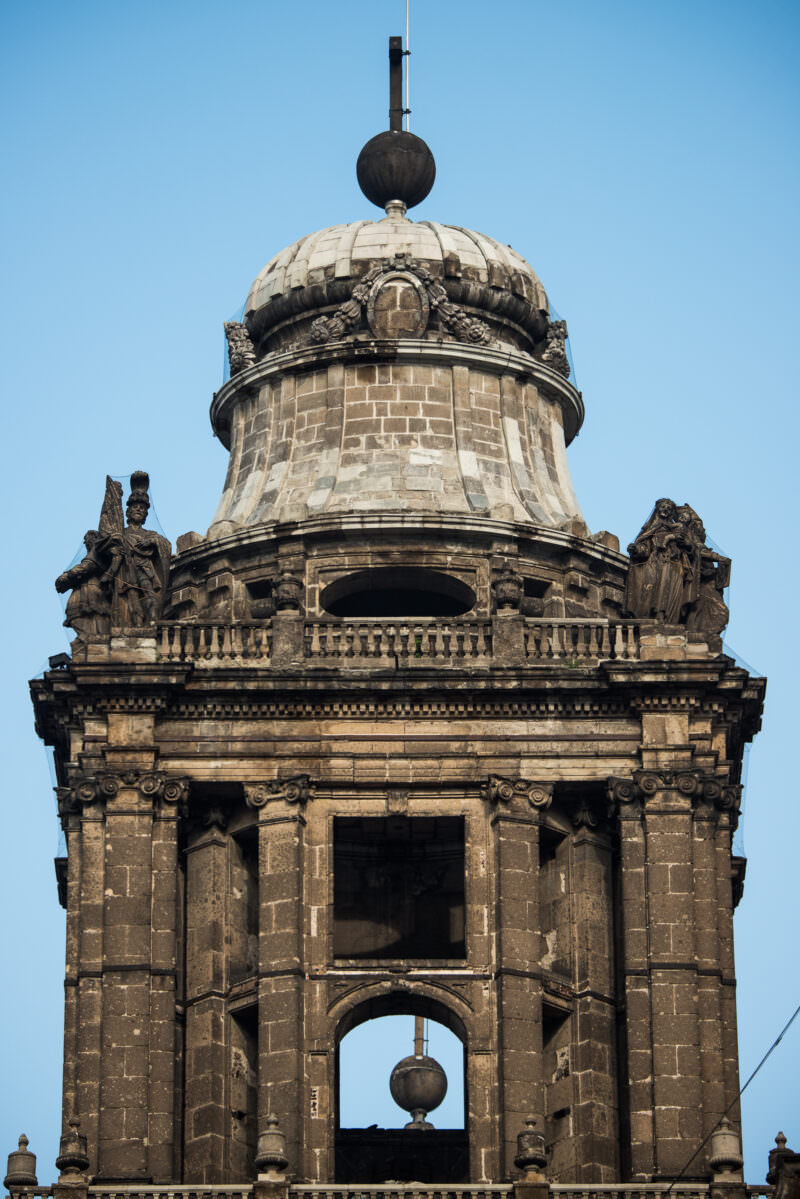
The exterior of the cathedral, with its Gothic styling and weathered gray stone, somehow manages to look heavy and even somewhat drab despite its ornamentation, the gray stone looking far more like it should be in cold and dark Europe than in Central America.
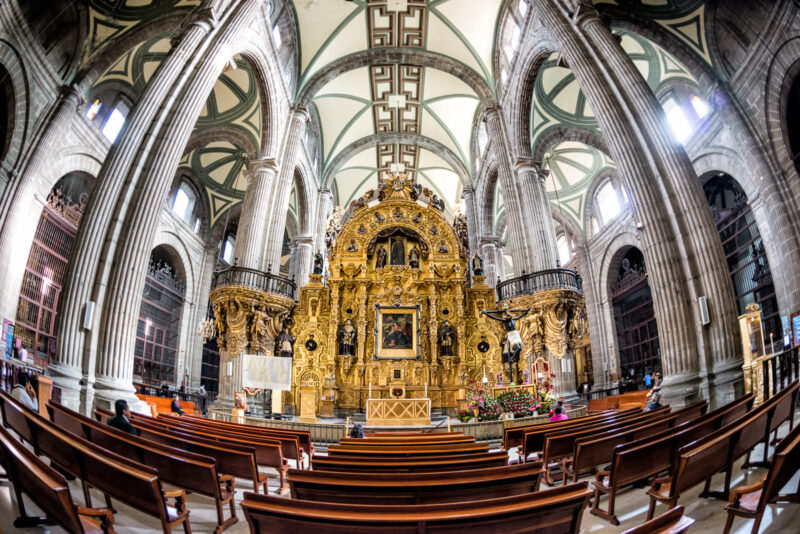
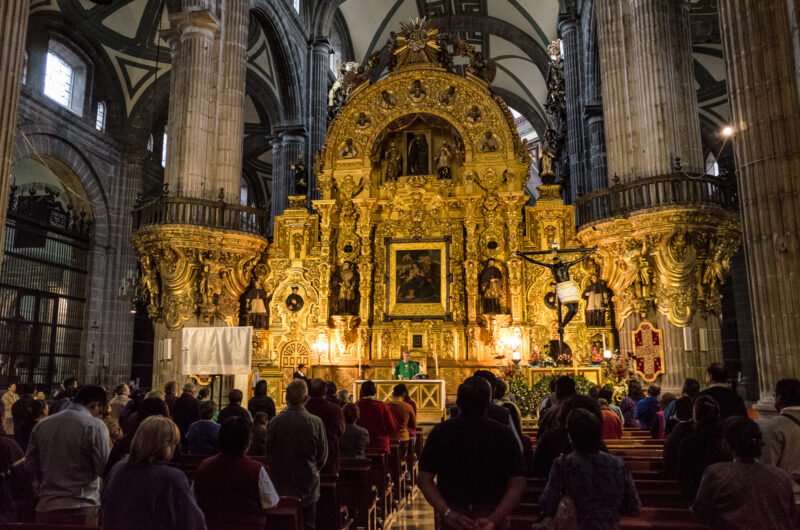
But step inside and you’re immediately greeted by the glistening, large, and ornate gold Altar of Forgiveness. It is here that many of the cathedral’s day-to-day services are held. But it is just a preview of what lies beyond.
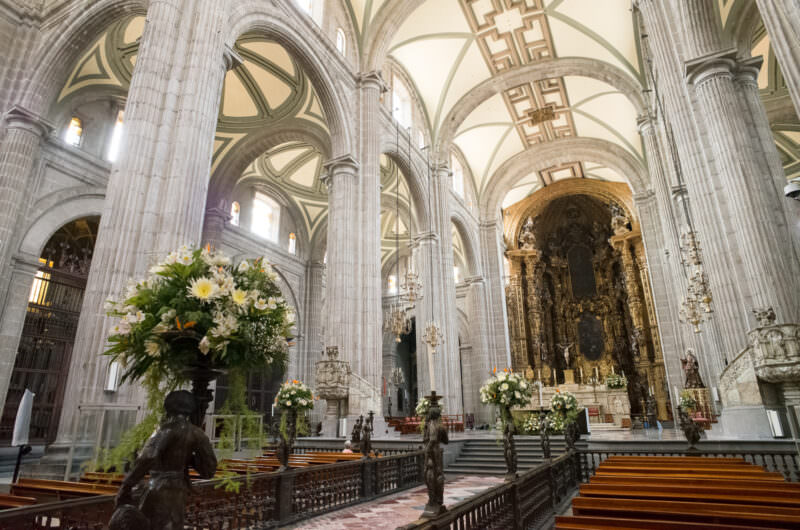
There’s an even larger altar, the Altar of the Kings (Altar de los Reyes), in the apse at the northern end behind the high altar that stretches up to the towering ceiling. It manages to be even more ornate. And lining the sides of the nave are sixteen smaller chapels, each unique and ornate (only about four are open to visitors).
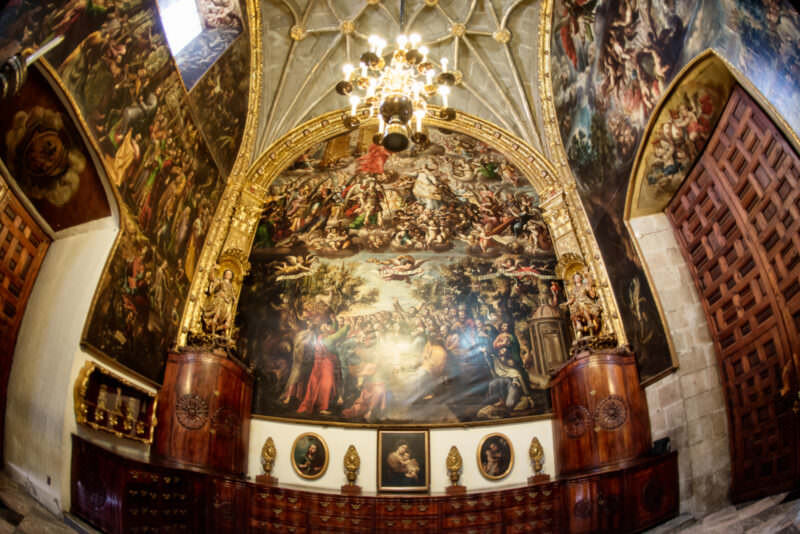
Step into the sacristy, on the northeast corner (when it’s open), and you’re greeted by yet another explosion of color and detail. Renaissance and Gothic art stretch from floor to the arched dome ceiling with a variety of religious scenes depicted.
Photos of Mexico City’s Metropolitan Cathedral
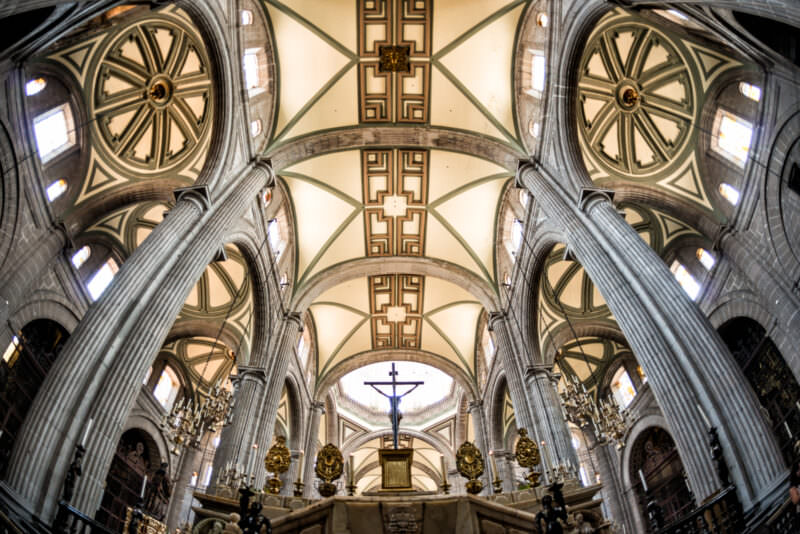
MEXICO CITY, Mexico — A fisheye view sweeps across the nave of the Catedral Metropolitana, capturing a gilded Baroque pulpit, the choir’s pipe organ, and the cathedral’s massive fluted cantera columns supporting ribbed vaults. The building’s 240-year construction campaign, from 1573 to 1813, forced successive architects to adapt the original five-aisle Latin-cross plan to the chronically unstable clays of the former Lake Texcoco — some interior columns toward the south stand nearly 33 inches (85 cm) taller than their northern counterparts, the differential settlement made visible in the stone itself. Photo by David Coleman / Have Camera Will TravelLicense this image at:DirectlyAlamy
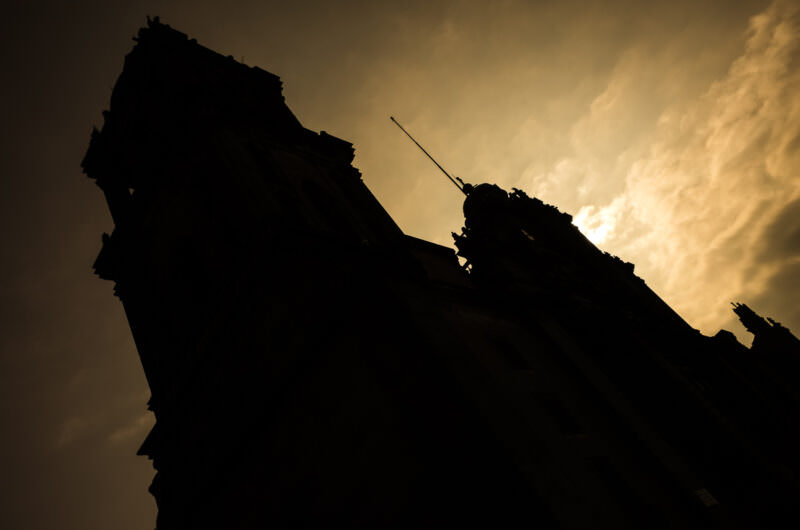
MEXICO CITY, Mexico — The bell tower and roofline of the Catedral Metropolitana cut a dramatic silhouette against a stormy sky above the Zócalo, the dramatic contra-jour light erasing four centuries of architectural detail into a single dark outline. Built over the drained lakebed of Texcoco on water-saturated clay, the cathedral has been sinking since construction began in 1573 — its differential lean was corrected only in a landmark 1993 – 1998 engineering campaign that later informed the rescue of the Leaning Tower of Pisa. Photo by David Coleman / Have Camera Will TravelLicense this image at:DirectlyAlamy
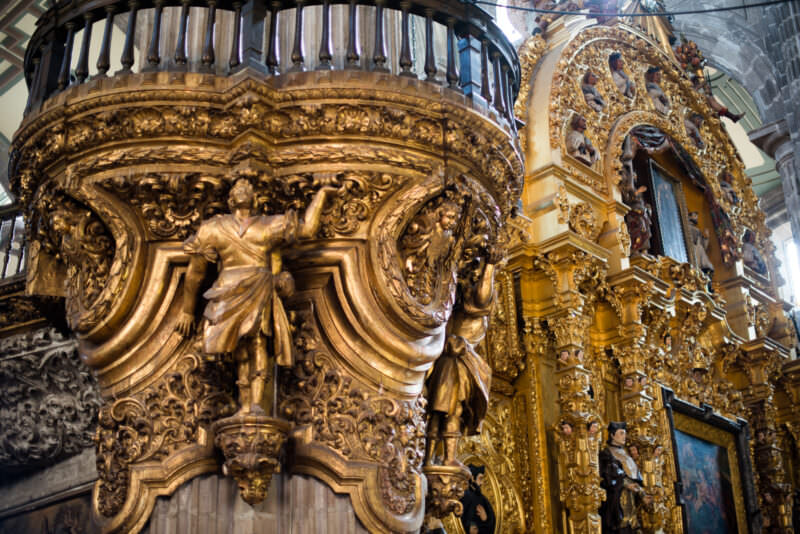
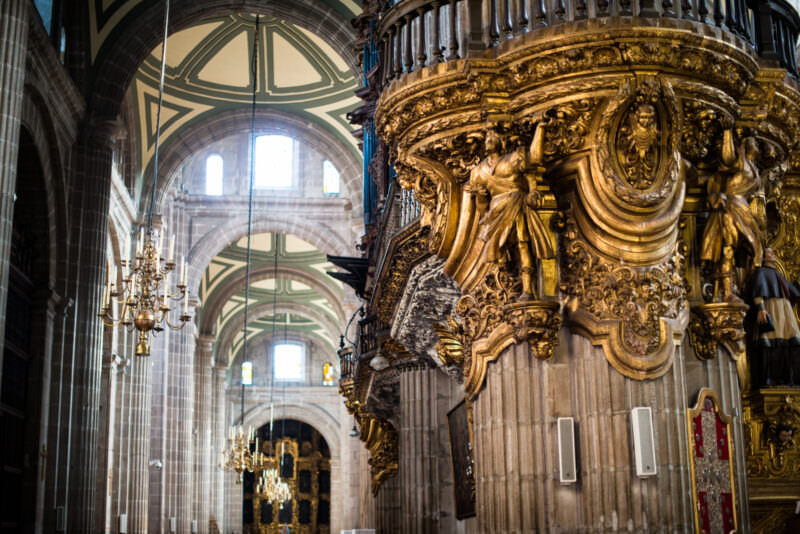
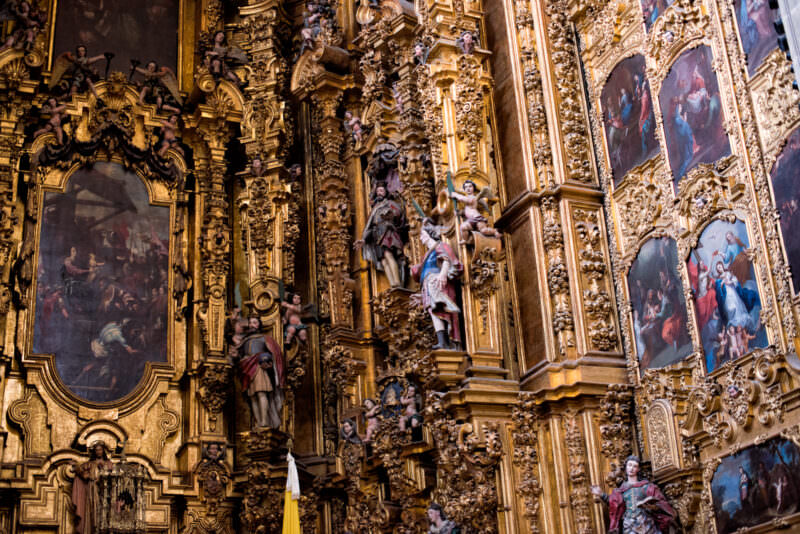
MEXICO CITY, Mexico — Gold-leaf figures surge from the elaborately carved pulpit of the Catedral Metropolitana, with a gilded Baroque retable crowded with painted canvases and polychrome saints visible immediately behind it. The gold-encrusted surfaces are carved from wood — a material chosen over heavier stone throughout the colonial interior because the cathedral sits on the water-saturated clays of the former Lake Texcoco, where every kilogram of dead load adds to the differential settlement that has been slowly tilting the building since the 1570s. Photo by David Coleman / Have Camera Will TravelLicense this image at:DirectlyAlamy
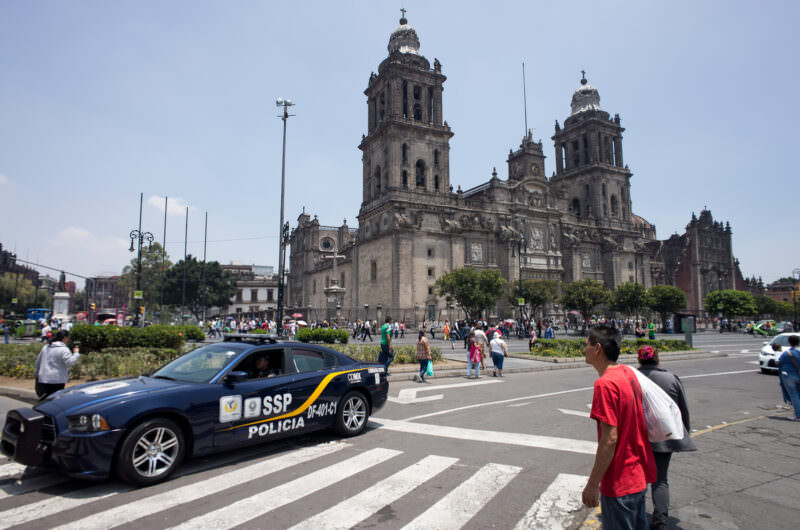
MEXICO CITY, Mexico — An SSP Policia patrol car crosses the Zócalo as pedestrians pass before the full west-facing profile of the Catedral Metropolitana, the largest cathedral in the Americas, its twin bell towers and Neoclassical dome rising above the central plaza of the UNESCO-designated historic centre. The cathedral’s foundations rest on the former lakebed clays of Lake Texcoco — so compressible that engineers between 1993 and 1998 deliberately removed about 4,220 cubic yards (3,230 m³) of clay to correct more than 35 inches (90 cm) of differential lean, a technique later applied to stabilize the Leaning Tower of Pisa. Photo by David Coleman / Have Camera Will TravelLicense this image at:DirectlyAlamy
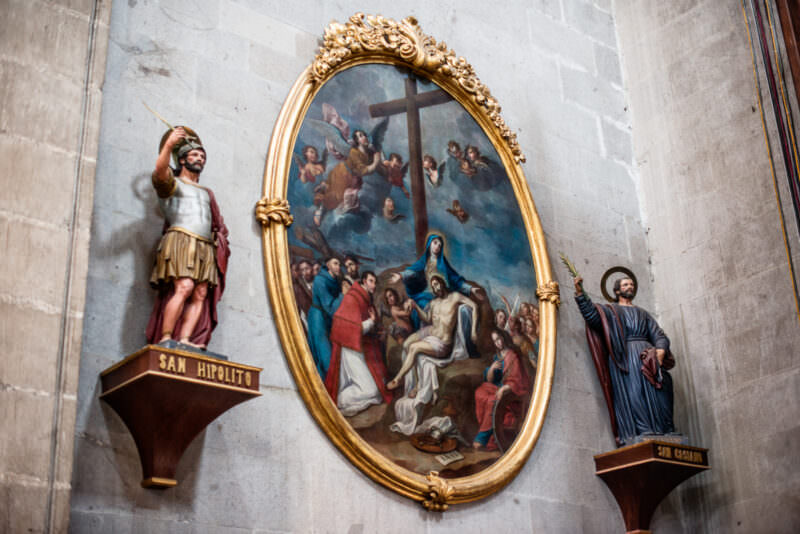
MEXICO CITY, Mexico — A colonial Pietà-scene painting in an ornate oval gilt frame hangs between polychrome statues of San Hipólito and San Casiano mounted on corbels along a chiluca-stone wall of the Catedral Metropolitana. San Hipólito carries particular significance here: the feast day of the Roman martyr Hippolytus, August 13, is the date the Spanish completed the siege of Tenochtitlan in 1521, and Cortés made him the patron saint of the new capital in memory of the conquest. Photo by David Coleman / Have Camera Will TravelLicense this image at:DirectlyAlamy
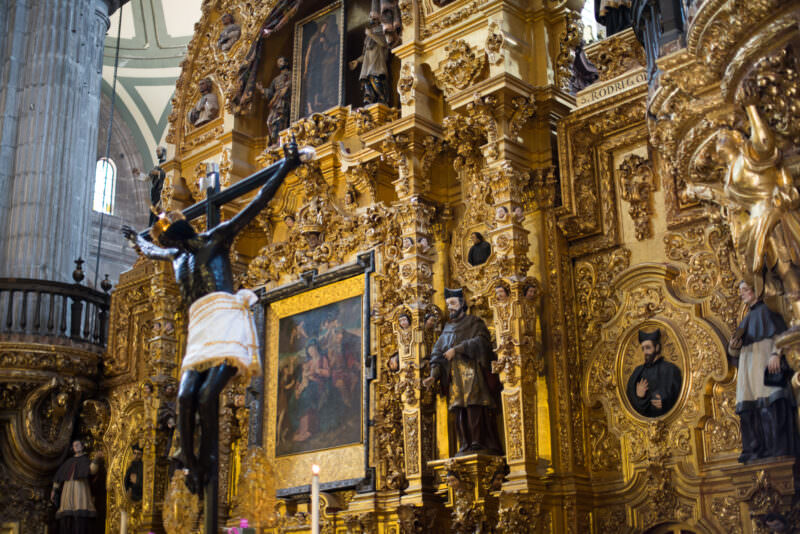
MEXICO CITY, Mexico — The Altar del Perdón (Altar of Forgiveness), designed by Jerónimo de Balbás and completed around 1735, anchors the nave of the Catedral Metropolitana beneath fluted cantera columns and ribbed vaults. Balbás introduced the estípite — an inverted-obelisk pilaster tapering downward — here before deploying it on the celebrated Altar de los Reyes, making this retablo the point of entry for the Mexican Churrigueresque style that would define colonial religious art across New Spain. Photo by David Coleman / Have Camera Will TravelLicense this image at:DirectlyAlamy
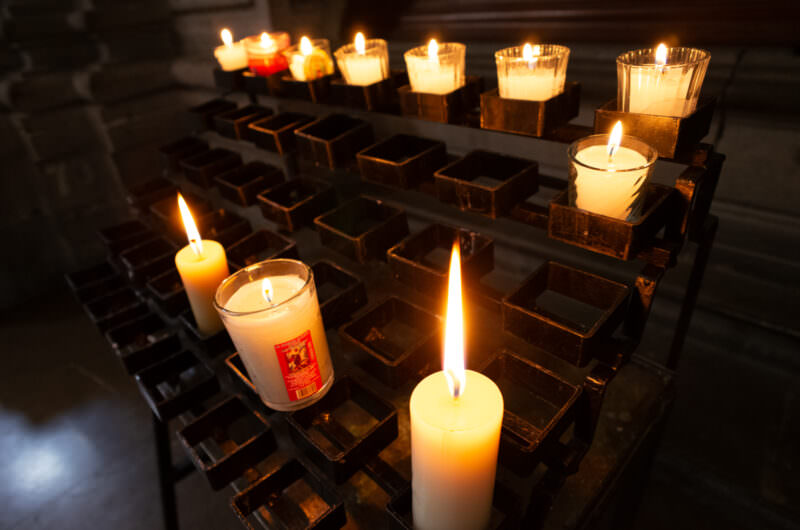
MEXICO CITY, Mexico — Votive candles burn on an iron rack inside the Catedral Metropolitana de la Asunción, the largest cathedral in the Americas. The practice of lighting a vela votiva — a candle left to burn in proxy for the petitioner — is rooted in pre-Christian Roman ritual and was absorbed into Catholic devotional life; in a cathedral built over the ceremonial heart of Aztec Tenochtitlan, the gesture carries layered meaning across two religious traditions. Photo by David Coleman / Have Camera Will TravelLicense this image at:DirectlyAlamy
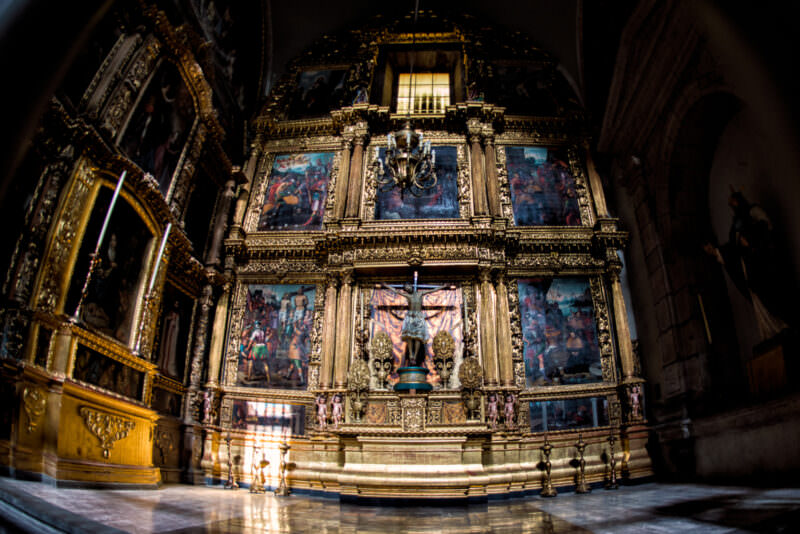
MEXICO CITY, Mexico — The gilded Baroque retablo of the Chapel of the Lord of the Column (Capilla del Señor de la Columna) fills the south aisle of the Catedral Metropolitana, its central crucifix flanked by large oil paintings of Passion scenes attributed to late-17th- to early-18th-century Mexican workshops. Each of the cathedral’s fourteen lateral chapels was historically maintained by a guild or confraternity, making them collective records of colonial patronage as much as devotional spaces. Photo by David Coleman / Have Camera Will TravelLicense this image at:DirectlyAlamy
MEXICO CITY, Mexico — The sacristy of the Catedral Metropolitana de la Asunción displays its Gothic stellar vault ceiling above floor-to-ceiling colonial oil paintings in gilded frames, with carved walnut vestment cabinets lining the walls below. The stellar vaulting overhead — far older in character than the cathedral’s Baroque and Neoclassical exterior — reflects the earliest phase of the building’s interior, when sixteenth-century builders still worked in the late-medieval Spanish tradition before Baroque taste overtook New Spain. Photo by David Coleman / Have Camera Will TravelLicense this image at:DirectlyAlamy
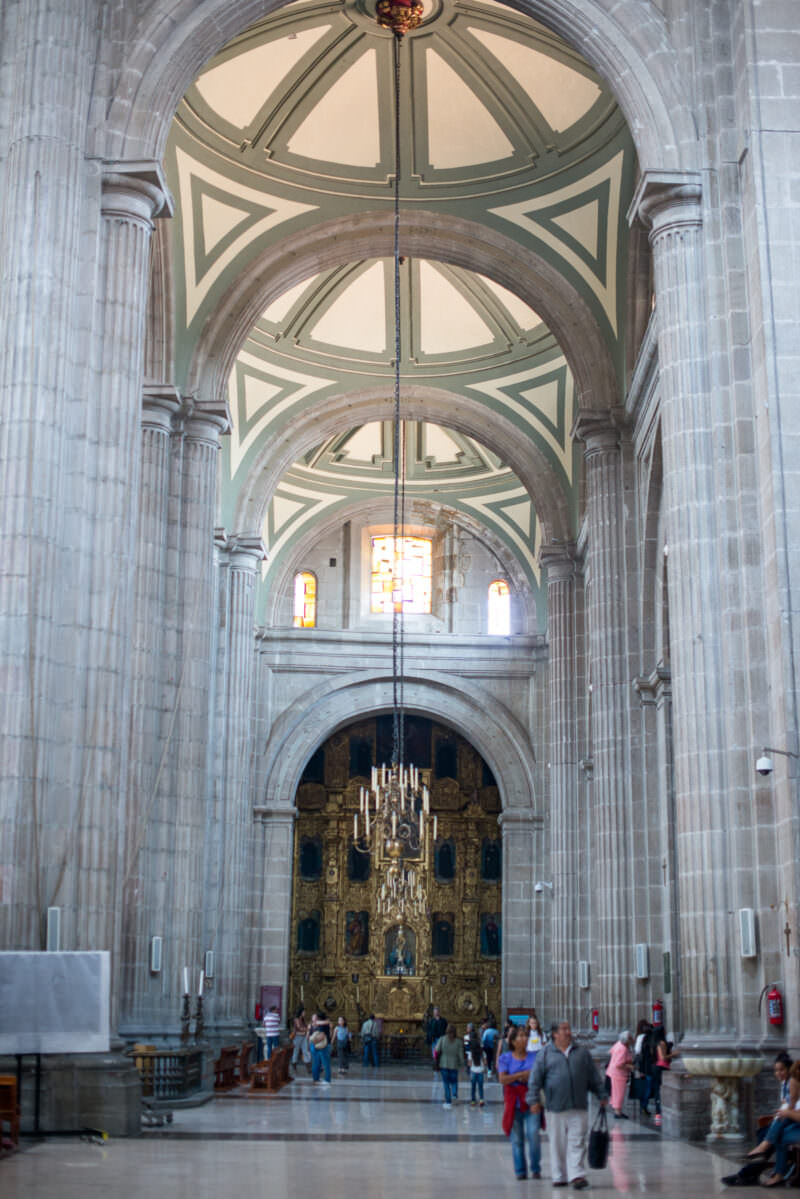
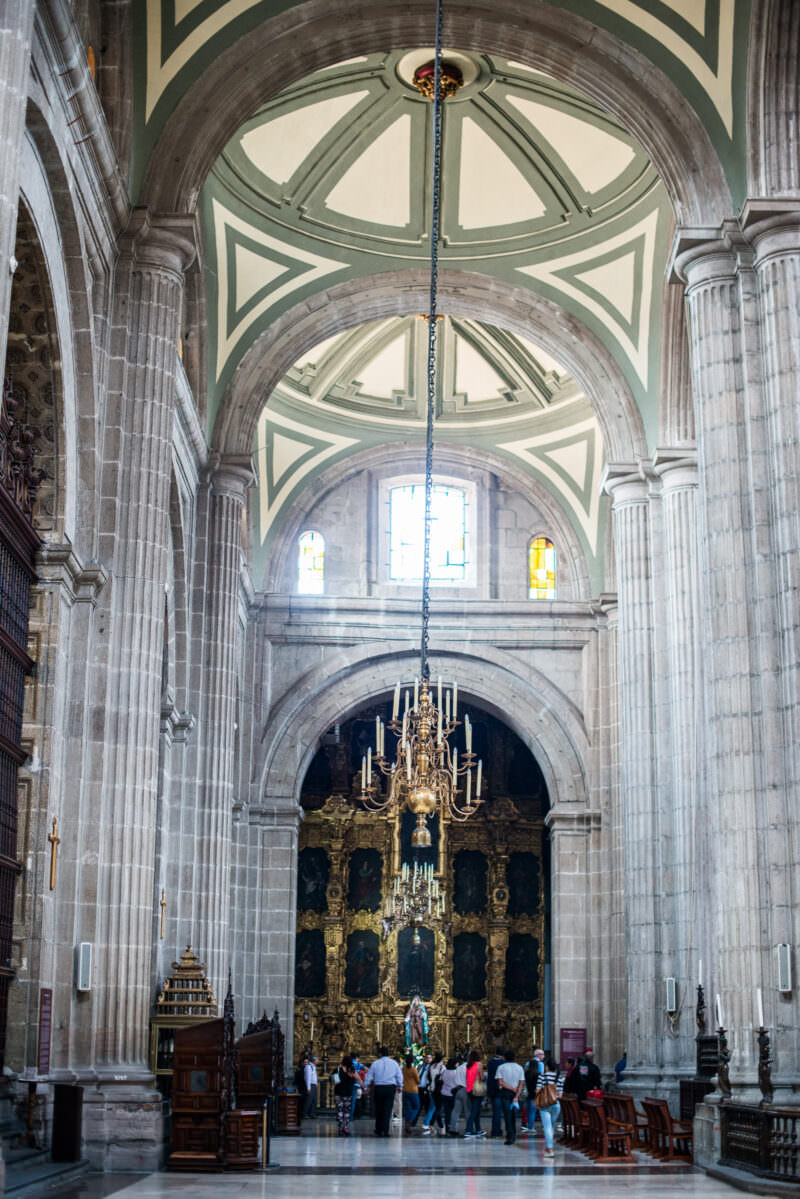
MEXICO CITY, Mexico — The five-aisle nave of the Metropolitan Cathedral — the largest cathedral in the Americas — stretches toward the Altar de los Reyes, Jerónimo de Balbás’s gilded apse retablo completed in 1737, with white flowers decorating the choir rail in the foreground. The fluted cantera columns lining the nave lean perceptibly out of plumb: centuries of differential settlement on the soft clays of the former Lake Texcoco forced masons to add up to 90 cm (35 in) of extra material to some columns to keep the vaults level — the evidence is still visible in the unequal courses of stone. Photo by David Coleman / Have Camera Will TravelLicense this image at:DirectlyAlamy
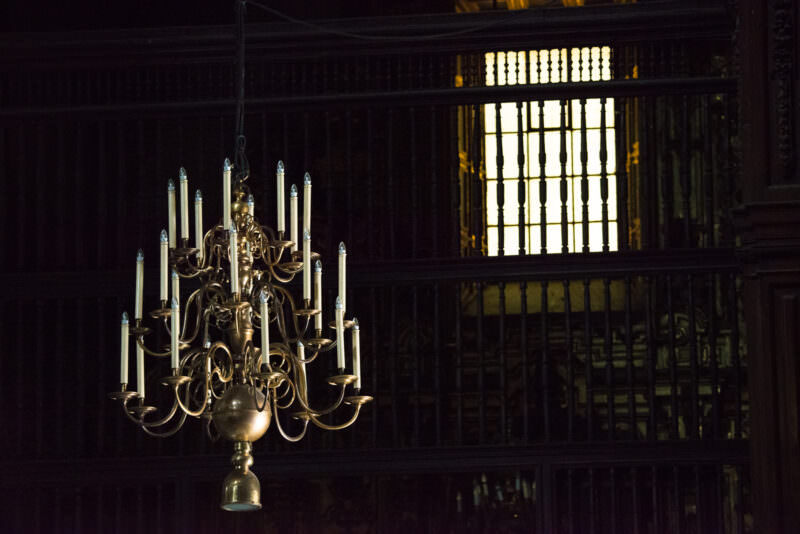
MEXICO CITY, Mexico — A multi-tiered brass candelabrum hangs before the dark carved woodwork of the Metropolitan Cathedral’s choir enclosure, with the iron grilles of an upper gallery visible behind. The choir’s celebrated bronze-alloy reja — cast in Macao in 1722 and shipped via Manila to Acapulco in roughly 125 crates before installation in 1730 — is a direct artifact of the Manila – Acapulco galleon trade that furnished the Americas’ largest cathedral across two oceans. Photo by David Coleman / Have Camera Will TravelLicense this image at:DirectlyAlamy
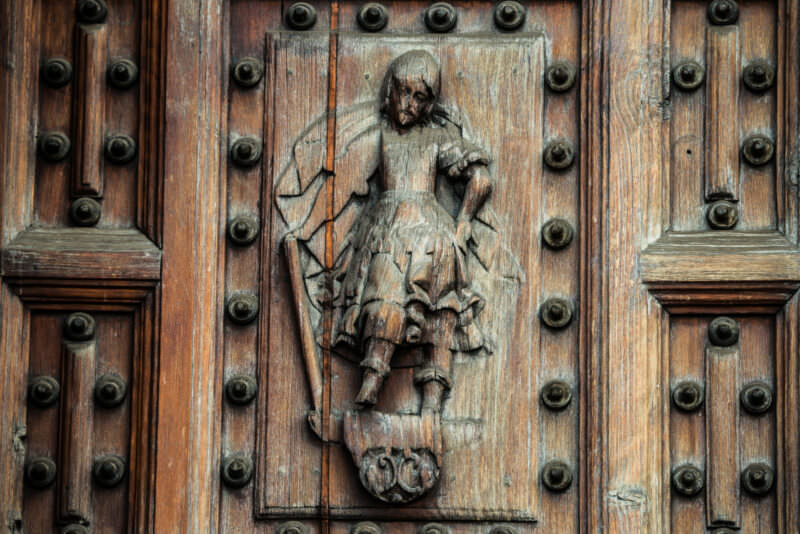
MEXICO CITY, Mexico — A weathered wood-relief panel on a door of the Catedral Metropolitana depicts a winged figure — likely an angel or archangel — carved in a colonial idiom that blends European iconography with the exuberant surface decoration characteristic of New Spain. The cathedral’s woodwork belongs to a tradition in which skilled local craftsmen, working under Spanish ecclesiastical direction, produced furnishings for the Americas’ largest and most prestigious Catholic seat. Photo by David Coleman / Have Camera Will TravelLicense this image at:DirectlyAlamy
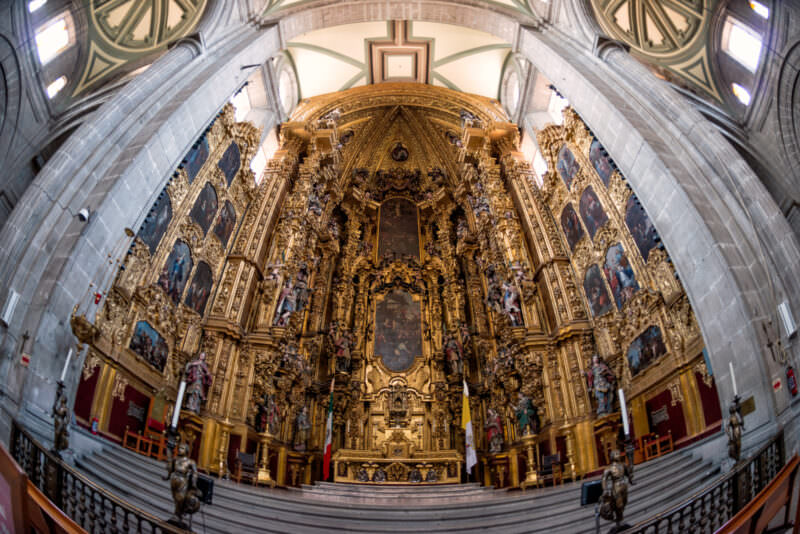
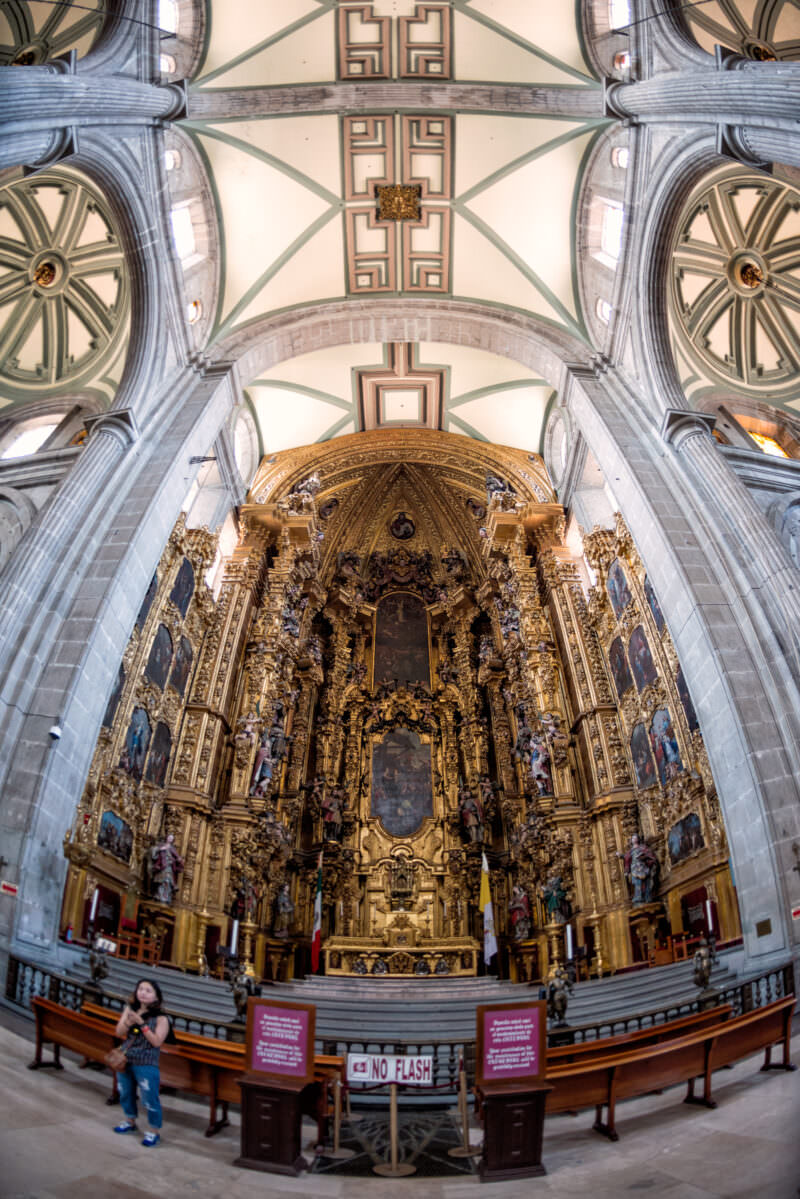
MEXICO CITY, Mexico — The Altar de los Reyes fills the apse of the Catedral Metropolitana in a fisheye view that captures the full 25-meter (82-foot) height of Jerónimo de Balbás’s gilded retablo against the cathedral’s ribbed vaults. Balbás built the structure in white cedar covered in gold leaf between 1718 and 1725, and master gilder Francisco Martínez completed the gilding by 1737 — the year the altar was inaugurated, and the year the estípite pilaster it introduced had already begun reshaping retablo design across New Spain. Photo by David Coleman / Have Camera Will TravelLicense this image at:DirectlyAlamy
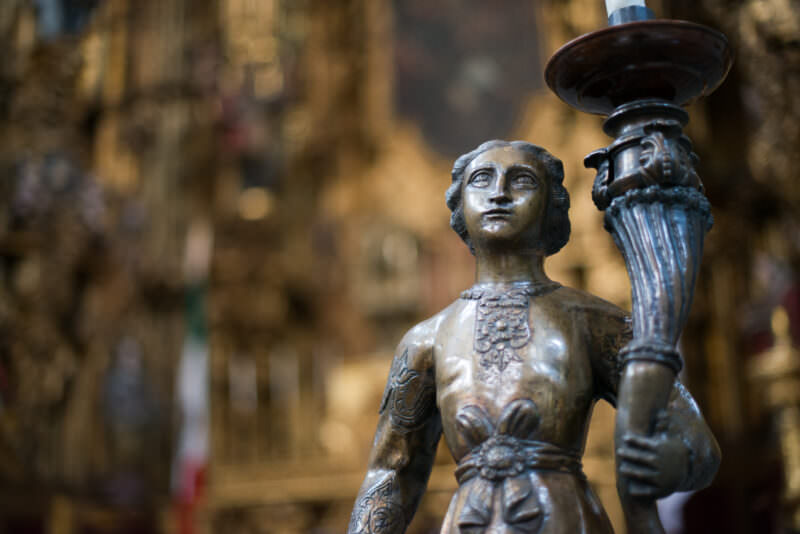
MEXICO CITY, Mexico — A bronze figural candle holder in the Catedral Metropolitana de la Asunción stands before the gilded blaze of a Baroque retable, its ornate embossed drapery and torch-bearing pose characteristic of New Spain’s colonial metalwork tradition. The gilt background visible behind it is the Altar de los Reyes, carved by Jerónimo de Balbás beginning in 1718 — the retable that introduced the inverted estípite pilaster to Mexico and launched the Mexican Churrigueresque style. Photo by David Coleman / Have Camera Will TravelLicense this image at:DirectlyAlamy
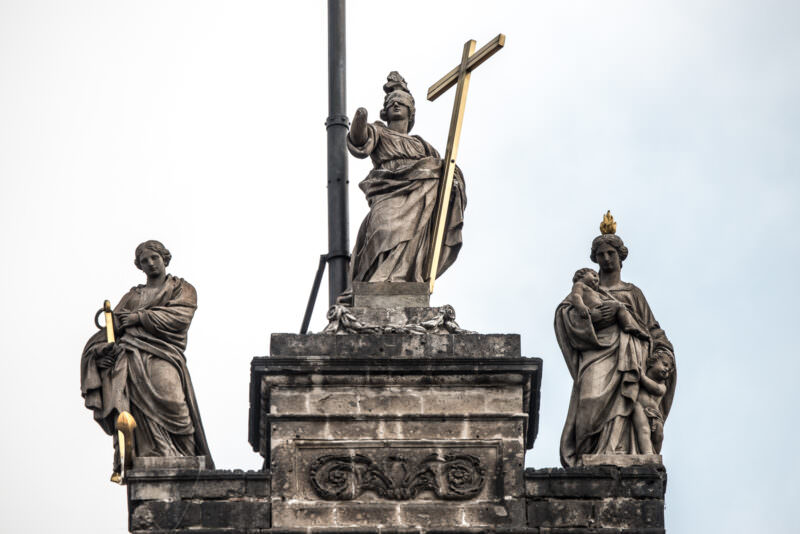
MEXICO CITY, Mexico — Three Neoclassical stone figures sculpted by Manuel Tolsá crown the clock section of the Catedral Metropolitana’s main facade: Faith (center, blindfolded, bearing a cross), Hope (left, holding an anchor), and Charity (right, with a child). Tolsá, a Valencian sculptor who also redesigned the cathedral’s dome and unified the facade between 1792 and 1813, placed the three theological virtues precisely where they would be legible from the Zócalo below — the final layer of meaning added to a building 240 years in the making. Photo by David Coleman / Have Camera Will TravelLicense this image at:DirectlyAlamy
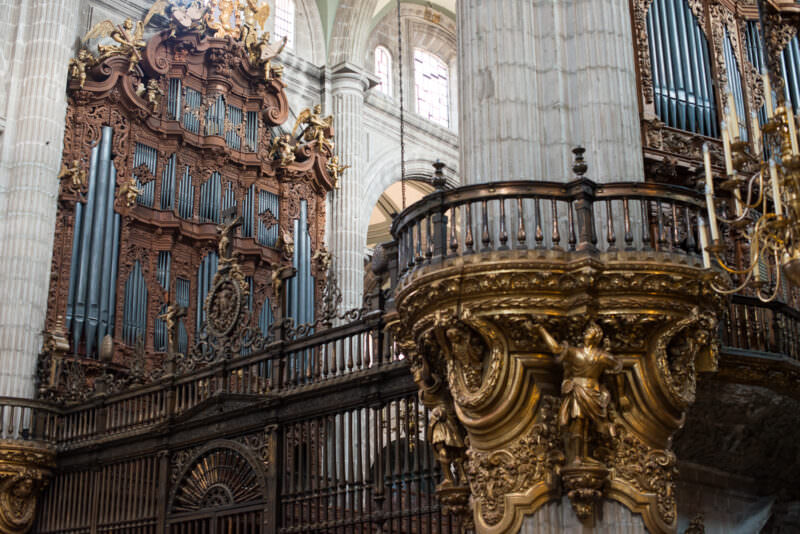
MEXICO CITY, Mexico — Both of the Metropolitan Cathedral’s monumental Baroque pipe organs are visible simultaneously from the choir level, flanking the gilded pulpit in the foreground. The two instruments — the Órgano del Evangelio and the Órgano de la Epístola — are among the largest historic organs in the Americas; both were badly damaged in the 1967 fire and subsequently restored, their elaborately carved wooden cases bearing gilded angel figures characteristic of New Spain’s Baroque workshops. Photo by David Coleman / Have Camera Will TravelLicense this image at:DirectlyAlamy
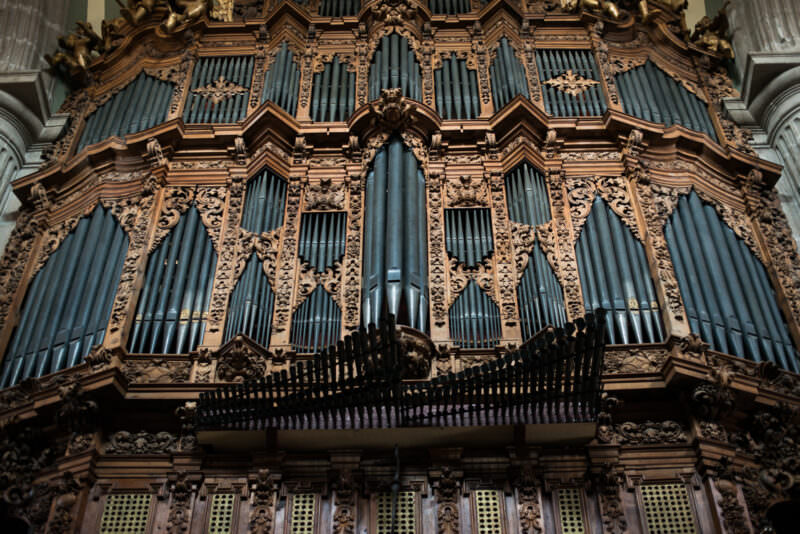
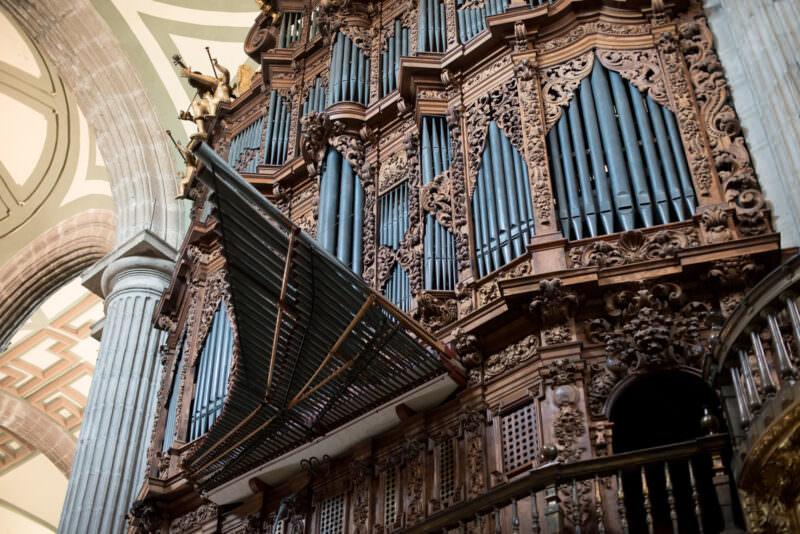
MEXICO CITY, Mexico — The elaborately carved wooden case of one of the Catedral Metropolitana’s twin eighteenth-century pipe organs fills the frame, its ranks of pewter-grey metal pipes nested within cascading Baroque acanthus scrollwork and cherub figures. The two organs — Organo del Evangelio and Organo de la Epistola — flank the choir and rank among the largest surviving colonial-era instruments in the Americas; both were severely damaged by a cathedral fire in 1967 and subsequently restored. Photo by David Coleman / Have Camera Will TravelLicense this image at:DirectlyAlamy
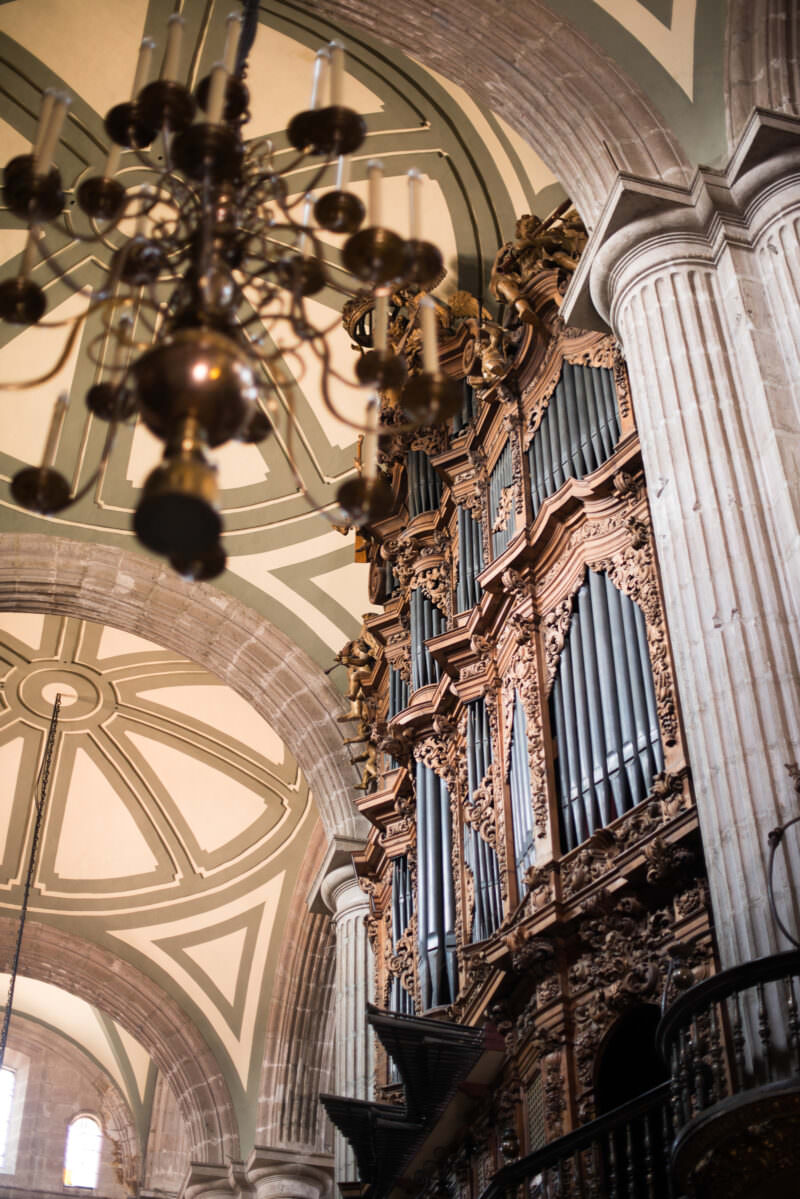
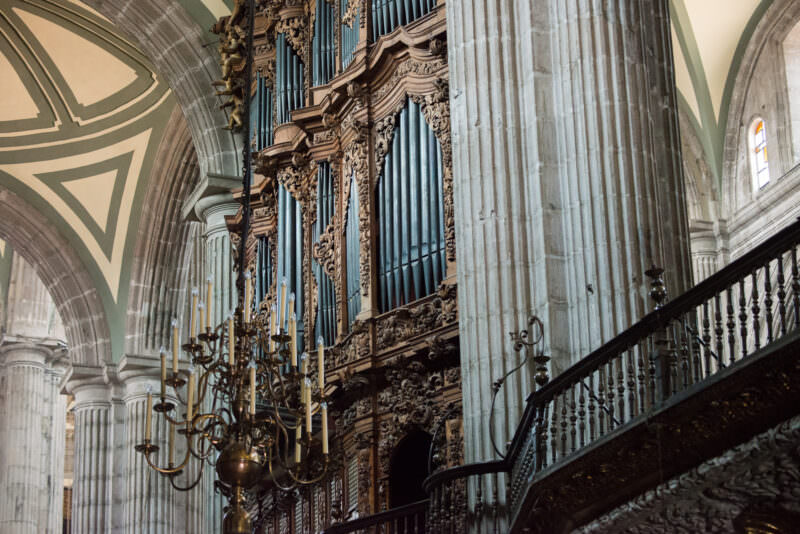
MEXICO CITY, Mexico — One of two monumental eighteenth-century pipe organs flanking the choir of the Metropolitan Cathedral, seen from below against the cathedral’s ribbed vaulting and a cantera column. Both organs were gravely damaged in a 1967 fire and underwent restoration; they rank among the largest surviving colonial-era instruments in the Americas, their carved wooden cases crowded with gilt angel figures in the Baroque fashion of New Spain. Photo by David Coleman / Have Camera Will TravelLicense this image at:DirectlyAlamy
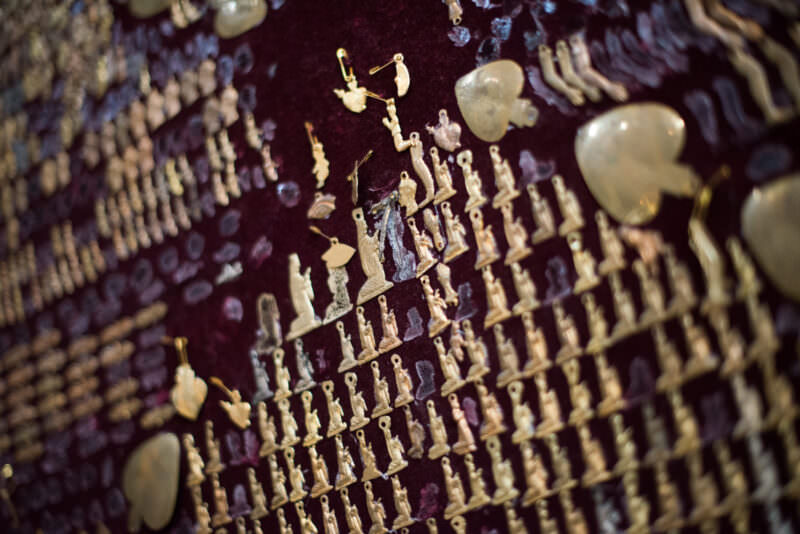
MEXICO CITY, Mexico — Hundreds of small metal milagros (votive offerings) pressed into deep-red velvet cover a sacred image in the Metropolitan Cathedral, each charm shaped as a figure of the Virgin or a body part representing a petition or answered prayer. The practice — rooted in both Spanish Catholic and pre-Hispanic votive traditions — makes communal devotion physically legible: the density of accumulated charms maps the weight of collective hope left at a single sacred image over time. Photo by David Coleman / Have Camera Will TravelLicense this image at:DirectlyAlamy
MEXICO CITY, Mexico — The Altar del Perdón (Altar of Forgiveness) in the Metropolitan Cathedral displays the Cristo del Veneno — the darkened Christ figure in the foreground — against Jerónimo de Balbás’s gilded Churrigueresque retablo. Balbás introduced the estípite pilaster, an inverted-obelisk column form, to New Spain here before deploying it again in the celebrated Altar de los Reyes; the 1967 fire that severely damaged both works triggered a decade-long restoration using gold-leaf reapplication and structural consolidation. Photo by David Coleman / Have Camera Will TravelLicense this image at:DirectlyAlamy
MEXICO CITY, Mexico — One of the two monumental 18th-century pipe organs flanking the choir of the Catedral Metropolitana fills its carved walnut case above the nave, its ranks of metal pipes rising behind dense Churrigueresque ornament and a gilded angel figurehead. Both organs were gravely damaged in a 1967 fire and subsequently restored; they are among the largest surviving colonial-era pipe organs in the Americas. Photo by David Coleman / Have Camera Will TravelLicense this image at:DirectlyAlamy
MEXICO CITY, Mexico — The central nave of the Catedral Metropolitana stretches toward the gilded Altar de los Reyes in the apse, its great fluted cantera columns and barrel vault framing a long axial view above visitors on the floor below. The pendant chain visible at center is the cathedral’s subsidence-monitoring pendulum — a permanent instrument that tracked the building’s lean across decades until the 1993 – 1998 underexcavation campaign corrected more than 90 cm (35 in) of differential settlement caused by the compressible clays of former Lake Texcoco beneath the foundations. Photo by David Coleman / Have Camera Will TravelLicense this image at:DirectlyAlamy
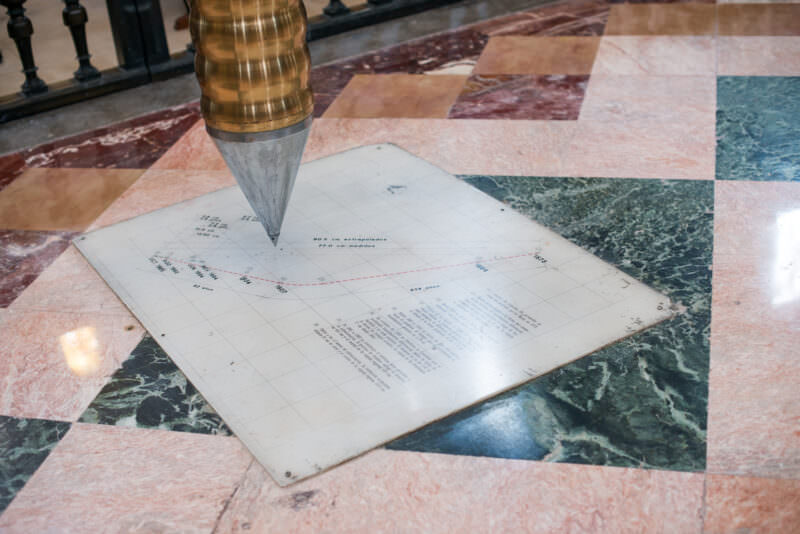
MEXICO CITY, Mexico — The brass tip of the Catedral Metropolitana’s subsidence pendulum hovers over a floor-mounted tracking chart, its printed Spanish text legible: “90.5 cm extrapolados / 77.0 cm medidos,” recording the differential settlement measured and projected across the cathedral’s nave. Engineers corrected more than 90 cm (35 in) of that lean between 1993 and 1998 by extracting roughly 4,220 cubic meters of clay from beneath the high side of the building — an underexcavation technique the Leaning Tower of Pisa committee subsequently adopted to stabilize that structure. Photo by David Coleman / Have Camera Will TravelLicense this image at:DirectlyAlamy
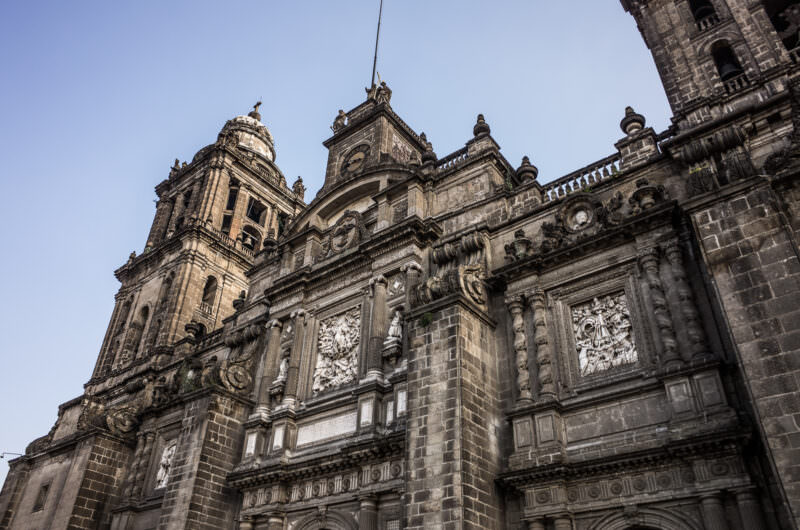
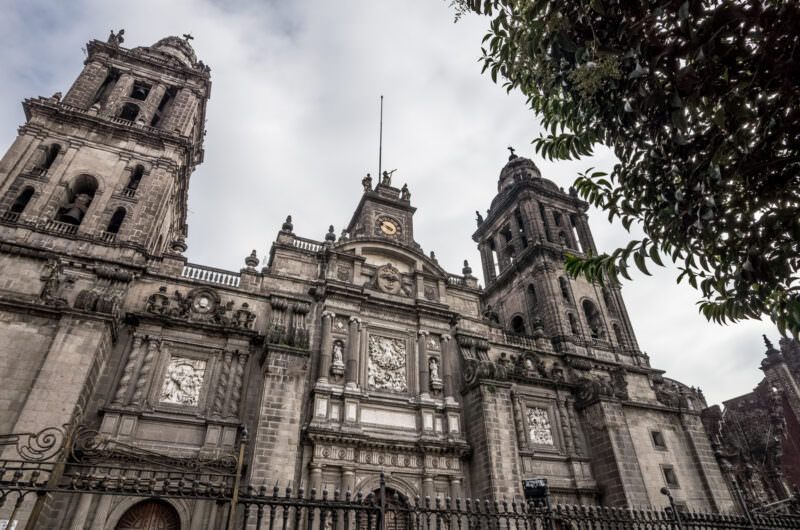
MEXICO CITY, Mexico — The south façade of the Catedral Metropolitana soars upward from street level, its layered surface reading as a compressed history of viceregal taste: restrained Renaissance stonework at the base gives way to deeply carved Baroque relief panels and, crowning the central bay, the Neoclassical clock added by Manuel Tolsá. The white high-relief panels contrast with the dark grey andesite and red tezontle volcanic stone that forms the cathedral’s structural core — a deliberate choice to save weight on the notoriously soft lakebed clay beneath the Zócalo. Photo by David Coleman / Have Camera Will TravelLicense this image at:DirectlyAlamy
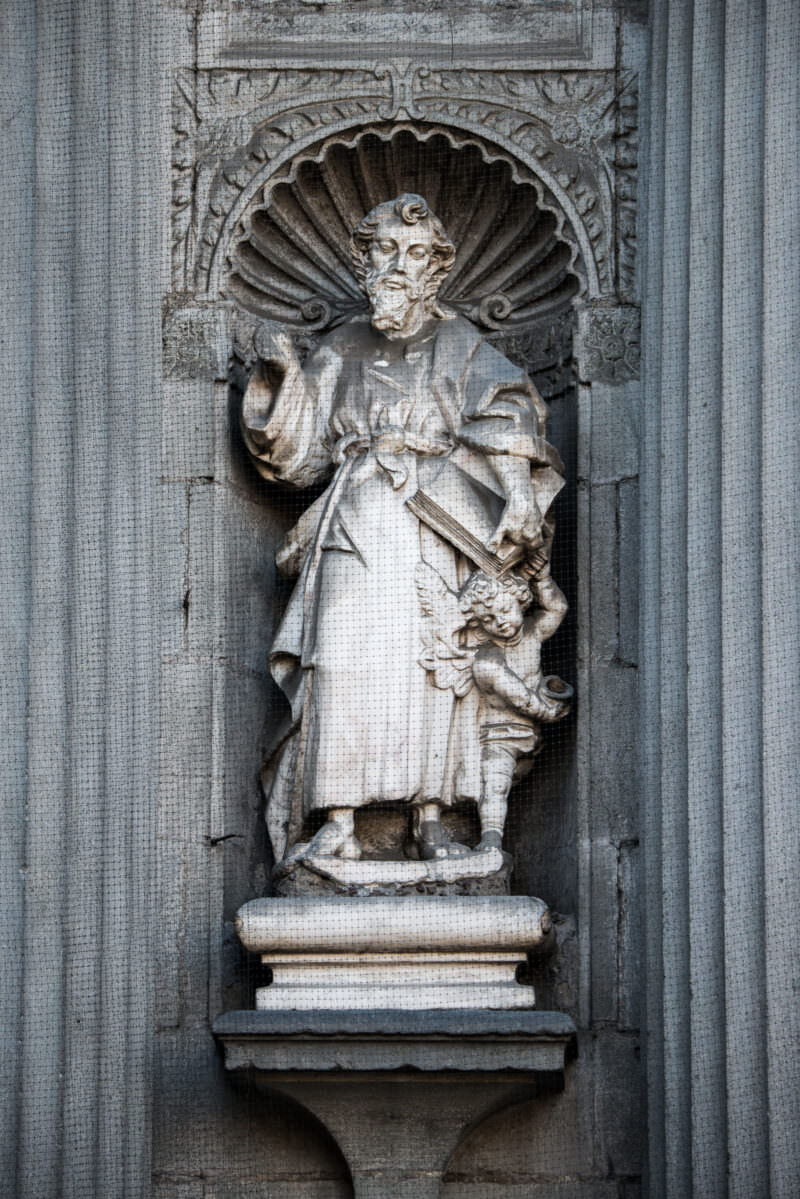
MEXICO CITY, Mexico — A chiluca stone apostle figure occupies a shell-canopied niche on the south façade of the Catedral Metropolitana, the largest cathedral in the Americas. The fine-grained white chiluca, quarried in the hills north of Mexico City, was reserved throughout the cathedral’s 240-year construction for facing, sculpture, and decorative detail — giving the façade its characteristic contrast of pale ornament against the darker volcanic mass beneath. Photo by David Coleman / Have Camera Will TravelLicense this image at:DirectlyAlamy
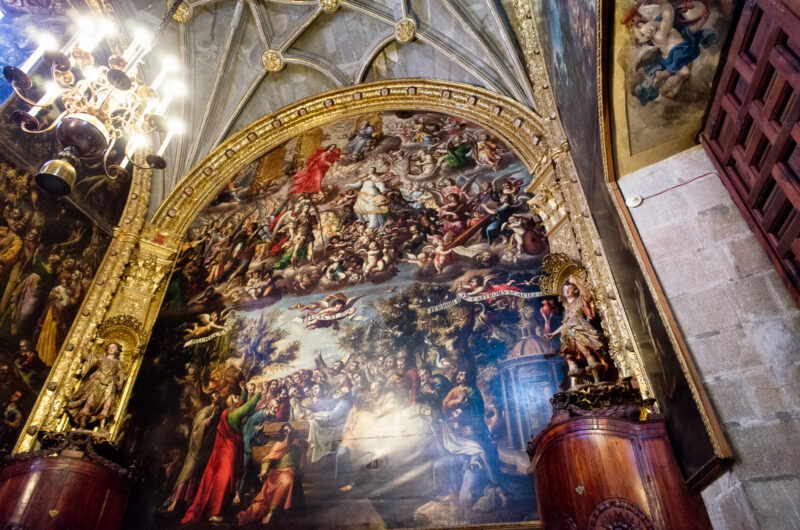
MEXICO CITY, Mexico — A monumental Baroque painting fills the arched end wall of the Catedral Metropolitana’s sacristy, its upper register depicting a celestial scene with the Virgin surrounded by angels and its lower register a crowded earthly gathering, both framed by a gilded retable arch beneath a Gothic ribbed vault. The sacristy’s ribbed ceiling — a late Gothic survival embedded in a building completed under Neoclassical direction — reflects the 240-year construction campaign that left medieval structural forms standing alongside Baroque decoration, all within the seat of the Archdiocese of Mexico. Photo by David Coleman / Have Camera Will TravelLicense this image at:DirectlyAlamy
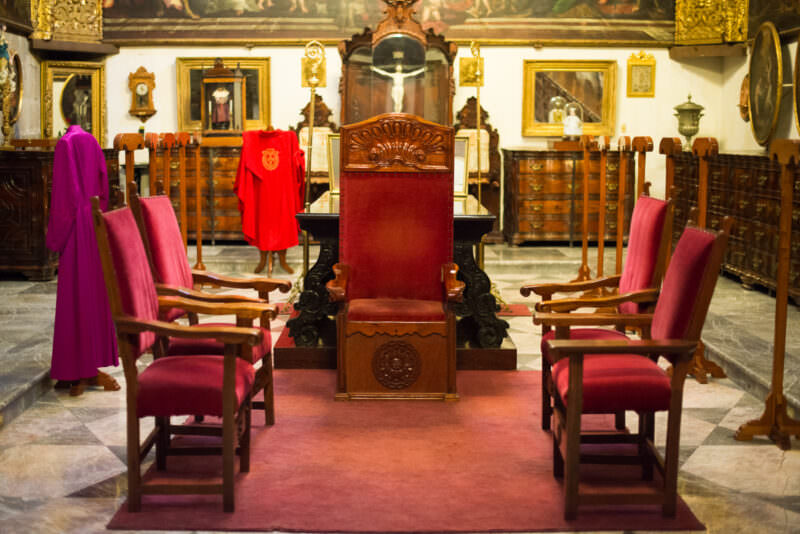
MEXICO CITY, Mexico — The sacristy of the Catedral Metropolitana displays a carved wooden archbishop’s throne flanked by crimson upholstered chairs, with rows of Baroque vestment-storage cabinets lining the walls and liturgical vestments — scarlet and violet — hung on standing racks. The color of each vestment is liturgically prescribed: scarlet for feasts of martyrs and Pentecost, violet for Advent and Lent, marking the rank and season of every ceremony performed in the Americas’ largest cathedral. Photo by David Coleman / Have Camera Will TravelLicense this image at:DirectlyAlamy
MEXICO CITY, Mexico — The apse wall of the Catedral Metropolitana’s sacristy is covered by a monumental colonial oil painting of a crowd scene, framed by a gilded arch beneath a stellar ribbed vault, with flanking Baroque canvases extending across every wall surface. The sacristy’s stellar vault belongs to the earliest phase of the interior construction, predating the cathedral’s Baroque transformation, and its comprehensive cycle of paintings constitutes one of the most intact ensembles of viceregal religious painting surviving in New Spain. Photo by David Coleman / Have Camera Will TravelLicense this image at:DirectlyAlamy
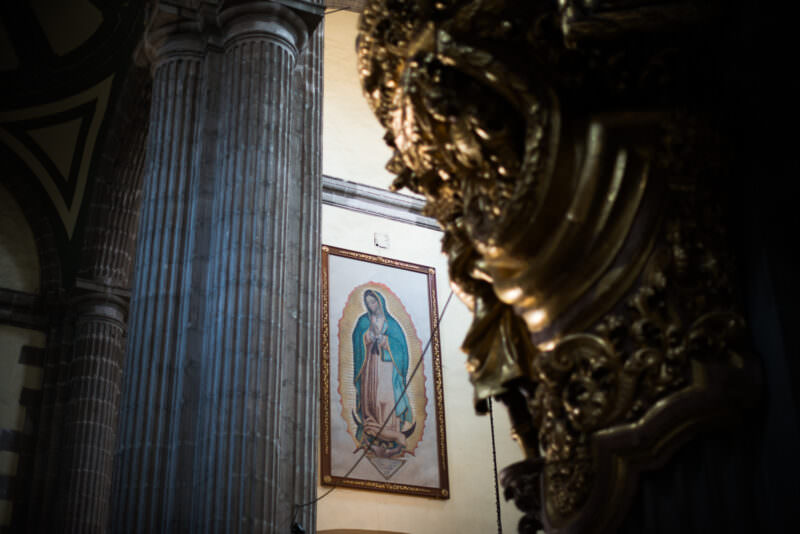
MEXICO CITY, Mexico — A reproduction of the tilma image of Our Lady of Guadalupe hangs in one of the Catedral Metropolitana’s side chapels, framed between a dark cantera column and the gilded Baroque scroll of a lateral retable. The canonical image — showing the Virgin standing on a crescent moon, wrapped in a star-studded mantle — is the central icon of Mexican Catholicism, and the cathedral maintains a dedicated Guadalupe chapel as part of the fourteen lateral chapels that open along its outer aisles. Photo by David Coleman / Have Camera Will TravelLicense this image at:DirectlyAlamy
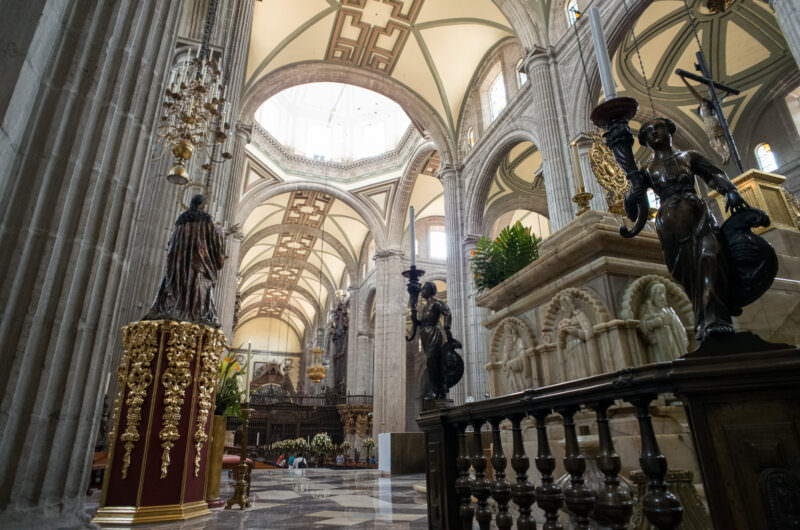
MEXICO CITY, Mexico — Bronze figural candle holders and a carved marble altar furnishing occupy the foreground of the Catedral Metropolitana’s transept crossing, with Manuel Tolsá’s octagonal dome flooding the nave beyond with natural light. Tolsá replaced the original low, ill-proportioned cupola with the taller drum and lantern visible here after taking over the project around 1792, imposing a Neoclassical unity that finally completed the 240-year building campaign in 1813. Photo by David Coleman / Have Camera Will TravelLicense this image at:DirectlyAlamy
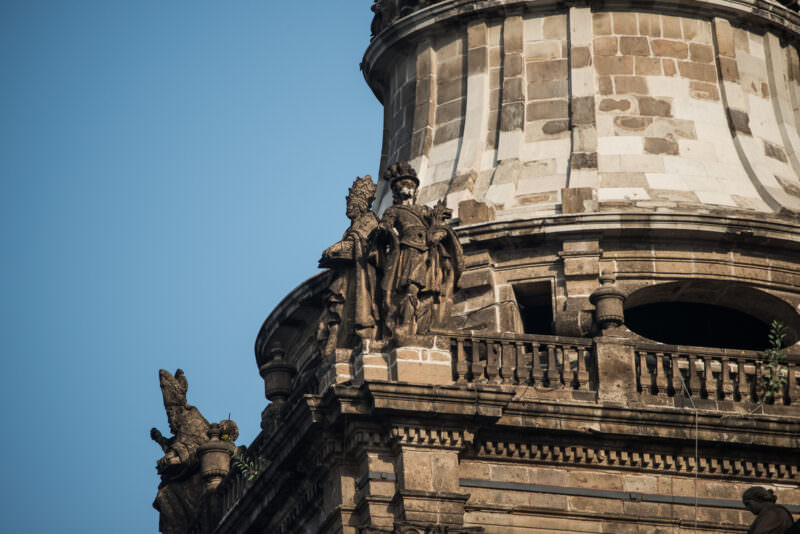
MEXICO CITY, Mexico — Stone saints flank the drum of a bell tower at the Catedral Metropolitana, their figures carved in chiluca, the fine-grained white volcanic stone quarried in the hills north of the city. The towers were raised between 1787 and 1791 under architect José Damián Ortiz de Castro, who designed their distinctive bell-shaped crowns specifically to resist earthquake loading — a practical concession to the seismic reality of the Valley of Mexico. Photo by David Coleman / Have Camera Will TravelLicense this image at:DirectlyAlamy
MEXICO CITY, Mexico — A gilded Baroque pulpit dominates the foreground of the Catedral Metropolitana’s nave, its carved figures and foliage in gold leaf contrasting with the long barrel-vaulted nave receding behind it. The cathedral’s interior columns are themselves out of plumb — some rising as much as 85 centimeters (33 inches) taller than their northern counterparts — direct evidence of the differential settlement in the compressible lakeclays of former Lake Texcoco that engineers fought to correct from 1993 to 1998. Photo by David Coleman / Have Camera Will TravelLicense this image at:DirectlyAlamy
MEXICO CITY, Mexico — The Altar de los Reyes occupies the full apse of the Catedral Metropolitana in a wide fisheye view, with the cathedral’s ribbed and coffered vaults soaring overhead and a single visitor visible at the barrier below. The retablo’s white-cedar structure covered in gold leaf was inaugurated in 1737, and its estípite pilasters — the inverted-obelisk form Balbás introduced here — triggered a wholesale shift in New Spain’s retablo workshops that lasted until the Neoclassical reforms displaced Baroque ornament at the century’s end. Photo by David Coleman / Have Camera Will TravelLicense this image at:DirectlyAlamy
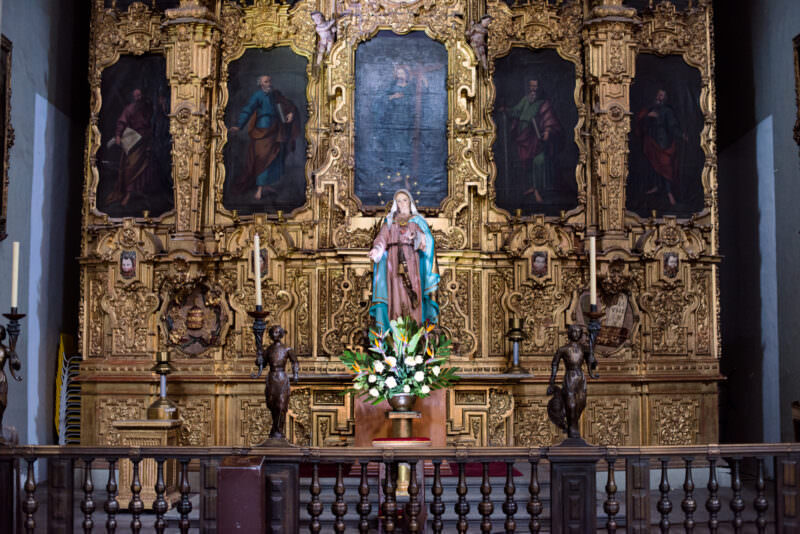
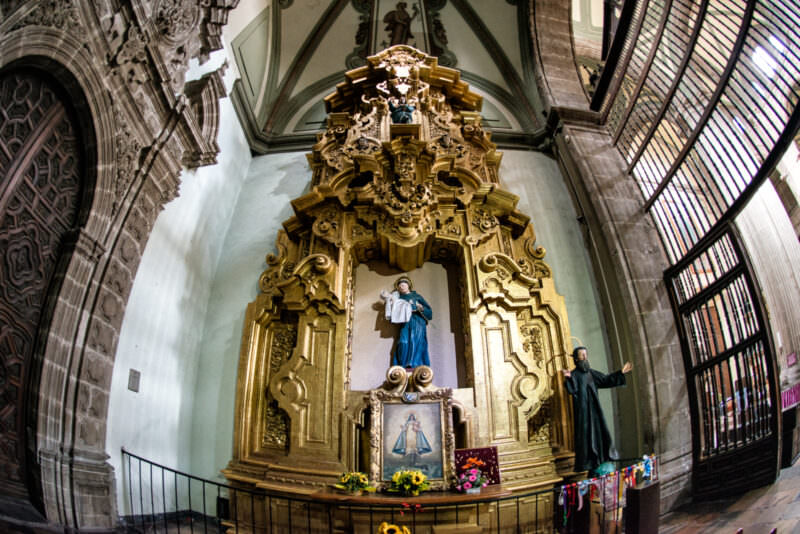
MEXICO CITY, Mexico — The Capilla del Inmaculado Corazón de María displays a polychrome statue of the Virgin set within a gilded Baroque retablo, its carved panels populated with apostle paintings and dense acanthus ornament, inside the Catedral Metropolitana. The retablo’s scrolling estofado decoration and Solomonic detailing are characteristic of the Mexican Baroque that thrived in the cathedral’s lateral chapels throughout the eighteenth century, when each chapel was maintained and furnished by a guild or confraternity. Photo by David Coleman / Have Camera Will TravelLicense this image at:DirectlyAlamy
MEXICO CITY, Mexico — A side aisle of the Catedral Metropolitana stretches toward a gilded Baroque retablo beneath a ribbed vault of pale chiluca stone, with visitors gathered around the altar below. The cathedral’s 40 cantera columns carry 51 vaults across five aisles, a structural system scaled down from an original seven-aisle Sevillian plan specifically because the soft clays of the former Lake Texcoco could not bear the greater load. Photo by David Coleman / Have Camera Will TravelLicense this image at:DirectlyAlamy
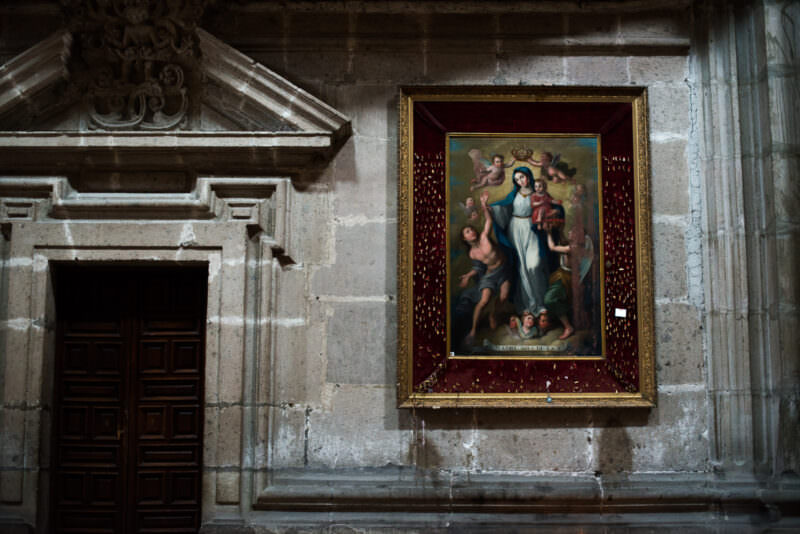
MEXICO CITY, Mexico — A colonial-era devotional painting titled “Madre Ssma de la…” — most likely “Madre Santísima de la Luz” (Most Holy Mother of Light) — hangs against the chiluca limestone interior wall of the Catedral Metropolitana, alongside a chapel doorway framed in a classical broken pediment. The cathedral’s white chiluca facing stone, quarried in the hills north of the city, was used throughout for decorative detail while cheaper volcanic tezontle filled the structural core. Photo by David Coleman / Have Camera Will TravelLicense this image at:DirectlyAlamy
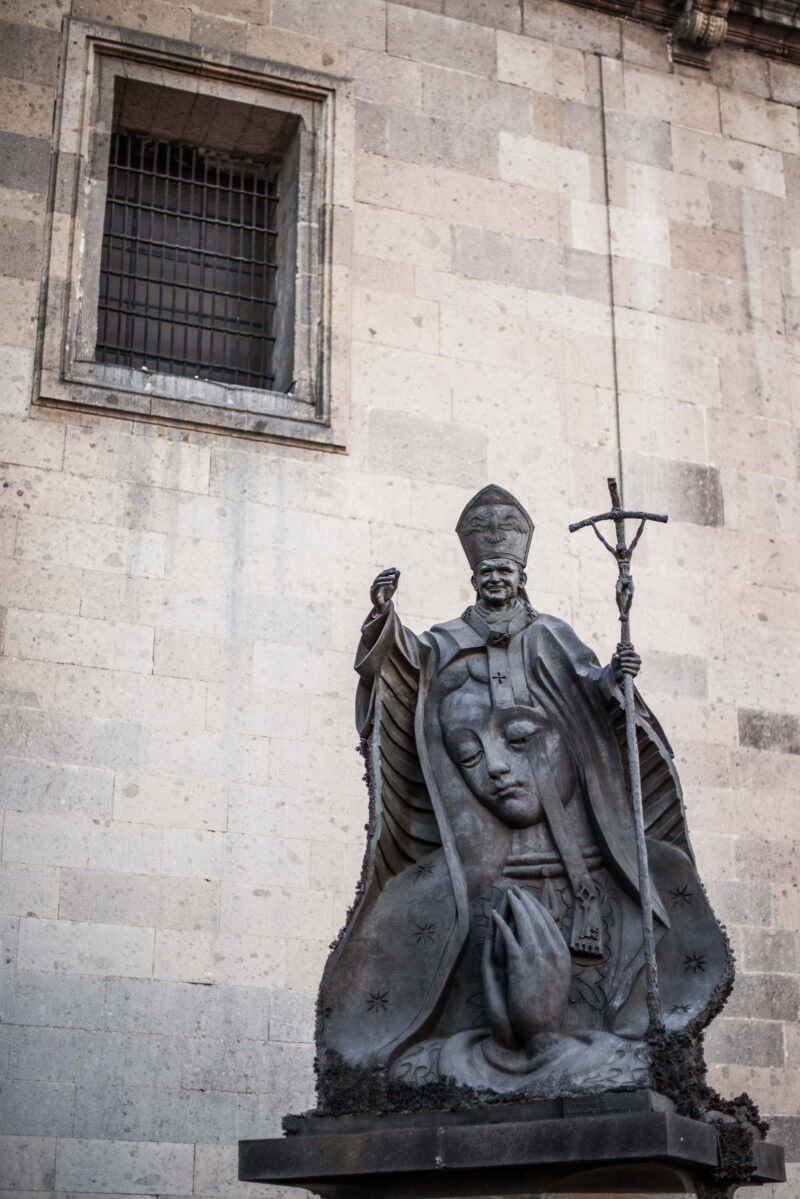
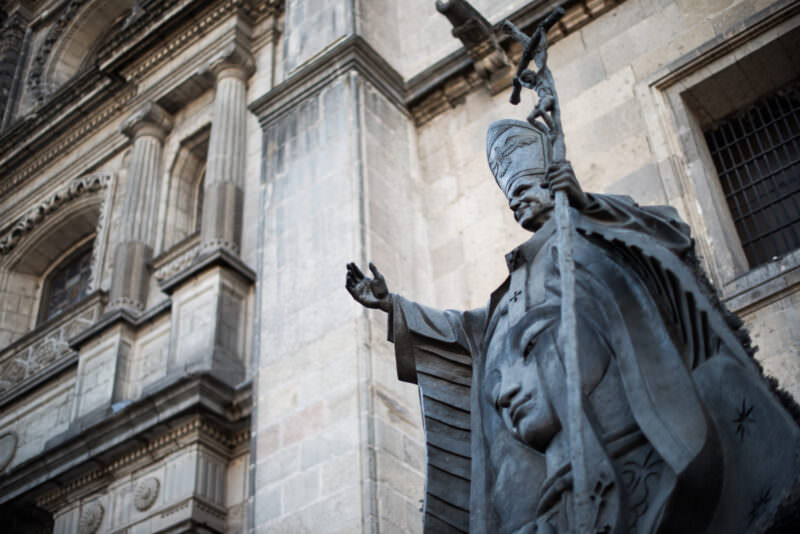
MEXICO CITY, Mexico — The bronze sculpture Llaves de Fe (Keys of Faith) by Mexican sculptor Francisco Cárdenas Martínez stands against the chiluca-stone flank of the Catedral Metropolitana, depicting Pope John Paul II above a relief of the Virgin of Guadalupe. Cast from keys donated by more than 7 million Mexican citizens and unveiled in 2007, the 3.1-meter (10.2-foot) statue commemorates the 30th anniversary of the pope’s first visit to Mexico in 1979 — the first of five papal visits that made Mexico the country he visited most. Photo by David Coleman / Have Camera Will TravelLicense this image at:DirectlyAlamy
MEXICO CITY, Mexico — One of the Catedral Metropolitana’s two monumental eighteenth-century pipe organs rises beside a fluted cantera column, its richly carved wooden case set against the cathedral’s ribbed nave vaults. The two instruments — the Organo del Evangelio (Gospel organ) and the Organo de la Epistola (Epistle organ) — are among the largest historic pipe organs in the Americas and were both gravely damaged in a 1967 fire, requiring major restoration before they could be returned to use. Photo by David Coleman / Have Camera Will TravelLicense this image at:DirectlyAlamy
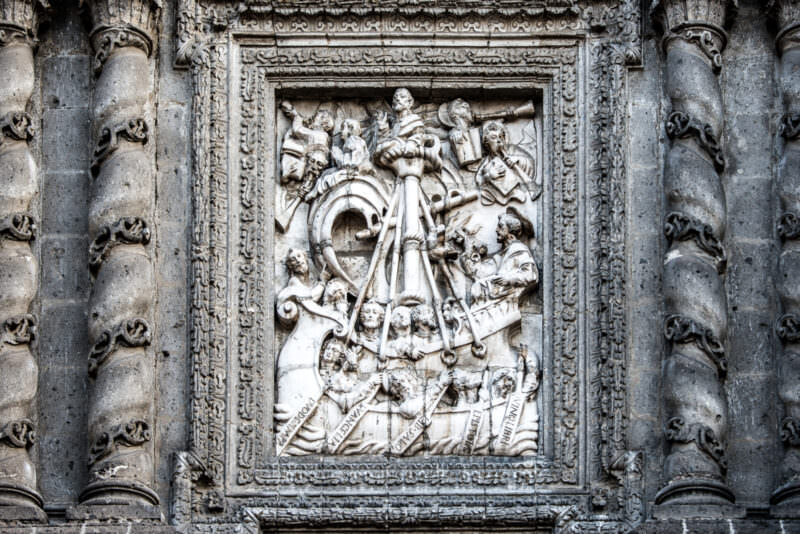
MEXICO CITY, Mexico — A chiluca stone relief panel on the south façade of El Sagrario Metropolitano displays a densely populated Eucharistic allegory, with scrolls inscribed “DUODECIMA,” “EVANGELITA,” “EPISTOLA,” and “VINE LIBRI” flanking a central bishop-like figure surrounded by saints and angels. Architect Lorenzo Rodríguez designed the façade (1749 – 1768) so that every sculptural element — apostles, church fathers, prophets, and archangels — declared the glory of the Blessed Sacrament the building was built to house, making the exterior function as a theological argument in carved stone. Photo by David Coleman / Have Camera Will TravelLicense this image at:DirectlyAlamy
MEXICO CITY, Mexico — A fisheye view up the central nave of the Catedral Metropolitana de la Asunción reveals the barrel vault and flanking conoidal vaults carried on forty massive fluted cantera columns, the Americas’ largest cathedral interior recorded in a single frame. Because the building’s foundation of wooden stakes driven into Lake Texcoco clay settled unevenly over centuries, some columns toward the south stand nearly 33 inches (85 cm) taller than their northern counterparts — differential settlement frozen in stone and still legible from below. Photo by David Coleman / Have Camera Will TravelLicense this image at:DirectlyAlamy
MEXICO CITY, Mexico — Gold-leafed estípite pilasters and polychrome sculptures crowd the lateral face of the Altar de los Reyes inside the Catedral Metropolitana, a detail revealing the inverted-obelisk form that Jerónimo de Balbás introduced to New Spain when he began this retablo in 1718. That motif — the estípite, tapering downward rather than upward — became the defining ornament of the Mexican Churrigueresque, spreading from this altar to every major retablo workshop in the viceroyalty. Photo by David Coleman / Have Camera Will TravelLicense this image at:DirectlyAlamy
MEXICO CITY, Mexico — The south facade of the Catedral Metropolitana rises above the Zócalo, its stratified stonework reading from Renaissance severity at the base through Baroque relief panels and portal sculpture to Manuel Tolsá’s Neoclassical balustrade and clock at the roofline — a visible record of the 240-year campaign that built it. The bell towers, completed by José Damián Ortiz de Castro between 1787 and 1791 and crowned with their distinctive bell-shaped remates, were engineered to resist earthquakes while carrying the load of eight sculpted figures of church doctors on each. Photo by David Coleman / Have Camera Will TravelLicense this image at:DirectlyAlamy
MEXICO CITY, Mexico — A late Baroque gilded retablo set into a side chapel of the Catedral Metropolitana holds a polychrome figure of a blue-robed Virgin, flanked by a dark-habited friar with arms outstretched and offerings of fresh sunflowers at the altar rail. The cathedral’s fourteen lateral chapels were each historically maintained by a guild or confraternity, furnishing the building with a layered survey of colonial Mexican devotional sculpture spanning the full 240-year construction period. Photo by David Coleman / Have Camera Will TravelLicense this image at:DirectlyAlamy
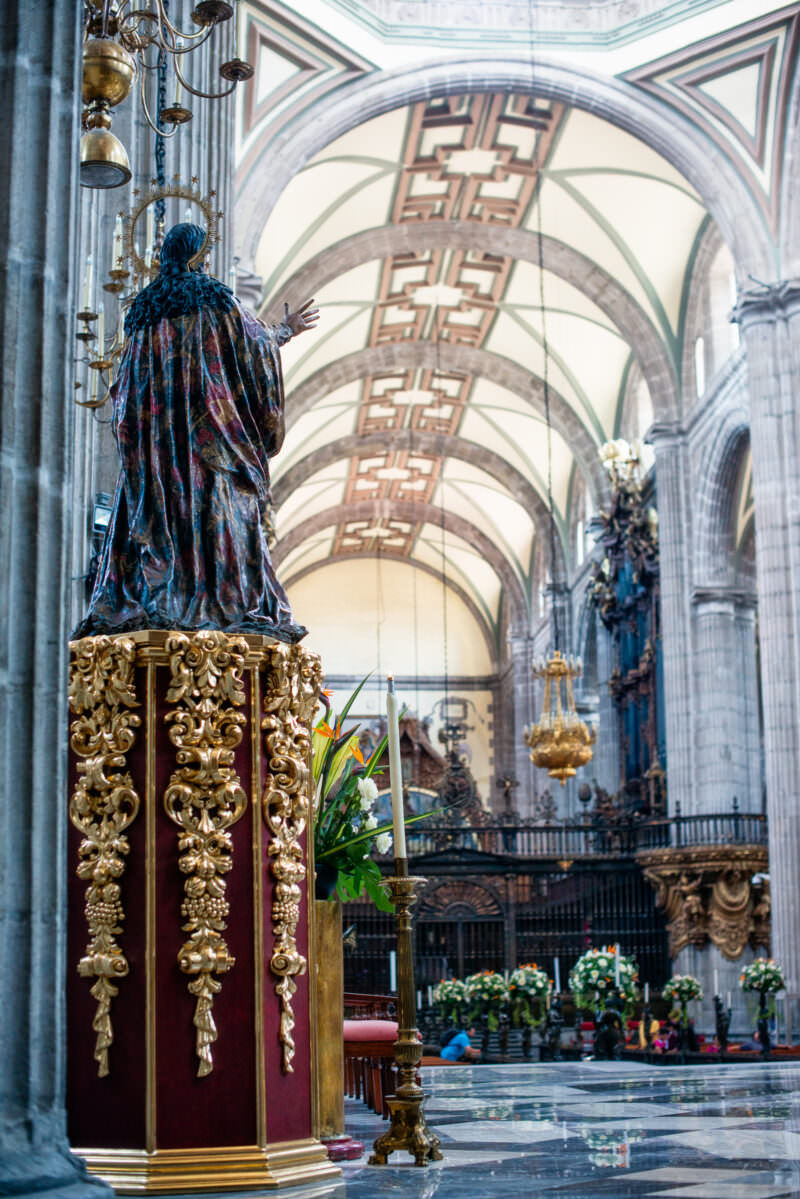
MEXICO CITY, Mexico — A dark-robed colonial figure on a gilded Baroque pedestal faces the length of the Catedral Metropolitana’s central nave, the choir screen’s bronze reja visible in the middle distance. That grille — cast in Macao in 1722 from tumbaga and calamina alloys, shipped via Manila to Acapulco in roughly 125 crates, and installed in 1730 — is a direct artifact of the Manila – Acapulco galleon trade embedded in the Americas’ largest cathedral. Photo by David Coleman / Have Camera Will TravelLicense this image at:DirectlyAlamy
MEXICO CITY, Mexico — A low-angle view of Llaves de Fe (Keys of Faith), the bronze sculpture of Pope John Paul II by Francisco Cárdenas Martínez, set against the Baroque upper stonework of the Catedral Metropolitana. The figure raising his hand in blessing stands over the face of the Virgin of Guadalupe — a deliberate pairing that references John Paul II’s canonization of Juan Diego in 2002 and the deep Marian identity of Mexican Catholicism. Photo by David Coleman / Have Camera Will TravelLicense this image at:DirectlyAlamy
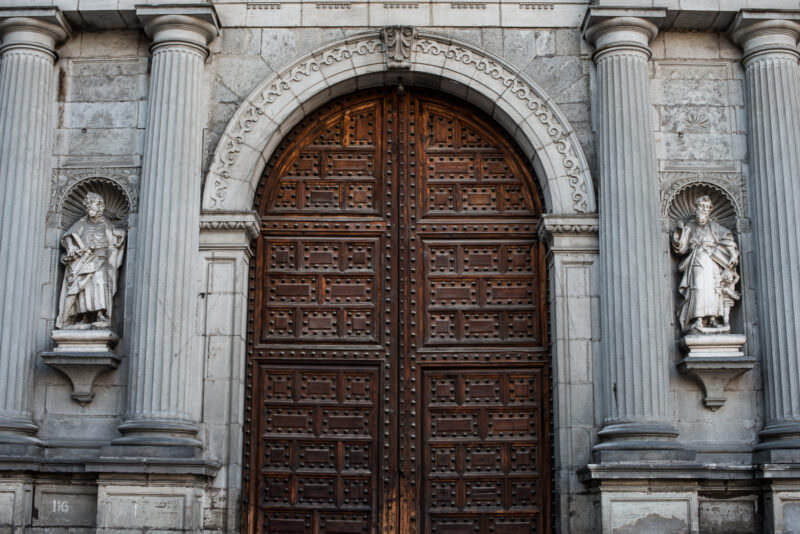
MEXICO CITY, Mexico — A studded wooden portal flanked by two chiluca-stone apostle figures marks one of the lateral entrances of the Catedral Metropolitana, the largest cathedral in the Americas. The cathedral’s 240-year construction from 1573 to 1813 layered Renaissance, Baroque, and Neoclassical work onto a single façade — producing the mix of restrained classical columns and exuberant shell-niche sculpture visible here in a single doorway. Photo by David Coleman / Have Camera Will TravelLicense this image at:DirectlyAlamy
MEXICO CITY, Mexico — One of the Catedral Metropolitana’s twin bell towers rises to its distinctive bell-shaped crown, designed by José Damián Ortiz de Castro and completed in 1791, with stone saints at its corners and a sphere-and-cross finial above. The towers hold about 35 bells; the oldest, Santa María de la Asunción, was cast in 1578 and weighs roughly 7 tons (6,350 kg), while the largest, Santa María de Guadalupe, cast in 1791, tips the scales at about 13 tons (11,800 kg). Photo by David Coleman / Have Camera Will TravelLicense this image at:DirectlyAlamy
MEXICO CITY, Mexico — A congregation fills the nave of the Catedral Metropolitana during Mass, facing the gilded Altar del Perdón — a Churrigueresque retable designed by Jerónimo de Balbás and completed by 1735. The altar’s name recalls its original function: here condemned criminals received final absolution before execution, a practice that ended with the colonial era but left the altar its singular title. Photo by David Coleman / Have Camera Will TravelLicense this image at:DirectlyAlamy
What to know before you go
Plaza de la Constitución S/N, Centro, Cuauhtémoc, 06000 Ciudad de México, CDMX, Mexico
More about the Mexico City Metropolitan Cathedral
The Mexico City Metropolitan Cathedral, also known as the Metropolitan Cathedral of the Assumption of the Most Blessed Virgin Mary into Heaven, is a prominent architectural and religious landmark in Mexico City. Located in the historic center, the cathedral is not only the largest and oldest church in Latin America but also the seat of the Roman Catholic Archdiocese of Mexico.
Constructed between 1573 and 1813, the cathedral showcases a blend of architectural styles, such as Baroque, Neo-Classical, and Renaissance, reflecting the various stages of its construction. The facade comprises four sections, each adorned with intricately carved columns, statues, and reliefs. The bell towers house a total of 25 bells, with the Santa Maria de Guadalupe bell, weighing around 13,000 kg, being the largest.
The cathedral’s interior is home to 14 lateral chapels, each dedicated to a different saint and exhibiting unique artistic treasures, including paintings, sculptures, and altarpieces. Among the most noteworthy elements are the gilded Altar of the Kings, the Choir area with its ornately carved wooden seats, and the two 18th-century pipe organs (the Órgano del Evangelio and the Órgano de la Epístola), which are among the largest historic organs in the Americas.
As a result of Mexico City’s unstable subsoil, the cathedral has experienced significant sinking and tilting, which has necessitated ongoing restoration efforts. The preservation work includes measures to reinforce the foundation, adjust the building’s inclination, and restore artworks and structural elements affected by the movement.
Enjoyed this article? Personalize your search results.
I'm a freelance travel photographer based in Washington DC. Seven continents, up mountains, underwater, and a bunch of places in between. My images have appeared in numerous publications, and you can check out some of my gear reviews and tips here. More »