The Musical Instruments Museum (Musee des Instruments de Musique) in Brussels has a lot to see, but it has even more to hear.
This is a museum for the senses. But not the usual ones. Sure, you can look at the exhibits. You can read them if you read French or Dutch — the text isn’t in English. But here what you really want to do here is listen.
And yet it’s surprisingly hushed. As visitors wander through the museum, with its dim, atmospheric lighting that looks a bit like stage lighting, they’re wearing headphones. The portable audio players around their necks are loaded up with examples of the instruments you’re looking at being played. And so you get to hear the musical instruments doing what they best — playing music. This is what guided audio tours were made for.
With over 8,000 instruments from around the world and throughout history, the Musical Instrument Museum presents music in a truly global context. There’s also a very good collection paying tribute to Belgian musical history. Among Belgium’s musical claim to fame is that Brussels was home to Adolphe Sax, inventor of the saxophone.
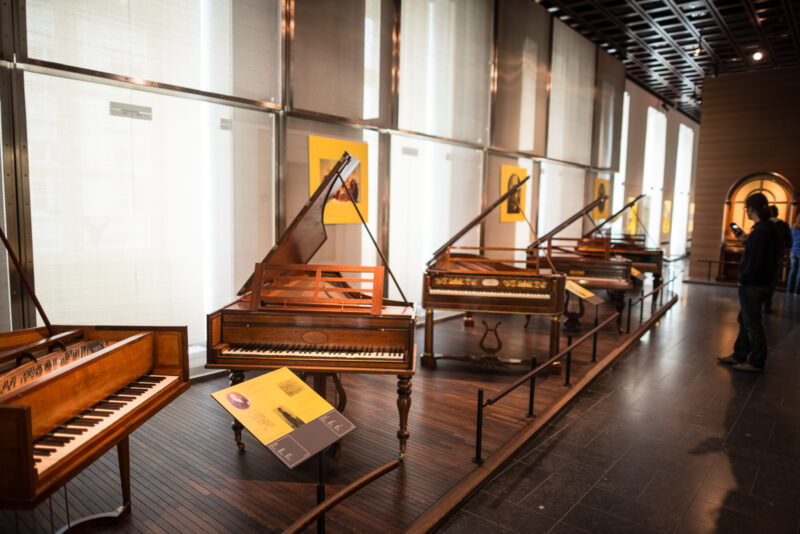
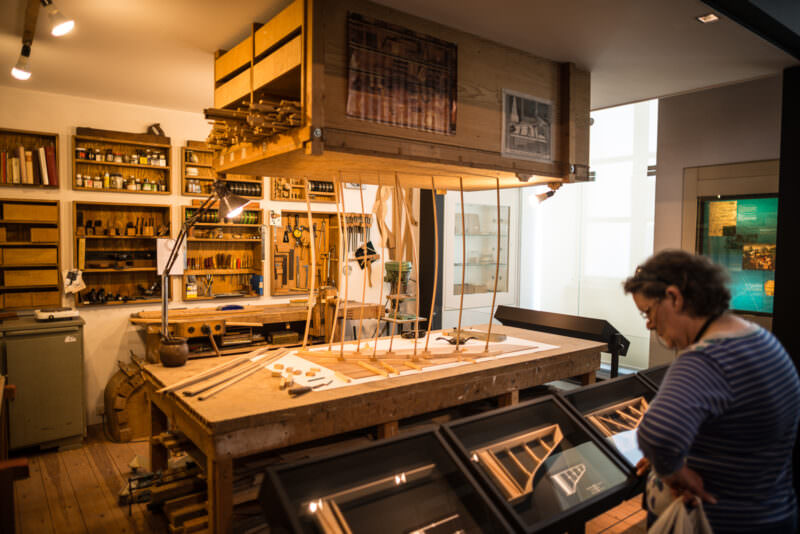
As you work your way up through the museum, you’ll move through themes: mechanical instruments in the basement, traditional instruments on the ground floor, modern orchestral instruments on the first floor, and keyboard and stringed instruments on the second floor. You’ll see the usual suspects: oboes, bassoons, clarinets, and violins. There are pianolas and bass guitars, chimes and sitars. There are all sorts of keyboards that were once played in the great halls of Europe and, with their impossibly ornate inlay, served as decoration in between recitals. There’s even a mockup of a piano building workshop.
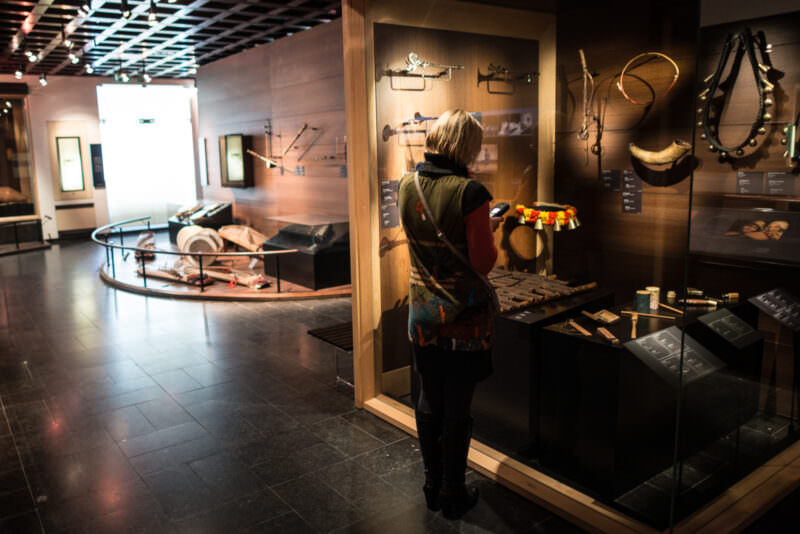
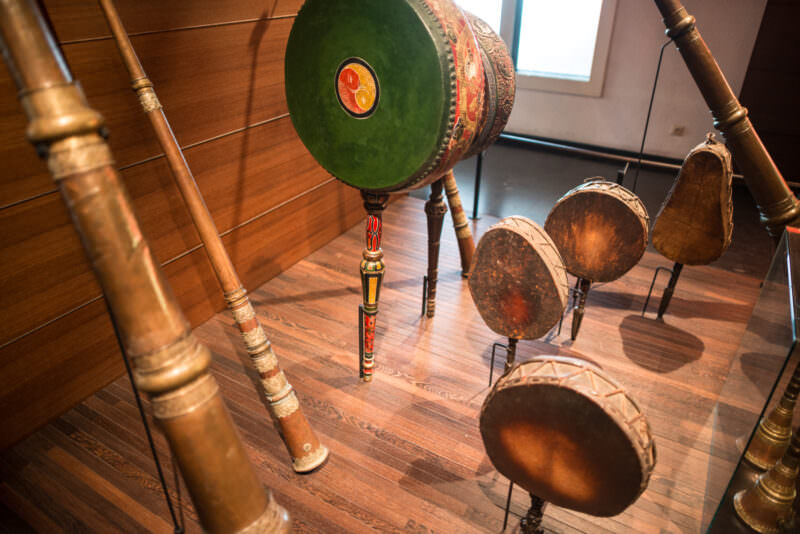
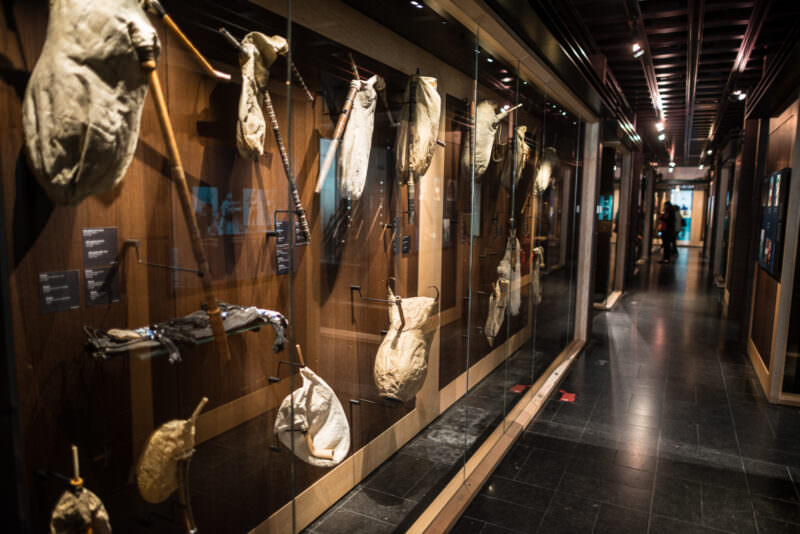
But the real strength of the collection lies in the instruments you never knew existed. Who knew there were so many variations on what we know as Scottish bagpipes? And that they come from all over, not just Scotland? How many different sounds can you get out of a drum, anyway? And what exactly is that weird-looking bendy thing that looks like someone glued a bunch of hookahs together? And what on earth does it sound like?
Unfortunately, you don’t get to play the instruments. Or maybe that’s a good thing. In the hands of experts, many of these instruments can create beautiful music. But in the hands of the average tourist, it’s just going to end up noise.
Photos of the Musical Instrument Museum of Brussels
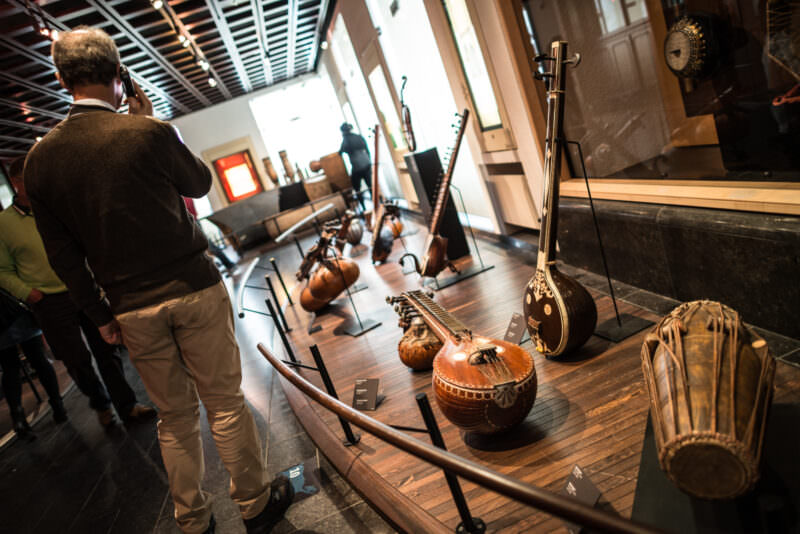
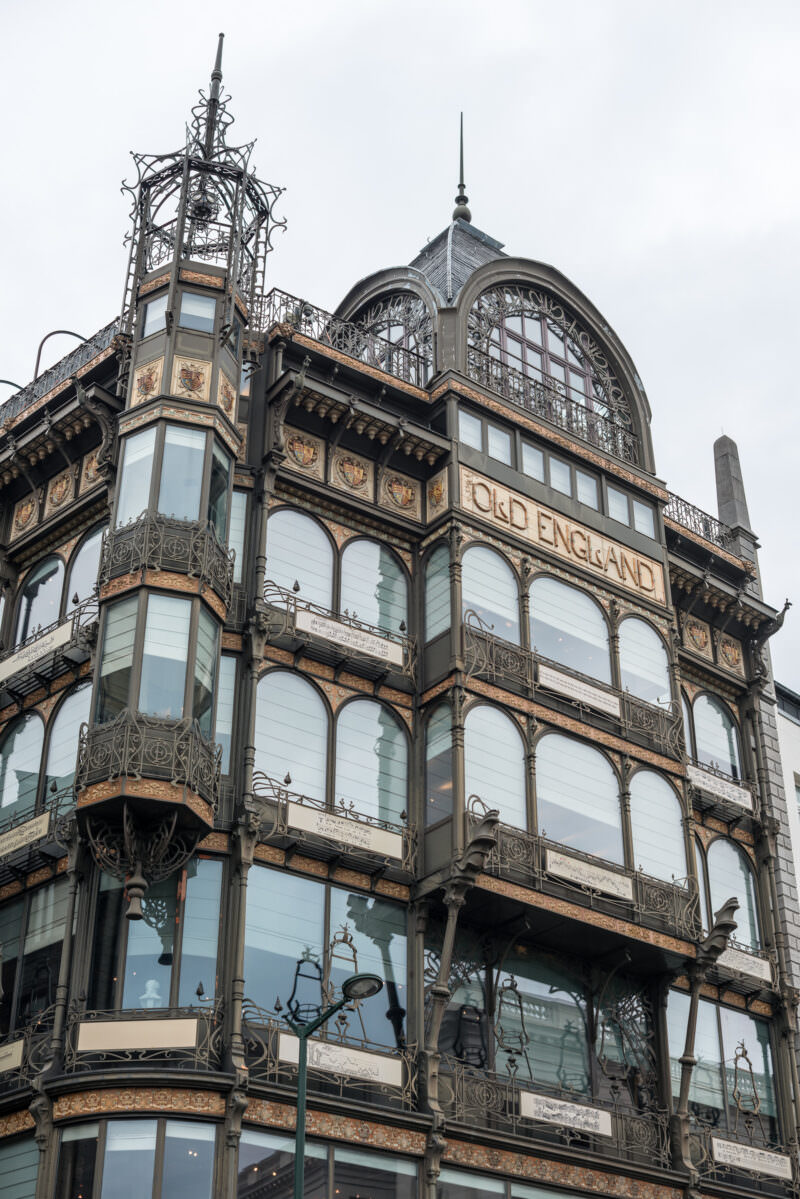
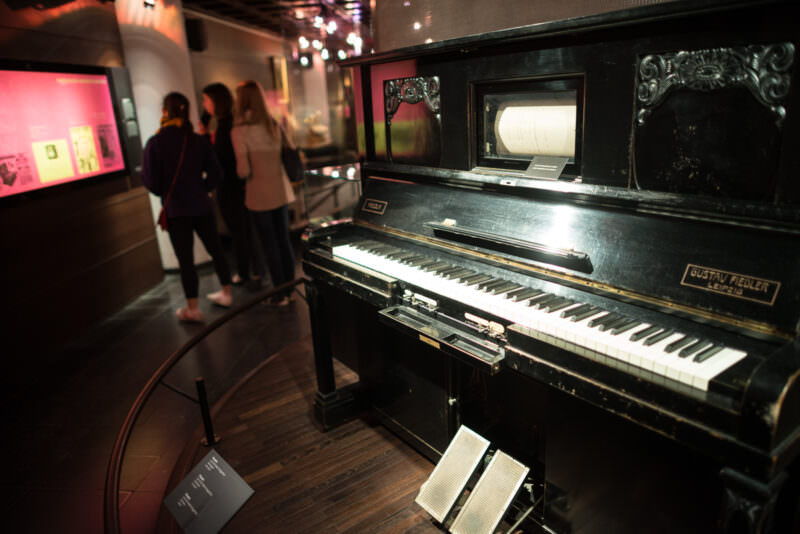
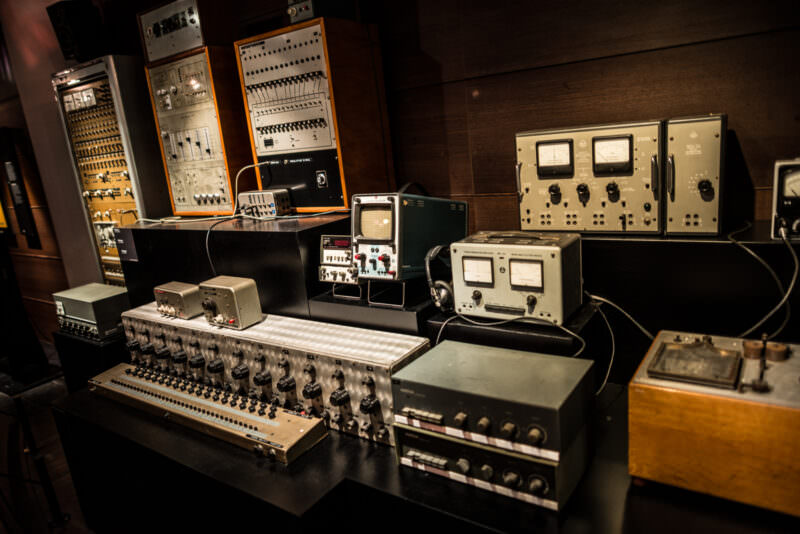
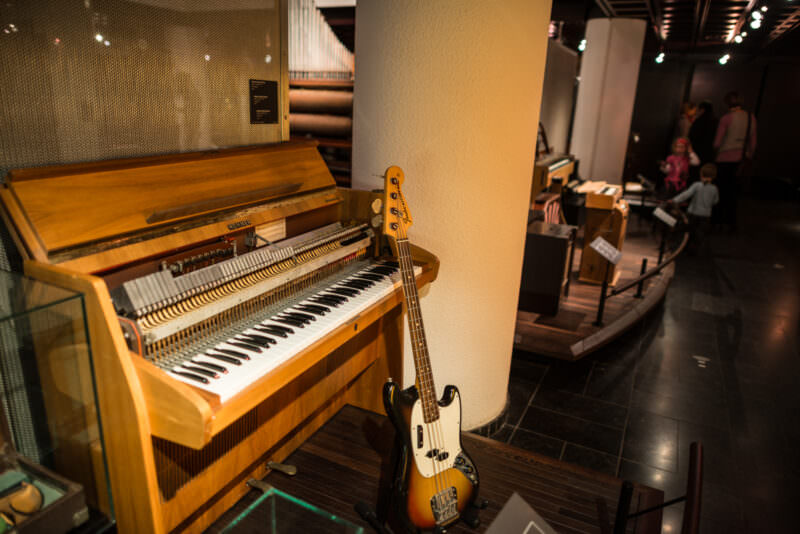
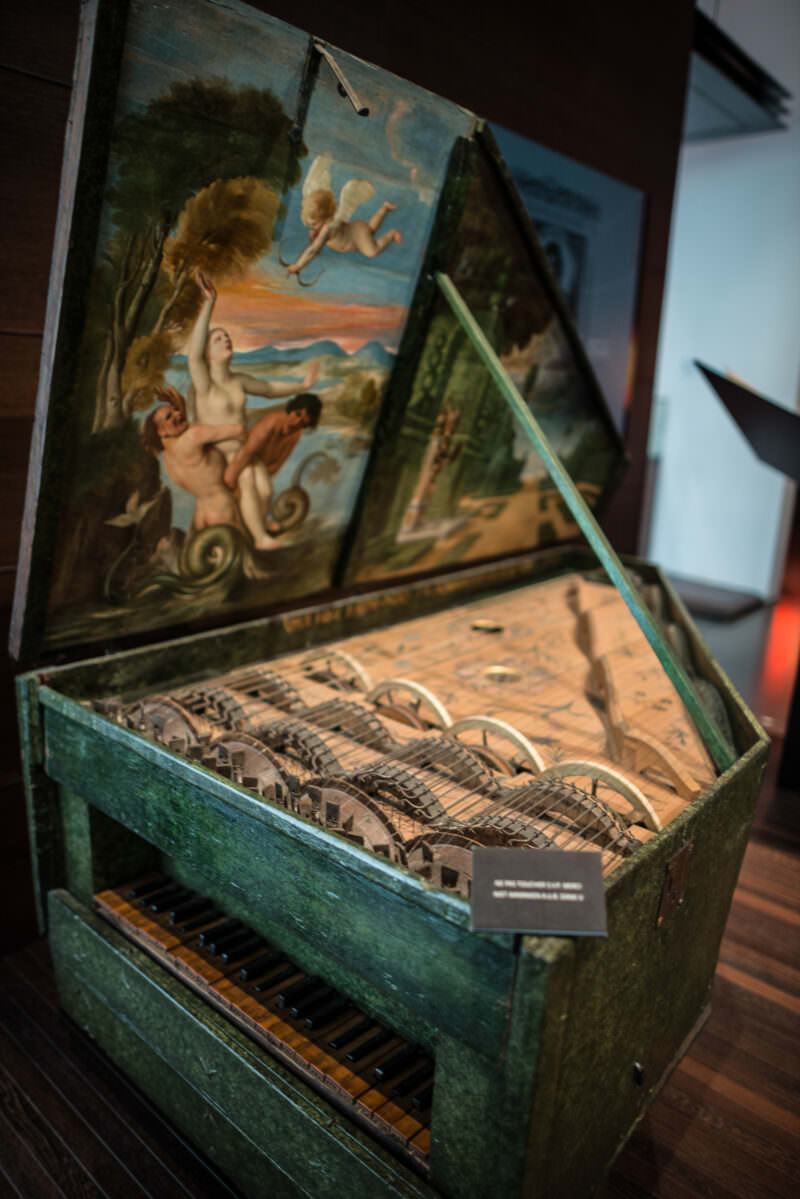
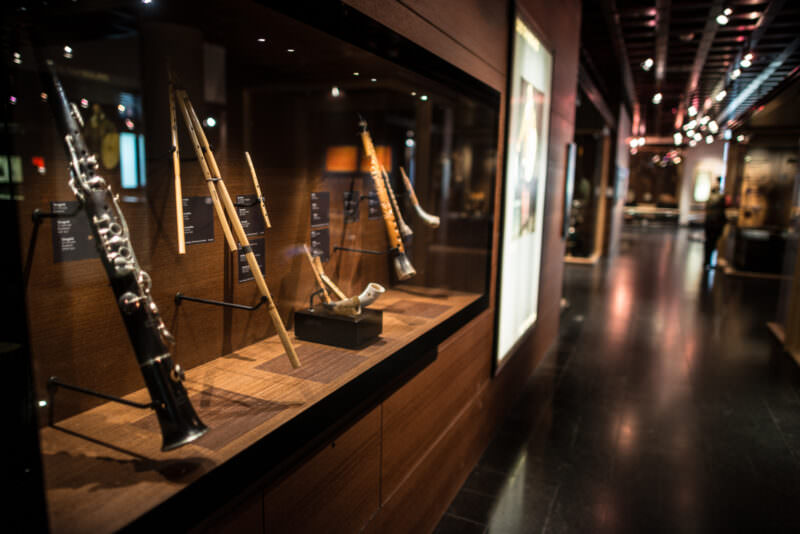
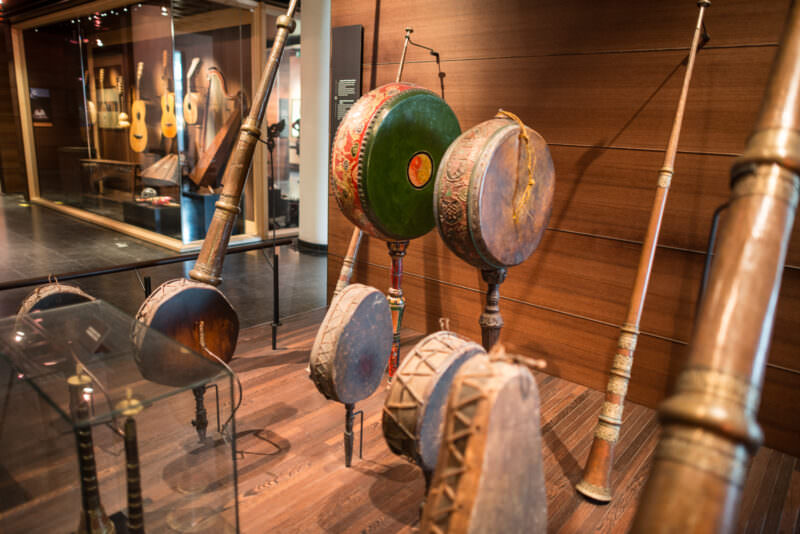
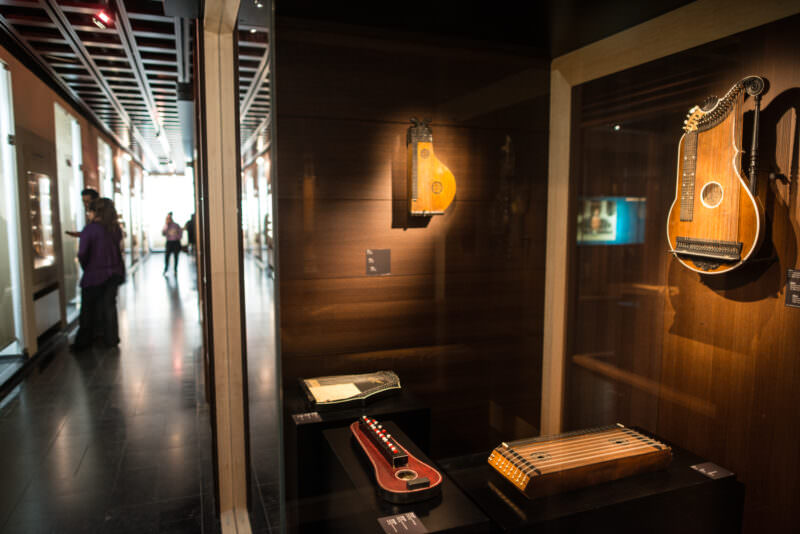
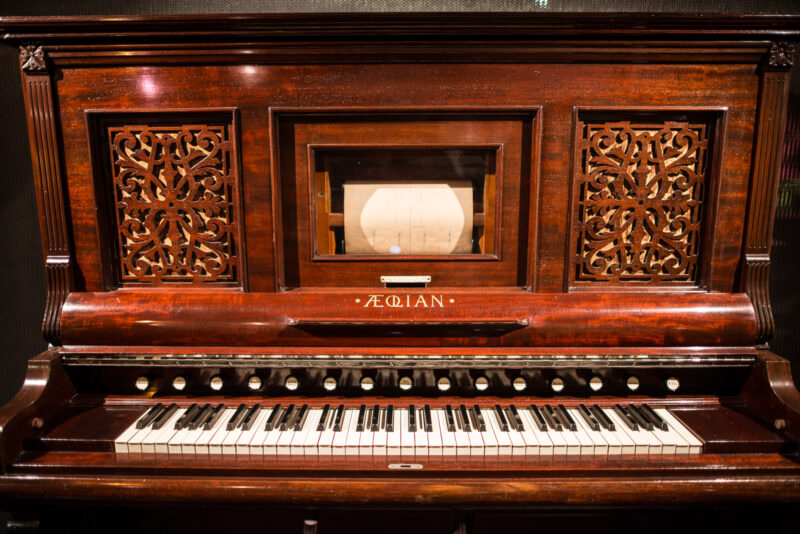
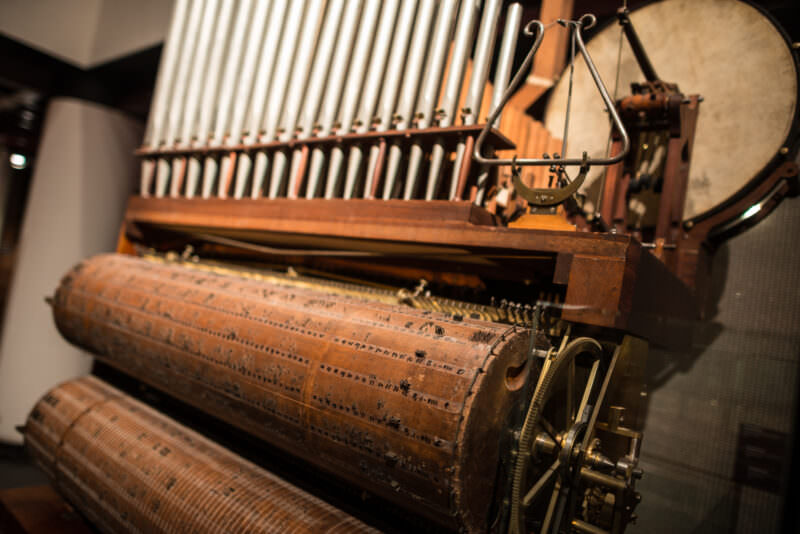
BRUSSELS, Belgium — An Aeolian harmonium, built in New York around 1890, sits on display at the Musical Instruments Museum. The perforated paper roll visible behind the central glass panel identifies this as a player reed organ made by the Aeolian Organ and Music Company, founded in 1887. By pumping the lower foot treadles to create suction, an operator could play complex, pre-arranged music without formal keyboard training, bringing full orchestral arrangements into late 19th-century parlors. Aeolian would go on to dominate the early 20th-century market with player pianos and custom pipe organs before the phonograph displaced the format. Photo by David Coleman / Have Camera Will TravelLicense this image at:DirectlyAlamyBRUSSELS, Belgium — A visitor examines a display of traditional Indian instruments, including a long-necked tanpura and a double-headed mridangam drum, at the Musical Instruments Museum. The museum’s infrared audioguide automatically triggers recordings of the specific instruments on display as visitors approach, realizing the institution’s stated aim of “you will see what you will hear.” About 200 musical extracts are keyed to positions across the four galleries, allowing the global collection to function as an active acoustic archive rather than a silent visual exhibit. Photo by David Coleman / Have Camera Will TravelLicense this image at:DirectlyAlamyBRUSSELS, Belgium — A collection of early pianos and fortepianos lines a gallery inside the Musical Instruments Museum. The instruments feature entirely wooden frames built to support low-tension parallel stringing, producing the highly articulate, rapid-decaying sound favored by Classical-era composers before cast-iron plates enabled the massive string tension of modern concert grands. This keyboard floor sits within the former Old England department store designed by Paul Saintenoy in 1898 – 1900, a protected Art Nouveau monument that the museum has occupied since 2000. Photo by David Coleman / Have Camera Will TravelLicense this image at:DirectlyAlamyBRUSSELS, Belgium — A visitor examines a display of traditional folk instruments at the Musical Instruments Museum. The gallery represents a fraction of the institution’s organological collection, which encompasses over 8,000 pieces managed by the Royal Museums of Art and History. These global artifacts are housed within the former Old England department store, a protected Art Nouveau monument of 1898 – 1900 designed by Paul Saintenoy, adapted across four floors to showcase the evolution of musical design worldwide. Photo by David Coleman / Have Camera Will TravelLicense this image at:DirectlyAlamyBRUSSELS, Belgium — A visitor views a reconstructed piano maker’s workshop at the Musical Instruments Museum. On the central workbench, flexible wooden rods called go-bars are wedged against an overhead deck to apply downward pressure while adhesive cures — a traditional clamping technique that provides even tension across delicate acoustic ribs without damaging the thin soundboard beneath. The workshop reconstruction is among the museum’s displays tracing keyboard instrument manufacture, housed on one of four floors within the former Old England building. Photo by David Coleman / Have Camera Will TravelLicense this image at:DirectlyAlamyBRUSSELS, Belgium — The Old England building displays the sweeping iron frame and expansive glass panels characteristic of Belgian Art Nouveau. Architect Paul Saintenoy designed the structure in 1898 – 1900 for a Scottish-style fashion retailer, maximizing natural light through a near-curtain-wall façade across seven storeys. The Belgian State purchased the building in 1979, and after restoration and heritage classification in 1989, it reopened in 2000 as home to the Musical Instruments Museum and its collection of over 8,000 pieces. The iron ornament stripped from the façade in 1938 and the corner turret removed in 1956 were partly restored during the 1990s renovation, returning much of Saintenoy’s original character. Photo by David Coleman / Have Camera Will TravelLicense this image at:DirectlyAlamyBRUSSELS, Belgium — A 1900 pianola manufactured by Gustav Fiedler of Leipzig stands on display at the Musical Instruments Museum. The perforated paper roll visible in the upper window dictates the notes through a pneumatic mechanism, and operators powered the system by pumping the large foot pedals. This allowed people without musical training to perform complex piano arrangements, serving a broad domestic market before the widespread adoption of the phonograph. The instrument is among roughly 1,200 pieces on display from a collection exceeding 8,000. Photo by David Coleman / Have Camera Will TravelLicense this image at:DirectlyAlamyBRUSSELS, Belgium — A 1679 double-manual harpsichord by Vincent Tibaut anchors a display at the Musical Instruments Museum. The maker’s inscription, “Fait par moy vincent Tibaut A Tolose,” sits directly above the twin keyboards. This two-tiered design allowed 17th-century players to change volume and tone by switching between different sets of plucked strings, a vital mechanical workaround before the invention of the piano. The instrument is part of the museum’s keyboard floor, housed in the former Old England building designed by Paul Saintenoy in 1898 – 1900. Photo by David Coleman / Have Camera Will TravelLicense this image at:DirectlyAlamyBRUSSELS, Belgium — Early electronic synthesizers, sequencers, and sound generators are displayed at the Musical Instruments Museum. The visible array of patch bays, analog dials, and oscilloscope screens illustrates the mid-20th-century shift toward voltage-controlled synthesis. Before digital software, composers physically routed electrical signals through these modular units to generate and manipulate sound waves, establishing the hardware foundation for modern electronic music. The museum’s electronic instruments floor traces this evolution as part of a collection exceeding 8,000 pieces. Photo by David Coleman / Have Camera Will TravelLicense this image at:DirectlyAlamyBRUSSELS, Belgium — A Fender Mustang Bass leans against a Hohner Electra-Piano at the Musical Instruments Museum. The exposed action of the keyboard reveals the mechanical hammers used to strike metal reeds, an electromechanical design that required amplification to produce sound. Positioned near traditional organ pipes, the display illustrates the mid-20th-century transition from acoustic resonance to electric instrumentation. The museum organizes its collection of over 8,000 pieces by world traditions, European chronology, keyboard instruments, and mechanical and electronic instruments. Photo by David Coleman / Have Camera Will TravelLicense this image at:DirectlyAlamyBRUSSELS, Belgium — A 1625 Geigenwerk is displayed with its painted lid open at the Musical Instruments Museum. The visible wheels inside the casing are the core of this rare bowed keyboard instrument built by Raymundo Truchado: when a player presses a key, the corresponding string is pulled against a spinning, rosined wheel, producing a continuous, violin-like sustained tone impossible on a standard plucked harpsichord. The instrument sits among the museum’s keyboard holdings, a floor that also includes the world’s oldest surviving saxophone and a collection of 125 Sax-family instruments — the largest such public holding worldwide. Photo by David Coleman / Have Camera Will TravelLicense this image at:DirectlyAlamyBRUSSELS, Belgium — Long brass horns and painted ceremonial drums stand on display at the Musical Instruments Museum. The exhibit highlights traditional performance tools from diverse Asian cultures, part of the institution’s global collection of over 8,000 pieces. Founded on 1 February 1877 as the instrument collection of the Brussels Royal Conservatory, the museum spans four floors of the former Old England department store, organizing its holdings by geographic origin and instrument family. Photo by David Coleman / Have Camera Will TravelLicense this image at:DirectlyAlamyBRUSSELS, Belgium — Traditional woodwinds sit in a glass display case at the Musical Instruments Museum. The black keyed instrument on the left is a Hungarian tárogató, redesigned by V.J. Schunda in the 1890s with a conical bore and modern keywork. Beside it rests a Sardinian launeddas, an ancient triple-pipe played using circular breathing to produce a continuous polyphonic drone and melody. Both instruments are part of the museum’s world-traditions holdings, which span over 8,000 pieces organized by geographic origin. Photo by David Coleman / Have Camera Will TravelLicense this image at:DirectlyAlamyBRUSSELS, Belgium — Dozens of bagpipe variations hang in a glass display corridor at the Musical Instruments Museum. The preserved animal-hide reservoirs and wooden drones demonstrate the core mechanics of an instrument that evolved across Europe, the Middle East, and North Africa long before becoming synonymous with the Scottish Highlands. As one of the four federal Royal Museums of Art and History, the institution curates over 8,000 instruments to trace these global cultural adaptations, with roughly 1,200 on display across four floors. Photo by David Coleman / Have Camera Will TravelLicense this image at:DirectlyAlamyBRUSSELS, Belgium — Traditional Tibetan percussion and wind instruments are displayed on a wooden platform at the Musical Instruments Museum. The long brass dung chen horns and pole-mounted nga drums are central to Buddhist ritual music; monks play the telescoping horns in pairs to produce a deep, droning sub-bass tone intended to invoke deities during monastic ceremonies. The display is part of the museum’s world-traditions floor, one of four exhibition levels within the former Old England building. Photo by David Coleman / Have Camera Will TravelLicense this image at:DirectlyAlamyBRUSSELS, Belgium — Concert and chord zithers are displayed along a glass corridor at the Musical Instruments Museum. Housed in the former Old England department store, a protected Art Nouveau monument of 1898 – 1900, the institution operates as one of the four federal Royal Museums of Art and History. The visible fretboards and button mechanisms highlight the mechanical evolution of stringed instruments, representing a fraction of a collection exceeding 8,000 pieces. Photo by David Coleman / Have Camera Will TravelLicense this image at:DirectlyAlamyBRUSSELS, Belgium — An 1890s harmonium built by the New York-based Aeolian Organ and Music Company is displayed at the Musical Instruments Museum. The perforated paper roll visible through the central glass panel allowed the instrument to play automatically, driven by foot treadles that created suction across the reed ranks. Founded in 1887, Aeolian pioneered these self-playing reed organs before dominating the early 20th-century market with player pianos and custom pipe organs. A second Aeolian harmonium from the same period is also part of the museum’s collection. Photo by David Coleman / Have Camera Will TravelLicense this image at:DirectlyAlamyBRUSSELS, Belgium — A hybrid automated instrument combining pipe organ elements with mechanical percussion is displayed at the Musical Instruments Museum. The prominent wooden cylinder is studded with metal pins that function as physical programming: as the barrel rotates, the pins mechanically trigger specific notes and percussion strikes. This barrel-and-pin technology predates the perforated paper roll by centuries, representing an earlier strand of analog automation that also drove musical clocks and fairground organs. The museum, founded on 1 February 1877, houses over 8,000 instruments across four exhibition floors. Photo by David Coleman / Have Camera Will TravelLicense this image at:DirectlyAlamy
What to know before you go
The museum is housed in a distinctive and ornate building, known as the Old England department store building in the Mont des Arts district of downtown Brussels. It’s steps from the Royal Museum of Fine Arts of Belgium and a couple of blocks from the Royal Palace.
There’s a restaurant on the top floor offers a great view out over the city.
I'm a freelance travel photographer based in Washington DC. Seven continents, up mountains, underwater, and a bunch of places in between. My images have appeared in numerous publications, and you can check out some of my gear reviews and tips here. More »