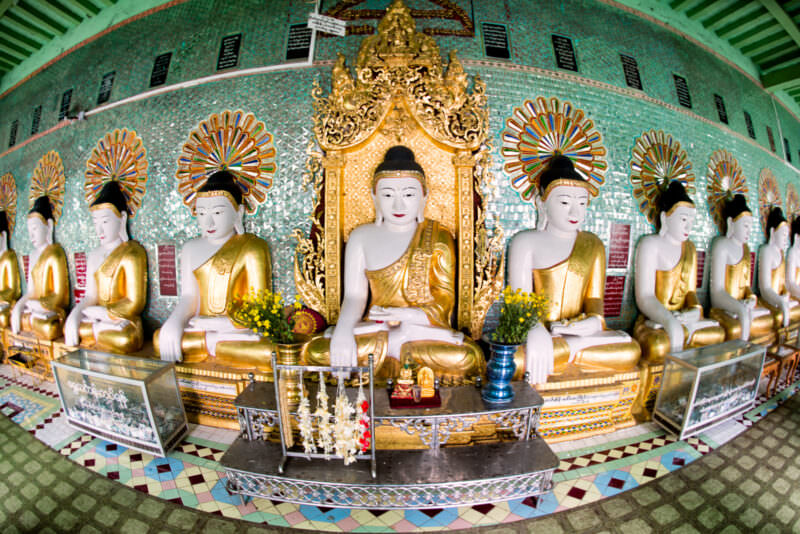
SAGAING, Myanmar (Burma) – U Min Thonze Pagoda is an explosion of color, with forty-five gilded statues of the Buddha in a crescent colonnade on a hilltop in Sagaing.
Many of Myanmar’s pagodas are very, very old. But they’re also living monuments. Many of the pagodas in the Bagan Archaeological Zone are protected and are now frozen in time, but others elsewhere undergo constant regeneration and change. That’s thanks to the strong tradition of donors. Give enough money and you can have a say in paint colors, adding tiles, or any of the thousands of design decisions that might go into making up a pagoda. Even for small donations, many pagodas have glass donation boxes where each is designated for a particular purpose.
Oo Hmin Thone Sel Pagoda is a prime example. Generous donors have allowed for recent renovations that have added new coats of paint, added many thousands of green tiles, paved the sweeping patio, and refreshed the artwork throughout the complex. The result is both resplendent and decidedly busy.
As with many Burmese names, you might see variations in how it is transliterated. It also sometimes appears as Oohminthonesel Pagoda, U Min Thonze Pagoda, or Umin Thonze Pagoda.
The pagoda stands on the top of a hill — Sagaing Hill, as it happens — in the religious district of Sagaing, across the Ayeyarwaddy River (Irrawaddy River) from Mandalay, a compact area that is home to many, many temples, monasteries, and nunneries. For a short period in the early 14th century, Sagaing was the capital of the Shan kingdom. Now it’s known as a spiritual heartland, home to something like 6,000 monks and nuns.
The layout of Oo Hmin Thone Sel Pagoda isn’t your typical temple layout. It’s a large crescent looking out southwest from the hillside over the surrounding countryside. It’s not actually a cave, but when you’re inside it feels a bit like you’re in a long, shallow cave carved into the mountainside.
Have Camera Will Travel // Newsletter
Practical field notes, hands-on gear tests.
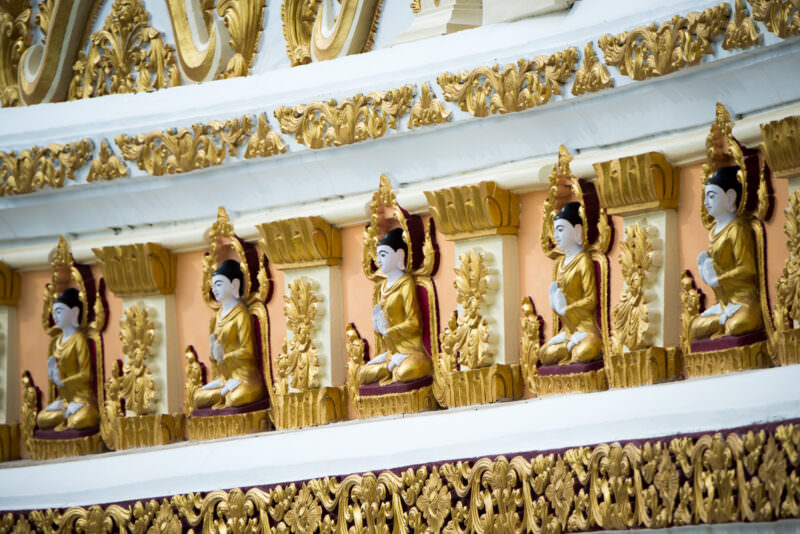
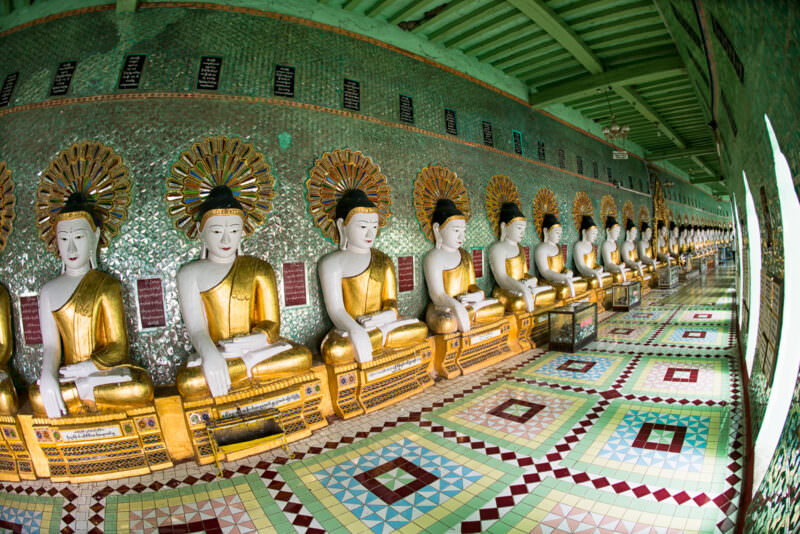
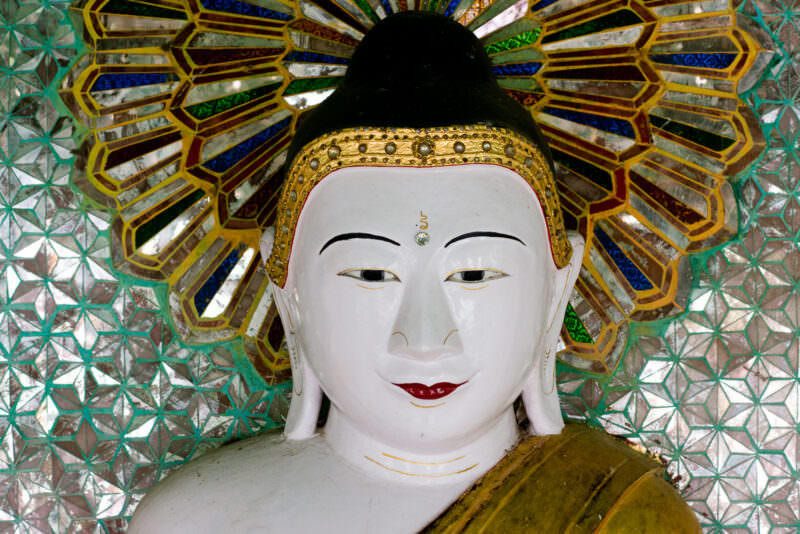
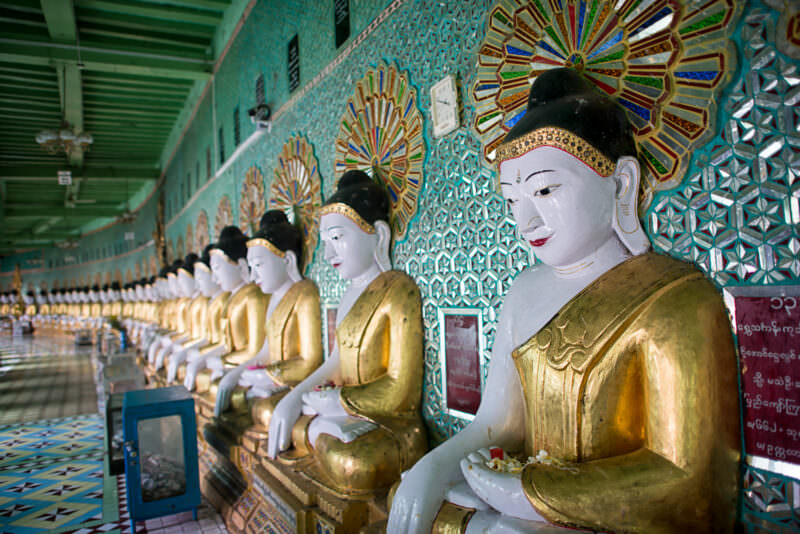
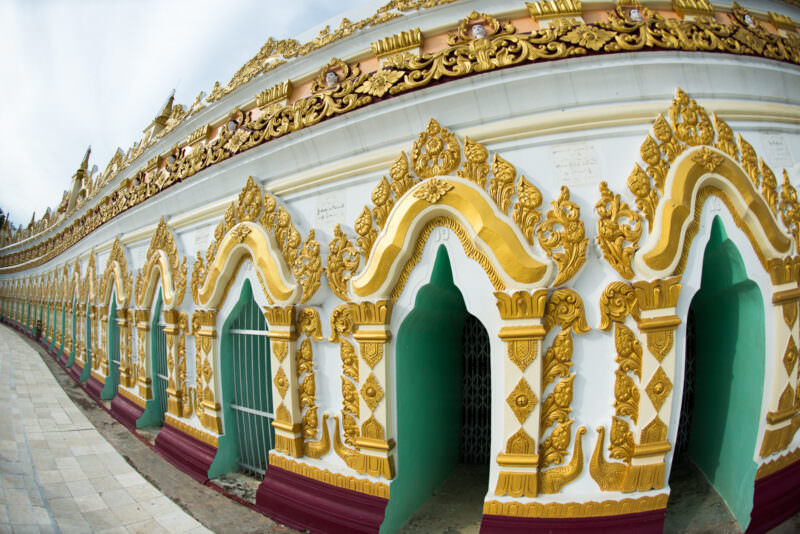
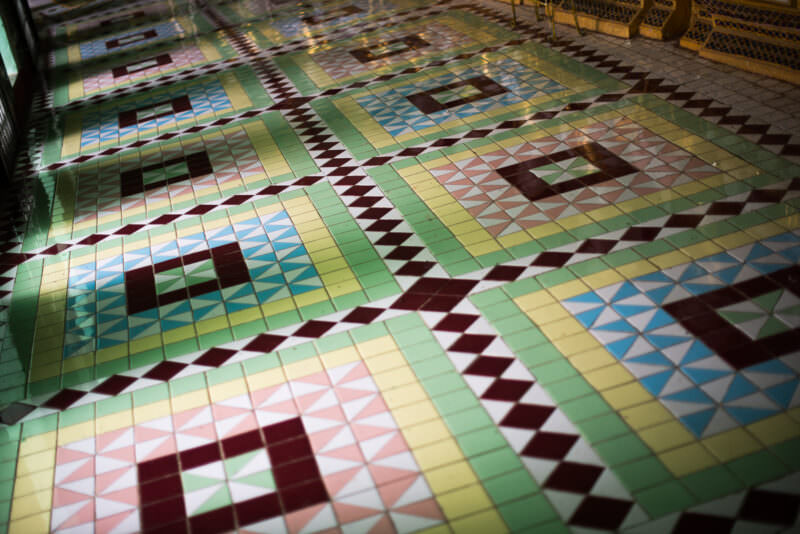
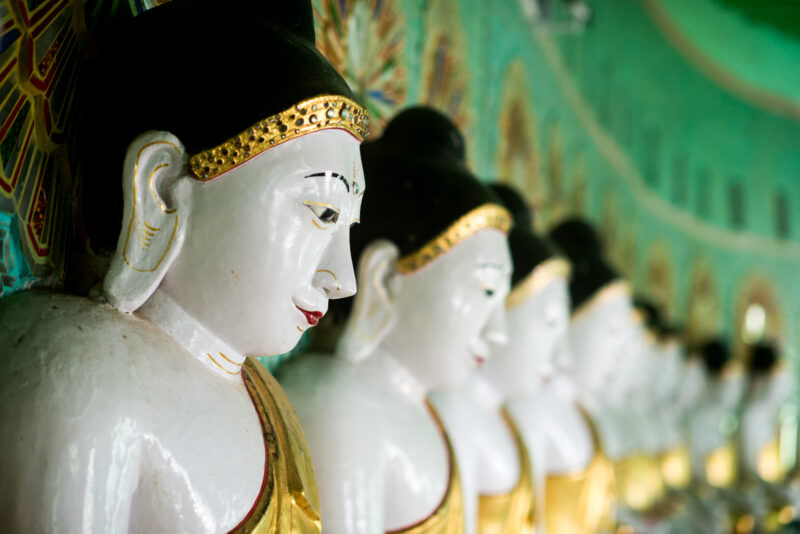
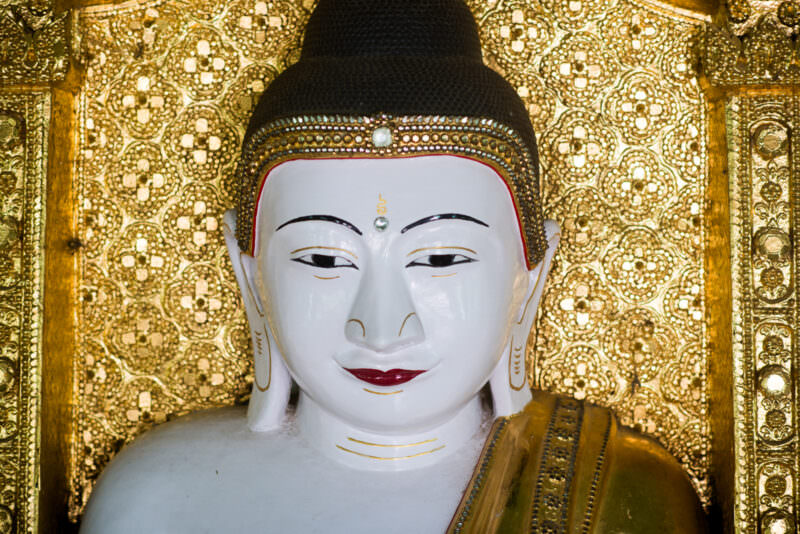
It isn’t what you’d call plain. There are the intricate geometric patterns of the tiled floor and the reflective cut glass-mosaic of the walls. The outside is filled with thirty arched openings, each rimmed with ornate gilded designs. But the main feature is a row of forty-five gilded Buddha images that line the wall looking out. Each is subtly distinct in facial modeling and hand position. They stretch out around the gentle curve of the colonnade, so that you can’t see the end of them if you stand at one end.
Photos of Oo Hmin Thone Sel Pagoda
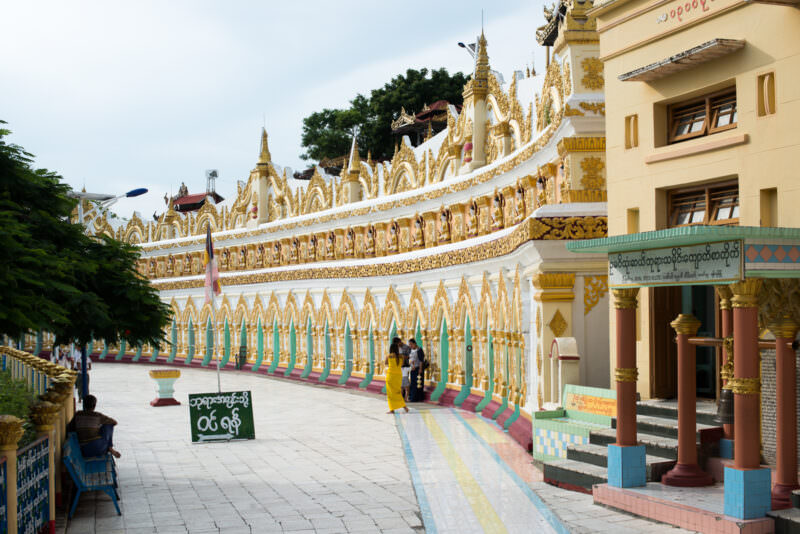
SAGAING, Myanmar — The full sweep of U Min Thonze Pagoda’s (also known as Umin Thonze) crescent outer wall is visible from the paved forecourt, its thirty gilded arches curving across the hillside in a plan unique among Sagaing Hill’s hundreds of religious structures. The arch openings measure 6 feet 7 inches (2 m) high and 2 feet 5 inches (0.74 m) wide; ten Manuthiha lion-man guardian figures and seven small stupas are set on the southern facades, visible at either end of the curve. The wide courtyard in the foreground, edged by a small offering pedestal, marks the pilgrimage approach to the colonnade. Photo by David Coleman / Have Camera Will TravelLicense this image at:DirectlyAlamy
SAGAING, Myanmar — A close view of the central figures inside U Min Thonze Pagoda (also known as Umin Thonze) reveals forty-five gilded, white-faced Buddha images seated in an unbroken crescent row against a wall of reflective cut-glass mosaic. Each image is subtly distinct in facial modelling and hand position — the entire row a product of the Konbaung-period reconstruction, reflecting the gilded stucco and mirror-glass ornament characteristic of 19th-century Burmese royal patronage. Fresh flower offerings on the altar table in front of the central figure confirm the shrine remains an active devotional site. Photo by David Coleman / Have Camera Will TravelLicense this image at:DirectlyAlamy
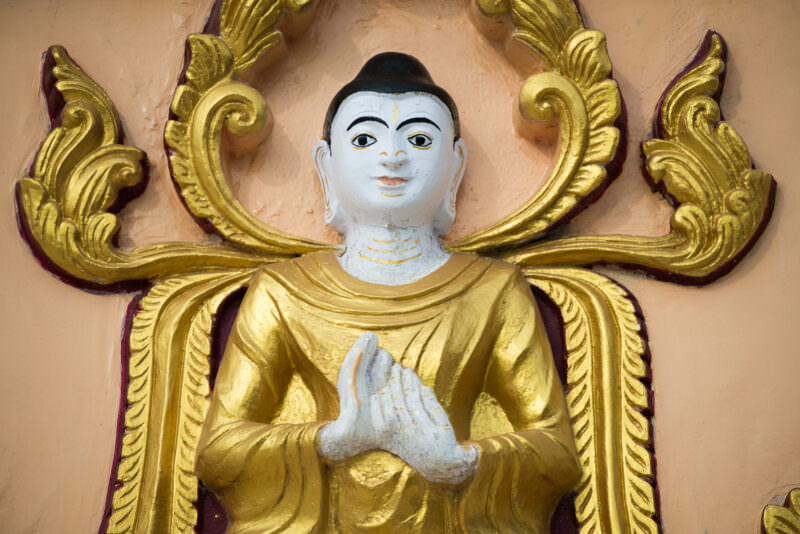
SAGAING, Myanmar — A single gilded Buddha in the anjali mudra — hands pressed together at the chest — occupies one of forty-five distinct niches at U Min Thonze Pagoda (also known as Umin Thonze) on Sagaing Hill. The name translates as “Thirty Caves Pagoda,” referencing the thirty arched openings along the curved outer wall; the present crescent colonnade, built into the hillside, reflects Konbaung-period decorative taste and is traditionally dated to a mid-19th-century reconstruction. Photo by David Coleman / Have Camera Will TravelLicense this image at:DirectlyAlamy
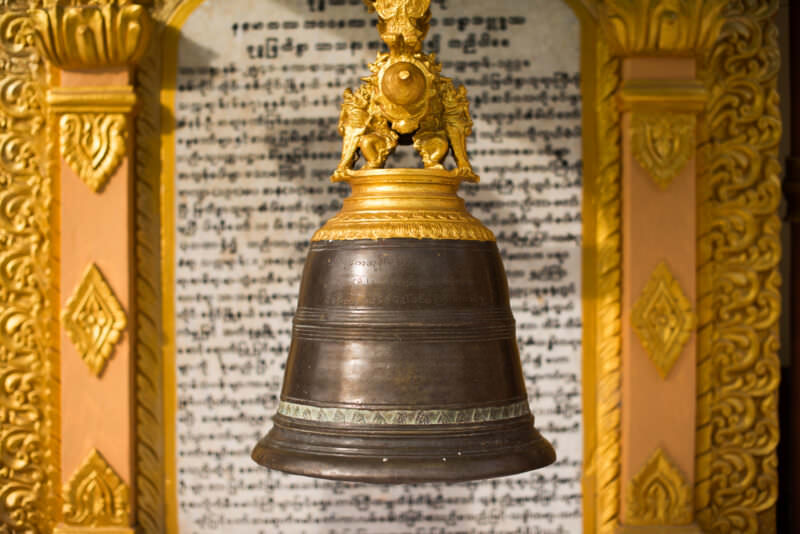
SAGAING, Myanmar — A bronze devotional bell hangs before a marble inscription board in Burmese script at U Min Thonze Pagoda (also known as Umin Thonze or “Thirty Caves Pagoda”) on Sagaing Hill. Striking such bells is a Theravada Buddhist merit-sharing practice: the sound is understood to extend the spiritual benefit of a pilgrim’s visit to all sentient beings within earshot. The present fabric of the pagoda dates to a reconstruction completed around 1847 under King Pagan Min of the Konbaung dynasty, following the catastrophic 1839 Ava earthquake on the Sagaing Fault. Photo by David Coleman / Have Camera Will TravelLicense this image at:DirectlyAlamy
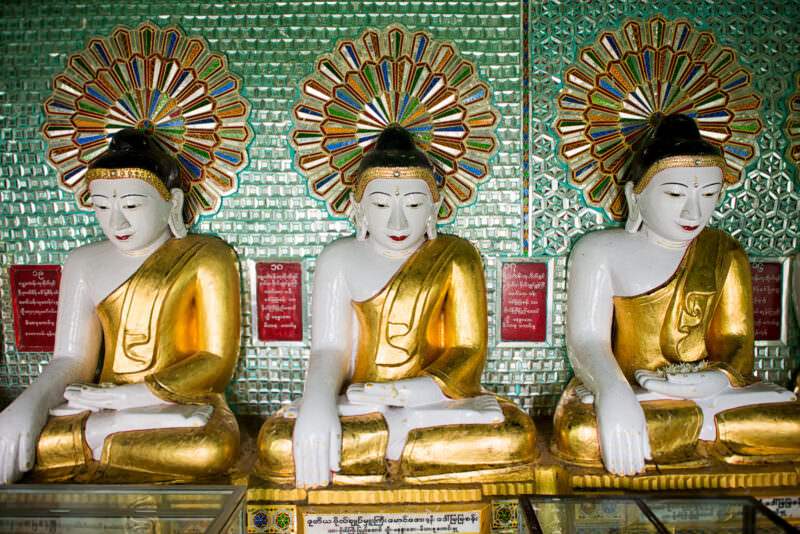
SAGAING, Myanmar — Three gilded Buddha images sit shoulder to shoulder against the glass-mosaic wall of U Min Thonze Pagoda (also known as Umin Thonze), red donor plaques in Burmese script visible between them. The reflective mosaic backing — cut mirror-glass set in stucco in a geometric pattern — is characteristic of Konbaung-period Buddhist decoration and fills the interior with scattered light admitted through the colonnade’s thirty outer arches; the forty-five figures in the crescent row each differ subtly in face and gesture, so no two are identical. Photo by David Coleman / Have Camera Will TravelLicense this image at:DirectlyAlamy
SAGAING, Myanmar — Gilded Buddha figures in individual stucco niches line the exterior arcade of U Min Thonze Pagoda (also known as Umin Thonze or “Thirty Caves Pagoda”) on Sagaing Hill. The forty-five images inside the crescent colonnade differ subtly from one another in scale and facial modelling — a distinctive feature of the Konbaung-period rebuild, whose present fabric dates to the mid-19th century rather than any surviving medieval original. Photo by David Coleman / Have Camera Will TravelLicense this image at:DirectlyAlamy
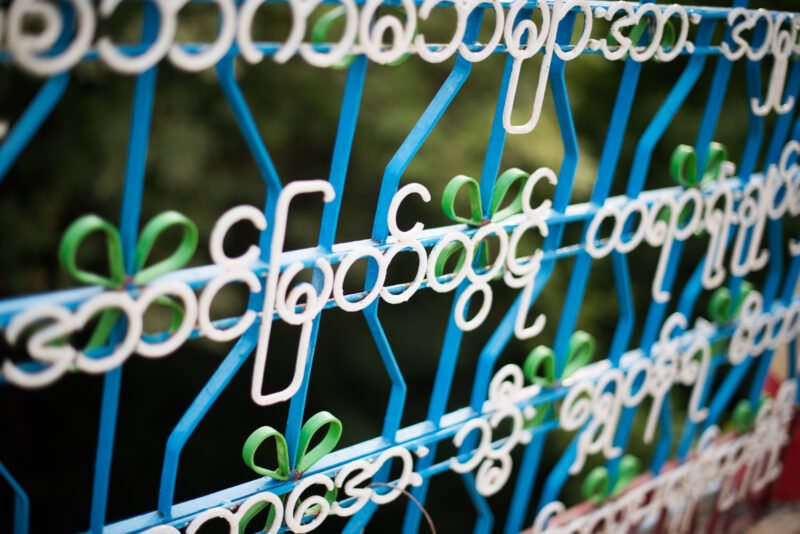
SAGAING, Myanmar — White-painted iron characters forming Burmese script are bent and welded into the bars of a blue metal fence at U Min Thonze Pagoda (also known as Umin Thonze) on Sagaing Hill. The Burmese script’s distinctive circular letterforms — a consequence of the traditional practice of writing on palm leaves, where straight strokes would split the leaf — lend themselves naturally to the scrollwork and ironwork traditions of Burmese decorative crafts. The fence marks the boundary of a shrine that sits directly on the Sagaing Fault, one of the world’s major active strike-slip faults, which ruptured in a magnitude-7.7 earthquake in March 2025. Photo by David Coleman / Have Camera Will TravelLicense this image at:DirectlyAlamy
SAGAING, Myanmar — The crescent colonnade of U Min Thonze Pagoda (also known as Umin Thonze), on the western slope of Sagaing Hill, houses forty-five gilded Buddha images in a single curved row backed by Konbaung-period cut glass-mosaic work. The name combines Burmese u min (“cave”) and thonze (“thirty”), referring to the thirty arched openings along the outer wall that admit light evenly across the full arc of figures. The shrine sits directly above the Sagaing Fault, which ruptured in a magnitude-7.7 earthquake on 28 March 2025; its neighbour, Soon U Ponya Shin Pagoda, was severely damaged in that event. Photo by David Coleman / Have Camera Will TravelLicense this image at:DirectlyAlamy
SAGAING, Myanmar — Visitors walk the forecourt of U Min Thonze Pagoda (also known as Umin Thonze), where the full sweep of the crescent colonnade’s thirty gold-and-white ornate arches stretches along Sagaing Hill. The curved outer wall is architecturally unusual in the Burmese Buddhist tradition, which is dominated by solid bell-shaped stupas and cross-axial hollow temples; the plan here is closer in concept to the rock-cut cave-shrines of Bagan, with the hillside providing the concave back wall against which forty-five gilded Buddha images are ranged. The present facade dates to a reconstruction completed around 1847 under King Pagan Min of the Konbaung dynasty. Photo by David Coleman / Have Camera Will TravelLicense this image at:DirectlyAlamy
SAGAING, Myanmar — A white-faced Buddha at U Min Thonze Pagoda (also known as Umin Thonze) is framed by a radiating halo of coloured and mirrored glass mosaic, its geometric star-pattern surround a vivid example of Konbaung-dynasty decorative technique. Cut mirror-glass set into stucco was the standard Konbaung prestige finish for shrine interiors — it bounces daylight entering through the colonnade’s thirty arched openings back across all forty-five images, making the hall far brighter inside than its hillside position would otherwise allow. Photo by David Coleman / Have Camera Will TravelLicense this image at:DirectlyAlamy
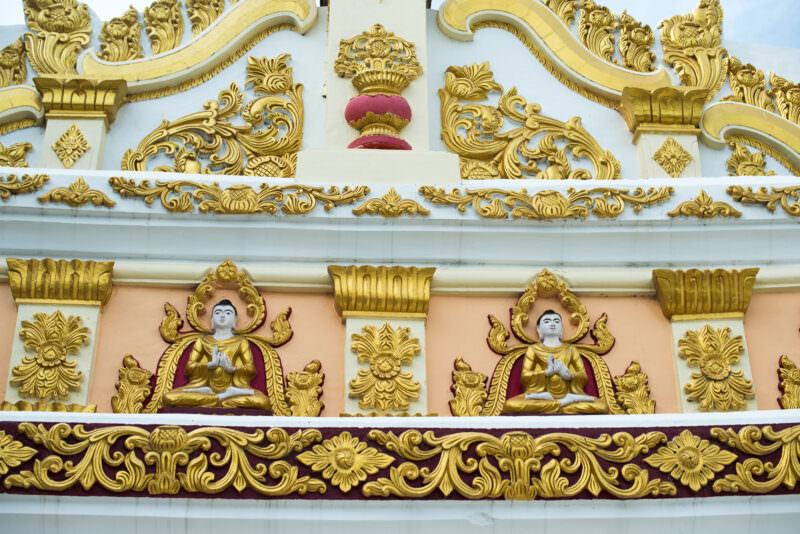
SAGAING, Myanmar — Close-up detail of the upper registers of U Min Thonze Pagoda’s (also known as Umin Thonze) outer wall shows two seated white Buddha reliefs set into gilded niches, framed by dense floral stucco scrollwork in the Konbaung decorative style. This ornamental vocabulary — gilded carved plaster layered over brick, with figures set in recessed arched niches between pilasters — is characteristic of 19th-century Burmese royal workshop production and reflects the rebuilding programme associated with King Pagan Min in the 1840s. The Sagaing Fault runs directly beneath this hill, and the quality of this stucco-over-brick construction made it acutely vulnerable to the major earthquakes that have repeatedly struck the area. Photo by David Coleman / Have Camera Will TravelLicense this image at:DirectlyAlamy
SAGAING, Myanmar — The full crescent row of forty-five gilded Buddha images recedes along the inner wall of U Min Thonze Pagoda (also known as Umin Thonze), each figure backed by a starburst of reflective glass mosaic — a signature technique of Konbaung-period Buddhist decoration, in which cut mirror-glass set in stucco amplifies light entering through the thirty arched openings opposite. The shrine sits directly on the Sagaing Fault, and the present fabric traditionally dates to a mid-19th-century rebuild after a large earthquake destroyed an earlier structure on this site. Photo by David Coleman / Have Camera Will TravelLicense this image at:DirectlyAlamy
SAGAING, Myanmar — The convex outer wall of U Min Thonze Pagoda (also known as Umin Thonze or “Thirty Caves Pagoda”) sweeps along the slope of Sagaing Hill, its thirty gilded-stucco arches — each decorated with unique floral and foliate ornament — giving the shrine its Burmese name: u min (“cave”) plus thonze (“thirty”). The curved crescent plan, embedding the vaulted gallery into the hillside, is unusual within the mainland Southeast Asian Buddhist architectural tradition dominated by solid zedi stupas and four-entrance gu temples. The present fabric reflects the Konbaung-period reconstruction rather than any surviving medieval original. Photo by David Coleman / Have Camera Will TravelLicense this image at:DirectlyAlamy
SAGAING, Myanmar — A shaft of light rakes across the polychromatic geometric floor tiles of U Min Thonze Pagoda (also known as Umin Thonze) on Sagaing Hill, cast through one of the thirty arched openings that give the shrine its name — u min (“cave”) and thonze (“thirty”) in Burmese. The tilework, combining diamonds, triangles and interlocking borders in green, blue, red, yellow and white, is part of the ornamental scheme the Konbaung dynasty favoured for reconstructed religious buildings in the mid-19th century, a period when cut glass-mosaic and patterned ceramics became the signature interior finish across the region. Photo by David Coleman / Have Camera Will TravelLicense this image at:DirectlyAlamy
SAGAING, Myanmar — White-faced Buddha images recede in a tight profile line along the curved inner wall of U Min Thonze Pagoda (also known as Umin Thonze), their gold robes and jewelled headbands subtly distinct from figure to figure. The colonnade holds forty-five images in a single crescent row — each individually modelled rather than cast from one mould — a scale of repetition unusual within the Burmese Buddhist building repertoire, which is dominated by solid stupas and cross-axial temple plans rather than curved gallery shrines. Photo by David Coleman / Have Camera Will TravelLicense this image at:DirectlyAlamy
SAGAING, Myanmar — A single white-faced Buddha image from U Min Thonze Pagoda (also known as Umin Thonze or “Thirty Caves Pagoda”) fills the frame, its white lacquer finish set against the dense gold floral glass mosaic that lines the colonnade wall. The reflective cut-mirror mosaic is a hallmark of Konbaung-period Buddhist decoration — mirror glass set into stucco so that daylight entering through the thirty arched openings bounces back along the entire crescent interior, dramatizing each of the forty-five gilded figures in turn. Photo by David Coleman / Have Camera Will TravelLicense this image at:DirectlyAlamy
What to Know Before You Go
Sagaing is in such an unstable geological region that it has its own name: the Sagaing Fault. In March 2025, a major earthquake damaged much of the region and made much of it inaccessible.
This is a hilly area, and there’s a short walk uphill to the main pagoda through a covered market area.
How to Get to OoHminThoneSel Pagoda
The OoHminThoneSel Pagoda is located in the Sagaing Region of Myanmar. The nearest major city is Mandalay, which is approximately 21 kilometers (13 miles) away. The closest major airport is Mandalay International Airport (MDL), which offers domestic and international flights. From the airport or Mandalay city center, visitors can hire a taxi or arrange for private transportation to reach the pagoda.
Enjoyed this article? Personalize your search results.
I'm a freelance travel photographer based in Washington DC. Seven continents, up mountains, underwater, and a bunch of places in between. My images have appeared in numerous publications, and you can check out some of my gear reviews and tips here. More »