MANDALAY, Myanmar (Burma) – There’s not quite so much of the gold left that once covered the wood, but its ornately carved teak is arguably even more impressive.
There’s not quite so much of the gold left that once covered the wood, but its ornately carved teak is arguably even more impressive.
Built in the 1850s of carved teak, Shwenandaw Monastery was originally part of the imperial palace at Mandalay. In 1878 it was moved, because King Mindon had died in the building — you can still see the chamber where he died — and the new king preferred not to be constantly reminded of it. It now sits on a site near the base of Mandalay Hill, in the north of Mandalay.
It was originally the king’s private retreat. After he died, for a long time it was a monastery.
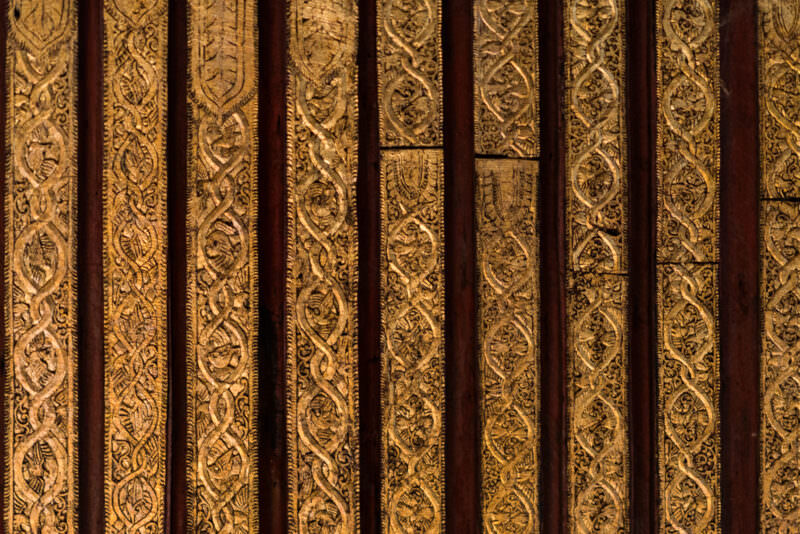
Its architectural style is traditional Burmese. Numerous solid teak tree trunks hold the structure up off the ground. All of the monastery’s interior is also constructed from teak, from the massive floor planks to the walls and the ornate decoration. The outside now looks blackish, but it was originally covered in gold leaf. You can still see the gold leaf lining the walls and ceiling inside. And there’s no electrical wiring or air conditioning here — it’s all natural light and fresh air ventilation.
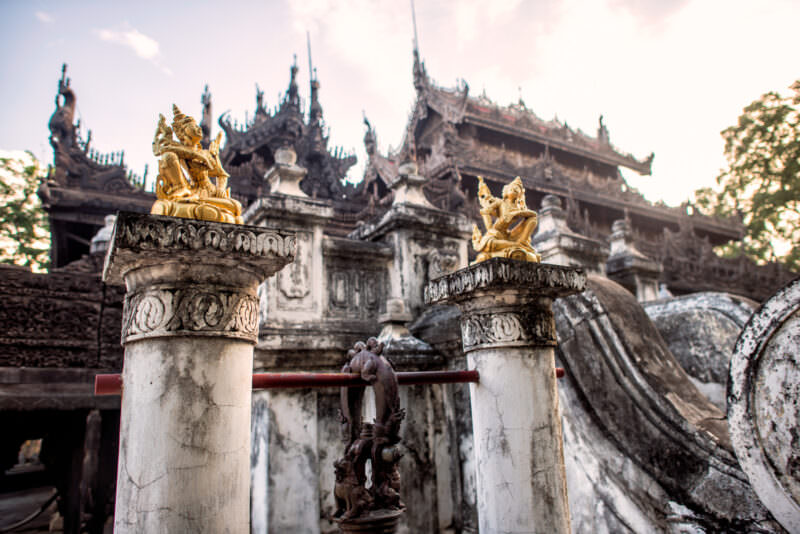
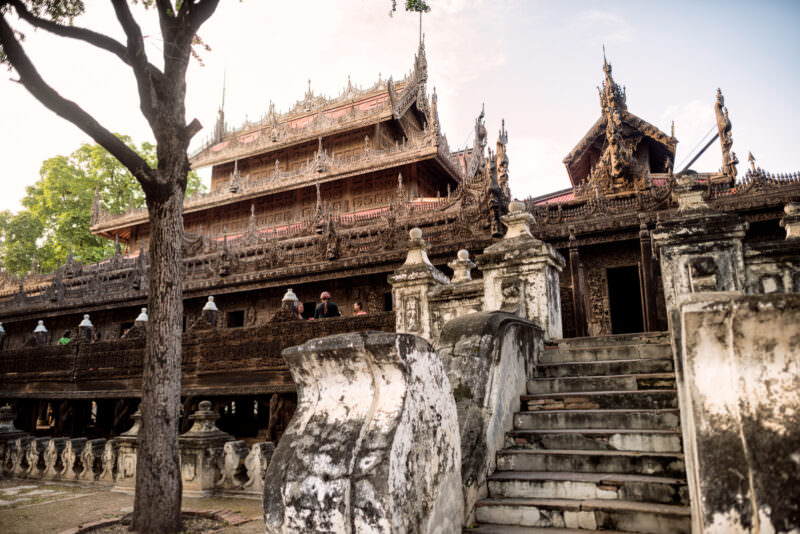
MANDALAY, Myanmar — Gilded celestial figures crown whitewashed stone pedestals in the courtyard of Shwenandaw Monastery (also known as Shwe Nandaw Kyaung), with the deeply carved teak pyatthat roof rising behind them. The contrast between the freshly gilded bronze figures in the foreground and the bare, weathered teak beyond captures the monastery’s defining paradox: named the “Golden Palace Monastery,” its exterior gold was lost to a century of tropical weathering, while its carved teak surface — the most valuable element — survives as Myanmar’s principal remaining fragment of the Mandalay Palace. Photo by David Coleman / Have Camera Will TravelLicense this image at:DirectlyAlamy
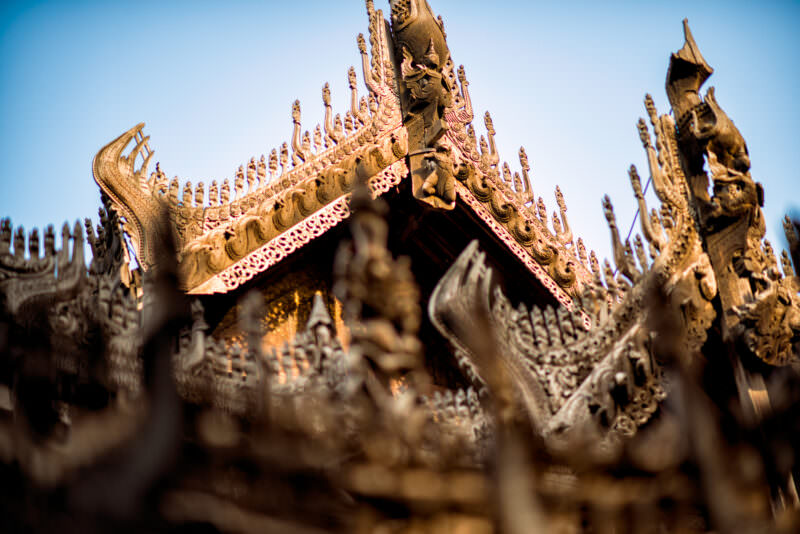
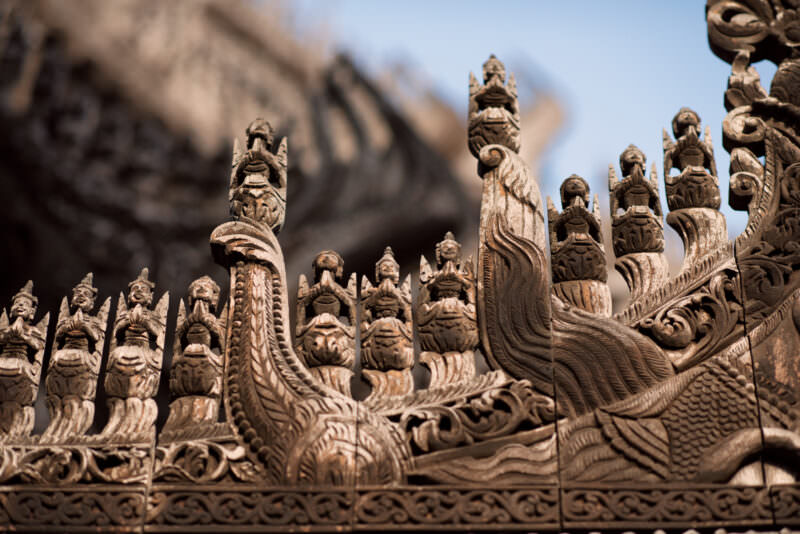
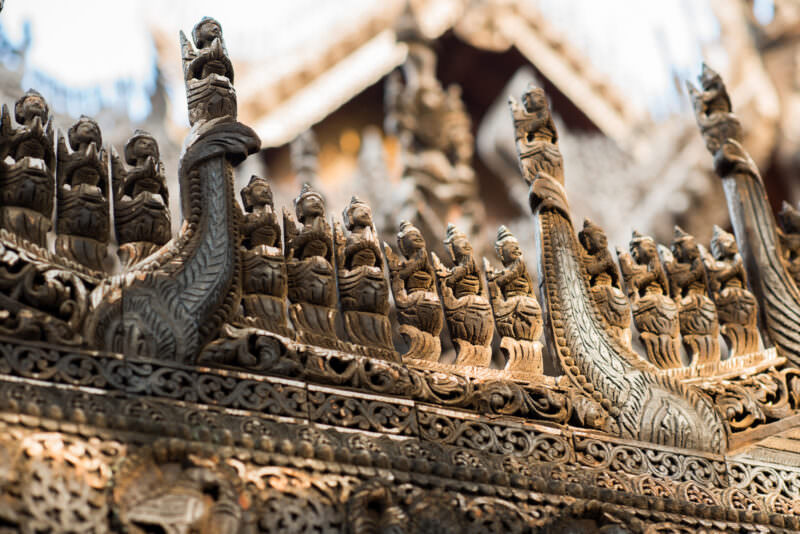
MANDALAY, Myanmar — Dense ranks of teak finials, nagas, and celestial figures sweep across the multi-tiered roofline of Shwenandaw Monastery (also known as Shwe Nandaw Kyaung). The pyatthat roof form — its stacked diminishing tiers a visual marker of Burmese royal and sacred status — survives here as the only intact example from King Mindon’s mid-19th-century Mandalay Palace, the rest of which was destroyed by fire during the Allied assault on the Japanese-held fort in March 1945. Photo by David Coleman / Have Camera Will TravelLicense this image at:DirectlyAlamy
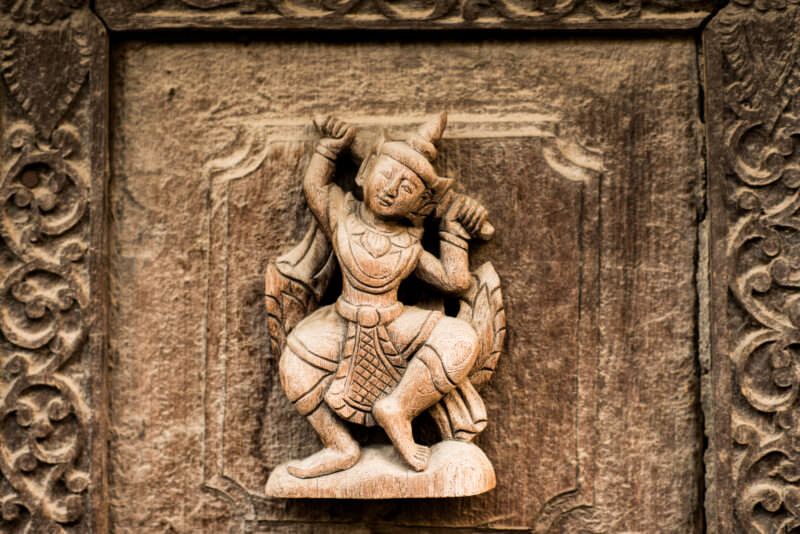
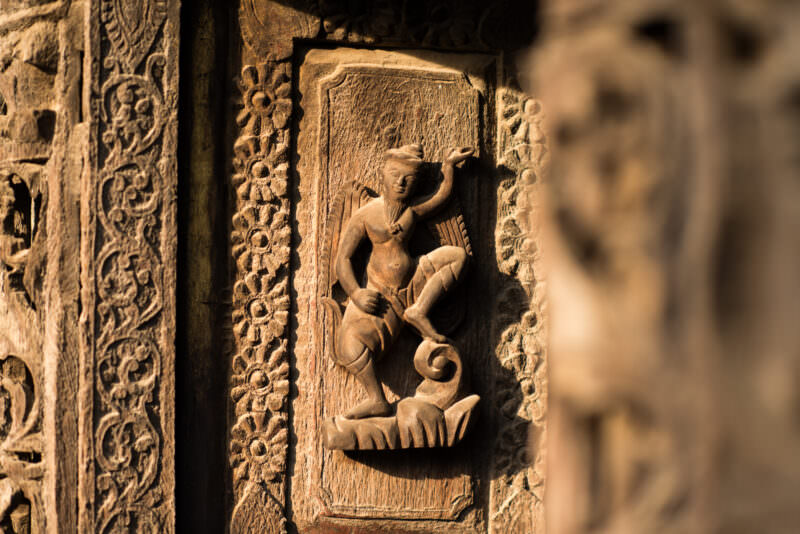
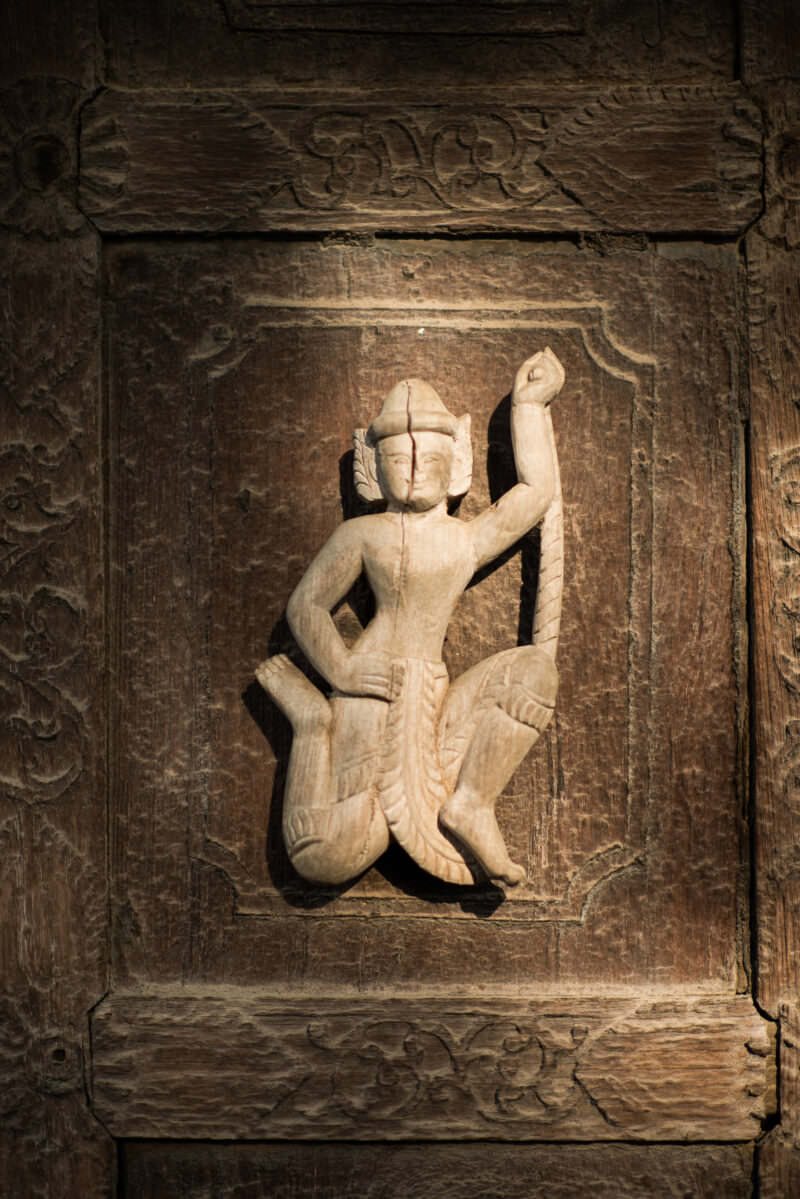
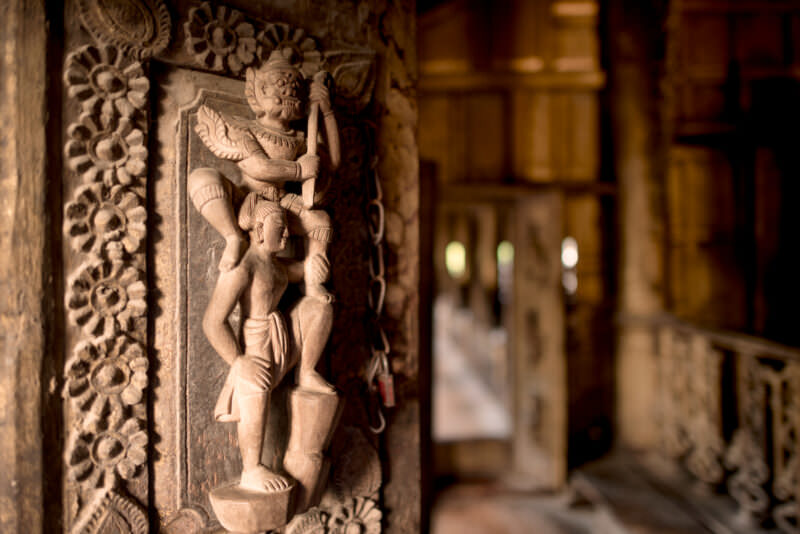
MANDALAY, Myanmar — A court dancer carved in high relief dominates a teak door panel at Shwenandaw Monastery (also known as Shwe Nandaw Kyaung), the figure’s posture drawn from the classical Burmese dance vocabulary codified under the Konbaung court. The panel’s bare, grain-exposed surface shows exactly what the World Monuments Fund conservation project — begun in 2014 — is working to stabilize: carved teak that was richly gilded in the palace era and has been losing its surface to the tropical monsoon climate ever since. Photo by David Coleman / Have Camera Will TravelLicense this image at:DirectlyAlamy
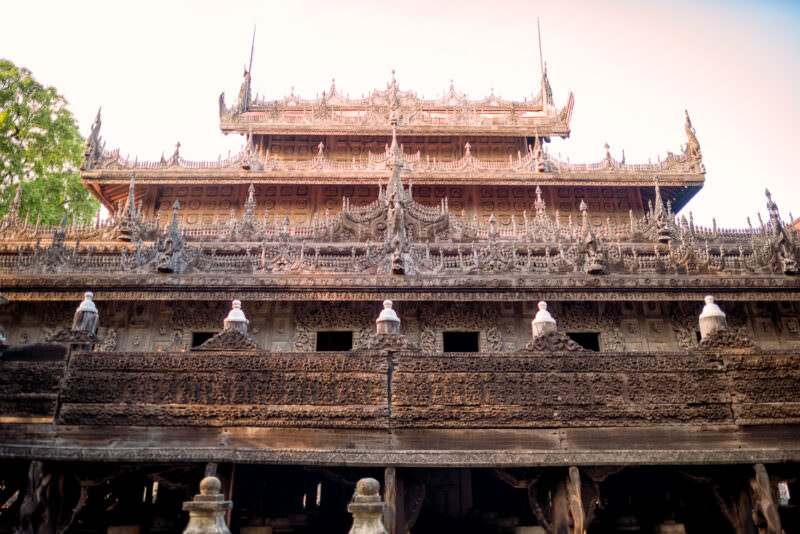
MANDALAY, Myanmar — The upper facade of Shwenandaw Monastery (also known as Shwe Nandaw Kyaung) shows tier upon tier of deep-relief teak carving, finials, and crested eaves-boards rising toward the pyatthat roof — every surface worked in the Konbaung royal idiom. The bare silver-grey teak visible here was once entirely gilded and set with glass mosaic; a World Monuments Fund conservation project begun in 2014 has focused in part on documenting and stabilizing this exterior carving, the most weather-exposed element of the building. Photo by David Coleman / Have Camera Will TravelLicense this image at:DirectlyAlamy
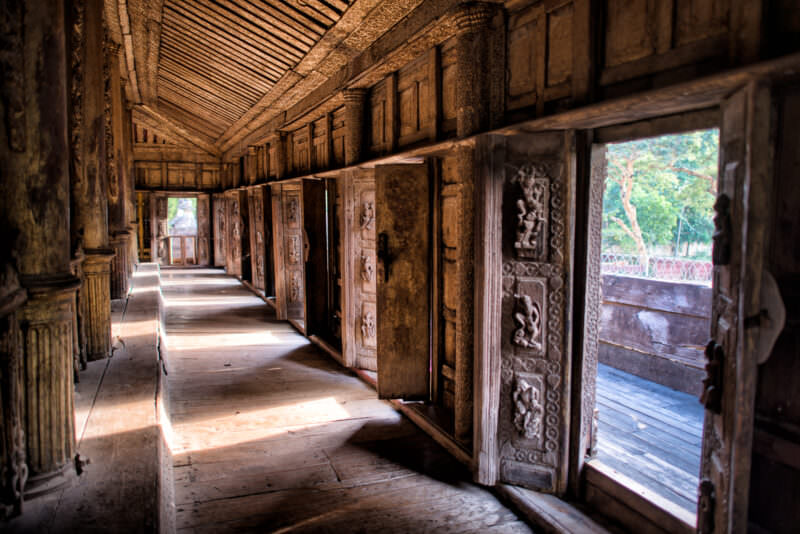
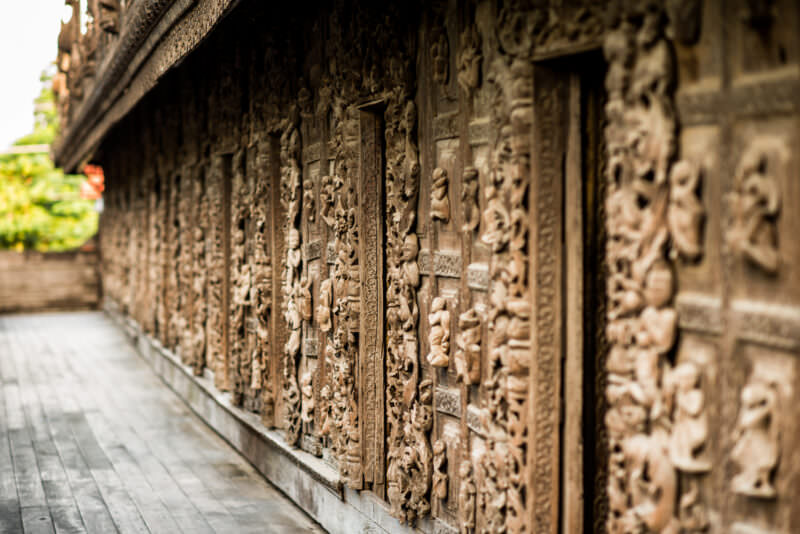
MANDALAY, Myanmar — Carved teak doors line the veranda corridor of Shwenandaw Monastery (also known as Shwe Nandaw Kyaung), the sole surviving timber structure from King Mindon’s 19th-century Mandalay Palace. The door panels carry deep-relief figural carvings — court figures and mythological subjects — that once formed part of the royal apartment where Mindon died in 1878; King Thibaw had the entire building dismantled and moved outside the palace walls as a memorial monastery, a relocation that saved it when Allied forces destroyed the rest of the timber palace in March 1945. Photo by David Coleman / Have Camera Will TravelLicense this image at:DirectlyAlamy
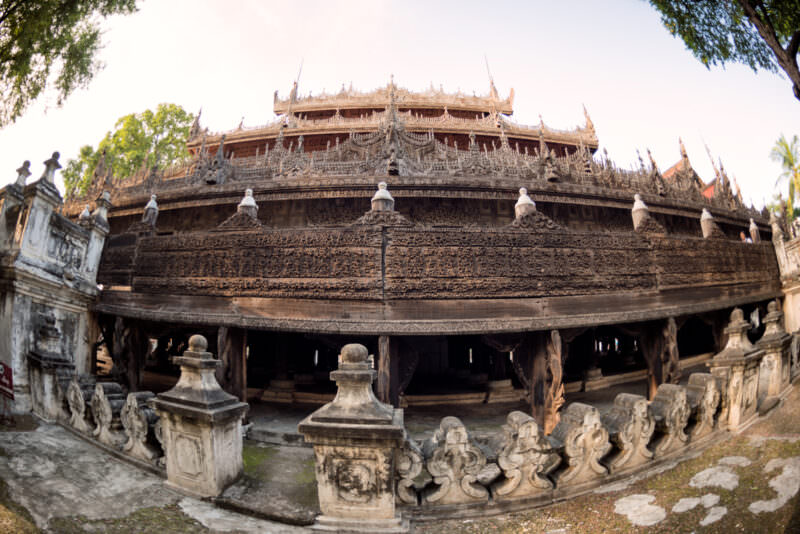
MANDALAY, Myanmar — The silvered-teak exterior of Shwenandaw Monastery (also known as Shwe Nandaw Kyaung) presents unbroken registers of deep-relief carving beneath its tiered pyatthat roof, with a sandstone balustrade running the full perimeter. The bare grey-brown surface tells the building’s material history: the exterior was once gilded and set with glass mosaic, as was standard in Konbaung royal monasteries, but tropical weathering stripped that finish away over a century, leaving carved teak whose original name — “Golden Palace Monastery” — now reads as irony. Photo by David Coleman / Have Camera Will TravelLicense this image at:DirectlyAlamy
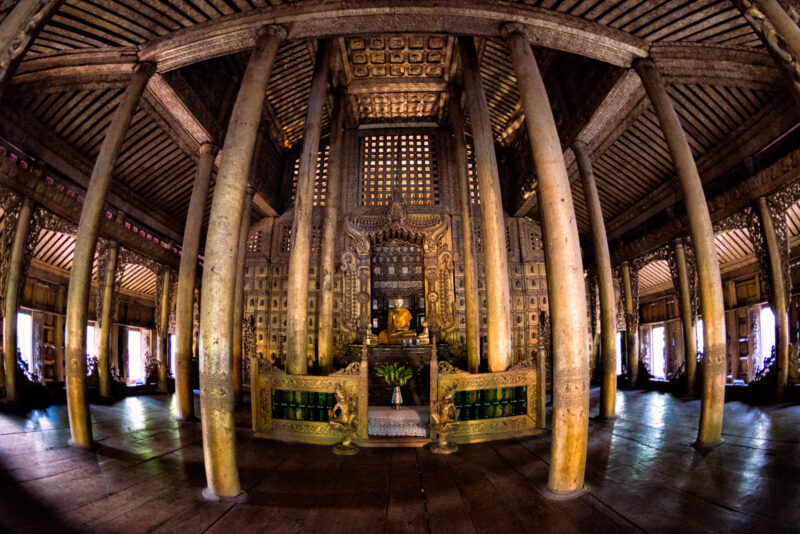
MANDALAY, Myanmar — A fisheye view reveals the full forest of teak columns radiating outward from the central Buddha shrine of Shwenandaw Monastery (also known as Shwe Nandaw Kyaung), the ceiling structure and densely carved walls stretching to every side. Because King Thibaw had the building removed from the palace enclosure in 1878 and re-erected outside the walls, it stood apart from Fort Dufferin when Allied forces destroyed the remaining timber palace in March 1945 — its displacement the accident of survival. Photo by David Coleman / Have Camera Will TravelLicense this image at:DirectlyAlamy
MANDALAY, Myanmar — Gold-leafed teak panels inside Shwenandaw Monastery (also known as Shwe Nandaw Kyaung) display the interlocking vine-scroll and zoomorphic carving of the Konbaung royal style. This gilding survives only in sheltered interior surfaces; the World Monuments Fund conservation project, funded by the U.S. Ambassadors Fund for Cultural Preservation, has worked since 2014 to stabilize these panels against the moisture and lacquer failure that have stripped the exterior bare. Photo by David Coleman / Have Camera Will TravelLicense this image at:DirectlyAlamy
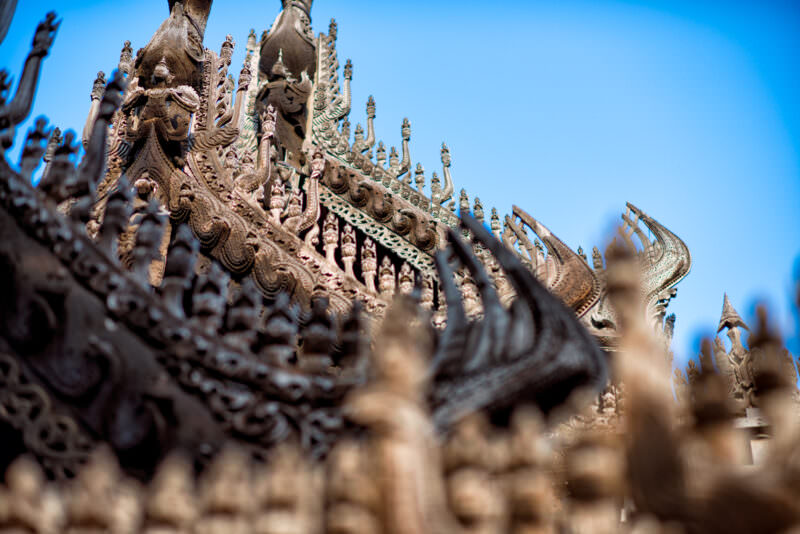
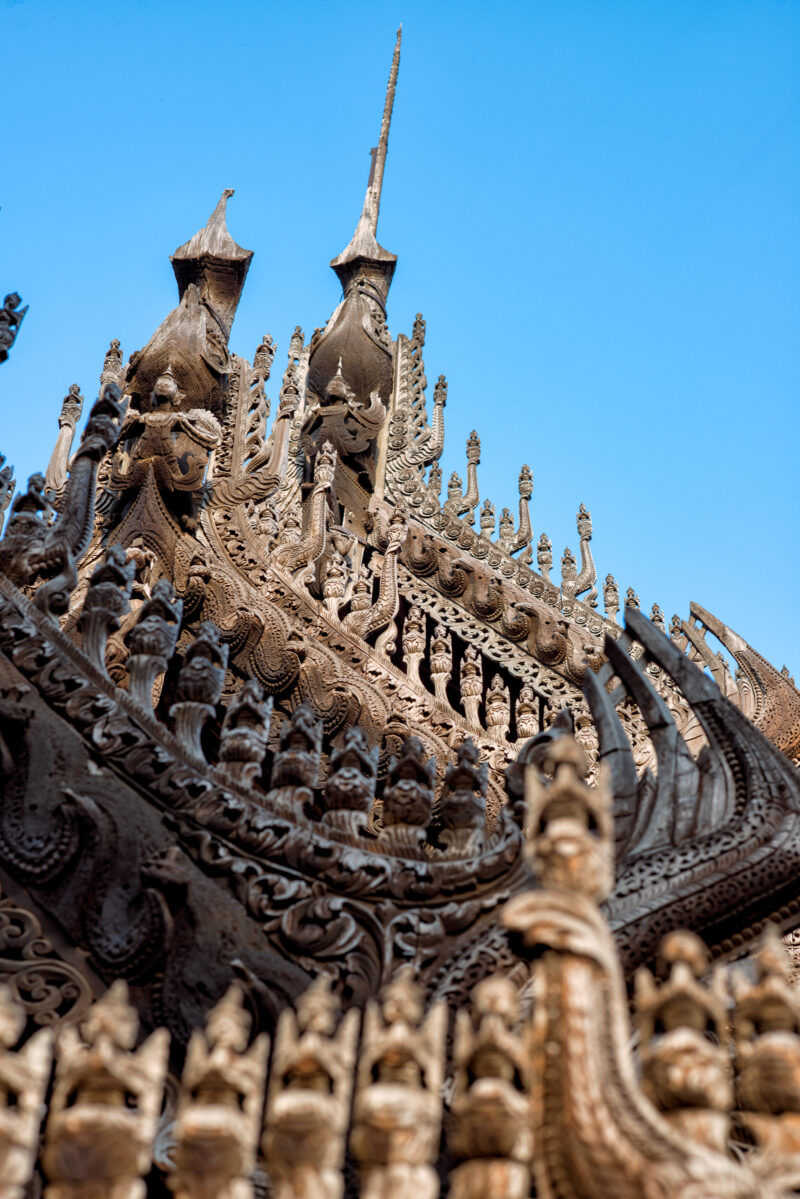
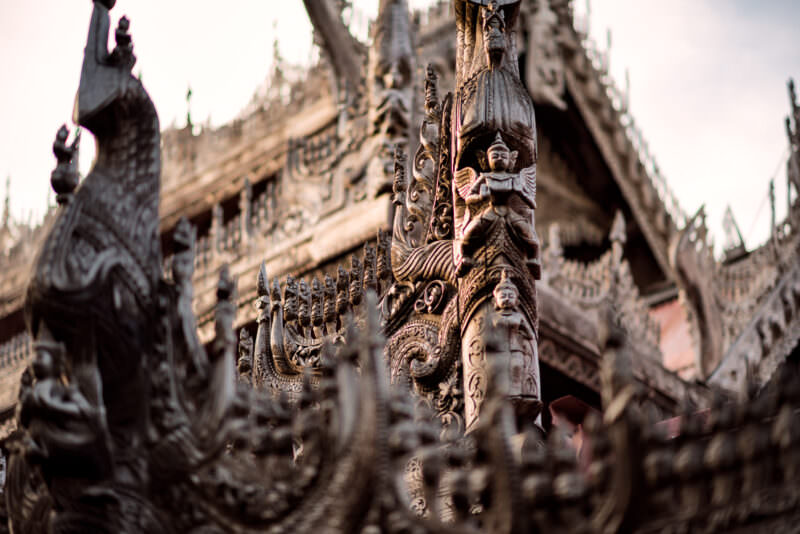
MANDALAY, Myanmar — The tiered pyatthat roofline of Shwenandaw Monastery (also known as Shwe Nandaw Kyaung) bristles with carved teak finials, naga serpents, and mythical figures against a clear sky. The pyatthat — a stacked, diminishing-tier spire form reserved in Burmese royal practice for sacred and royal buildings — marks this structure as a fragment of King Mindon’s palace, the only substantial timber element to survive after the rest of the Mandalay Palace complex burned during the Allied assault of March 1945. Photo by David Coleman / Have Camera Will TravelLicense this image at:DirectlyAlamy
MANDALAY, Myanmar — Jataka panels and registers of mythical figures cover every surface of the exterior walkway wall at Shwenandaw Monastery (also known as Shwe Nandaw Kyaung), receding in forced perspective along the teak-planked veranda. The Jataka — the Buddha’s 547 past-life stories — form the standard narrative program for Burmese royal monastery carving, making these walls a continuous visual scripture that once also blazed with gold leaf and glass inlay when the building was King Mindon’s private palace apartment. Photo by David Coleman / Have Camera Will TravelLicense this image at:DirectlyAlamy
MANDALAY, Myanmar — Sandstone staircases and a weathered balustrade approach the multi-tiered teak facade of Shwenandaw Monastery (also known as Shwe Nandaw Kyaung), the principal surviving timber fragment of King Mindon’s Mandalay Palace. King Thibaw, believing the building haunted by his father’s spirit, had the entire structure dismantled and moved outside the palace walls in 1878 — a superstition that saved it when Allied forces burned the rest of the timber palace in March 1945. Photo by David Coleman / Have Camera Will TravelLicense this image at:DirectlyAlamy
MANDALAY, Myanmar — A celestial dancer carved in high relief occupies a framed teak panel at Shwenandaw Monastery (also known as Shwe Nandaw Kyaung), surrounded by floral scrollwork. The warm, bare wood visible here was once entirely gilded and set with glass mosaic — the Konbaung royal idiom that Mindon applied to all his major monastery buildings; the exterior gilding has weathered away, leaving the silver-grey teak that gives the “Golden Palace Monastery” its quietly ironic appearance today. Photo by David Coleman / Have Camera Will TravelLicense this image at:DirectlyAlamy
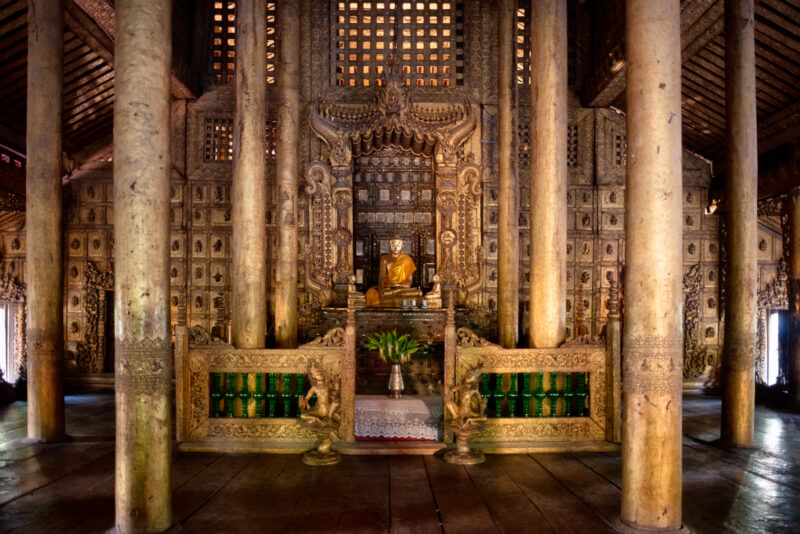
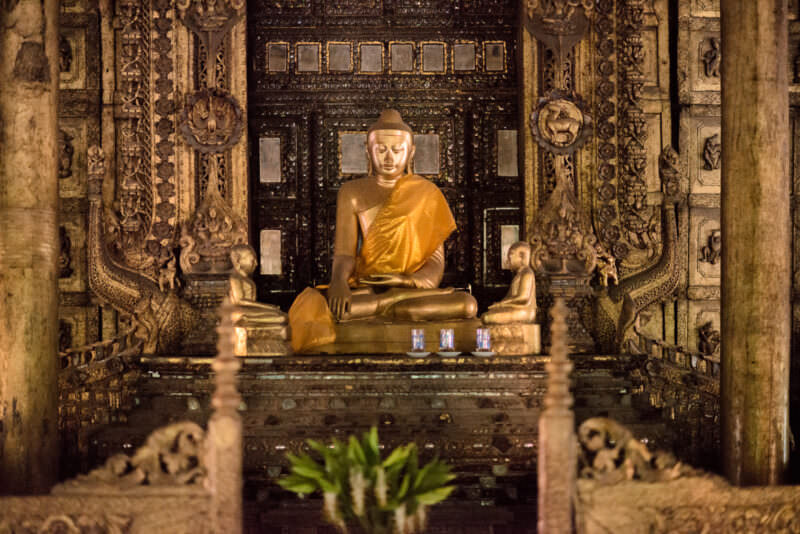
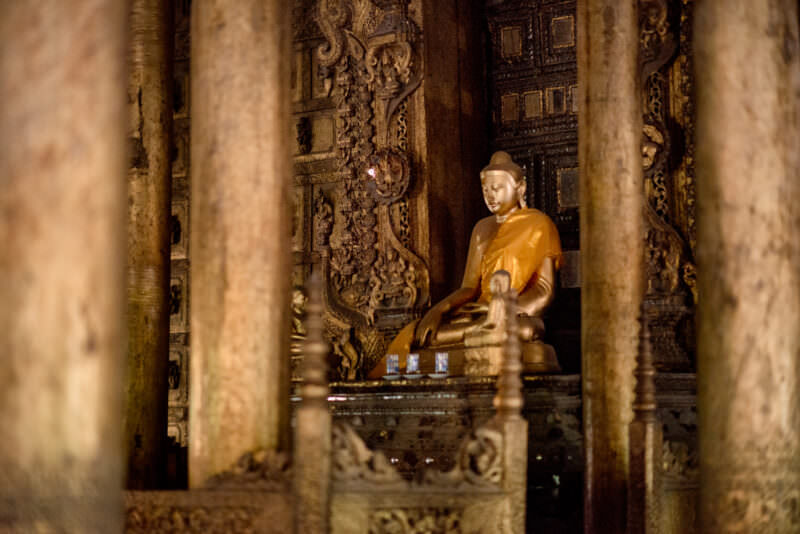
MANDALAY, Myanmar — A gilded Buddha in the bhumisparsha mudra sits enthroned within the carved teak interior of Shwenandaw Monastery (also known as Shwe Nandaw Kyaung), surrounded by lacquered relief panels and flanked by smaller attendant figures. The darkened interior woodwork retains the gilding and lacquer that the exterior has long lost to weathering — a visible record of the World Monuments Fund conservation program’s core challenge: stabilizing a tropical-climate teak building originally designed as a palace apartment, not a monastery. Photo by David Coleman / Have Camera Will TravelLicense this image at:DirectlyAlamy
MANDALAY, Myanmar — The tiered *pyatthat* spire roof of Shwenandaw Monastery (also known as Shwe Nandaw Kyaung), densely worked with nagas, celestial figures, and foliate cresting, rises against a clear sky. The stacked, diminishing-tier spire form was reserved in Burmese practice for royal and sacred buildings, marking this structure — the only standing timber fragment of King Mindon’s Mandalay Palace — as both monastery and palace simultaneously. Photo by David Coleman / Have Camera Will TravelLicense this image at:DirectlyAlamy
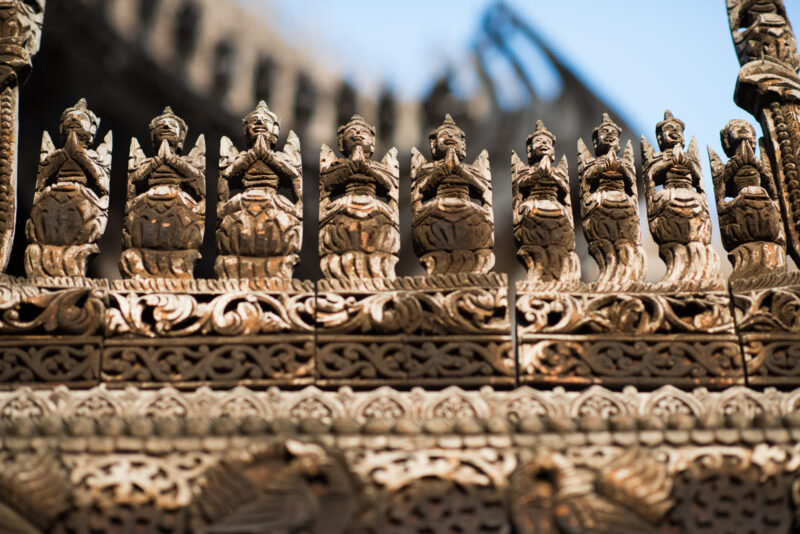
MANDALAY, Myanmar — A row of teak figures in prayer posture (*anjali mudra*) lines the roofline balustrade of Shwenandaw Monastery (also known as Shwe Nandaw Kyaung), above a band of dense foliate relief. King Thibaw had the building — his father King Mindon’s private palace apartment — dismantled and removed from the royal city after Mindon’s death in 1878; its relocation outside the palace walls is the reason it alone escaped the fire that destroyed the rest of the timber palace in March 1945. Photo by David Coleman / Have Camera Will TravelLicense this image at:DirectlyAlamy
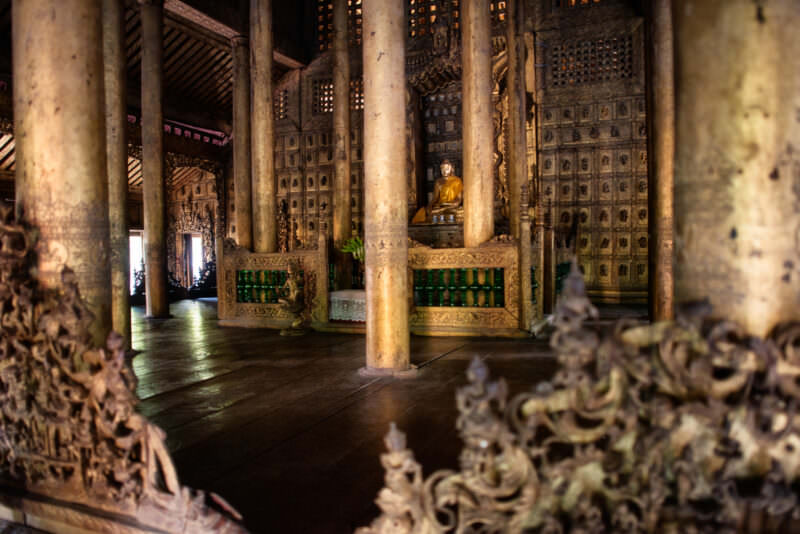
MANDALAY, Myanmar — A gilded Buddha presides from the central shrine of Shwenandaw Monastery (also known as Shwe Nandaw Kyaung), seen through a forest of massive teak columns, with Jataka relief panels covering every wall surface. The green glass-mosaic inlay visible on the altar rail is a survival of the original Konbaung royal decorative program — the same gilt-and-glass vocabulary that once covered the entire building when it stood as King Mindon’s private apartment inside the Mandalay Palace. Photo by David Coleman / Have Camera Will TravelLicense this image at:DirectlyAlamy
MANDALAY, Myanmar — Mythical creatures and crowned figures crowd the eave-boards of Shwenandaw Monastery (also known as Shwe Nandaw Kyaung), the sole surviving timber fragment of King Mindon’s 1857 – 1859 Mandalay Palace. The silvered, gilding-free exterior tells its own story: this royal apartment once blazed with gold leaf and glass mosaic, finishes that survive today only on the sheltered interior carving. Photo by David Coleman / Have Camera Will TravelLicense this image at:DirectlyAlamy
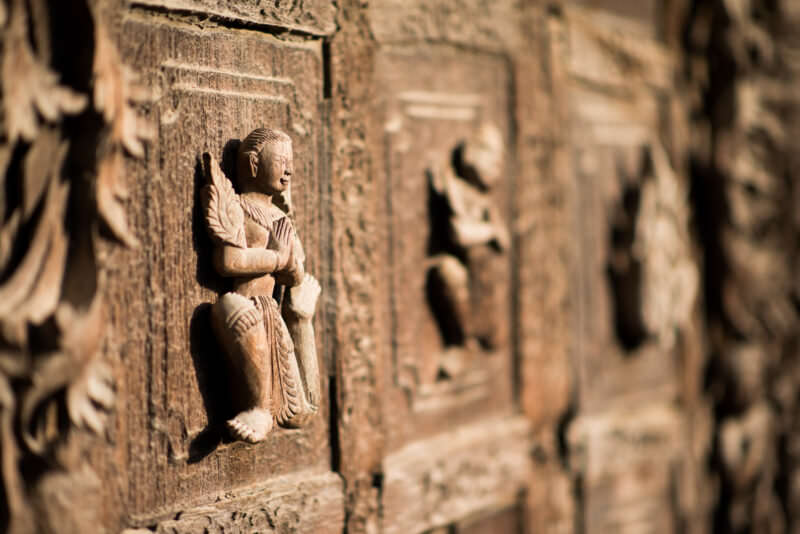
MANDALAY, Myanmar — A praying teak figure in shallow relief adorns an exterior panel of Shwenandaw Monastery (also known as Shwe Nandaw Kyaung), the sole surviving timber structure of King Mindon’s Mandalay Palace. The exterior gilding that once covered figures like this has weathered entirely away; what survives is the carving itself — teak hard enough that tropical weathering erodes the surface detail but rarely destroys the form, preserving this 19th-century Konbaung royal iconographic program intact. Photo by David Coleman / Have Camera Will TravelLicense this image at:DirectlyAlamy
MANDALAY, Myanmar — A newly carved teak court dancer occupies a door panel at Shwenandaw Monastery (also known as Shwe Nandaw Kyaung), its pale, unweathered wood distinguishing it from the silver-grey originals around it. The figure is consistent with the replacement-carving campaign carried out under the World Monuments Fund conservation project, which trained younger craftspeople under master carver U Kan Khyunt to produce panels matching the 19th-century originals. Photo by David Coleman / Have Camera Will TravelLicense this image at:DirectlyAlamy
MANDALAY, Myanmar — A row of weathered teak figures crowds the eave-board of Shwenandaw Monastery (also known as Shwe Nandaw Kyaung), their gilding long stripped by tropical weathering. These figures once formed part of a surface sheathed inside and out in gold leaf and glass mosaic — the full royal Konbaung treatment — but the exterior gilding has weathered to bare silver-grey teak, making the “Golden Palace Monastery” now golden in name only. Photo by David Coleman / Have Camera Will TravelLicense this image at:DirectlyAlamy
MANDALAY, Myanmar — A deep-relief teak panel inside Shwenandaw Monastery (also known as Shwe Nandaw Kyaung) depicts a demon seizing a human figure, a narrative motif drawn from the Jataka — the past-life stories of the Buddha — that cover the building’s exterior and interior surfaces. The carving program is the defining feature of Burma’s Konbaung royal teak monasteries, a tradition now rare: large-format teak and the craftsmen to carve it have both grown scarce, making the Shwenandaw’s survival the principal record of the type. Photo by David Coleman / Have Camera Will TravelLicense this image at:DirectlyAlamy
MANDALAY, Myanmar — A gilded Buddha shrine seen through massive teak columns inside Shwenandaw Monastery (also known as Shwe Nandaw Kyaung), the sole surviving original timber structure from King Mindon’s Mandalay Palace. The heavy teak posts carry a hall that began as a royal apartment; when Thibaw had the entire carved structure dismantled and re-erected outside the palace walls in 1878, the forest of columns came with it — now framing a Buddhist image where a king once lived. Photo by David Coleman / Have Camera Will TravelLicense this image at:DirectlyAlamy
MANDALAY, Myanmar — Close-up detail of the silver-grey carved teak exterior of Shwenandaw Monastery (also known as Shwe Nandaw Kyaung), showing celestial figures, nagas, and foliate ornament on the roof structure. The building’s “Golden” name now survives only in irony: once gilded and set with glass mosaic inside and out, the exterior gilding has entirely weathered away, leaving bare teak while lacquered and gilded finishes persist in sheltered interior carving. Photo by David Coleman / Have Camera Will TravelLicense this image at:DirectlyAlamy
More about Shwenandaw Monastery
Originally built in Amarapura during the 19th century
Moved to Mandalay by King Mindon who used it as his personal apartment
Reconstructed as a monastery by King Thibaw due to concerns of the building being haunted by King Mindon’s spirit
Features traditional Burmese architecture and craftsmanship
Known for its intricate wood carvings, which include Jataka tales, floral motifs, and mythical creatures
Initially gilded in gold, earning it the name Golden Palace Monastery
Most of the gold has worn off, revealing the carved teak wood beneath
Located in Mandalay, Myanmar
The Shwenandaw Monastery, also known as Shwenandaw Kyaung, is a historic Buddhist monastery situated in Mandalay, Myanmar. This stunning teak wood structure was built in the 1850s and showcases the exquisite craftsmanship and traditional Burmese architecture of the period. Initially part of the royal palace complex in Mandalay, King Mindon used it as his personal apartment. After his death in 1878, his son King Thibaw had the building dismantled and moved outside the palace walls. Following his death, his son King Thibaw reconstructed the building as a monastery due to concerns that it was haunted by his father’s spirit.
Visitors to Shwenandaw Monastery can admire the intricate wood carvings that cover both the interior and exterior of the building. These carvings depict scenes from the Jataka tales, stories of the previous lives of the Buddha, as well as traditional Burmese floral motifs and mythical creatures. Although the monastery was once covered in gold, much of it has worn off over time, revealing the beautifully carved teak wood beneath.
Shwenandaw Monastery is located in Mandalay, Myanmar. The nearest major airport is Mandalay International Airport (MDL). From there, visitors can take a taxi or arrange transportation to the monastery, which is situated in the heart of the city.
Have Camera Will Travel // Newsletter
Practical field notes, hands-on gear tests.
Mandalay, Myanmar (Burma)
What to know before you go
While it’s no longer a functioning religious site, it once was. So you’ll still have to take your shoes off.
Shwenandaw Monastery FAQs
What is the history of Shwenandaw Monastery?
Shwenandaw Monastery was built in the 19th century as part of the Mandalay Royal Palace complex. It was originally known as the Golden Palace Monastery, and was built entirely out of teak wood. After King Mindon’s death in 1878, his son, King Thibaw, moved the building outside the palace walls and converted it into a monastery.
How old is the teak wood used in Shwenandaw Monastery?
The teak wood used in the construction of Shwenandaw Monastery is estimated to be over 150 years old. It is said to have been salvaged from the former Mandalay Palace, which was destroyed during the British invasion of 1885.
What is the significance of the carvings on the exterior and interior of Shwenandaw Monastery?
The carvings on the exterior and interior of Shwenandaw Monastery depict scenes from Buddhist mythology and the life of the Buddha. They are considered to be some of the finest examples of traditional Burmese woodcarving.
How can I get to Shwenandaw Monastery?
Shwenandaw Monastery is located in the heart of Mandalay, Myanmar, about 1.2 miles (2 km) north of the city center. It is easily accessible by taxi, motorbike, or on foot from most parts of the city. It is also often included as part of guided tours of Mandalay’s historical sites. It is open daily from 9:00 AM to 5:00 PM, and there is a small entrance fee for visitors.
What is the significance of Shwenandaw Monastery?
Shwenandaw Monastery, also known as the Golden Palace Monastery, is a historic Buddhist monastery in Mandalay, Myanmar. It is famous for its exquisite teak wood carvings depicting scenes from the Jataka tales and traditional Burmese motifs. The monastery was originally part of King Mindon’s royal palace but was dismantled and reassembled as a separate structure to preserve its unique artistry.
Enjoyed this article? Personalize your search results.
I'm a freelance travel photographer based in Washington DC. Seven continents, up mountains, underwater, and a bunch of places in between. My images have appeared in numerous publications, and you can check out some of my gear reviews and tips here. More »