When your camera saves a RAW file, it doesn’t just save the sensor data. It also generates a processed JPEG preview and embeds it directly into the RAW file. This is the image you see on your camera’s LCD screen, and it’s what fast culling apps like Photo Mechanic use to show you thumbnails almost instantly — no RAW rendering required.
Why Extract the Embedded JPEG?
- Speed: Extracting an existing JPEG is nearly instantaneous compared to rendering a RAW file from scratch.
- In-camera look: If you shot with a specific Film Simulation, Picture Style, or other in-camera profile, that rendering is baked into the embedded JPEG but ignored by RAW processors like Lightroom. Extracting it is the only way to get that exact look without replicating it manually.
- Corruption salvage: If a RAW file is corrupted and won’t open, the embedded JPEG is often still intact and can be rescued. It’s one of the few options available when you have no working backup.1
- Lightweight sharing: Quickly pull “good enough” files to send or post without running a full export workflow.
Here are the main tools for extracting those embedded JPEGs from RAW files.
Apps and Tools to Extract JPG Previews from RAW Files
While there aren’t many apps that can do this, there are a few that take different approaches.
RawPreviewExtractor
This is a paid app (but not expensive) and is currently the most powerful of dedicated apps for this purpose (Instant JPEG from RAW used to the go-to, but it has been abandoned).
It does basically what the free ERawP app does (more on that below), except for one important feature: it copies the EXIF data from the Raw file to the extracted JPEG.
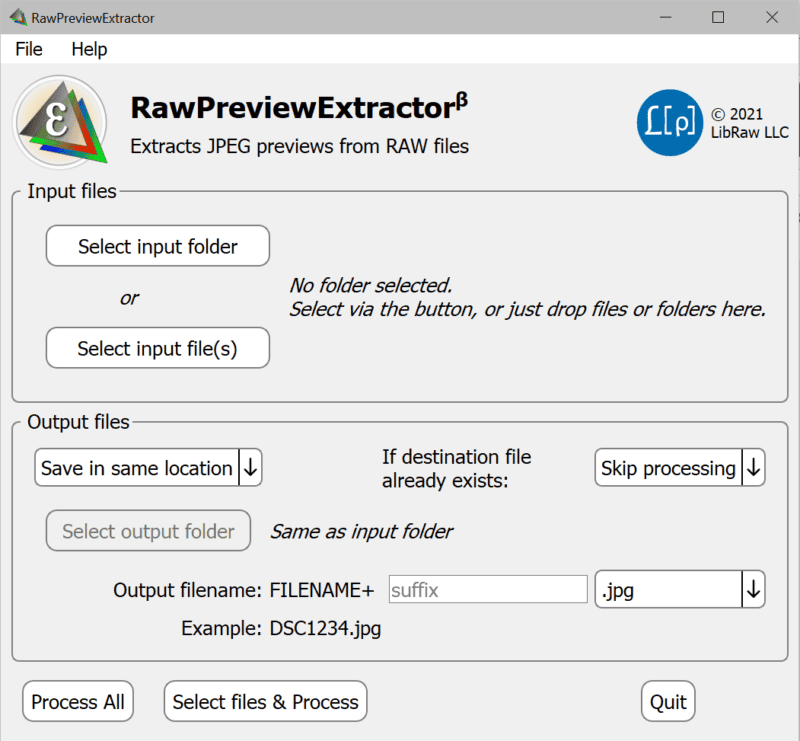
It’s available for Windows and Mac, and you can find it here.
ERawP
The ERawP app (Extra Raw Preview) by Fulvio Senore is the most straightforward free dedicated tool for this job. It’s free, open-source, and available for Windows, Linux, and Mac.
The workflow is about as simple as it gets: select your source directory, choose a destination folder, and hit go.

The main caveat is that ERawP isn’t actively developed — it’s been at version 1.0 for some years, and the documentation is sparse. For common formats like CR2, NEF, and ARW it works well. For newer or less common proprietary RAW formats, your mileage may vary. Worth testing on a sample batch before committing to it for a large job.
You can download ERawP here.
ExifTool
ExifTool by Phil Harvey is free, extraordinarily powerful, and actively maintained.
The tradeoff is that it’s a command-line tool, and extracting embedded JPEGs has a wrinkle: depending on the camera manufacturer, the embedded JPEG may be stored under different tag names inside the RAW file’s metadata structure. There’s no single universal command that works across all formats.
The two most common tags to try are JpgFromRaw and PreviewImage. JpgFromRaw tends to contain a higher-quality or full-resolution JPEG on cameras that embed one (Canon CR2/CR3, Nikon NEF, and others).
PreviewImage is a fallback that works more broadly across formats but may only contain a medium-resolution preview. Try JpgFromRaw first — if it produces an empty or tiny file, switch to PreviewImage.
To extract from all files of a specific type in a folder, using Sony ARW as the example:
exiftool -b -JpgFromRaw -w _preview.jpg -ext ARW -r .Instructions: Change ARW to your camera’s RAW extension: NEF (Nikon), CR2 or CR3 (Canon), RAF (Fujifilm), ORF (Olympus/OM System), DNG, etc.
The-w _preview.jpgflag appends_previewto each original filename for the output. The-rflag processes subfolders recursively.
The period at the end is part of the command. It tells ExifTool to process the current directory. Make sure you’ve navigated to the right folder first withcd /path/to/your/folder, or on a Mac, by typingcd(with a trailing space) and then dragging the folder from Finder into the Terminal window.
If JpgFromRaw produces empty files for your format, substitute -PreviewImage instead:
exiftool -b -PreviewImage -w _preview.jpg -ext ARW -r .For those who’d rather avoid the terminal, ExifToolGUI (Windows) and jExifToolGUI (Mac/Windows/Linux) put a graphical interface on top of ExifTool. That said, the tag-name variation between manufacturers means it’s still not entirely simple even with a GUI.
Photo Mechanic
Photo Mechanic is the tool photojournalists and sports photographers reach for precisely because it only uses embedded previews — it never renders RAW data until you explicitly ask it to, which is why it displays thumbnails so much faster than Lightroom or other RAW processors.
The export function (in current versions, Tools > Export JPEG Previews) extracts those embedded JPEGs directly. If you shoot high volume and need the fastest possible turnaround, it’s the best option available.
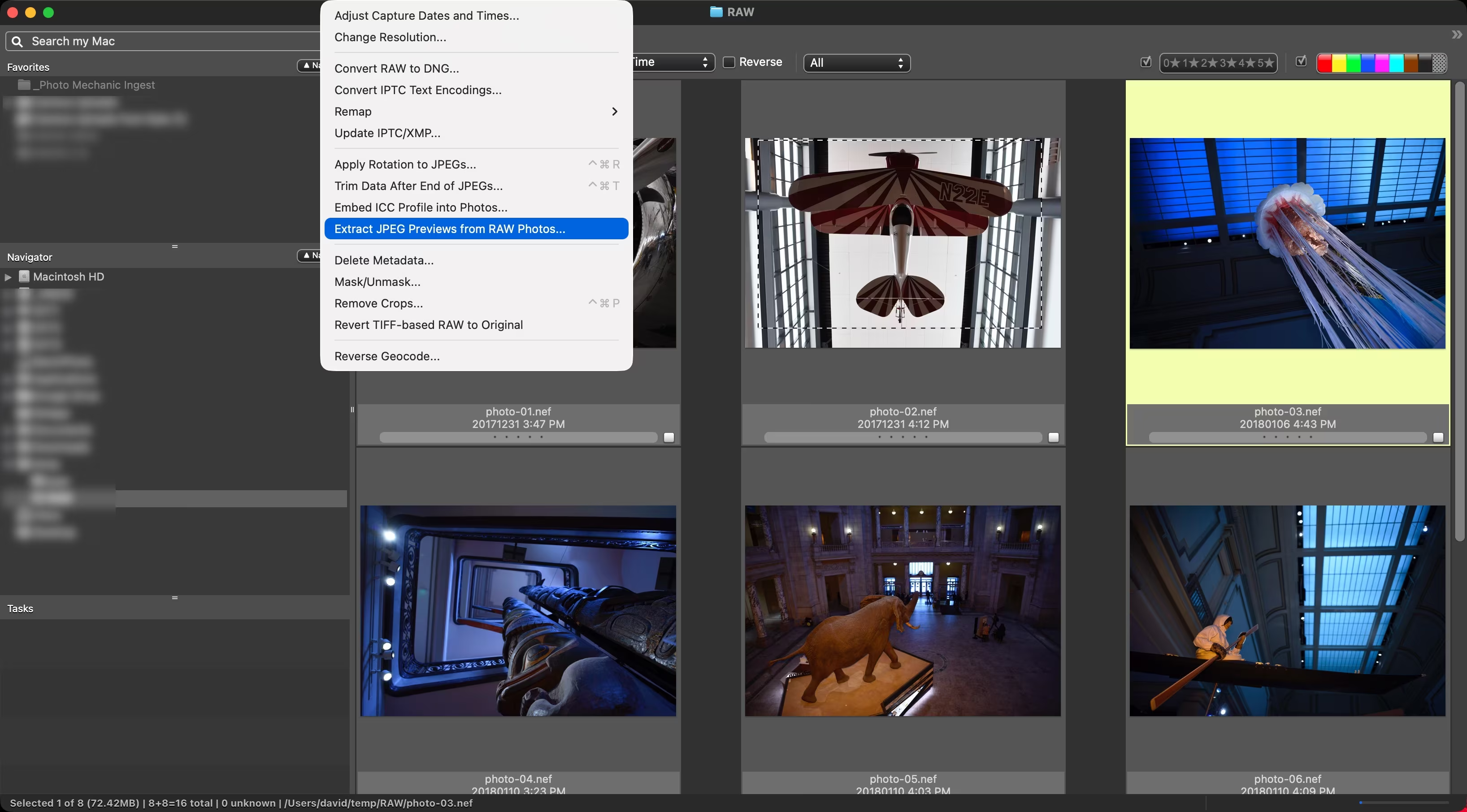
The catch: Photo Mechanic isn’t cheap, which makes this a practical option mainly if you’re already using it — or planning to, since it’s genuinely useful well beyond just JPEG extraction.
Things Worth Knowing
RAW formats never quite turned into the Wild West that some feared when they first appeared, but they’re also not particularly uniform. So mileage will vary according to format and camera, and there are some things worth knowing about this process.
Resolution Varies by Camera
Not all embedded JPEGs are the same size. Some cameras embed a full-resolution JPEG; others only embed a medium-sized preview (2048px or similar). If your extracted files look smaller than expected, check your camera’s “Preview Size” or “Image Quality” settings — many cameras let you choose the embedded preview resolution independently of the RAW file.


The Lightroom Non-Solution
Lightroom Classic’s Embedded & Sidecar preview option at import uses the embedded JPEG for fast initial display, which makes culling much quicker.
But Lightroom provides no way to actually export or save those embedded JPEGs to disk — it will always render its own version on export. For that, you need one of the tools above.
Salvaging Corrupted RAW Files
If a RAW file is corrupted and won’t open in Lightroom or any RAW processor, the embedded JPEG preview is often still readable — it occupies a small, self-contained section of the file that frequently escapes the corruption.
In that case, the same tools I’ve mentioned above can be very useful.
Notes & References:
- Bampton, Lightroom — The Missing FAQ, 2015, p. 542. [↩︎]