The short answer
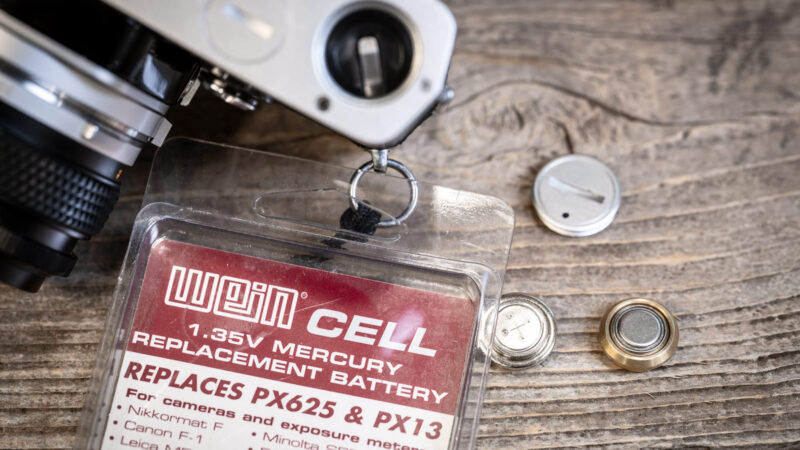
If you’ve dug out an old film camera, as I did recently when I dug out my old Olympus OM-1 (the film version from 1972), you might run into a bit of a problem. Film is still easy enough to get, even if the range of options has shrunk. But getting the right batteries can be less so.
Many old film cameras don’t need a battery to run at all because they’re fully mechanical. But some need a battery only for the light meter. You can shoot without it, but a built-in light meter sure is convenient. (Some also need a battery for some shutter speeds, but not all.)
If you find your camera needs a PX625, PX13, PX400, PX675 or similar battery, it was designed around a mercury cell. Those haven’t been legally sold in the United States since 1996 because mercury is so toxic for the environment (and us!).
So what can you do? There isn’t a true drop-in 1:1 replacement, but there are some workarounds. Each of the modern workarounds is imperfect, but they’re still useful for getting your camera up and running.
There are four basic options, in order of complexity:
- A modern silver-oxide cell that fits but shows the meter a little high, but consistently
- An adapter that drops a modern cell’s voltage to the right level
- A zinc-air cell that gives the right voltage but dies quickly
- Or having the meter recalibrated by a technician
Before I dive deeper, a quick warning up front: there is a 1.5 volt alkaline cell that you can buy that is in the PX625 shape. It fits perfectly. But it’s also the least-good option available. More on that below.
How much does your camera meter actually care?
But before you start down one of the more involved and expensive paths, it’s worth a quick test to see how much your camera meter actually cares. Because some kinds of light meters are more forgiving of a little voltage variation than others.
Basically, it depends on how the meter circuit was designed. There are two types.
Bridge-type circuits are relatively tolerant. Where the meter is built as a balanced bridge, the reading depends on the ratio between two arms of the circuit rather than the absolute supply voltage. Feed it a higher voltage and both arms rise together, so the reading barely moves. Cameras like this often run a 1.55 V silver-oxide cell with an error small enough to ignore on negative film, which is more forgiving on exposure.
Simple circuits are not tolerant. Where the meter reads the light cell’s output directly against the battery as a reference, a 1.55 V cell in place of a 1.35 V cell shifts the reading — usually toward underexposure, because the meter thinks there is more light than there is. On slide film, that’s a real problem because of how unforgiving slide film is on exposure.


The Quick & (Relatively) Cheap Test
I haven’t found a master list of which cameras used each of those meter types, but there’s a quick and cheap way to find out which you have that doesn’t involve math or tearing the camera apart. Just drop a fresh silver-oxide cell into the camera (and make sure it’s fresh, because voltage will drop off on old batteries), point the camera at an evenly lit surface, and compare its reading against a meter you trust — a handheld meter if you have one, but more conveniently another camera at the same ISO or even one of the light meter apps you can get for your phone.
It’s worth doing at several brightness levels, because the error is often not constant across the range. A camera reading half a stop high in bright light may read a stop and a half high in dim light.
If it’s off by a consistent amount, there’s a good chance that the meter is the bridge-type circuit, and it’s pretty easy to factor in with your exposure settings. You can just give a little more exposure than the meter recommends. So you can probably stick with that battery and head out shooting.
If the variance is all over the place, that’s much trickier to account for on the fly, in which case you might want to explore the other options.
Four (+ one) mercury battery replacement strategies for cameras
1. A modern silver-oxide cell
This is probably the best option for most shooters most of the time. Especially if you’re shooting negative film, which is more forgiving on exposure than slide film. It’s the cheapest and simplest option. And because silver oxide discharges evenly, whatever the error turns out to be, it stays constant over the cell’s life. That’s what makes it practical to simply correct.
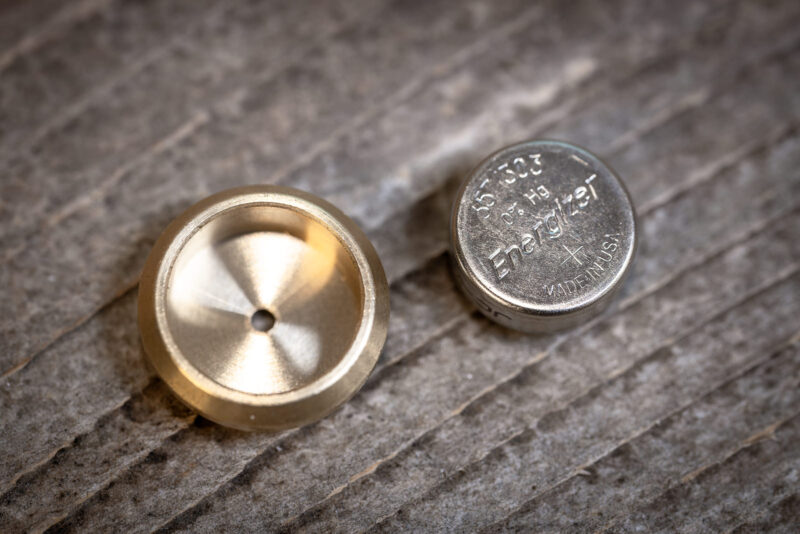
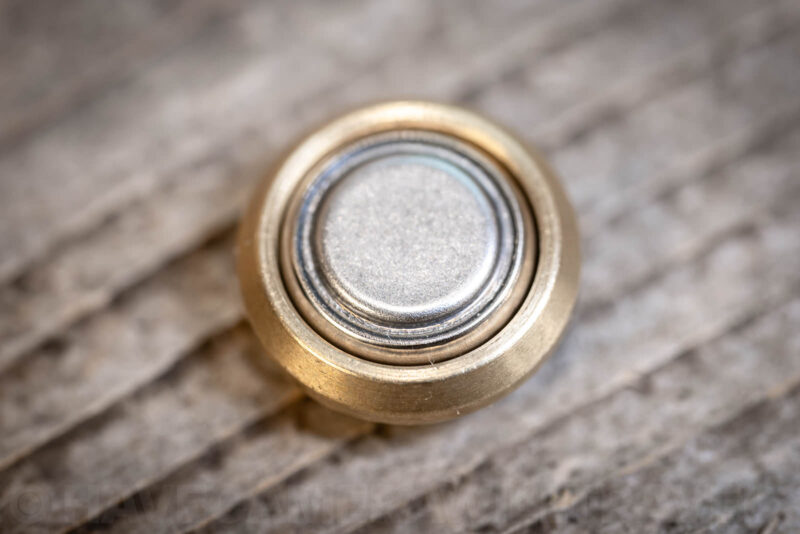
Get: An SR43 or SR44 with a spacer for the mechanical fit, and run it at its native 1.55 V. Your camera probably needs 1.35 V. The battery is 1.55V. So the meter is going to read high.
A small catch: The SR43 and SR44 batteries are not the same physical size of the PX625, so you’ll need a small spacer for the mechanical fit. Unlike the adapter below, this is simply a spacer and has no effect on the current. You can buy them cheaply on Amazon and elsewhere — they’re often machined brass. But don’t believe it if it says it “converts” voltage — it doesn’t (there are specialized versions that do, but they’re significantly more expensive and harder to find; more on those in the next section).
Cons: There are two main downsides. Firstly, the meter reading is going to be off. But at least it’s consistently off. Secondly, it’s a flawed option if your camera has a simple-circuit meter.
How to correct it: There are a couple of ways to correct for the consistent meter variance. First, measure the error as above. Then, two options. The simplest is to factor it into the film speed ISO/ASA setting on the camera. If the meter reads two-thirds of a stop high with ISO 400 film, set the dial to 250. That way, you can continue using the meter as usual and middle the reading. If you prefer, you can instead set the camera’s film speed at the film’s actual speed and just adjust for it on the fly as you’re shooting. In either case, it costs nothing and works well so long as the error is reasonably constant across the brightness range.
2. A voltage-dropping adapter (MR-9 and similar)
If you’re shooting slide film, or have determined that your camera’s meter is a simple-circuit style that’s more sensitive to voltage variances, a better option is to use a voltage-dropping adapter.
It starts with the same battery as above, an SR43 or SR44, but instead of a plain spacer you use a small adapter that bridges the size difference between a PX625 and the SR43/SR44 and actually drops the voltage from 1.55 V to about 1.35 V.
Pros: This is the closest thing to a genuine fix — it corrects the voltage rather than working around it. The cells inside are cheap and available anywhere, and the adapter is reusable indefinitely, so you only need to buy it once.
Cons: The voltage-dropping adapter costs substantially more than a battery; this is a precision accessory, not a consumable. It is also thicker than some compartments expect and does not fit every camera. So be sure to check your specific model first.
3. A zinc-air cell (WeinCELL or hearing-aid cells)
A WeinCELL is a special kind of battery that is the same physical size as the PX625 and also matches its voltage closely (1.35 V to 1.4 V).
Sounds perfect. And it’s what I did initially. But there’s a catch, and it’s to do with their chemistry. It’s what is known as a zinc-air cell (also used in hearing-aid batteries).
When you install a zinc-air battery, you peel a sticker off the back. And from the moment you do that, the battery starts depleting, because the chemistry generates the power by taking oxygen from the air, and once that starts, the reaction keeps running until it stops (expect weeks to months, but not a year). They’re also sensitive to humidity and affected by altitude.
So this is viable as a cheap, short-term option. But it’s less convenient longer-term unless you’re willing to change batteries often.
The cheaper variant: A hearing-aid zinc-air cell (size 675) fitted with an O-ring or spacer to take up the diameter difference. You get the same voltage advantage, same short life, but at a fraction of the price. The downside is that you’re improvising the mechanical fit.
4. Recalibration by a technician
This is the “best” option in terms of being a permanent fix. But it’s also the most involved and expensive.
It’s to have a repair technician adjust the meter circuit to read correctly on 1.55 V. From then on, you can just use the SR43/SR44 batteries (1.55 V) as normal, with the difference being that you no longer need to remember to offset the film speed setting or exposure values.
This isn’t a DIY job, and it’s not something every service technician will offer.
Tip: This might not be cost-effective as a standalone service job, but if you’re already sending the camera in for service anyway, they might be able to bundle a meter calibration as part of the same job. So worth asking.
5. Don’t use the built-in meter at all
So here’s the plus one. It’s to ditch the camera’s built-in meter completely. Sure, it makes shooting less convenient, but convenience isn’t always necessary when we’re having fun with older cameras. And there’s no actual requirement that you have to use the camera’s built-in meter — at least, not with any camera that would be taking mercury cells.
Most of the cameras that use these kinds of batteries are fully mechanical, and the battery is only used for the light meter (yes, there are a few exceptions). The Nikon F, Leicaflex, Canon FTb, Pentax Spotmatics and Minolta SRTs all fire at every shutter speed with a dead battery or none at all. (There are some other cameras that only work on limited shutter speeds without a battery; check the manual to see if yours is one of them.)
So a battery isn’t actually required for firing the shutter or adjusting the exposure. Which leaves several other options for judging the exposure: guesstimate based on experience, the trusty old Sunny 16 rule, or a dedicated external light meter or phone app.
Decoding the jargon: what PX625 and PX625A actually mean
If you thought camera and lens models were complicated, welcome to the world of batteries!
“PX625” was originally Mallory’s designation for a mercuric-oxide cell at 1.35 volts. Energizer’s own engineering datasheet for the EPX625 states it plainly: “Chemical System: Mercuric Oxide (Zn/HgO) … Voltage: 1.35V.” Their E625 datasheet says the same.
But the number describes a size and a shape as much as a chemistry, and the same 15.6mm package has been sold in other chemistries. The one to watch for is the “A” suffix:
| What you’ll see | Chemistry | Voltage | What it means for you |
|---|---|---|---|
| PX625, EPX625, E625, MR9 | Mercuric oxide | 1.35 V | The original. Not legally sold in the US since 1996. |
| PX625A, V625U, LR9 | Alkaline | 1.5 V | Fits perfectly, on sale now, and the worst option — see below. |
| MR-9 adapter + SR43 | Silver oxide, voltage-dropped | ~1.35 V | The closest thing to a proper fix. |
| WeinCELL MRB625 | Zinc-air | ~1.35–1.4 V | Right voltage, short life. |
| SR43 / SR44 with a spacer | Silver oxide | 1.55 V | Cheap, constant error you can offset. |
Why the alkaline PX625A is the worst choice. It gives you the same 1.5 volt error as the silver-oxide version. But because its chemistry is alkaline instead, it doesn’t discharge as a flat constant. Silver oxide is workable precisely because its error stays roughly constant, so you can dial it out on the film-speed dial. An alkaline cell takes that away: the meter reads high, and how much it reads high changes as the cell drains. So you’re trying to correct for a moving target. Sure, it’ll work well enough in a pinch, but it’s the least useful option here, which is why I haven’t included it above.
So check the chemistry, not the number. If the cell or packet says 1.35 V, it’s mercuric oxide. You won’t find these in stores anymore, so the most likely place you’ll come across them is probably in a box sitting in the attic (in which case, dispose of it responsibly; see below).
If it says 1.5 V in a PX625 shape, it’s alkaline, whatever the “625” implies. That will fit, and it will work, sort of.
The other designations: PX13, MR9, H-D and PX675
The same cell was sold under a pile of different numbers. PX625, PX13, MR9, H-D and EPX625 all describe the same 1.35 V mercuric-oxide cell — Mallory, Duracell, Energizer and the camera makers each had their own designation for it, which is why a camera manual and a battery packet can name the same thing two different ways.
The PX675 is a different cell: smaller, but also 1.35 V mercuric oxide. It’s the one case where the cheap fix is easy, because a size 675 hearing-aid zinc-air cell is the same physical size and drops straight in without a spacer. Wein and Exell both sell it packaged for cameras as the MRB675.
| Designation | Voltage | Also sold as | Typically found in |
|---|---|---|---|
| PX625 / PX13 | 1.35 V | MR9, RM-625R, H-D, EPX625 | The commonest camera cell — Canon FTb and F-1, Leica M5 and Leicaflex, Minolta SRT series, Nikon F Photomic finders, Olympus OM-1, Pentax Spotmatic F |
| PX400 | 1.35 V | RM-400R, V400PX | Pentax Spotmatic SP and Spotmatic II |
| PX675 | 1.35 V | MR44, RM-675R | Konica Autoreflex T series |
| PX640 | 1.35 V1 | EPX640, E640N | Various rangefinders and compacts. Watch for the plain E640 in the same size: it is a 1.4 V cell. |
| PX32 | 5.6 V | E164, HM-4N | Yashica Electro 35 — four 1.4 V 640-size cells stacked into one battery, not a button cell2 |
One more size trap: the PX625 and the modern LR44/SR44 are not the same cell. The PX625 is about 15.6mm across and squat; an SR44 is about 11.6mm. They are not interchangeable without an adapter or spacer, despite whatever an online listing claims.
Why cameras used mercury cells in the first place
So why did they use toxic mercury for these batteries, anyway? It’s because a characteristic of the chemistry of the mercuric-oxide cells made them close to ideal for a camera’s light meter.
They held a nearly constant voltage for almost their whole life. A mercury cell sits at about 1.35 volts from the day you fit it until shortly before it dies (and then drops off a cliff). And they last a relatively long time. So long life and stable voltage. For a light meter, that’s a great combination.
That mattered. An exposure meter is a voltage-sensitive device: it compares current through a light-sensitive cell against a reference, and the reference is the battery. If the battery drifts as it discharges, the readings drift with it. Designers in the 1960s and 1970s could either build voltage-regulating circuitry into a small mechanical camera, or specify a battery that simply didn’t drift. They chose the battery.
That choice is exactly why we have a problem now. Those meters were calibrated around 1.35 volts and assumed the number would hold. But the assumption proved wrong: 1.35 volts disappeared from mainstream batteries.
Mercury cells had two other virtues. They packed a lot of energy into a small volume, which is why a meter ran for a year or more on a cell the size of a shirt button. And they tolerated heat well, which is a plus for a device that you might want to take to pretty inhospitable climates.
RIP PX625: why mercury batteries were banned
Mercury is a potent neurotoxin that accumulates in the environment, and batteries were a meaningful contributor because they went into household waste, then into landfills and municipal incinerators.
In the United States, the key law is the Mercury-Containing and Rechargeable Battery Management Act, signed 13 May 1996. Its stated purpose is “to phase out the use of batteries containing mercury,” and Section 205 is unambiguous:
“No person shall sell, offer for sale, or offer for promotional purposes any button cell mercuric-oxide battery for use in the United States on or after the date of enactment of this Act.”
And thus died the PX625.
The European Union restricted and then banned mercury button cells through its own batteries directives, and other countries followed. The upshot is the same: new mercuric-oxide button cells are not legitimately available in stores. (I have no idea if you can find them through less-reputable sources — I’ve never tried.)
If you happen to see one listed on eBay or another marketplace, aside from the legal issue, there’s also a practical one: a cell manufactured before 1996 is now at least thirty years old, well past any shelf life, and an old cell is precisely the one that leaks inside your camera.
Safety & disposal
Mercury batteries were banned for good reasons, and if you come across old batteries in a camera that hasn’t been used for decades, it’s best to handle them with care and dispose of them responsibly.
Here’s what the U.S. Environmental Protection Agency says on it:
The mercury in button cell batteries can escape into the environment after they have been thrown away and are either incinerated or end up in landfills. Though there are no federal regulations prohibiting throwing button cell batteries in the regular garbage, they should be recycled. If they are not recycled, almost all of this mercury in them can end up in waste that gets incinerated or landfilled. If incinerated, the mercury can end up back in the air; if landfilled, it could end up in groundwater, and potentially in sources of drinking water. In addition, keep in mind that states or municipalities may prohibit throwing button cell batteries into the trash.
If you open up your old camera’s battery compartment and there’s a white or blue-green crust, that’s probably electrolyte and corrosion products. That’s caustic, and it’s the thing most likely to burn your fingers or eat your camera’s contacts — but it isn’t the mercury.
If a cell is stuck fast in a corroded compartment, that’s a job for a repair technician. Forcing it risks breaking it open and damaging contacts that are hard to replace and potentially exposing toxic chemicals from the battery.
Which cameras this affects
I’ve run into this issue myself when bringing an old Olympus OM-1 back into service. It’s a camera I hadn’t picked up for decades, well before the mercury battery ban went into effect. So I went down the rabbit hole in combination with fleshing out my camera battery compatibility charts and thought someone else might find it helpful.
These bodies I’ve come across in building my camera battery finders that were designed around mercury cells:
- Canon — EF, EX Auto, EXEE, F-1, FTb, FTb-N
- Konica — Autoreflex A3, Autoreflex T, Autoreflex T3
- Leica — CL (1973), Leicaflex, Leicaflex SL, Leicaflex SL2, M5
- Minolta — Hi-Matic 7s, Hi-Matic E, SR-1 (clip-on meter), SR-7, SRT-101, SRT-102, SRT-201
- Nikon — F (the Photomic metering finders)
- Olympus / OM System — OM-1, OM-1n
- Pentax — Spotmatic SP, Spotmatic II, Spotmatic F
- Ricoh — 500 G, Singlex TLS
- Yashica — Electro 35 GSN / GTN (5.6 V PX32 — a different type of battery from the rest)
In nearly every case the battery runs the meter only and the camera is fully mechanical otherwise. The Yashica Electro 35 is the exception: its shutter is electronically timed, so a flat battery means no usable exposures rather than just no meter.
Notes & References:
- Eveready’s own Eveready Battery Engineering Data (1976) (scanned copy on archive.org) rates the EPX640, “designed specifically for photo use,” at 1.35 volts (page 667) and the E640N at 1.35 volts (page 671), but the plain E640 at 1.4 volts (page 669). The same book gives the reason: 1.35 volts for a cell whose depolarizer is pure mercuric oxide, 1.4 volts for one that mixes mercuric oxide with manganese dioxide (page 601). [↩︎]
- Energizer’s E164 datasheet lists the battery as “Four 640-P in series,” and its E640 datasheet names the 640-P as the E640’s cell — the version Eveready rates at 1.4 volts in its Eveready Battery Engineering Data (1976) (scanned copy on archive.org), page 669. Four of them make 5.6 volts. [↩︎]