
Several of Nikon’s DSLRs can be purchased in a bundle with a 18-55mm kit lens. Its formal designation is the AF-P DX NIKKOR 18-55mm f/3.5-5.6G VR. (Technically, there are a few different 18-55mm options, but this is the one I’m using for these examples.)
This is one of Nikon’s entry-level lenses. It’s inexpensive, small, light, and versatile and makes for a good everyday starter lens.
If you’re looking to invest in your lens collection, there are better options for low light, blurring the background, and overall optical quality, but those lenses are not going to be in everyone’s budget, especially right off the bat.
It’s often cheaper to buy the body and a kit lens as a bundle rather than separately, and there’s sometimes a choice of a bundle that includes just the 18-55mm lens or another that includes both the 18-55mm as well as a much longer (and larger) 70-300mm lens.
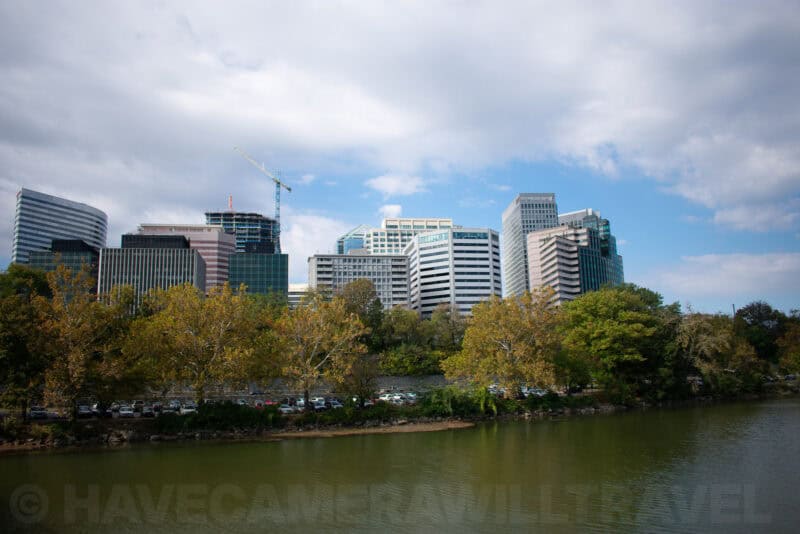
Of course, there are several considerations when choosing a lens, but one of the key ones in this case is how much you can zoom in and out. So here are some practical examples that show the zoom range of the 18-55mm in case you’re trying to decide which lens bundle to go with, whether you’re buying for yourself or as a gift.
Zoomed out to 18mm, you get the equivalent focal length of 27mm if you were using a full-frame camera (also known as 35mm equivalent focal length). Zoomed in fully, it’s the equivalent of 82mm on a full-frame camera. So it’s wide enough for general everyday shooting of places and landscapes while also zooming in enough to be useful for flattering people photos. If you’re going on safari in Africa or looking to do sports photos, you’ll probably find that the 70-300mm lens will be more useful for those.
These were taken with the 18-55mm on a Nikon D3400. The practical zoom range is the same on any of Nikon’s DX series cameras, all of which include an APS-C cropped sensor.








Thank you! This is exactly what I was hoping to find in a search of lens ranges.
Glad it’s useful!