Here’s a rundown of how to charge the battery for your Nikon D3400 DSLR camera.
Need a spare battery or charger? I’ve compared the D3400 battery and charger options separately.
How to charge Nikon D3400 batteries
On many cameras, you can plug in your camera to a USB power source, which will charge the battery. It’s one of several options for charging the battery on those cameras.
And it can be especially convenient because it means that the camera does double duty as a battery charger. It’s not always the ideal method, mainly because it means that your camera is out of action while you’re charging (by contrast to using an external charger with a spare battery, for example), but it requires minimal equipment, and it’s simple.

But that choice isn’t available with the Nikon D3400. For reasons that aren’t entirely clear to me, Nikon has decided that for the D3400 and D3500, you can’t charge the battery while it’s in the camera. So you can’t just connect the camera to a USB power source and use the camera itself as a battery charger.
Instead, you have to take the battery out of the camera, put it into an external charger, and then connect that charger to a power source.
The model of the charger for the D3400’s batteries is the MH-24.
It’s an AC charger, which means it plugs into a wall outlet. It’s also an auto-switching outlet. So long as you have the correct cable or plug (or are using a standard travel adapter), it will automatically handle both 110 or 240-volt power sources.
You can also get aftermarket versions from other manufacturers. In my experience, some of them are very good, although it’s also possible to come across ones from no-name brands that don’t work as well. I tend to stick to ones from larger manufacturers, such as Wasabi Power, Anker, Smatree, RAVPower, and Watson, when possible.
There are two other benefits of aftermarket versions:
- For one, they’re often less expensive than the original.
- For another, they often offer features not available in the Nikon original. Some, for instance, can charge multiple batteries at once. Others can charge from a USB power source — something that can be very handy when you’re looking for a more portable option, such as when traveling, and want to be able to use a car charger or a USB power brick.
Spare batteries for the Nikon D3400
The battery for the Nikon D3400 is model number EN-EL14a.
That 1230mAh capacity is also why the D3400 has such strong battery life for an entry-level DSLR — Nikon rates it at roughly 1,200 shots per charge (CIPA standard), well above most cameras in its class.
It’s a lithium-ion battery pack rated at 7.2 V / 1230mAh / 8.9Wh.1
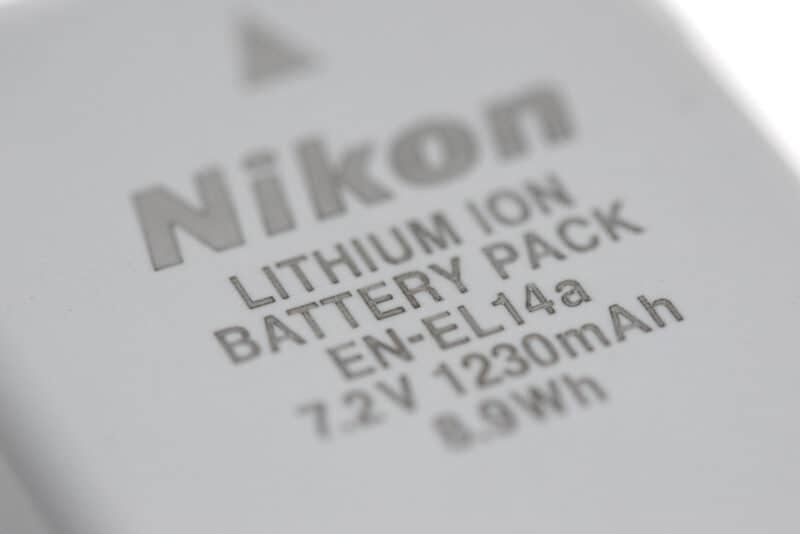
The safest option is to go with the Nikon-branded version. That gives more assurance that it is — and will remain — compatible.
What I mean by that second part — that it will remain — is that it is a technical possibility for camera manufacturers to issue a firmware update that restricts the camera to using only batteries produced by the manufacturer, so that it stops working with batteries made by other manufacturers. It might be because of some compatibility issue — camera manufacturers understandably aren’t enthusiastic about spending support resources on dealing with problems caused by accessories produced by other manufacturers. It’s rare that a camera manufacturer would go to those lengths, but it has happened (we’re looking at you, GoPro).
All that said, I’ve also had very good experiences with some of the better-known aftermarket manufacturers. Watson, Wasabi Power, and Smatree are good examples.
I’ve used many batteries for many cameras produced by those manufacturers and found them to be basically the same as the originals. And they’re often much less expensive. So long as you use them with your eyes open to the potential downsides, they can be a very good option.
All of them will reference the original Nikon model number and market themselves as EN-EL14a replacement batteries.

Some aftermarket EN-EL14a replacement batteries go a step further and build a USB-C or Micro-USB charging port directly into the battery itself, so you can top it up from a power bank, laptop, or car charger without any separate charger at all. It’s a genuinely useful option if you want to travel light, though keep in mind these batteries usually have a slightly smaller capacity than the standard EN-EL14a to make room for the extra electronics.