The battery life for the Nikon D3400 is actually one of its strong points — Nikon rates it at around 1,200 shots per charge, which is excellent for an entry-level DSLR. But it’s pretty much inevitable that you’ll run into situations where your battery is running out of juice right when things are getting interesting. So having fully charged spares on hand is always a good idea — a truism with any digital camera, not just the D3400.
Looking for how the charging actually works rather than what to buy? See how to charge Nikon D3400 batteries.
If you’re after a spare battery for a Nikon D3400, or need to replace a dying one, the obvious choice is to get the Nikon-branded replacement batteries. And while that’s a safe way to go, there are also options with some other features that you (and your wallet) might prefer.
So here’s a quick rundown of different Nikon D3400 battery and charger options that work well with this camera. It includes Nikon original versions as well as some good options from aftermarket manufacturers.
Nikon D3400 battery: EN-EL14a
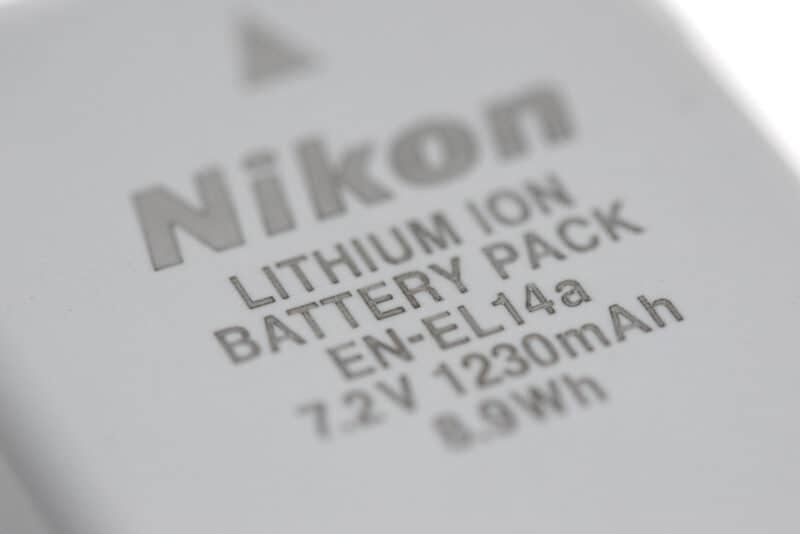
Nikon makes two models of batteries that will work in the D3400, the EN-EL14a and the older EN-EL14.
The best option, and the one that comes with the camera, is the EN-EL14a. It’s a lithium-ion (aka li-ion battery) rated for 1230mAh.
An older model, the EN-EL14, will also work just fine but will drain more quickly. That’s because the EN-EL14 is rated at 1030mAh, while the EN-EL-14a is rated at 1230mAh. In short, the “a” version holds more juice. There’s really no reason to seek out the older model — go with the newer version if possible.
Obviously, Nikon has their own, and they’re the ones that they recommend. They’re the safe option. But they’re not necessarily the most affordable option.
But I’ve also found some of the more affordable aftermarket versions to work well, particularly the batteries from Wasabi Power. I’ve used their batteries for several years in other cameras and found them to be one of the better aftermarket camera battery manufacturers.
The Wasabi Power batteries that I’ve found to work well in the Nikon D3400 have a model number BTR-ENEL14-JWP. It also has a capacity rating higher than either of the Nikon models: 1500mAh. I’ve been using these in my D3400 and found them to work well. You can buy them individually, in 2-battery packs, and bundled with a USB dual charger.
Nikon D3400 battery chargers
There are a few different varieties of battery chargers for the Nikon D3400, ranging from the simple, single-battery AC charger provided by Nikon to dual-bay USB chargers from aftermarket manufacturers. Here’s a quick rundown of the options.
The D3400 comes with a battery charger. It’s a single-bay AC charger, with the prongs for the wall socket folding back into the body of the charger, and it takes about two hours to fully charge a battery. If you need to replace it, the one manufactured by Nikon has the model number MH-24.
As always, Nikon recommends using their own branded products. But something I don’t like about the MH-24 is that it only works with an AC power outlet — and one with enough room to fit the charger, at that. That’s not always convenient when traveling.


But there are other good options from aftermarket manufacturers, some of which use a much more convenient, if slower, charging method: via USB. That saves me having to carry around a bunch of different AC adapters whenever I travel (I like to travel light). It also means that I can charge my camera batteries from an external powerbrick even while I’m out and about taking photos.
My current favorite is the NiteCore UNK1 USB charger. It has two bays, one for the EN-EL14/a and another for the EN-EL15/a batteries like the ones the Nikon D810 takes. If you’re only using the D3400, you’ll only be using one of these bays. It also has a small LED screen that shows a more precise percentage for charging status as well as battery health and the current flowing. It’s smaller and lighter than the official Nikon MH-24 charger and can be powered via USB by an external powerbank, AC charger, or in the car.
Another good option that also uses USB are these dual-battery chargers. They’re a little slower to charge — they’re 0.6A rather than the 0.9A of Nikon’s MH-24, but they’re still very lightweight and convenient if you’re traveling.
An even more versatile alternative

If access to AC power isn’t a problem, I’m a big fan of these dual-chargers because you can mix and match adapter plates for different types of batteries. Since I use a range of different cameras, it means I can cut down on the overall bulk by taking the one charger and a few lightweight and inexpensive adapter plates. Or you can, of course, charge two batteries of the same type together. It also has an LED screen that gives a more precise indication of the charging status — something I find very handy when I’m trying to head out the door and want a sense of how long the charge is likely to take.
The main charger acts as a docking base. Here’s a direct link for the adapter plates for the Nikon D3400’s EN-EL14/a batteries.
Things worth knowing
How long does the Nikon D3400 battery last?
Nikon rates the EN-EL14a at roughly 1,200 shots per charge under CIPA testing conditions, which is unusually good for an entry-level DSLR — more than double what you’d get from many rival cameras in this class. Real-world numbers will vary depending on how much you use the rear LCD, live view, and flash, but even heavy use should get you through a full day of casual shooting.
How do I know if my Nikon D3400 battery needs replacing?
Like any lithium-ion battery, the EN-EL14a will hold less charge over time. If you’re noticing the battery draining much faster than it used to, or it won’t hold a charge overnight, it’s worth checking the battery info screen in the camera’s setup menu, which shows a rough charge-life indicator. A battery that drops noticeably faster than it used to is a good sign it’s due for replacement.
Can I use an old Nikon EN-EL14 in a D3400 that came with an EN-EL14a?
Yes. The original EN-EL14 (1030mAh) is fully compatible with the D3400 — it’ll just give you somewhat fewer shots per charge than the EN-EL14a (1230mAh) that ships with the camera.