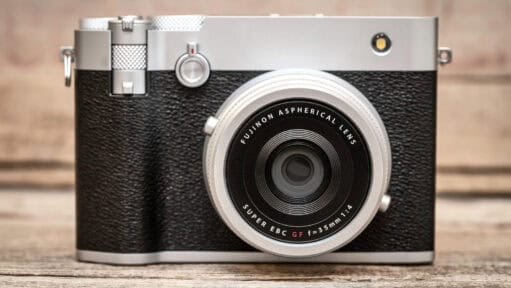
Fujifilm GFX100RF: Medium Format, Reconsidered for Street and Travel
After a month shooting the Fujifilm GFX100RF, I found a camera with genuinely excellent image quality but real low-light limitations that changed how I'd recommend using it.
Announced in 2025, the Fujifilm GFX100RF is the first fixed-lens camera in Fujifilm’s GFX medium-format system — effectively the medium-format answer to its hugely popular X100 series. It pairs a 102-megapixel sensor larger than full-frame, for enormous detail and tonal depth, with a fixed 35mm F4 lens that gives a wide 28mm-equivalent field of view well suited to travel and street shooting.
At about 735g it’s the lightest GFX yet, and its leaf-shutter design means near-silent shooting and flash sync at any shutter speed. A dedicated aspect-ratio dial with nine ratios and a built-in 4-stop neutral-density (ND) filter — which cuts the light so you can shoot wide open or slow in bright sun — add real in-camera creative control.
The trade-offs for that compact size are no in-body stabilization and a modest constant F4 aperture, so it rewards good light and a steady hand. As Fujifilm’s first camera of its kind, it opens a new niche rather than replacing anything.
Here are my hands-on tips and guides to shooting with the Fujifilm GFX100RF.
After a month shooting the Fujifilm GFX100RF, I found a camera with genuinely excellent image quality but real low-light limitations that changed how I'd recommend using it.
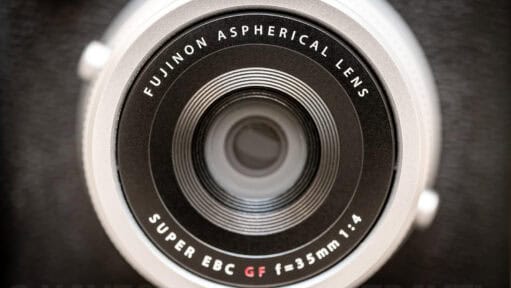
The GFX100RF's digital teleconverter is a real composition tool thanks to its 102MP sensor — but the physical switch is easy to bump by accident. Here's what each crop costs in resolution, how RAW files handle it, and the menu setting that stops unintended crops.
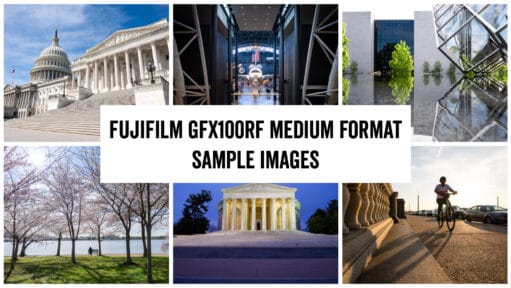
A collection of real-world Fujifilm GFX100RF sample images, shot with its fixed 28mm-equivalent f/4 lens and no in-body stabilization, each with the exact exposure settings used to keep them sharp.
With no IBIS and a 102MP sensor, the Fujifilm GFX100RF's default Auto ISO minimum shutter speed isn't fast enough to guarantee sharp handheld files. Here's the three-profile setup I now use, plus a manual footnote that quietly overrides it.

My name is David Coleman, and this is my site. I take photos for a living. Seven continents. Dozens of countries. Up mountains. Underwater. And a bunch of places in between. I'm based in Washington, D.C.
This site is where I post practical photography help, tips, and troubleshooting.
All posts and reviews on this site are written by me. And I only review gear with which I have personal hands-on experience. By a photographer, for photographers. More about me.


© 2009-2026 David Coleman | Have Camera Will Travel LLC
Photos by David Coleman. Please contact me for licensing images. Images are registered with the U.S. Copyright Office.
Have Camera Will Travel LLC | 901 N Glebe Rd, Arlington, VA 22203 | +1.703.942.9245

