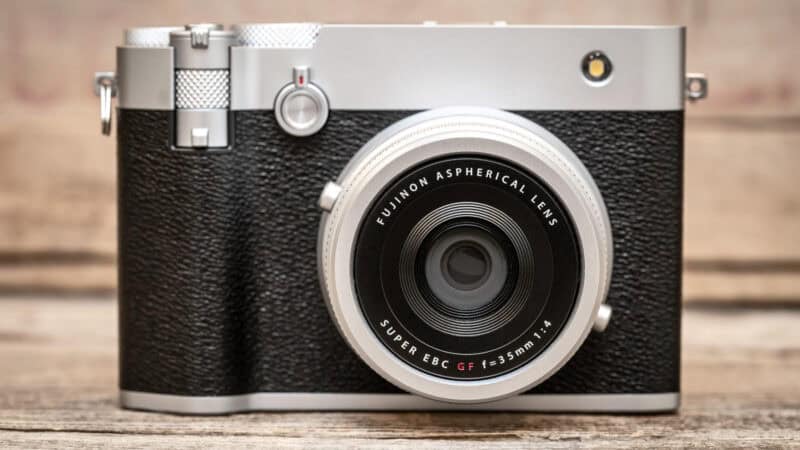
I’ve been intrigued by the Fujifilm GFX100RF for a while, and I’ve been excited to shoot with it. I’m a long-time fan of Fujifilm cameras. And I love shooting with smaller, highly mobile cameras that don’t skimp on image quality. Cameras like Fujifilm’s X-Pro and X100 lines, and the Ricoh GRs or Sony RX1R III.
So I got my hands on one (thanks, B&H!) and have been shooting with it for a month. And to cut to the chase, here’s my conclusion: it’s a very good camera with impressive image quality and clever features. But its low-light limitations make it a poor fit for the kind of shooting I do most.
If you’ve been here before, you’ll probably have noticed that when it comes to cameras and lenses, I’m not one for lab results or put much weight in what it looks like on paper. It’s nothing against those sites that do that — some of them do a wonderful job. But those types of tests don’t much interest me in any practical sense, and there are plenty of other places you can get those. Instead, what I’m interested in are far more hands-on: What it’s like to shoot with; am I happy with the photos I get with it?
So it’s with that approach that I’m reviewing this. Yes, that means it’s subjective. And proudly and deliberately so.
A medium-format compact?
First, though, a quick explanation of what this camera is, because it falls in an unusual spot in Fujifilm’s lineup. Or, for that matter, in the broader range of cameras available.
The GFX part of its name tells you it’s in Fujifilm’s medium-format lineup. So much larger sensors than in most consumer cameras available today. What it doesn’t share with X-series cameras like the X-T5 and the X100VI is the sensor design: GFX sensors use a conventional Bayer color filter array rather than Fujifilm’s X-Trans layout.
But within the medium-format lineup, this one is unique in that it has a fixed lens. And it’s a prime lens at that.
Overall, and especially so for a medium-format camera, this is relatively compact and mobile.
Which is really the key point about this camera: a massive sensor with medium-format capabilities in a genuinely portable body. The engineering behind it is impressive. And it’s the lightest medium-format camera body that Fujifilm has produced. This is not a medium-format camera designed to be stuck in a studio or permanently attached to a tripod, as so many more cumbersome medium-format cameras are.
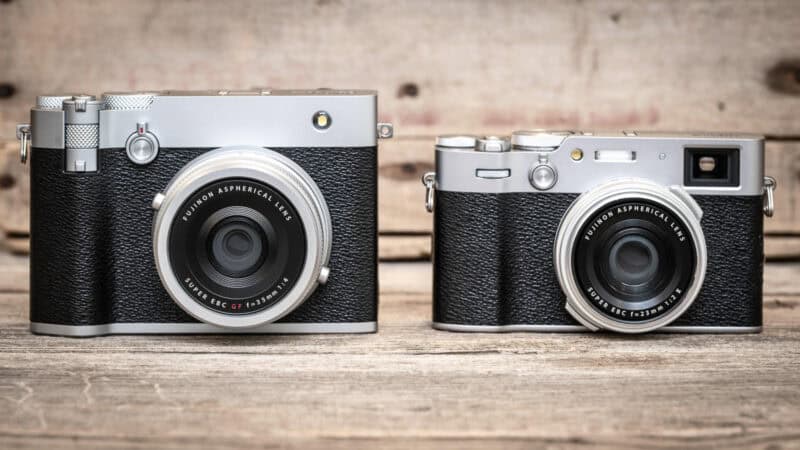
It’s designed to be taken out and about, for shooting handheld. It has a leaf shutter, which is unusual in medium-format. It even comes with a rope strap in the box. With retro, unobtrusive styling that doesn’t scream a high-end “steal-me” vibe.
Which brings me back to why I’ve been intrigued: a high-quality, high-resolution, relatively compact camera sounds like a really fun combination for street and travel photography.
And it is, to a point. The quality of the hardware is excellent. A super-sharp lens. A solid, metal body. A superb sensor.
Yes, but . . . the trade-offs
But there are real limitations worth knowing about. And it’s there that I found that it fell short for me. And much of it has to do with core things you deal with when shooting street and travel photography: shooting in low and variable lighting.
And that gap between how it presents and how it actually wants to be used is the through-line of this review. It’s also the most useful thing to understand before deciding whether the GFX100RF makes sense for the way you shoot.
Firstly, the lens. It’s sharp. Very sharp, actually. And it’s small. What it isn’t is fast, at least by travel and street photography standards. With a maximum aperture of f/4, it’s mid-range. Now, it is certainly true that lens apertures on a medium-range camera do not conform directly to apertures on a smaller-sensor camera. That’s why medium-format cameras can often produce that kind of extremely narrow focus plane with dreamy bokeh — think the classic black and white portraits from last century. But it doesn’t change the physics of how much light is getting onto the sensor. And in low-light shooting, as is often required in travel and street photography, that matters.
Secondly, there’s no built-in stabilization. Not in the lens, and not in the camera. That matters more than normal with this camera because with a sensor that’s so large and with so much resolution, you’re going to notice even minute amounts of camera shake.


Thirdly, the sensor’s ISO sensitivity isn’t particularly expansive. It native ISO maxes out at 12800. Sure, you can go higher in extended ISO range, but I personally try not to use extended ISO unless I have to — the image quality costs are often too high for my tastes. A larger sensor with larger photo sites isn’t going to show image noise anywhere near as much as a smaller sensor with smaller photo sites. But a somewhat restricted ISO range is still going to impose downwind restrictions on what shutter speeds and apertures you have available.
There are other reasons I can see photographers balking at this camera (aside from the price, which is a biggie by itself). The image files that come out are massive. At 200MB a pop for the RAW files, it doesn’t take long to fill up a memory card or hard drive. And if you’re processing that RAW file in something like Nik Color Efex or Silver Efex, you’re going to be eating some serious storage space.
It’s also not ideally designed for rapid shooting. Yes, there’s a burst mode (it maxes out at 6fps with the mechanical leaf shutter, or 4 in some configurations). And yes, the controls are responsive. But this is not really a camera designed for fast-paced action, and certainly not for sports or wildlife. Burst mode on this camera is a thing you can do, not a thing the camera is built around.
I found it best for slower, more deliberative shooting. And yes, I agree that there is much virtue in slowing down and being more deliberate. I’m not in any way saying that that is a bad thing. But my point is simply that in considering whether the GFX100RF might be for you, it’s worth knowing that the camera will push you more in the direction of slowing down and shooting fewer shots. Some photographers will like that; some might not.
This is a deliberate camera. A considered camera. A camera that rewards you for thinking before you press the shutter, and gently penalizes you when you don’t.
None of this is intended to bash this camera. There are many things I really liked about it, and I enjoyed shooting with it. But, for me, I found a mis-match, or at least a tension, between what it’s intended to be and how it performs in real-world shooting.
I also don’t see it as an upgrade from the X100VI. You’ll get more pixels, true, but the X100VI’s faster lens and in-body stabilization matter more for street and travel shooting. I think a more direct competitor is the Sony RX1R III, even though they’re in different sensor classes.
The category it actually fits
There are other 100-megapixel-class medium format cameras out there. The GFX100 II, the GFX100S II, the Hasselblad X2D — all built around the same 43.8 × 32.9 mm sensor architecture. They’re larger, they take interchangeable lenses, and they’re built around studio and landscape workflows that let you take your time.
As far as I’m aware, the GFX100RF is the first GFX camera with a fixed lens. And that design decision is key, because without a lens mount and the back focus a focal-plane shutter requires, Fujifilm has been able to collapse the body around a leaf-shutter lens and end up with something roughly the size of a compact mirrorless body with a small pancake lens attached. It’s bigger than an X100VI, but not by that much.
What 102 megapixels actually gets you
The native file is 11648 × 8736 pixels in the sensor’s native 4:3 aspect ratio (you can select other aspect ratios if you like, but the sensor itself is 4:3, and the other aspect ratios are cropped from that.1
To put that in perspective:
| Camera | Resolution | Megapixels |
|---|---|---|
| Fujifilm GFX100RF (4:3) | 11648 × 8736 | ~102 MP |
| Fujifilm GFX100RF (3:2) | 11648 × 7768 | ~90 MP |
| Sony A7R V | 9504 × 6336 | ~61 MP |
| Nikon Z8 / Z9 | 8256 × 5504 | ~45 MP |
| Fujifilm X100VI | 7728 × 5152 | ~40 MP |
| Sony A1 II | 8640 × 5760 | ~50 MP |
The lens
The lens is excellent, and I found it to be very, very sharp. And for a medium-format lens, it’s especially compact.
It’s technically a 35mm f/4 Fujinon, but if you’re more used to standard non-medium-format perspectives, this translates to a perspective of about 28mm when converted to typical mirrorless or DSLR terms. So it’s a classic street photography perspective — wide, but not too wide.
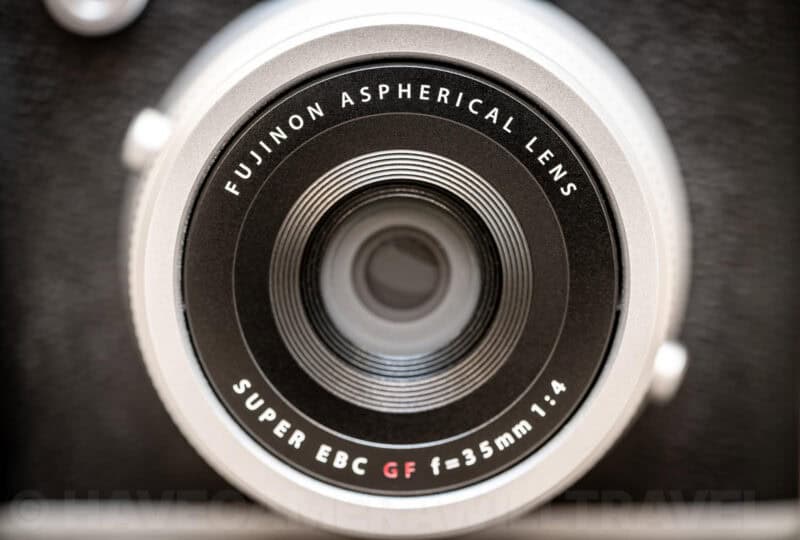
Part of the magic here is that the leaf shutter is built into the lens itself. That’s what allowed Fujifilm to shorten the back focus and shrink the body. It’s not the first camera to do that — classic film medium format rangefinders like the Mamiya 6 and 7 did it decades ago, and newer digital medium formats like the Hasselblad X line also take that approach.
But a downside is that, with a maximum aperture of f/4, it isn’t fast. On medium format, depth-of-field math doesn’t translate one-for-one with full frame: the equivalent depth of field at f/4 on this sensor sits around f/3.2 in full-frame terms. That’s a useful working aperture in good light, but it’s slower than ideal for this type of shooting.
In the field
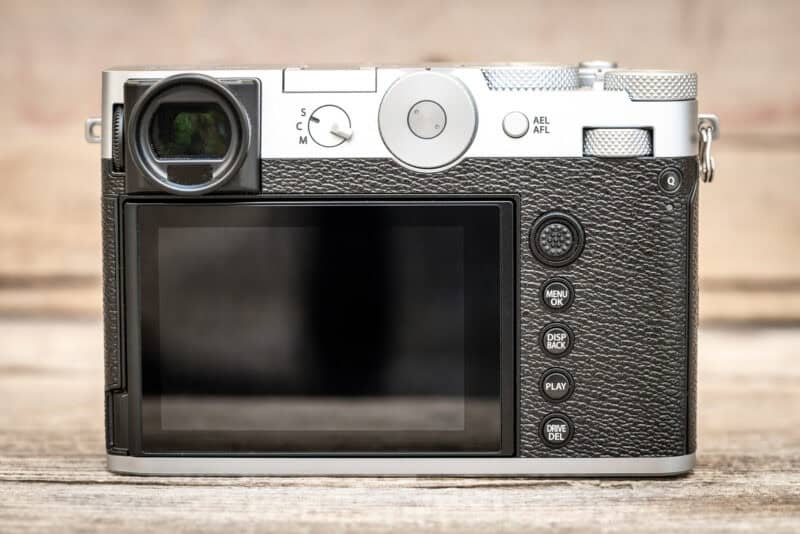
It’s a fun camera to shoot with. The dials are all aluminum, machined to a standard you can feel. So if it’s not optimized to the hilt for ergonomics, it does have that classic retro approach that has a proven track record. The tilting 3.15″ rear screen is sharp and responsive.
Autofocus is the same phase-detect and contrast hybrid Fujifilm uses across the current line, with face and eye detection plus subject detection for animals, birds, cars, motorcycles, planes and trains. One quirk worth knowing: human detection is a separate mode from the others, so you can’t have the camera watching for people and for animals or vehicles at the same time. It keeps up with the pace of street, landscape and portrait work, but tracking isn’t as tenacious as the best mirrorless systems, so fast-moving subjects aren’t its strength.
That said, between the GFX100RF and the X-Pro series, I still find the X-Pro more enjoyable for pure shooting. The hybrid optical/electronic viewfinder on the X-Pro line is something the GFX100RF can’t match, and the X-Pro feels more spontaneous in the hand. But that’s not really an apples-to-apples comparison given the file sizes the GFX100RF produces. If Fujifilm ever releases an X-Pro4 (pretty please!), I’m going to be eager to test and compare it.
Two practical things to know before you take it out for a long day. First, weather resistance isn’t a given: the GFX100RF is only sealed with the supplied adapter ring and a 49mm protective filter fitted over the front of the lens. Both are in the box, but bare, straight out of the box, it isn’t sealed.
Second, battery life is genuinely good. Fujifilm’s CIPA rating is about 820 frames with the LCD, which is roughly double what the Leica Q3 or the X100VI are rated for, and it runs on the same NP-W235 pack as the bigger GFX bodies.
Sample images
Here are some sample images I’ve taken with the GFX100RF. You can click on each image for a full-size version. I’ve also posted a larger collection of sample images separately.


The aspect ratio dial
Medium format has historically come in a wide range of aspect ratios — 1:1, 4:5, 6:4.5, 6:6, 6:7, 6:9 — but rarely the 3:2 of 35mm and most digital cameras.
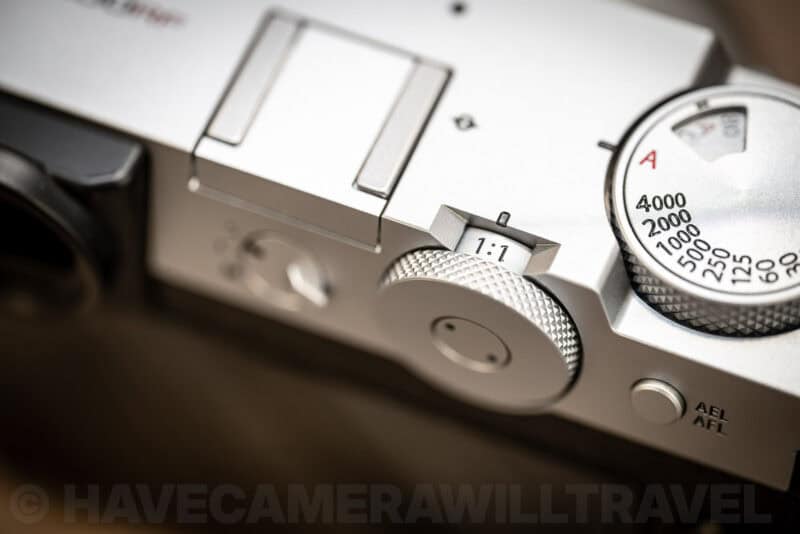
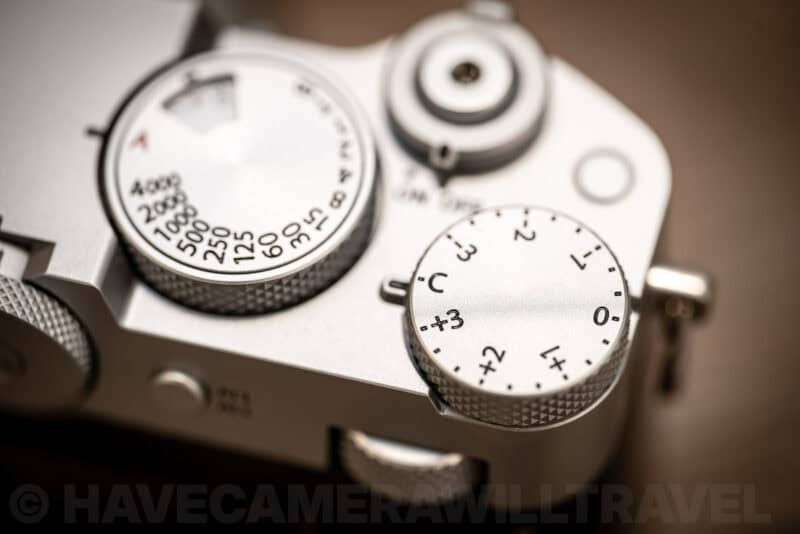
The GFX100RF’s native sensor aspect ratio is 4:3, but in a nod to traditional medium-format shooters, there’s a dedicated dial that cycles through nine available ratios:
4:3 · 3:2 · 16:9 · 65:24 · 17:6 · 3:4 · 1:1 · 7:6 · 5:4
Plus a “C” position that lets you assign any other available ratio to the rear command dial.
There are a couple of things worth knowing about how the dial actually works, in case you’re wondering why it doesn’t seem to be doing anything when you change it.
- The crop only bakes in for JPEG, HEIF, and TIFF files — and yes, TIFF is available on this camera. RAW always records the full 4:3 frame, with the chosen aspect ratio saved as metadata. When you open the RAF in Lightroom or Capture One, it’ll display in the chosen ratio by default, but the underlying file is uncropped and you can recover the full frame at any time.
- The 65:24 panoramic ratio corresponds roughly to the XPan format from the late 1990s — a touch worth appreciating if you have any history with that unusual camera.2
The digital teleconverter
Separate from the aspect ratio dial, the front of the camera has a small teleconverter selector switch with four positions:
| Position | Equivalent focal length | Crop factor |
|---|---|---|
| OFF | 28mm | 1.0× (native) |
| 45mm | 36mm | ~1.3× |
| 63mm | 50mm | ~1.8× |
| 80mm | 63mm | ~2.3× |
Like the aspect ratio dial, the crop applies natively to JPEG, HEIF, and TIFF at capture. RAW always records the full uncropped frame, with the crop selection saved as metadata. To produce a cropped RAW output, the in-camera RAW conversion menu has a RAW CONVERSION > DIGITAL TELE-CONV. option.
Even the deepest crop produces a file comparable to a current full-frame body.
About that crop switch
Now the part I find genuinely annoying.
The teleconverter selector sits on the front of the camera in a position that’s far too easy to bump. I’ve found it drifts off OFF with depressing regularity — usually when I’m taking the camera out of a bag or shifting grip.
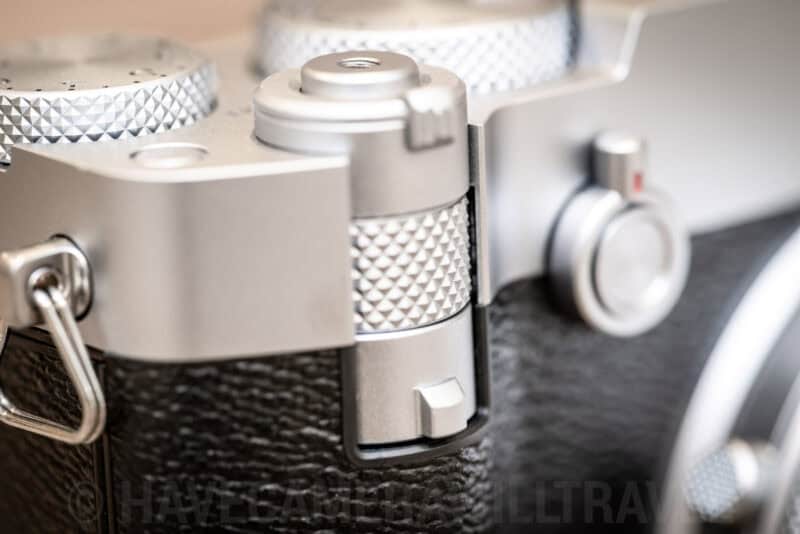
If you shoot RAW, the underlying file is fine. The crop is metadata, fully reversible. But it does affect what you see on the rear screen and through the EVF, and the RAF will open in Lightroom or Capture One at the cropped view by default. So you’re spending time undoing or correcting something you didn’t choose to do in the first place.
I went looking for a way to disable or reassign the switch, but I couldn’t find one. The Fujifilm Fn assignment system on this camera covers function buttons, the control lever, the touch-screen gestures, and the command dials — but the digital tele-converter selector is hardcoded. The closest workaround is the LOCK function under D BUTTON/DIAL SETTING, which can lock specified controls — but even there, the documentation doesn’t show the tele-converter switch among the lockable items.
For a camera otherwise so customizable, that’s a strange omission. Whether it bothers you depends on how often you use the crops deliberately versus how often you bump the switch by accident.
The aperture / shutter relationship
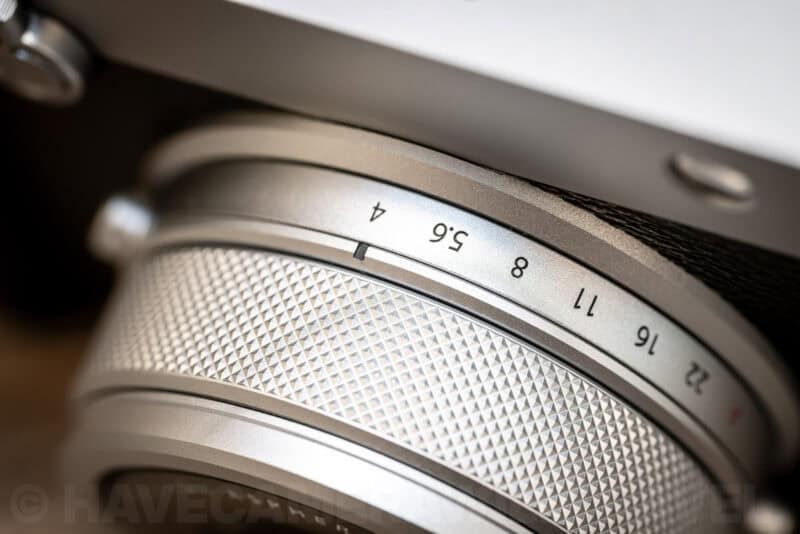
Because the leaf shutter is integrated into the lens, the maximum mechanical shutter speed shifts with aperture on a sliding scale:
- At f/4 (wide open): max 1/2000 s
- At f/8: max 1/4000 s
- Apertures between those endpoints land somewhere on a spectrum
This is a structural characteristic of leaf shutters, not a limitation Fujifilm chose. It’s worth knowing because it means shooting wide open in bright daylight runs into a ceiling at 1/2000 s — which, on a 102 MP sensor, is sometimes not enough.
That’s where the built-in 4-stop ND filter comes in.
The ND filter and leaf-shutter advantage
A single menu toggle activates a 4 EV neutral density filter, available for both stills and video. Combined with the leaf shutter, you get:
- Wide aperture in bright daylight without hitting shutter speed limits or carrying screw-on ND filters
- Slow-shutter motion blur in daylight without external filters
- Flash work outdoors at any shutter speed within the mechanical range — no high-speed sync needed
That last point is the genuine advantage. On focal-plane shutter cameras, mixing strobe with daylight at wide apertures usually means HSS, with all its compromises in flash power and recycle time. The GFX100RF’s leaf shutter syncs at every available mechanical speed, capped only by the aperture-dependent maximum I mentioned above.
One caveat if you’re planning to work strobes at the top of the range: in practice you can rely on sync up to around 1/2000 s. Above that, at the very briefest exposures, the shutter can close before the flash has finished dumping its burst, so you lose part of the output — something DPReview noted in its testing. That’s still far beyond what a focal-plane body will give you without high-speed sync.
This is the kind of thing photographers who shoot weddings, environmental portraits, or daylight-balanced fashion will recognize as quietly significant. It’s not the headline feature, but it’s can come in very handy in some situations.
Where the camera struggles: Low light
This is the thing to understand most clearly before buying and my biggest hesitation with this camera. And my biggest disappointment.
The GFX100RF is shaped like a street and travel camera. But it’s not built to handle the variable light those genres throw at you. The limitation shows up in three reinforcing ways:
- Maximum aperture is f/4. As I mentioned above, that’s about f/3.2 equivalent for depth-of-field and per-area light gathering compared to full frame. That’s useful in good light, but it’s only so-so in the kind of variable lighting that makes street and travel photography extra fun.
- No in-body image stabilization. The only stabilization on this camera is Digital Image Stabilization, and it’s available exclusively for video.3 Still photography relies entirely on shutter speed, technique, and physical support. There’s much less wiggle room than on a stabilized body, and the 102 MP sensor is unforgiving of micro-jitter — every bit of camera shake shows when you view the images up close.
- Standard ISO range tops out at 12800. The full standard range is ISO 80 to 12800, with extended sensitivities up to ISO 102400 available. Whether the extended ISOs are usable for your work is a question only your output requirements can answer, and on a 102 MP sensor the noise penalty at high sensitivities is more visible than on lower-resolution bodies.
Stack those together — f/4 maximum, no IBIS, modest ISO ceiling — and the camera that looks designed for street and travel shooting reveals itself as actually designed for considered, deliberate shooting in good light. Architecture, landscape, environmental portraits, daylight commercial work. It excels at all of that. But asking it to handle a dim café, a rainy alley at dusk, or any of the lighting conditions that define real-world street and travel photography is pushing its limits.
This isn’t a flaw in execution — every spec in the camera is well-implemented, and I can’t really quibble with the engineering and performance. And maybe it’s really about my own unrealistic expectations. If your work happens predominantly in good light, the GFX100RF is extraordinary. If your work depends on flexibility across lighting conditions, it’s a harder fit than the marketing suggests.
A practical workaround. Configure Auto ISO with a sensible MINIMUM SHUTTER SPEED — typically faster than the reciprocal-rule starting point given the resolution. For handheld work at 28mm equivalent, I find 1/125 s is a reasonable floor; for the deeper teleconverter crops, scale that up proportionally. The setting is under
A SHOOTING SETTING > ISO AUTO SETTING.
White balance
Like other recent Fujifilm cameras, I found that the auto white balance can be inconsistent. I find I’m correcting more often than I’d like, and I see a distinctive cast on a lot of files even when the conditions don’t seem to warrant it.
If you’re shooting with one of the in-camera film simulations or applying a profile in post (Lightroom or the Fujifilm X app), this is less of an issue — the simulation work overrides most of the cast. But if you’re shooting clean RAW for full color control, expect to spend more time on white balance than with most current cameras.
Worth noting: the camera supports 20 film simulations, including REALA ACE, Classic Chrome, Classic Neg, Nostalgic Neg, Acros, and Eterna. The simulations are well-tuned and probably the easiest path to good color out of the camera. And they’re fun!
Memory cards
There are two SD card slots, both UHS-II. Given the file sizes — 210 MB per uncompressed RAF, more if you shoot RAW + JPEG — overflow mode is the most natural configuration. Mirror and split-format modes are available if you’d rather have backup at capture.
For the card class, V60 is the realistic minimum, and V90 is the safer choice. The reasoning is less about video bitrate (the camera does shoot 4K/30p at up to 720 Mbps in H.265 All-Intra internally4, but stills are clearly the design priority) and more about clearing the buffer fast enough during burst shooting and during sustained capture. Saving those massive files takes a while even with a very fast memory card!
On video on this camera
The GFX100RF’s video specs are surprisingly capable — 4K up to 30p, 10-bit 4:2:2 internal, F-Log and F-Log2, ProRes 422 HQ over USB-C to SSD, HLG support5. But the design doesn’t really invite video work, and it’s not something I’ve used it for.
Who this camera makes sense for
A working photographer who shoots predominantly in controllable or good light — landscape, architecture, environmental portraits, fashion, daylight commercial, deliberate travel work — and wants the file quality of a 102 MP medium format sensor in something they’ll actually carry. For that photographer, the GFX100RF is genuinely special. Files are extraordinary. The camera is portable in a way no other 102 MP body is. The leaf shutter and built-in ND open up flash and motion-blur options that focal-plane bodies struggle with.
A photographer expecting a higher-resolution X100VI will be disappointed — not because the GFX100RF is bad, but because it’s a different tool with different demands. I find the X100VI is the more flexible all-rounder. The GFX100RF is the more specialized tool for some situations.
A pure street or low-light travel shooter will run into the limitations more often than the strengths. f/4 with no IBIS in the genres where light is the variable is a tough combination, no matter what the camera looks like.
And underlying all of this is that this camera is not priced as an impulse buy or something you stash in your camera bag just for occasional use. At north of $5,000, it’s a substantial investment.
Notes & References:
- Fujifilm GFX100RF Owner’s Manual Ver. 1.10, p. 408. [↩︎]
- The Hasselblad XPan / Fujifilm TX-1 was a 35mm panoramic rangefinder co-developed by the two companies, with a native frame ratio close to 65:24. [↩︎]
- Fujifilm GFX100RF Owner’s Manual Ver. 1.10, p. 188 [↩︎]
- Fujifilm GFX100RF Owner’s Manual Ver. 1.10, p. 410 [↩︎]
- Fujifilm GFX100RF Owner’s Manual Ver. 1.10, pp. 186, 410 [↩︎]