To charge the Canon Rebel T7 battery, you need to physically take the battery out of the camera body and use the external battery charger that came in the box.
Unlike many modern mirrorless cameras or smartphones, you absolutely cannot charge the battery inside the camera by connecting a USB power cable. The USB port on the side of the T7 is wired purely for data transfer, not power delivery.
If you’ve lost your original charger, or you just want a backup battery so you never run out of juice on a shoot, there are official model numbers and aftermarket suggestions below.
Note: This camera is marketed as the Canon EOS Rebel T7 in the Americas. In Japan, it’s known as the Kiss X90. In Southeast Asia, it’s known as the EOS 1500D. And in other parts of the world, it’s marketed as the EOS 2000D. They all use the exact same battery system.
Which battery does the Canon Rebel T7 use?
The official model number for the Canon Rebel T7 battery is the Canon LP-E10.
It’s a rechargeable lithium-ion battery pack officially rated at 860 mAh. The camera comes with one standard in the box.

It’s an incredibly common battery format that several other popular Canon DSLRs use, so finding replacements is usually quite easy.
(Note: The LP-E10 is exactly the same battery used by the older Canon EOS Rebel T3, T5, and T6. However, please be aware that the Canon EOS Rebel T7i uses a completely different battery — the LC-E17 — that is strictly incompatible with the standard T7).
If you’re after a replacement or an extra spare for your camera bag, you can grab the official Canon-branded LP-E10. If you want absolute peace of mind and maximum lifespan, the official version is always the safest bet since it’s guaranteed by Canon itself. The catch? They naturally come with a premium price tag.
Alternatively, you can easily find aftermarket versions of the LP-E10 manufactured by third-party brands. They’re often significantly cheaper, and many of them perform perfectly well. But quality control definitely varies wildly with lesser-known brands, so try to stick to reputable third-party options (like Watson) that have solid user reviews.
Better yet, some aftermarket battery kits actually come bundled with their own dual-charger dock. I’m a massive fan of these because they often utilize USB charging cables rather than wall prongs. This greatly expands your charging options when traveling, allowing you to charge your camera batteries directly from a laptop, car charger, or portable power bank.
T7 charging time guidelines
Here is the official charging guidance provided directly from Canon in the T7 manual:
“It takes approx. 2 hours to fully recharge a completely exhausted battery at room temperature (23°C / 73°F). The time required to recharge the battery will vary greatly depending on the ambient temperature and the battery’s remaining capacity.
For safety reasons, recharging in low temperatures (6°C – 10°C / 43°F – 50°F) will take longer (up to approx. 4 hours).”
Battery chargers
If you’ve lost the charger that came in the box, there are two official replacement options from Canon.
- LC-E10 Charger: This plugs directly into the wall. The two metal prongs are permanently attached to the charger body and cleanly fold out for use.
- LC-E10E Charger: This version utilizes a separate power cord instead of folding prongs. However, it tends to be much harder to find in most U.S. stores.
Both models are “switching” chargers, which means you can safely use them internationally without an electrical converter — they automatically handle anywhere from 100V to 240V. However, when traveling abroad, you will still likely need to buy a cheap, physical plug adapter to make the prongs fit into foreign wall sockets.
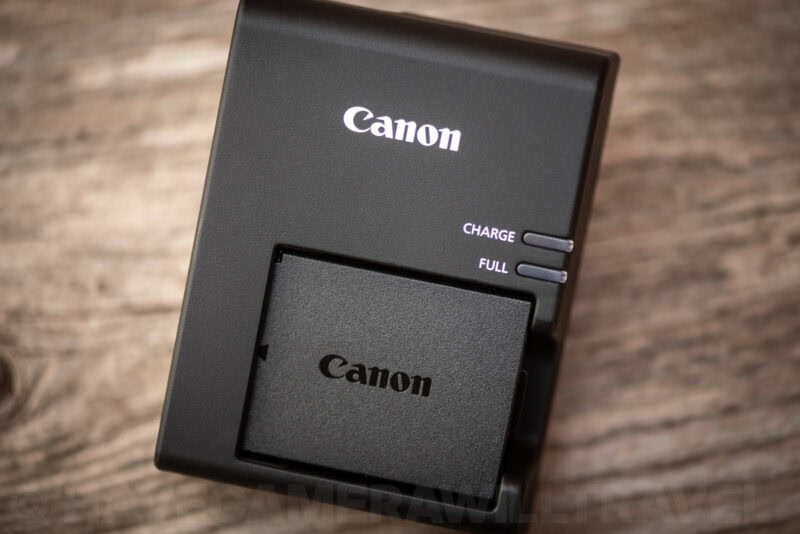
Again, there are plenty of aftermarket chargers available. They typically offer three distinct advantages over buying an official replacement:
- They are much cheaper: They’re frequently sold as a bundled kit with one or two batteries included, making them exceptional value for budget shooters.
- Dual Charging: Several models are dual-battery chargers, meaning you can fully charge two batteries simultaneously overnight before a big shoot.
- USB Power: Many third-party chargers use a USB power source instead of a wall plug, massively increasing your flexibility when charging on location.
Powering a Canon Rebel T7 with external AC power
If you’re recording long videos or shooting endless timelapses from your living room, you don’t actually need to rely on the battery. You can run your Rebel T7 continuously from external AC wall power using an ACK-E10 AC Adapter and DC Coupler Kit.
These specialized accessories don’t come in the standard T7 box, so you’ll need to pick them up separately.
Once again, there are third-party aftermarket versions of this kit that are much cheaper than the official Canon bundle.
These power kits are sold in different configurations. Some are “all-in-one” bundles that include everything you need to plug into the wall immediately. But you can also buy the parts individually if you prefer.
The two physical parts you’ll need to run your T7 directly from AC power are the CA-PS7000 AC Adapter and a DC Coupler DR-E10. The coupler is essentially a hollow dummy battery that slides into your camera and tethers out to the adapter cable. *(Note: these are the exact component parts included in the full ACK-E10 kit mentioned above. It’s almost always cheaper to just buy them as a pre-packaged kit!)*
Pro tips for extending your battery life
- If you plan to throw the camera in a drawer for an extended period of time without using it, always physically remove the battery from the body.
- When the battery is sitting inside the camera, there’s a tiny, continuous electrical drain on it even when the power switch is flipped off. So always be sure to top up the battery before heading out for a critical shoot.
- All rechargeable lithium-ion batteries have a finite chemical life expectancy. If you notice your battery dying incredibly fast even after you’ve supposedly charged it to 100%, its cells are degrading. It’s simply time to buy a replacement.