A memory card is an essential accessory to make the camera work, but the Panasonic LUMIX FZ80 doesn’t come with a memory card as standard. Some retailers put together a deal bundle that might include some accessories, including a memory card, but chances are you’ll have to pick up a memory card separately. Or maybe you want something bigger with larger storage capacity — the cards that are included in bundles are often on the small side and might fill up quickly, especially if you’re on a trip.1
But what type of memory card should you get for the FZ80? That’s where this post comes in — hopefully, to help you get out shooting sooner and taking full advantage of all the features of your new camera rather than spending your time searching the web and trying to make sense of cryptic technical codes. I’ve been buying and testing numerous SD cards for several years and have put many of the most popular SD cards on the market through their paces.
Panasonic LUMIX FZ80 SD Card Quick Recommendations
If you just want some quick recommendations, here you go. Any of these will work well in the FZ80. These SD cards meet the needs of the FZ80’s feature, have a strong track record of reliability, are readily available, and are usually cost-effective.
- Type: SDXC / SDHC
- Video Speed Class: V30
- UHS Bus Interface Type: UHS-I
- Maximum Read Speed: 230 MB/s
- Storage Capacities: 32GB, 64GB, 128GB, 256GB, 512GB
Check current price and availability at:
- Video Speed Class: V30
- UHS Bus Interface Type: UHS-I
- Maximum Read Speed: 150 MB/s
- Storage Capacities: 64GB, 128GB, 256GB
Check current price and availability at:
- Type: SDXC
- Video Speed Class: V30
- UHS Bus Interface Type: UHS-I
- Maximum Read Speed: Up to 180 MB/s
- Storage Capacities: 128GB, 256GB, 512GB, 1TB
Check current price and availability at:
Recommendations checked: August 2026
LUMIX FZ80 SD card compatibility & requirements
The Panasonic LUMIX FZ80 is a point-and-shoot with a very long 60x optical zoom (even longer with digital zoom). It has an 18-megapixel sensor (or 18.1 effective, if you want to be picky) and shoots 4K30 video at a video bitrate of up to 100Mb/s. It also has a 4K photo burst mode that can shoot at up to 30 frames per second. It has a single UHS-I SD card slot. It’s compatible with SDXC, SDHC, and SD cards.
The video bitrate refers to the amount of data being written to the memory card when shooting video. When using the 4K30 and 4K25 modes, it’s up to a moderately high 100 Mb/s. So you’ll need a card that can keep up with that, but it’s still well below some higher-end models that can shoot at 400Mb/s and higher.


So the FZ80 needs a card that is relatively fast, but it doesn’t need the fastest SD card that money can buy.
If you go looking in the FZ80’s manual, it says that the camera is compatible with speed class 3 SD cards. In practice, that rating system has largely been superseded by a newer version. The cards will still have U3 on them, but newer cards are also likely to have V30 or V60 printed on them. Any of those meet the recommended video speed class.
Because of the way that cameras interface with memory cards, once you have a card that meets the requirements of the camera, you don’t get any extra benefit by inserting a card with high specs and performance that exceeds the camera’s capabilities.2 You can use a V90 card, for example, but the FZ80 can’t take advantage of the card’s full capabilities, and you won’t see any extra benefit in the camera. And, naturally, high-performance cards are more expensive. So why pay extra for high performance that your FZ80 can’t use? By all means, if you already have a fast SD card on hand, you can use it in the FZ80, but it won’t get you any extra performance in the camera (it might when downloading the photos and videos to a computer).
That said, in the recommendations below, I’m factoring in cost-effectiveness as well. And because memory card manufacturers are coming out with newer, faster models all the time, it’s quite possible that the most cost-effective cards are faster than your camera needs. But that’s a case where it makes sense to go with the cost-effective option even if its performance exceeds the requirements of the camera.
Panasonic FZ80 SD card recommendations in detail
So which SD card should you get for your Panasonic LUMIX FZ80? Here’s the more detailed version.
So why get a good memory card?
A higher performing memory card isn’t going to help you take better photos or improve image quality. But it can let you take advantage of all of the camera’s features. A card that’s not fast enough to keep up with the camera can cause issues like locking up, dropped frames, and overheating.
There’s also the issue of reliability. There are plenty of junk memory cards on the market. Not only do they have flaky performance, but they’re also more likely to fail. And that means the risk of losing your photos and videos.
At the same time, you don’t want to pay extra for a high-performance SD card that’s overkill for the camera.
Practical recommendations
So what I’m aiming to do here is provide some practical recommendations on which SD cards to get for the Panasonic LUMIX FZ80 so you can spend less time searching online and more time out shooting. I’m not trying to list every SD card that works in the FZ80 — there are others that will work just fine as well. I’m focusing here on ones that offer a good combination of meeting the requirements of all of the FZ80’s features, are readily available at major retailers, are cost-effective, and come from major manufacturers with track records for good-quality cards. I’m also basing this on my own SD speed tests.
So here’s more detailed information on these cards, along with some others.
These cards are all rated V30 and work well in a very wide variety of cameras, with good versatility for shooting photos and 4K video.
My emphasis here is on cards that meet these criteria:
- They're fast enough for all the features of this camera.
- They're from a reputable and reliable brand, so you can count on them working well.
- They're readily available at major retailers, so you should be able to find them without much trouble.
- They're good value for money, so you're not paying too much for a card that is more than your camera can take full advantage of.
If you want to use a faster, fancier card, you can, but you won't see any extra benefit in doing so while you're operating the camera (but you might see some faster speeds when downloading the photos to a computer, depending on your computer and memory card reader combination). And, as always, I recommend buying from a major retailer to minimize the chances of getting burned with a counterfeit memory card.
SanDisk Extreme V30 UHS-I
- Type: SDXC / SDHC
- Video Speed Class: V30
- UHS Bus Interface Type: UHS-I
- Maximum Read Speed: 230 MB/s
- Storage Capacities: 32GB, 64GB, 128GB, 256GB, 512GB
Check current price and availability at:
SanDisk's Extreme range are good bets for many cameras, and that's true here too. SanDisk has faster ranges, like the Extreme Pro line, but this Extreme line is both quick enough for most cameras and usually less expensive than those faster cards.
One thing to note with SanDisk cards is that they recycle their model names. So you can find Extreme cards that are older and slower. You'll probably find those older versions work just fine — it really depends how far back you go. I've used many SanDisk Extreme cards over the years in many different cameras and have found them to be very reliable. They're also often good value, and you can sometimes find them sold in 2-packs (it's always good to have a spare on hand!).
Lexar High-Performance 800x PRO BLUE Series V30 UHS-I
- Video Speed Class: V30
- UHS Bus Interface Type: UHS-I
- Maximum Read Speed: 150 MB/s
- Storage Capacities: 64GB, 128GB, 256GB
Check current price and availability at:
The Lexar 800x Pro range is a relatively new model that replaces the old 633x cards that were mainstays of Lexar's SD cards for a long time. This newer V30 card is still a good combination of speed, reliability, and value, and you can often find them in multipacks to have spares on hand.
Delkin Devices ADVANTAGE V30 UHS-I SDXC (180 MB/s)
- Type: SDXC
- Video Speed Class: V30
- UHS Bus Interface Type: UHS-I
- Maximum Read Speed: Up to 180 MB/s
- Storage Capacities: 128GB, 256GB, 512GB, 1TB
Check current price and availability at:
Delkin Devices have recently come out with a range of new SD cards of varying speeds and specs. This is one of their mid-range cards that is rated for V30 video recording speeds. This newer version is rated for read speeds of up to 180 MB/s (the older version of the Advantage maxxed out at 90 MB/s).
Nextorage Classic V30 UHS-I SDXC Card
- Type: SDXC
- Video Speed Class: V30
- UHS Bus Interface Type: UHS-I
- Maximum Read Speed: Up to 200 MB/s
- Storage Capacities: 128GB, 256GB, 512GB
Check current price and availability at:
Japanese brand Nextorage makes excellent memory cards, although they're not always easy to find in stores in the US. But if you can find them, in my experience they're a very good bet. This is their basic (or "Classic") model, rated for V30.
Recommendations checked: August 2026
Decoding the SD card codes
SDHC vs SDXC
Most of the cards you’ll see available have either SDHC or SDXC printed on them.
As a practical matter, the Panasonic LUMIX FZ80 is compatible with both SDXC and SDHC, so you don’t need to worry much about this.
These are categories assigned by the SD Association, which is the organization that oversees and develops the standards for SD and microSD cards.
Technically, SDHC and SDXC refer to the type of filesystem used on the SD cards. SDHC cards used FAT32. SDXC cards use exFAT.
In practice, though, it also helps distinguish cards by their storage capacity, at least broadly. The SD Association determined that cards up to 32GB would be SDHC, while cards 64GB and above are SDXC.
Tip: Don’t get an SD Express or SDUC card. The FZ80 isn’t compatible with those types of cards.
UHS-I vs UHS-II
SD cards also have UHS-I or UHS-II on them (or often just an I or II). This refers to the type of interface that’s used to connect to the cards. It stands for ultra-high-speed bus.
UHS-I is the older, simpler bus interface. UHS-II is newer and potentially faster. The catch is that you only get the extra benefit of UHS-II if the device is also UHS-II. But the spec is designed to be backward compatible, so you can use UHS-II cards in UHS-I devices, but you will only get the speed of UHS-I.
The Panasonic LUMIX FZ80 has a UHS-I interface, so, as a practical matter, there’s no benefit to using UHS-II cards in it (but it’s perfectly fine to do so).
Video Speed Classes
The SD Association has come out with various rating systems over the years to help buyers choose a card that’s suitable for use in cameras. Because recording high-resolution video (or, more specifically, high-bitrate video) is often the most demanding operation in terms of a camera and its memory card, it’s known as a video speed class rating system.
Most cards available now have a mix of old and new speed class codes printed on them. And while it’s helpful, it’s still an imperfect system for judging the speed of an SD card.
As a practical matter in the Panasonic LUMIX FZ80, cards that have any of these on them should be fast enough:
- V30
- V60
- U3
V90 cards will also work fine, but they’re overkill for the FZ80.
There’s a separate rating system that you might also see on some cards. They might have an A1 or A2 on them. You can ignore that when choosing an SD card for a camera. It’s designed for the kinds of operations that gaming devices and smartphones do.
What size SD card to use in the Panasonic LUMIX FZ80
The FZ80 is compatible with SDHC and SDXC cards. That means you can use cards from 4GB all the way to the largest cards currently available, which are 256GB or even 512GB and 1TB cards.
The current sweet spot for a combination of convenience, being readily available, and being cost-effective is probably around the 128GB to 512GB cards. But you can use larger or smaller ones if you prefer — it’s mostly a matter of convenience of how much video footage or photo data you can store on the card before it fills up, and you have to download to a computer or some other device.
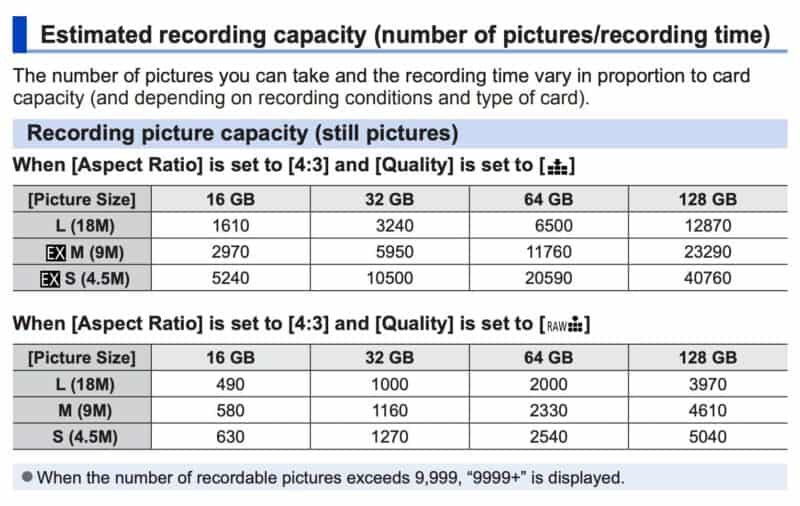
Panasonic provides these estimates in the manual for how many photos you can fit on various sizes of cards:
Ditto for the duration of video:

How to format SD cards
When you buy a new SD card, you should format — or initialize — it before use (and then regularly after that). Here’s some information on how to do that.
How to format memory cards in the Panasonic LUMIX FZ80
It is best practice to always format memory cards in the camera that you’ll be using them in. That sets the card up with the filesystem, folder hierarchy, and, in some cameras, a database file, so that the card is just how the camera expects. That greatly reduces the risk of unexpected errors and unpleasant surprises.
On the Panasonic LUMIX FZ80, you can find the format function under:
Menu > Setup > FormatHow to format SD cards with a computer
Having said that, it is still possible to format memory cards using a card reader and computer. You get a lot more flexibility that way, but also some extra risk if things aren’t set up just how the camera wants them. It’s also sometimes a good troubleshooting step if you’re having issues with a memory card.
There are some things to watch out for, particularly when it comes to choosing which filesystem to use. So I’ve put together guides on how to format SD cards on Mac and how to use the free SD Card Formatter app for Windows or Mac.
Notes & References:
- The formal product number for this camera is the DC-FZ80K. [↩︎]
- Depending on your computer and memory card reader setup, you might get some speed benefit when putting a faster memory card into your card reader and downloading images to your computer. [↩︎]