The Nikon D3500 has what it calls a continuous shooting mode. On other cameras, it’s often known as a burst mode.1 Basically, it allows you to take a rapid sequence of photos in quick succession.
It’s especially useful for fast-moving action to help maximize the chances that you’ll get the shot you’re after. Sports, for example. Or candid family photos of kids who can’t stop moving. Or wildlife on the move.
The D3500 can shoot at up to five frames per second (whether you actually get that speed depends on the shooting settings; more on that below).
So here’s a rundown of how to use the Nikon’s D3500’s built-in continuous/burst mode.
How to turn on continuous/burst mode on the Nikon D3500
Press the button on the back panel that has an icon that looks like a stack of photos. It’s the button in the middle in the photo at the top of this page (and the same button that you use for the D3500’s self-timer. That icon is the one for multiple exposures.
When you press that, you’ll get a popup of the Release mode screen. By default, it should have the single frame option selected (a rectangle with an “S”).

The one next to it, with the multi-image icon, is the continuous mode selection.
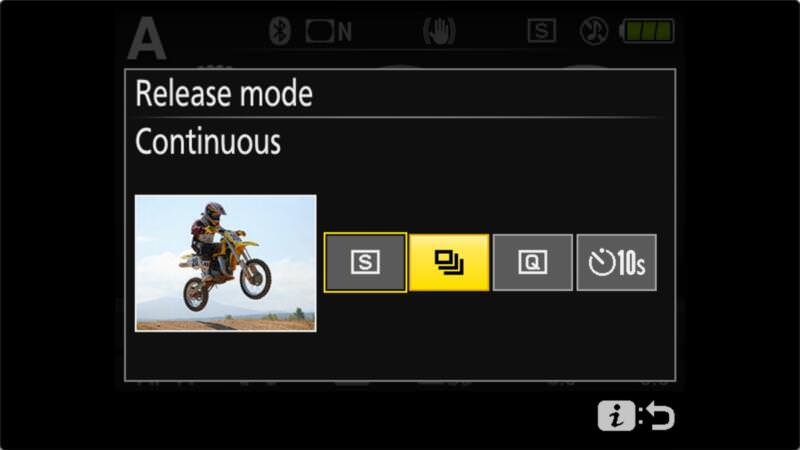
There are no settings you can control. The mode is either on or off. You can’t change the speed or any other options.
Once enabled, you’ll see a small icon on the main status screen. Like this:

Nikon D3500 continuous mode shooting rate
The shooting rate depends on the shooting mode you’re using, how full the internal memory buffer is (see below), and whether the battery power is running low.
The D3500’s maximum continuous shooting speed at full resolution is five frames per second.
If battery power is running low, the framerate slows down.
Memory buffer
The D3500 has an internal memory buffer. This isn’t storage space that you can access in the usual way — it’s fast flash memory that the camera can use for temporary storage as it’s waiting for data to be written to the memory card. So it’s similar to the RAM of a computer.
And this becomes very important when shooting in continuous/burst mode, because there’s a good chance that the camera is taking photos faster than the camera can write the data to the memory card (all the more reason to get a memory card that’s fast enough for the D3500).
The memory buffer has enough space for up to 100 images at a time, but that’s if you’re shooting JPEG-only.2 If you’re shooting one of the RAW modes (NEF or NEF + JPEG), then you won’t get anywhere near that many shots before the buffer fills up.
These are the buffer capacity estimates provided by Nikon.
| Image Quality Setting | |
|---|---|
| NEF (RAW) + JPEG Fine | 6 |
| NEF (RAW) | 16 |
| JPEG | 100 |
And there are other factors that reduce those even further. If you’re using the in-camera noise reduction, auto distortion control, or date stamp features, the buffer capacity drops.
You can get a real-time sense of how full the memory buffer is through the viewfinder. At the bottom-right, the number starting with R shows an estimate for how many photos can still fit in the memory buffer. It’s updated as images are written from the buffer to the memory card.
Things worth knowing
Unlike some other shooting features, such as the self-timer, continuous mode doesn’t disable automatically. If it’s something you use even semi-regularly, there’s no harm in keeping it engaged. You can still take a single photo — it just means being a bit more careful with how long you hold the shutter down. Then, if you want to shoot multiples, it’s already on, and you can just hold the shutter down.
Continuous Mode doesn’t work with the D3500’s built-in flash. If you have the flash enabled, you won’t be able to select continuous mode. You’ll need to turn the flash setting off first.
Notes & References:
- The D3500 manual refers to both continuous mode and burst mode. [↩︎]
- There’s an exception if you choose a shutter speed of four seconds or slower in the shutter-priority or manual modes; in those cases, there’s no limit on the number of shots that you can shoot in a single burst, because the files are being saved to the SD card faster than you’re taking them. [↩︎]



Thanks that helped