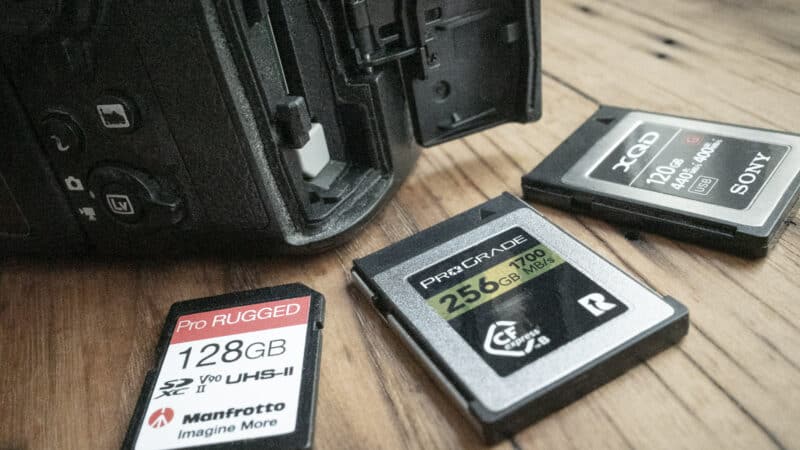
The Nikon Z6 III is a major upgrade from the Z6 II. While the dual-slot configuration (one CFexpress Type B, one SD UHS-II) looks identical on the outside, the camera’s EXPEED 7 processor and partially-stacked 24.5MP sensor change the storage math entirely. In practice, the older memory cards that easily handled the Z6 II’s basic 4K video will quickly bottleneck the Z6 III’s 6K RAW formats or choke its 20 fps burst buffer.
If you’re upgrading or building a new kit, here’s a practical look at exactly how I manage this dual-slot system, navigate the shifting CFexpress market, and buy cards fast enough to handle 6K RAW without overpaying.
Which Z6 Generation are you shooting?
This guide covers the high-bitrate requirements of the 2024 Nikon Z6 III. If you are using a previous model, the card slots and speed limits are different. Please see my dedicated guides for those cameras here:
– Nikon Z6 II Memory Card Recommendations (Dual CFexpress/SD Slots)
– Nikon Z6 Memory Card Recommendations (Original Single-Slot Model)
Nikon Z6 III compatibility & requirements
The Z6 III has two memory card slots. Slot 1 is for CFexpress Type B cards. Slot 2 is for SD cards, and it’s a UHS-II slot, so a UHS-II SDXC card is what belongs in it. Because CFexpress cards are drastically faster than even the fastest SD card, you’ll want the CFexpress slot to act as your primary drive.
In the official documentation, Nikon states that the Z6 III requires a CFexpress card with a maximum data transfer rate of at least 250 MB/s for basic 4K video recording, but requires a rate of at least 1500 MB/s for 6K/60p N-RAW.
However, for modern video workflows, focusing on the “maximum” (peak) speeds printed on the front of the card is a trap. Peak speeds are just marketing metrics. What actually dictates whether a recording fails or succeeds on the Z6 III is the minimum sustained write speed.
When shooting internal 6K/60p N-RAW (High Quality), the camera pushes data at roughly 5780 Mbps. That translates to roughly 722 MB/s. If your CFexpress card’s sustained write speed drops below that threshold for even a fraction of a second, the camera’s buffer overflows and the recording abruptly halts.
Here’s how the Z6 III’s flagship features map to real-world card requirements:
| Z6 III Feature / Codec | Data Rate / Requirement | Minimum Required Card |
|---|---|---|
| 6K/60p N-RAW (High Quality) | ~5780 Mbps (722 MB/s) | CFexpress Type B (800 MB/s+ Sustained Write) |
| 6K/30p ProRes RAW HQ | ~3400 Mbps (425 MB/s) | CFexpress Type B (500 MB/s+ Sustained Write) |
| 4K/120p H.265 10-bit | ~400 Mbps (50 MB/s) | CFexpress Type B OR SDXC V60 / V90 |
| 20 fps RAW Stills Burst | ~600 to 800 MB/s | CFexpress Type B (Fast sustained write preferred) |
Slot 1: CFexpress Type B cards & the 4.0 opportunity
The CFexpress market is currently transitioning from the older 2.0 spec to the newer, twice-as-fast 4.0 spec. Because the cards look identical, navigating this shift is actually a great opportunity to save some cash — if you know what to look for.
The Nikon Z6 III is a CFexpress 2.0 camera. It physically lacks the PCIe Gen 4 hardware required to hit the newer 4.0 speeds. This is a hardware limitation that cannot be changed with a firmware update.
Because the CFexpress standard is backward compatible, you can put a bleeding-edge 4.0 card into the Z6 III, and it will work flawlessly. The camera simply throttles that card down to 2.0 speeds. While you won’t see an in-camera performance bump from a 4.0 card, this backward compatibility opens up some opportunities for smart buying.
In a perfectly logical market, you’d just buy the cheapest 2.0 card you could find. But it’s not that simple. Because manufacturers are aggressively shifting their production lines to the new standard, newer 4.0 cards are sometimes actually cheaper and more readily available than the legacy 2.0 cards they replaced. In a market distortion due to algorithmic pricing based on the limited availability of legacy stock, I’ve even seen older 2.0 cards show up at massively inflated prices that are more expensive than the newer, faster 4.0 replacements.
So, my rule of thumb is to look at the sustained write speeds and go with whatever is cheaper, regardless of whether the label says 2.0 or 4.0. If you spot a 4.0 card for the same price or cheaper than its 2.0 equivalent, grabbing the newer version is a fantastic win. You keep extra money in your pocket today, and as a bonus, you unlock drastically faster desktop offload speeds when you get back to your desk (provided you pair it with a USB 4.0 memory card reader).
The high-performance cards listed below are essentially the modern, over-provisioned replacements for legacy 2.0 stock. Look for cards with a VPG400 logo — this guarantees a minimum sustained write speed of 400 MB/s, but the premium cards I recommend here sustain 800 MB/s or higher to comfortably clear the Z6 III’s 6K N-RAW bottleneck:
Two things about VPG are worth knowing before you shop on the badge alone. Certification is voluntary, so some genuinely fast cards never carry it at all, and the CompactFlash Association has warned that a few cards print the VPG flag without having been certified. And a higher number doesn’t automatically cover a lower one: the newer VPG800 and VPG1600 profile isn’t backward compatible with VPG400, so a VPG800 card only guarantees VPG400 performance if it has been certified for both and carries both logos. What the camera actually needs is sustained write speed — VPG400 is simply the most reliable guarantee that you’re getting it.
CFexpress cards have been evolving quickly. A recent evolution has been from CFexpress 2.0 to CFexpress 4.0. While most cameras still have a CFexpress 2.0 interface, the spec is designed to be backward compatible, so 4.0 cards will work in 2.0 devices (at 2.0 speeds). That's especially pertinent because many of the memory card makers are upgrading their lines to 4.0, making 2.0 cards harder to find in stores.
ProGrade Digital Iridium CFexpress 4.0 Type B (VPG400)
- Card Type: CFexpress 4.0 Type B
- VPG Rating: VPG400
- Maximum Read Speed: 3550 MB/s
- Sustained Write: 850–1500 MB/s (capacity dependent)
- Storage Capacities: 400GB, 800GB, 1.6TB
Check current price and availability at:
Delkin Devices BLACK CFexpress 4.0 Type B (VPG400)
- Card Type: CFexpress 4.0 Type B
- VPG Rating: VPG400
- Maximum Read Speed: 3700 MB/s
- Minimum Sustained Write: 2040 MB/s
- Storage Capacities: 512GB, 1TB, 2TB
Check current price and availability at:
Lexar Professional DIAMOND CFexpress 4.0 Type B
- Card Type: CFexpress 4.0 Type B
- VPG Rating: VPG400
- Maximum Read Speed: 3700 MB/s
- Minimum Sustained Write: 3200 MB/s
- Storage Capacities: 128GB, 256GB, 512GB, 1TB
Check current price and availability at:
Angelbird AV PRO SE CFexpress B — CFexpress 4.0 Type B (MK2)
- Card Type: CFexpress 4.0 Type B
- VPG Rating: not published (Angelbird uses sustained-write specs)
- Maximum Read Speed: 3700 MB/s
- Sustained Write: 500–3500 MB/s (capacity dependent)
- Storage Capacities: 256GB, 512GB, 1TB, 2TB, 4TB
Check current price and availability at:
SanDisk Extreme PRO CFexpress 4.0 Type B
- Card Type: CFexpress 4.0 Type B — backward compatible
- VPG Rating: VPG400/800 (128–400GB) · VPG1600 (1TB–4TB)
- Maximum Read Speed: 3700 MB/s
- Storage Capacities: 128GB, 256GB, 400GB, 1TB, 2TB, 4TB
Check current price and availability at:
Lexar Professional GOLD CFexpress 4.0 Type B
- Card Type: CFexpress 2.0 Type B
- Minimum Sustained Write: 3300 MB/s
- Storage Capacities: 128GB, 256GB
Check current price and availability at:
ProGrade Digital Gold CFexpress 4.0 Type B (works in 2.0 cameras)
- Card Type: CFexpress 4.0 Type B
- Maximum Read Speed: 3400 MB/s
- Storage Capacities: 128GB, 256GB, 512GB, 1TB, 2TB, 4TB
Check current price and availability at:
Recommendations checked: August 2026
XQD Cards: While the Z6 III is physically backward-compatible with legacy XQD cards, I’d recommend against using them. They’ll immediately bottleneck the camera, capping out around 400 MB/s peak, and can’t physically support any of the Z6 III’s advanced RAW video modes.
Slot 2: SDXC & the dual-slot bottleneck trap
If you’re bringing SD cards over from an older Z6 II, you need to watch your secondary slot settings. Because the Z6 III reads data off its partially-stacked sensor so quickly, mismatched cards can cause a massive workflow bottleneck.
If you configure the camera to Backup Mode (writing duplicate 24.5MP RAW files to both Slot 1 and Slot 2 simultaneously for an instant backup), the camera cannot clear its internal buffer until the photo is written to both locations. The entire camera will instantly throttle to the speed of the SD card.
In the field, shooting a 20 fps burst in backup mode with a slow UHS-I SD card in Slot 2 will cause the buffer to hit a wall almost immediately, completely neutralizing the speed of the Z6 III. If you shoot redundant RAW backups, based on my SD card speed tests, a fast V90 UHS-II SD card is absolutely essential.
- SanDisk Extreme Pro V90 UHS-II SDXC
- ProGrade Digital Iridium V90 UHS-II SDXC
- Lexar Professional 2000x Gold V90 UHS-II SDXC
- Type: SDXC
- Video Speed Class: V90
- UHS Bus Interface Type: UHS-II
- Maximum Read Speed: 310 MB/s
- Storage Capacities: 128GB, 256GB, 512GB, 1TB, 2TB
Check current price and availability at:
- Type: SDXC
- Video Speed Class: V90
- UHS Bus Interface Type: UHS-II
- Maximum Read Speed: 300 MB/s
- Storage Capacities: 128GB, 256GB, 512GB, 1TB
Check current price and availability at:
- Type: SDXC
- Video Speed Class: V90
- UHS Bus Interface Type: UHS-II
- Maximum Read Speed: 300 MB/s
- Storage Capacities: 64GB, 128GB, 256GB
Check current price and availability at:
Recommendations checked: August 2026
Heads up! Don’t buy an SD Express card. The Z6 III lacks the internal hardware to utilize the emerging SD Express standard. While they will physically fit, they will default to sluggish UHS-I speeds, wasting your money. Stick to standard UHS-II SDXC cards.
There’s no microSD slot on the Z6 III, and no reason to improvise one. A microSD card in a full-size adapter will physically fit Slot 2, but the adapter is a passive shell — it adds no speed and no capability, and full-size UHS-II microSD is rare enough that you’re almost certainly running at UHS-I speeds plus one extra connection that can fail mid-shoot. Put a full-size UHS-II SDXC card in that slot instead.
The golden rule & memory card readers
My golden rule for storage media is to always format the memory card directly inside the camera before a shoot, rather than relying on your computer to do it. You can format either slot by navigating to the yellow Setup Menu (Wrench Icon) and selecting Format memory card.
If you accidentally format the wrong card in the field, stop shooting immediately. Because the camera only performs a high-level format that wipes the directory index, you can usually recover your deleted photos later, as long as you haven’t written new files over the old data.
If your memory card begins to act sluggishly or throws read errors after months of use, a standard in-camera format might not be enough. In that case, I recommend connecting the card to your computer and executing a full format instead of a quick format using a dedicated utility tool to deeply restore the flash memory.
The cable bottleneck
The file sizes generated by the Z6 III are massive — a single minute of 6K/60p N-RAW takes up over 40GB of space. You will want a dedicated CFexpress Type B reader. However, be incredibly careful with how you connect it to your computer.
If you use a standard USB-C charging cable (like the one that came with your phone or laptop charger), your transfer speed will immediately bottleneck to 480 Mbps (roughly 60 MB/s) because charging cables lack the internal shielded data wires. Always use the short, stiff, high-speed data cable that ships in the box with a quality reader.