Quick Summary
- Latest Firmware: C:Ver.3.11 (Released September 2026).
- Manual update needed; doesn’t update automatically.
- Important: Use a fully charged battery and remove any third-party lenses before updating.
Modern digital cameras are essentially small computers with optical components. And surprisingly powerful ones at that. And just like any computer, they need to be programmed with instructions in order to know what to do.
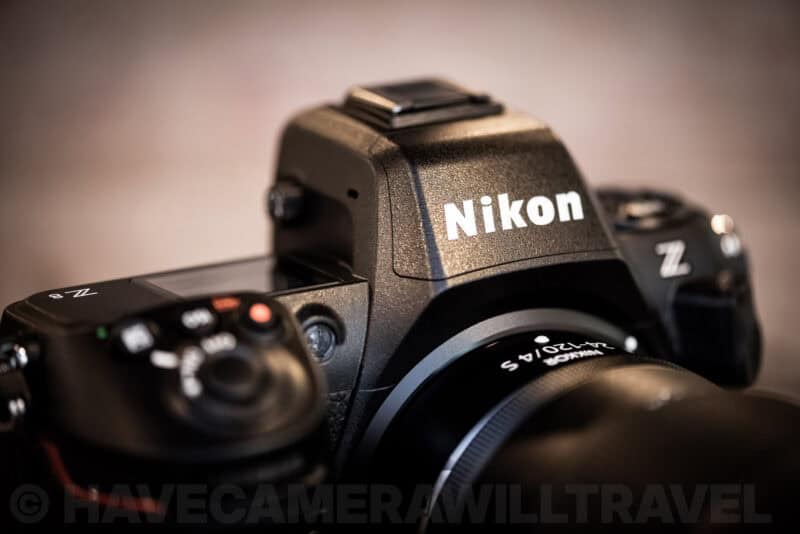
A camera’s firmware is software code that works with the camera’s hardware to control features and functions. It controls everything from the color and fonts of the menu system to the available ISO range to the responsiveness of the auto-focusing system. So it’s an essential part of the camera’s functionality — it won’t work without it.
WARNING: Don’t update your camera’s firmware with a third-party lens attached (e.g., Viltrox, TTArtisan). It can sometimes cause the update to hang. Always use a native Nikon lens or just a body cap (i.e., no lens). More.
Nikon’s own wording is narrower than most people assume. The download page says not to update with lenses other than Z-mount NIKKOR lenses, or mount adapters other than the FTZ and FTZ II, attached. So Nikon’s own F-mount adapter can stay on the camera; it’s third-party lenses and third-party adapters — Megadap, Techart, Fringer and the like — that should come off first.
The risk also runs in the other direction. Firmware 3.00, released in July 2025, left a batch of third-party adapters and lenses misbehaving on the Z8 until their makers pushed out their own matching updates. If you rely on third-party glass or an electronic adapter, it’s worth waiting a few days after a major Nikon release and checking that the lens or adapter maker has caught up before you update.
It’s also a way for camera manufacturers to make improvements to how a camera works after the camera has already been built and is in use (at least, they’re nearly always improvements, but there are some instances where things go in the wrong direction). They typically include bug fixes and sometimes new features.
So, in nearly all cases, it’s a very good idea to be running the latest firmware that’s available. It’s the version most likely to have any bugs squashed, any security glitches addressed, performance tweaks, as well as any new features added.1
Like most cameras, however, the Nikon Z8 doesn’t automatically update its firmware when a new version is released, even though the camera has wireless functionality built in.


While it’s not difficult to update a Z8’s firmware, it is a process you have to run manually.
And there are some things to watch out for to reduce the risk of problems.
The first step is to find out what version of the firmware your Z8 is already running.
You can then compare it to the version that Nikon makes available on their download page. If you already have the latest version, you’re good to go. If not, you can proceed to the firmware update process.
Step 1: How to check the Nikon Z8’s current firmware version
With the camera turned on, press the MENU button.
Scroll down to the SETUP MENU. That’s the one with the wrench/spanner icon.
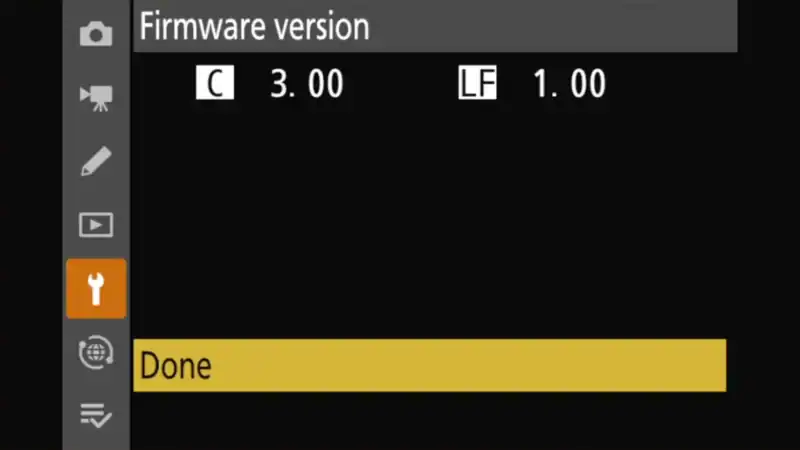
Scroll to the end of that section until you come to the Firmware version item.

Press the OK button to open up the page displaying the versions. You’ll notice two entries there. The “C” version is the camera’s firmware. The “LF” is the lens’s firmware version. One of the innovations with some newer lenses, including Nikon’s new Z-mount lenses, is that the lenses can have their own firmware that can tweak their performance. But those updates don’t tend to come frequently.
Some newer third-party lenses have their own USB-C port for updating firmware. For those, the firmware updates are handled directly and not through the camera; see the lens manufacturer’s website for details on their procedure.
Video guide
If you’d prefer a video version, I put together this quick guide:

Step 2: How to update the Nikon Z8’s firmware
There are two methods for updating the firmware of the Nikon Z8:
- using a computer (or tablet) using the memory card
- wirelessly through the SnapBridge app and a mobile device
I’m focusing here on the more traditional manual method using a computer and a memory card. While it is a manual process, I find it ultimately quicker and more reliable. It works with a computer, but it can also work with some tablets that can accept a memory card reader. And, frankly, I am just not a fan of SnapBridge.
The wireless method using SnapBridge is a good option if you’re on the road without access to a computer or memory card reader. Another advantage of SnapBridge is that it will tell you when an update becomes available on the Nikon site. If you decide to use the SnapBridge method, that app will guide you through the firmware update process.
You can find more details on the technical requirements on Nikon’s site.
Format a memory card in the camera
Format a memory card in the camera. This will wipe everything on the card, so make sure you’ve backed up any photos or videos before you start. While it’s not technically a requirement, starting the process with a freshly formatted card will reduce the risk of problems in running the firmware update.
I generally run the process from a CFexpress B card, but it appears to also work just fine from an SD card.
Download the firmware file
Using a computer, you’ll need to download and unpack the firmware file.
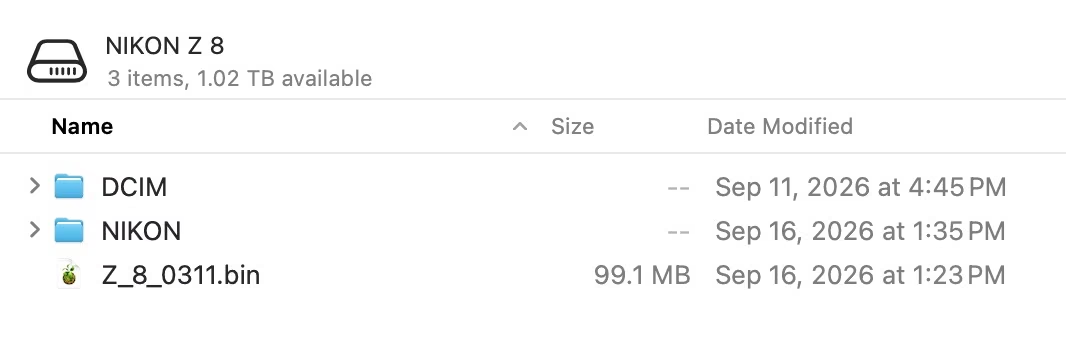
You can download the firmware for the Nikon Z8 here. The filename will be along the lines of Z_8_0311.bin.
Copy the .bin file to the memory card
Copy the .bin file from your computer to your memory card.
Make sure to put it in the root directory of the card. That is, make sure it’s in the topmost level and is not inside another folder. Don’t put it inside the DCIM folder, for instance — it should be alongside it.
Load the firmware in the camera
Once you’ve copied the .bin firmware file onto your memory card, insert the memory card into your camera and turn the camera on. Make sure your camera battery has plenty of charge left on it; you do not want it running out of power in the middle of the firmware update operation.
Then repeat the process of looking up the firmware version from above. That is, go to Setup Menu and then Firmware version.
If the camera has correctly identified the .bin file on the memory card, you’ll now see two new options appear on that screen: Update and Delete firmware update files.
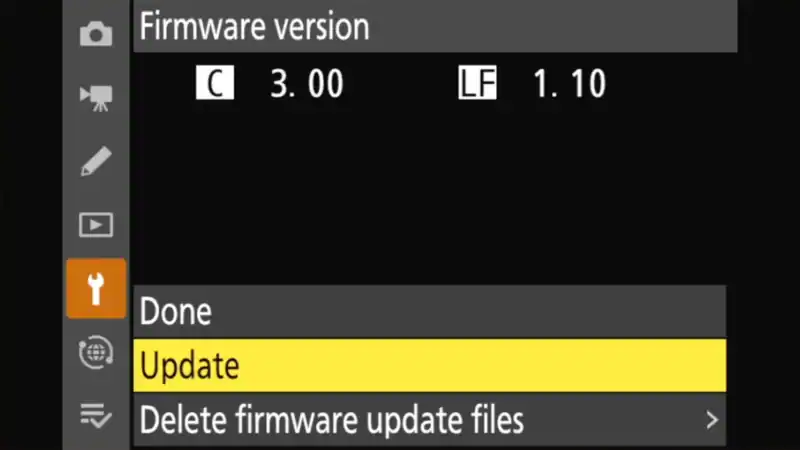
You’ll get some on-screen instructions walking you through the rest of the operation.
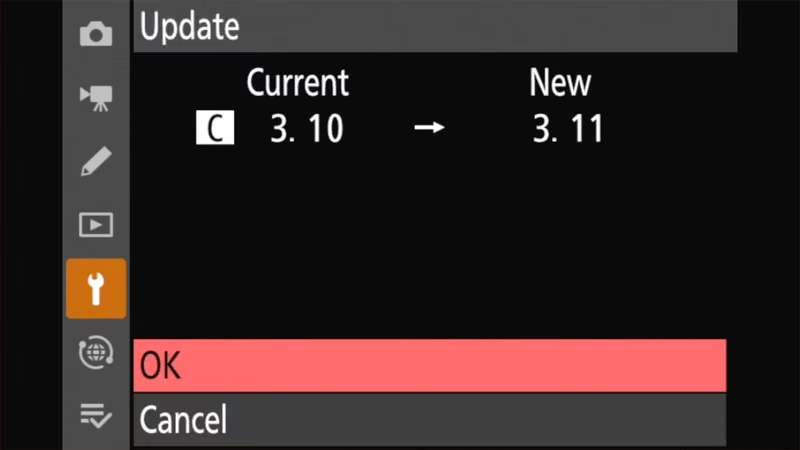
So move the cursor up to OK and click the OK button.
Important!
It’s very important that the camera not be interrupted while it’s updating the firmware. Doing so could render the camera inoperable (in other words: it can brick it because the firmware can be corrupted).
So do not use any controls or turn the power off while it’s doing this, and make sure there’s plenty of battery charge before you start. You’ll see a progress bar and this warning on the Z8’s back screen:
Updating . . . Warning! Do not turn camera off during update. Update will take several minutes.
Once the update is complete, you’ll get the instructions on the screen that:
Update completed. Turn camera off.
You can now turn the camera back and check the firmware version to confirm that the operation was successful.
Next, it’s good practice to remove the firmware file from the memory card. You could do that in a computer with a card reader, of course, but the two safest options are to format the card in the camera or use the built-in “Delete firmware update files” function by going to Setup Menu > Firmware > Delete firmware update files.
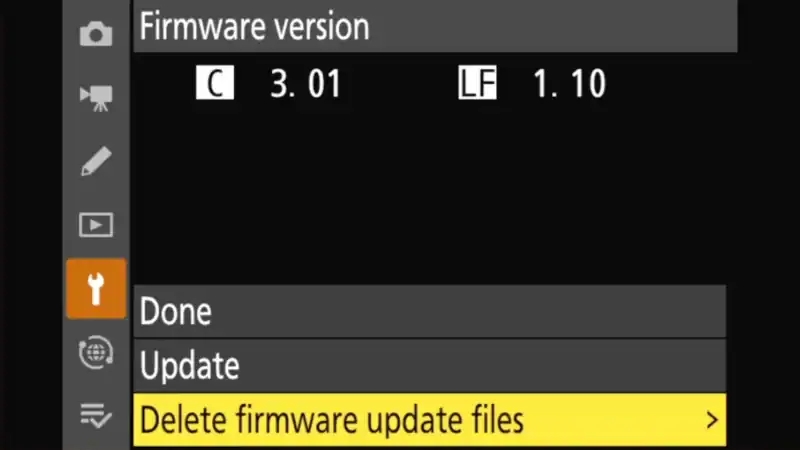
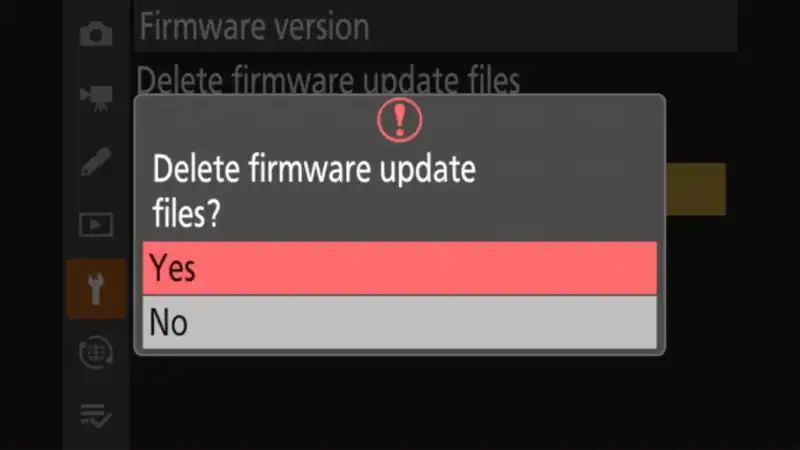
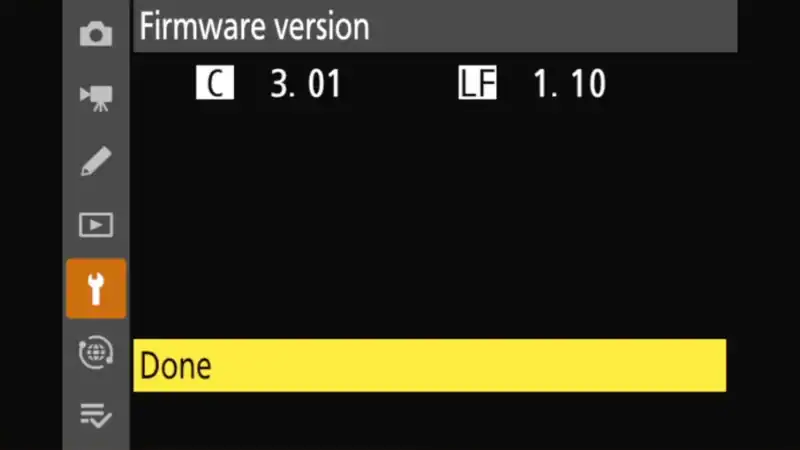
Now, when you go back to the firmware version screen, the update and cleanup options aren’t triggered because the file is no longer there. So the only option you’ll see is Done.
Where to find the latest Nikon Z8 firmware
You can find the latest Nikon Z8 firmware directly from Nikon’s download page for the Z8.
On that page, click on the firmware tab for a listing of the available downloads. That will give you a link to the specific page for downloading that firmware version, as well as the detailed changelog and instructions on how to update the Z8’s firmware.
The big one for Z8 owners was firmware 3.00, released in mid-2025. It added pixel-shift shooting that can be combined with focus shift shooting or AE bracketing, an in-camera focus limiter that restricts autofocus to a near and far distance you set, extended Wide-area AF (C1) and (C2) area patterns, and subject detection in manual focus. It also added support for Flexible Color Picture Controls, which you build in NX Studio and load onto the camera from a memory card. For video, N-Log View Assist was updated for more accurate contrast and detail on an external monitor. If you’re coming from 2.x, that’s the update that changed the most.
Types of firmware on the Nikon Z8
It’s not just the camera body that has firmware. These days, accessories such as lenses, flashes, teleconverters, electronic remotes, and even grips can come with firmware.
In this guide, I’ve been focusing on the C firmware, which is the code for the camera firmware. But there are several other types that you might see. You’ll only see these on the camera’s menu system if you have the relevant accessory attached.
I have a more detailed post on Nikon firmware codes separately, but here are the ones most relevant to the Z8.
- C – Camera firmware
- LF – Lens firmware
- MA – Mount adapter firmware
- S – Speedlight / flash firmware
- W – Wireless remote controller firmware
- TC – Teleconverter firmware
- RG – Remote grip firmware
If you need to update the firmware of one of these other types, you will have the option to select which firmware to update in the menu system.
Notes & References:
- There are some exceptions, such as when firmware introduces compatibility issues or introduces manufacturer-instigated limitations, such as not working with third-party batteries. But, as a general rule, it’s usually a good idea to keep the firmware up to date. [↩︎]