The Oben CTM-2500 is a light carbon-fiber monopod that does the monopod job — taking the weight of a long lens and steadying it — without much weight penalty in the bag. Hands-on notes below.
When legs beat a stick: travel tripods.
I don’t find myself using monopods nearly as often as tripods when I am traveling. But if you are shooting with a massive telephoto lens for wildlife or sports photography, they’re an absolute must.
Not only do they offer crucial stability when tracking a moving subject, but they take the immense physical weight off your arms when holding what can be very heavy glass. So I always make sure to have one strapped to my pack when I am carrying something like the Sigma 150-600mm telephoto.
For several years, my go-to has been the Sirui P-326 carbon fiber monopod. I’ve been very happy with how it performs, especially as an affordable option from a lesser-known brand. While there are certainly more refined and stronger supports available from the premium brands, they also tend to be astronomically more expensive. I have a very hard time justifying spending $300 or more on a single monopod for travel when I am not shooting professional sports or birding day in and day out.
Recently, B&H Photo sent me a new contender to test out in the field: the Oben CTM-2500 5-Section Carbon Fiber Monopod.
UPDATE: I originally wrote this review shortly after the Oben CTM-2500 hit the market. There have been newer models since, but as of 2026, you can still find this model available and at good prices.
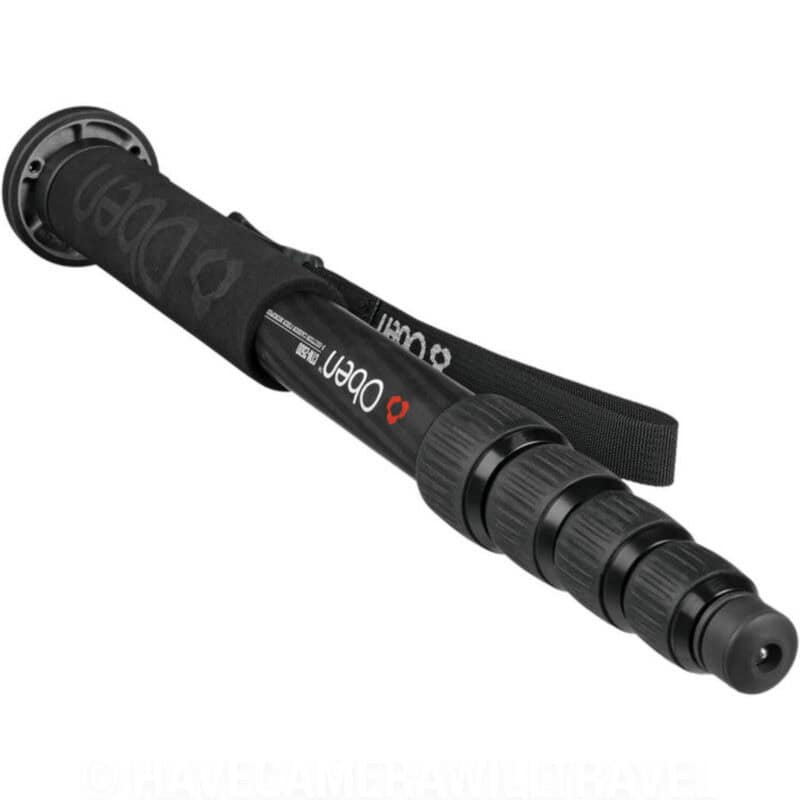
Here are my thoughts after putting it to work.
Build quality & twist locks
The carbon fiber legs extend in five sections. The twist locks are deeply rubberized and have fantastic grip. I found them incredibly easy to use with one hand, even when shooting in cold or damp conditions.
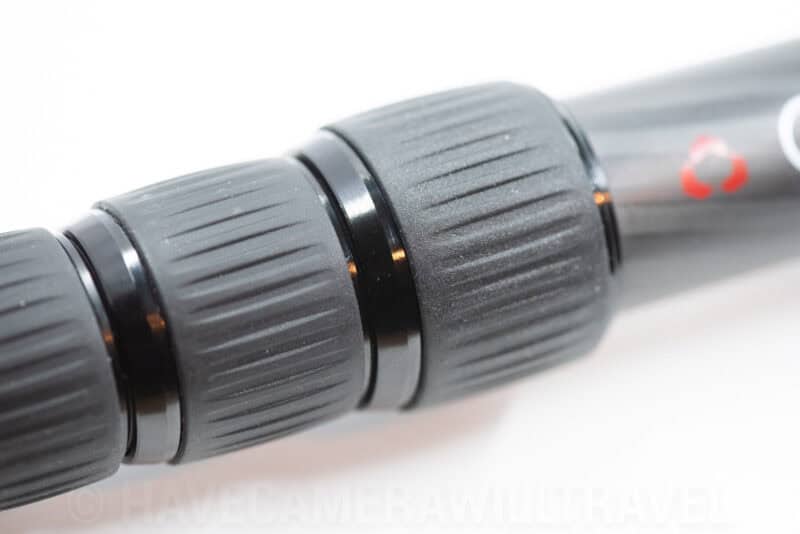
In my field tests, I found that the locks are strong, solid, and provide absolutely no wiggle room once tightened. Even when fully extended to its maximum height, the entire stick feels tight and solid with no hint of flimsiness or bowing under load.
Mounting & head options
The Oben is sold in two main configurations. One is just the bare monopod stick without a head. You can, of course, simply attach your camera or long lens collar directly to the top plate and shoot like that, but adding a dedicated tilt head or ballhead will vastly increase your flexibility when tracking subjects.
Monopod Field Tip: If you are not using your monopod fully extended, it is always a good idea to extend the top sections first until you reach your preferred shooting height. Those top carbon sections are significantly thicker and stiffer than the thin ones at the bottom.
The only exception to this rule is if you are shooting in deep dirt or mud — in that case, extend the bottom sections first to keep the twist locks as far away from the grit and grime as possible.
If you don’t want to supply your own head, Oben sells this bundled with their VH-R2 tilt head. That makes a great combination so long as you are happy using the proprietary quick-release plate it comes with (see my detailed review of the VH-R2). Bear in mind that adding any head might lower your maximum load capacity; the true maximum load capacity becomes whichever is lower between the head and the main stick.
Another great option is to add a simple quick-release clamp directly to the top plate. It doesn’t give you the extreme angle versatility of a full head, but it provides a way to pop a heavy camera on and off the stick very quickly.
The clamp I personally use for my workflow is a Desmond DAC-X1 skeleton clamp, which is fully compatible with my Arca-style quick-release plates.
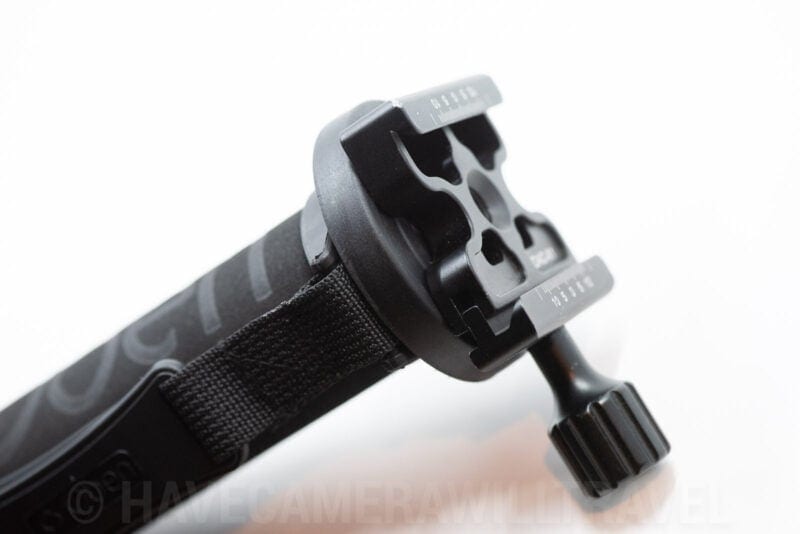
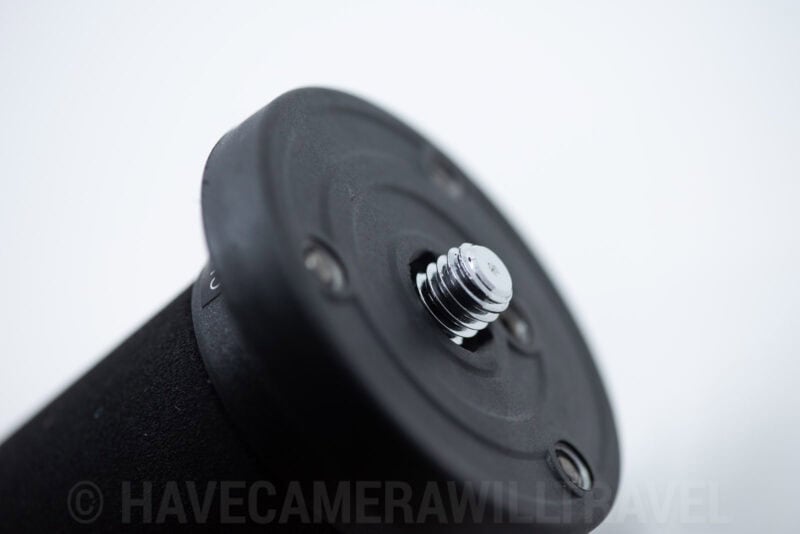
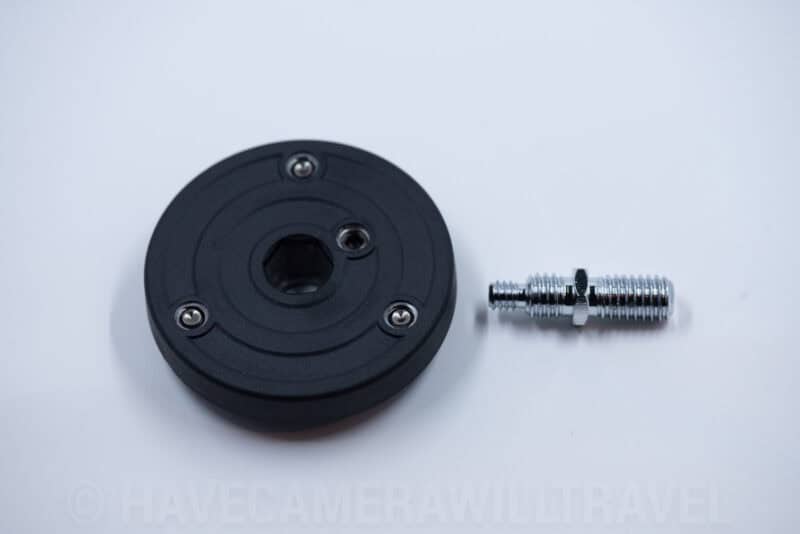
At the top, there is a broad attachment plate that uses the de facto universal mounting slugs. It features a 3/8″-16 slug by default, but if you want to use the smaller 1/4″-20 size instead, you can easily remove the plate and flip the reversible bolt around.
Grips, feet & straps
The Oben includes a thick, padded grip wrapped around the top section. Oben’s marketing materials call this a “leg warmer,” which I confess is not a term I’ve seen used before (they are usually called leg wraps or leg protectors). Oben touts it as a major feature for shooting in extreme weather, but in reality, it is mostly just a comfortable carrying grip. Because it’s made of dense foam, it will naturally get a bit banged up over time if you treat it roughly in the field.
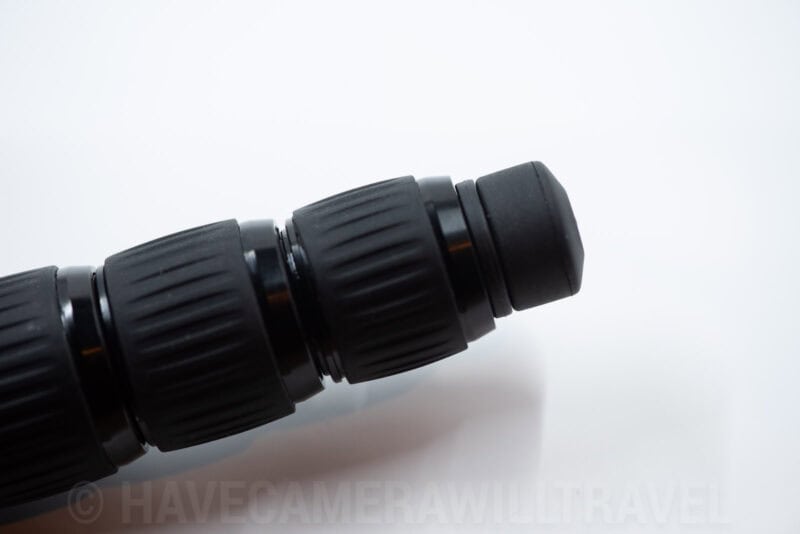
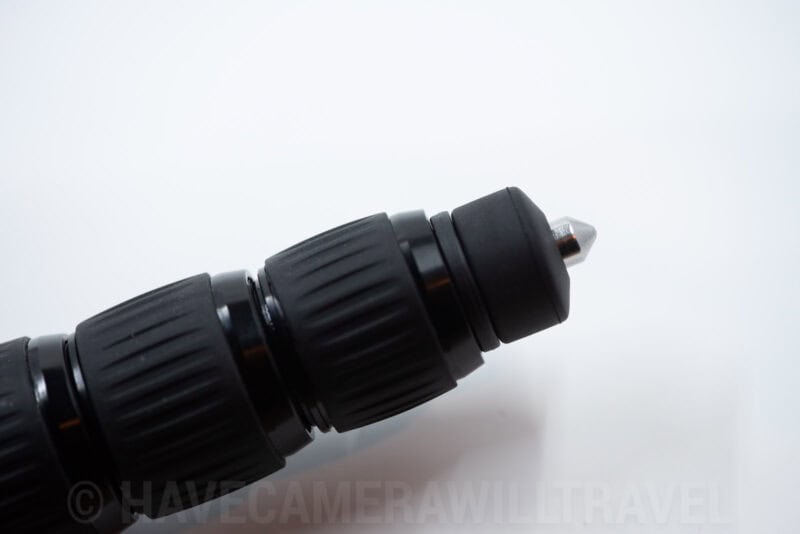
Down at the bottom, there is a retractable steel spike hidden in the foot. You just rotate the rubber foot surrounding it to make the spike dial in or out. The spike itself does not come out entirely, and you cannot remove the rubber foot to screw in a different kind of terrain shoe.
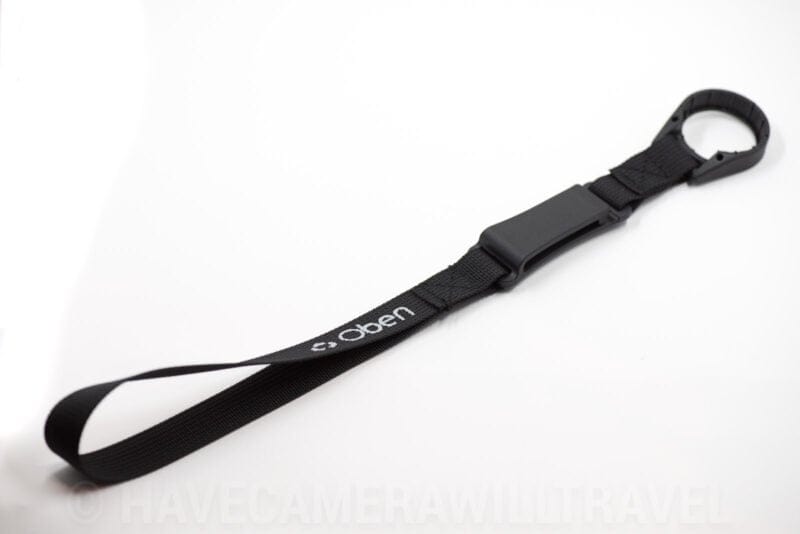
Most of the time, a wrist strap is just a wrist strap. While that’s mostly true here, there are a couple of minor things about this specific strap that I appreciate as nice touches.
First, there is an integrated belt clip that is actually quite useful for attaching the monopod to your belt or the accessory strap of your camera bag. Second, it is a very good length — a bit longer than usual — so it does not get in the way when you are actively using the strap as a security loop while shooting. The wrist strap is also completely removable by unscrewing the top mounting plate and sliding the collar off.
Core specifications
| Specification | Details |
|---|---|
| Maximum height | 64.0 inches / 164.8 cm |
| Minimum height | 17.5 inches / 44.4 cm |
| Load capacity | 26 lb / 12 kg |
| Weight | 1.05 lb / 0.47 kg |
| Leg Sections | 5 (Twist Locks) |
| Warranty | 5-year limited warranty |
What’s in the box?
- Oben CTM-2500 Monopod
- Wrist strap (with belt clip)
- Hex key
- Fabric carrying bag (not padded)
Oben CTM-2500 vs. Sirui P-326 carbon fiber
Oben’s CTM-2500 carbon fiber monopod is quite similar to my old Sirui P-326 in many ways.
They support very similar loads, are both made of carbon fiber, use twist locks for the extensions, and both feature built-in retractable steel spikes. The main structural difference is that the Oben is a 5-section monopod, compared to the 6 sections of the Sirui.
Taller shooters might greatly appreciate the extra height of the Oben — it is about 4 inches taller fully extended.
If luggage or camera bag space is at an absolute premium, the Sirui holds slight edges in both compactness (it is about 2.5 inches shorter when collapsed) and weight (about 10 percent lighter). Those aren’t massive differences, but they can matter if you are trying to travel as light as possible, especially with carry-on luggage or a walking-around daypack.


However, the Oben feels a bit stiffer and stronger in my hands. It does not appear to exhibit as much vibration when fully extended.
Overall, there is not a massive performance gap between them, and to my mind, they are both very good, affordable options. I consider the extra compactness of the Sirui a plus, but I also really like the extra strength and length of the Oben. For an upcoming trip to the Arctic where I will be heavily using long telephoto lenses, I chose to pack the Oben specifically because it is that little bit stronger and stiffer. The reality is that I am more than happy shooting with either of them.
Final thoughts & summary
The Oben CTM-2500 is a fantastic, solid, yet lightweight monopod.
Collapsing down to just under 18 inches, it easily fits into a carry-on bag without hassle. Yet, it extends to a generous maximum shooting height of up to 64 inches and boasts a substantial maximum load capacity of 26 pounds, all while weighing in at just a touch over one pound.
Price & availability: Oben CTM-2500
You can find the base monopod at B&H Photo for around $95. It is also sold bundled directly with Oben’s VH-R2 tilt head, which makes for a good pairing so long as you are happy using that head’s quick-release plate.
Check price and availability at:
The CTM-2500 is Oben’s top and strongest offering, but they also offer several alternatives, including a 4-section carbon fiber monopod that is slightly shorter when extended and slightly longer when packed down.