I like wide-angle lenses, something I’ve written about them many times on this site.
The focal length I find most versatile — or, at least, what I reach for most often for my general and travel photography — is 24mm (on a full-frame body). And I’ve written about how a 24mm f/1.4 is my desert island lens. If I could only use one lens for the rest of my life, that would be it.
So I was intrigued to try out these fast primes for Sony E-mount. Specifically, they’re the Sony E 15mm f/1.4 G and the Sigma 16mm f/1.4 DC DN.
While their names imply that they’re ultra-wide perspectives, they’re designed for APS-C sensors. So, on that cropped sensor size, they both come out around 24mm when converted to 35mm equivalent (or, technically, 22.5mm in the case of the Sony lens). Which is wide, but not what would normally be considered ultra-wide.
I’ve reviewed each of these lenses separately (Sony 15mm; Sigma 16mm), but I thought it might be useful to do a more direct side-by-side comparison as well. Hopefully, this might be helpful if you’re trying to choose between these two wide-angle fast primes for the Sony E-mount.
I’ve been shooting with them both on the same camera: the Sony a6700. It has an APS-C sensor, making the full-frame equivalent focal lengths of these lenses 22.5mm (Sony) and 24mm (Sigma).
Build & handling
In the photo at the top of this page, the Sony is on the left, with the Sigma on the right. As you can see, there’s a significant size difference.
The Sigma lens is larger and heavier. It also feels more solid in the hand.
The Sony is smaller and lighter and doesn’t feel quite as solid (particularly the manual-focus ring).


| Sigma | Sony | |
| Dimensions (ø x L) | 2.84 x 3.63″ / 72.2 x 92.3 mm | 2.6 x 2.7″ / 66.6 x 69.5 mm |
| Weight | 14.29 oz / 405 g | 7.7 oz / 219 g |
Neither lens has much in the way of switches and controls, with everything mostly handled through the camera’s own controls, which is pretty standard these days.
However, the Sony does have an aperture ring that you can either use to manually set the aperture (if you’ve enabled the manual-focus override option on the camera) or put into the automatic setting to control the aperture entirely through the camera. The Sigma doesn’t have an aperture ring.
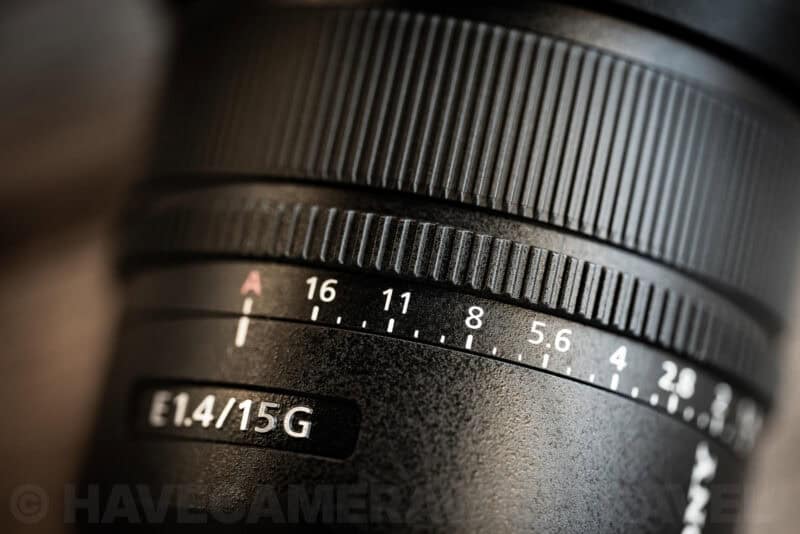
Normally, I quite like having a manual aperture ring. But in this case, I found it would too often be bumped from Automatic to manual mode when I went to shoot. It doesn’t lock into place, so somewhere between shooting and going in and out of my camera bag, the ring was being bumped into a different setting, and it’d take me a moment before shooting to correct from f/13 or something to an aperture much larger. You can probably count this as user error — it is in a way — but it happened frequently enough that it became a nuisance to me.
The manual focus ring on the Sigma is better and smoother. That’s something that matters when shooting video.

Image quality & output
I’m judging these lenses in terms of real-world shooting rather than lab test results, because their practical performance is what matters most to me. And I don’t really have any serious complaints about either lens.
That said, there are some differences.
In practical shooting, I found both to be sharp. Both locked onto focus well and quickly.
Field of view
The perspectives of each are very close, but they’re not identical. Here’s how the angles of view compare in number terms.
| Sigma | Sony | |
| Angle of View | 83.2° | 87° |
And here’s what it looks like in visual terms.








One thing to bear in mind with these is that Sony automatically embeds digital corrections in the files (and they’re enabled by default even in the RAW files). And for these shots, I’ve left the defaults as is. With the Sigma, the barrel distortion is not enabled by default, which is how I’ve left it (you can enable it in Lightroom Classic or other RAW processors).
That’s relevant to the field of view specifically because the barrel distortion correction does involve a tiny bit of cropping. It’s not much, but it’s also not zero. So that’s something to be aware of when comparing these.
Optical issues
In terms of optical “flaws” like vignetting, chromatic aberration, and barrel distortion, the only clear difference I found between them was in barrel distortion. For the images coming out of the camera and displayed the camera’s screen, the Sony lens produce far less barrel distortion.


But it turns out that that was misleading. The Sony does have 3 aspherical elements, but I was surprised at how much of the heavy lifting in keeping straight lines straight falls into digital corrections. Sony applies digital distortion correction automatically, whereas the Sigma doesn’t. I go into more detail on this in my review of the 15mm, but it turns out that if you disable that automatic correction, the Sigma actually has less optical distortion.
In practice, though, this isn’t something I consider a deciding factor. In many instances, I would tend to leave the built-in corrections enabled anyway when I’m shooting. So it’s not really an issue that would cause me to choose one over the other, but I did think it was an interesting point of difference between these lenses.
Minimum Focus Distance
Neither of these is a macro lens, so their minimum focus distances aren’t really core specs. Nevertheless, there is a significant difference here that might matter to some shooters.
Specifically, the Sony focuses a little closer than the Sigma. On both lenses, you can focus slightly closer using manual focus than with automatic focus (but not by much).
| Sigma | Sony | |
| Minimum Focus Distance (Manual Focus) | 9.8″ / 25 cm | 6.7″ / 17 cm |
Sample images
I’ve posted much larger collections individually of sample images that I’ve taken with these lenses. But here are a few quick examples.
Sony 15mm f1.4 sample images
I’ve posted a larger collection of Sony 15mm f1.4 sample images separately.



Sigma 16mm f1.4 sample images
I’ve posted a larger collection of Sigma 16mm f1.4 sample images separately.



Specs
| Specification | Sigma 16mm f/1.4 DC DN | Sony E 15mm f/1.4 G |
|---|---|---|
| Focal Length | 16mm (35mm Equivalent: 24mm) | 15mm (35mm Equivalent: 22.5mm) |
| Maximum Aperture | f/1.4 | f/1.4 |
| Minimum Aperture | f/16 | f/16 |
| Lens Mount | Sony E | Sony E |
| Lens Format Coverage | APS-C | APS-C |
| Angle of View | 83.2° | 87° |
| Minimum Focus Distance | 9.8″ / 25 cm | 6.7″ / 17 cm |
| Maximum Magnification | 0.1x | 0.15x |
| Optical Design | 16 Elements in 13 Groups | 13 Elements in 12 Groups |
| Diaphragm Blades | 9, Rounded | 7, Rounded |
| Focus Type | Autofocus | Autofocus |
| Image Stabilization | No | No |
| Filter Size | 67 mm (Front) | 55 mm (Front) |
| Dimensions (ø x L) | 2.84 x 3.63″ / 72.2 x 92.3 mm | 2.6 x 2.7″ / 66.6 x 69.5 mm |
| Weight | 14.29 oz / 405 g | 7.7 oz / 219 g |
So which would I buy?
Actually, that ended up being surprisingly easy, even if it’s not what I would have guessed at the outset.
I’d choose the Sigma.
Unless the size and weight differences are a factor if you’re packing light. In that case, the Sony has a clear advantage there.
But in just about all other respects, I actually enjoyed shooting with the Sigma more. It is heavier and larger, but I liked how it felt shooting with it. I liked how it performed as I was shooting with it. And I liked the results I got from it. Those, of course, are all very much subjective judgments, and every photographer has their own mix of preferences and tastes.
It’s priced a lot lower, but in the end, that was more cherry on top than a deciding factor.
That said, the Sony is a very good lens, and my preference isn’t about there being something wrong with it. It’s newer and in some respects a more sophisticated lens than the Sigma. But after shooting with them side-by-side, the Sigma is the one I’d reach for most often. That, to me, is the ultimate test.
Price & availability
Both of these lenses are designed for the Sony E-mount. The Sigma is also available in versions for other cropped-sensor mounts: Canon EF-M, Micro Four Thirds, Leica L, Fujifilm X, Nikon Z, and Canon RF.
And the pricing of these lenses is quite different.
The Sony has an MSRP of $749.
The Sigma has an MSRP of $449.