This is my hands-on review of the Sigma 16mm f/1.4 DC DN Contemporary lens.
It’s a fast prime designed for cropped sensors, and there are versions for Canon EF-M, Sony E, Micro Four Thirds, Nikon Z DX, Fujifilm X, and Leica L. I’ve been using it on the Sony E-mount version on a Sony a6700.
Overall, it’s a fast prime with impressive optics. And while it’s on the larger size for something like street photography or travel photography, it’s still quite well suited to those uses.
The a6700 that I’ve been using it on has an APS-C cropped sensor, so the effective focal length here is equivalent to a 24mm on a full-frame camera. On a Micro Four Thirds, which have a 2x crop factor, it’s equivalent to a 32mm.
The lens I’m focusing on here shouldn’t be confused with the Sigma 15mm f/1.4 Fisheye DG DN Art lens. While there’s also a version of that lens for Sony E-mount mirrorless cameras, that lens is a fisheye lens and a lot more expensive.
It falls in Sigma’s Contemporary lineup, which I was a little surprised at, because they often put these fast primes in their Art lineup.1

The giveaway is less about optical performance than it is price. Sigma clearly wanted to price this lens competitively. And they’ve succeeded: it has an MSRP of $449, and you can often find it for less than that. (NB: the Nikon Z version has an MSRP of $499.) It’s also a nice combination with Sigma’s 30mm f/1.4 and 56mm f/1.4; they’re all fast primes that are surprisingly inexpensive (and offered as a bundle).

I like fast primes, and a 24mm f/1.4 is probably my desert island lens. And that’s functionally what this is, since it’s designed for APS-C cropped sensors.

I’ve also been shooting with it alongside the Sony 15mm f/1.4. So they’re direct competitors for the Sony E cropped mount. I’ll do a more detailed comparison between these lenses separately, but I’ll still be using the Sony as a reference point from time to time here.
Sigma lens codes
Like most manufacturers, Sigma uses their own lens codes when naming their lenses.
The DC code in the lens name signifies that it’s designed for use for cameras with an APS-C sensor. They’re not recommended for full-frame cameras and won’t fill the entire frame on those.
The DN signifies that it’s designed specifically for mirrorless cameras.
Build & handling
Sony has a 15mm f/1.4 prime. This is obviously close in terms of perspective and speed, but there are also some important differences.
And one of them is that this Sigma lens is significantly larger and weightier than the Sony 15mm. It’s not a huge lens, by any means, but the difference between them might be enough to matter to someone trying to pack small and light.
It measures 5.8 inches (14.7 cm) long by 4.3 inches (10.9 cm) across and weighs not quite a pound (14.3 ounces / 405 grams).

In terms of handling, it’s a very clean and simple lens. By that I mean there are no switches, dials, or buttons. On the plus side, it means that there’s nothing to accidentally bump and change when you’re pulling the camera out of your camera bag. It also means that the aperture setting is handled entirely by the camera.
There’s only a large manual-focus ring, which takes up about half the length of the barrel. And I’m impressed with how smooth and true it is — it just feels refined, with no wiggle or give in it. That’s something that video shooters are likely to appreciate especially. That said, on at least some Sony cameras, manual-focus override is disabled by default, which means the focus ring won’t do anything unless you actively turn it on (I’ve put together a guide to setting manual focus override on the Sony a6700).
Performance
The stepping motor AF system autofocus when paired with the a6700 is very fast, quiet, and smooth. There’s hardly any physical movement, which helps.
And while it’s not a macro lens, it also focuses relative close, at down to 9.8 inches (25 cm). Which is a nice flexible working distance for picking out close details or tabletop-style photography on your travels.
I have no complaints with the optical performance of this lens in real-world shooting. And that, ultimately, is how I’m going to judge any camera gear. I’m less concerned with lab tests than real-world performance.
I’ve found it to be sharp, even wide open. And while there are some typical optical issues–barrel distortion being quite prominent, for example — in real-world shooting (rather than lab tests), there’s nothing that rises to the level of what I’d consider a problem. And much of it can be addressed quite well in post-processing with optical corrections profiles.
Overall, I find this a fun lens to shoot with. I wouldn’t mind if it was a bit smaller. I wouldn’t mind if it had less barrel distortion. But honestly, neither of those rise to the level of being a decisive issue for me (your preferences might vary). Factor in the price, and Sigma have created a very attractive lens here.
A handful of sample images
I’ll post a larger set of sample images separately, but here’s a small taste. I deliberately haven’t applied any post-processing optical corrects to these.

Contemporary 017 lens (35mm equivalent: 24 mm). Aperture: ƒ / 2.8; Shutter speed: 1/125 sec; ISO 8000; Exposure compensation: 0 EV. Photo by David Coleman / Have Camera Will Travel

Contemporary 017 lens (35mm equivalent: 24 mm). Aperture: ƒ / 1.4; Shutter speed: 1/4000 sec; ISO 100; Exposure compensation: 0 EV. Photo by David Coleman / Have Camera Will Travel

Contemporary 017 lens (35mm equivalent: 24 mm). Aperture: ƒ / 1.4; Shutter speed: 1/125 sec; ISO 400; Exposure compensation: 0 EV. Photo by David Coleman / Have Camera Will Travel

Contemporary 017 lens (35mm equivalent: 24 mm). Aperture: ƒ / 3.5; Shutter speed: 1/20 sec; ISO 320; Exposure compensation: 0 EV. I took this shot specifically for the many straight lines in the frame to get a sense of the barrel distortion. Photo by David Coleman / Have Camera Will Travel
What to know about these sample images
These were shot on a Sony a6700 in RAW and lightly processed in Lightroom Classic.
I haven’t applied extra optical corrections to these in post, but that’s not to say these are unadulterated optical versions. Because my objective here is to test typical real-world use rather than do scientific lab tests, I’ve left the default settings on.
But the default settings for this lens are different to the way they’re applied in the Sony 15mm f/1.4.


On the Sony lens, automatic corrections for issues like barrel distortion, chromatic aberration, and lens vignetting are applied automatically. And when you open the RAW files in Lightroom, the lens profile is automatically applied, and if you’re shooting JPG, the fixes are automatically applied in-camera to those JPGs.
But this Sigma lens does things a little differently. There is an embedded lens correction profile embedded automatically, but it reportedly only applies to chromatic aberration. That default embedded chromatic aberration fix is enabled for the images here.
It is also possible to apply third-party lens correction profiles in post-processing (Adobe, DxO, DIY, etc), but they’re not activated by default, so I have not applied those here.
Key specs
This lens doesn’t have built-in optical stabilization. That’s pretty standard with wide-angle lenses, where camera shake is less pronounced than with telephoto lenses. But if you need stabilization, you’ll be relying on the camera’s (if it has it).
With these specs, some vary based on the mount version you’re using. For example, the APS-C version has a wider field of view than the smaller-sensor Micro Four Thirds version. And there are some variations in the physical dimensions. I’m using here those for the Sony E-mount version, which is the version I’ve been shooting with.
It has an angle of view of 83.2°.
The lens design has 16 elements in 13 groups. It also has 9 rounded diaphragm blades, which help with nice round bokeh highlights.
It has 9 rounded diaphragm blades. That helps with rounder and smoother bokeh.
It has a maximum aperture of f/1.4 and a maximum aperture of f/16.
Its minimum focusing distance is 25 cm or 9.8 inches and has a maximum magnification of 1:9.9.
The Sony E version weighs 405 grams / 14.3 ounces and measures 72.2 (diameter) x 92.3mm (length / 2.8 x 3.6 inches.
It is also dust and splash-resistant.
And I was intrigued by Sigma’s prominent claim that it minimized sagittal coma flare. Mainly because I had no idea what sagittal coma flare is. But so far as I can determine, it’s just a fancy name for what is more commonly just referred to as coma. Large aperture lenses like this can be prone to it near the edges of the frame, and it can be especially noticeable with bright highlights in night-time or astrophotography. So there you go.
Filters & hood
It takes 67mm screw-on filters.
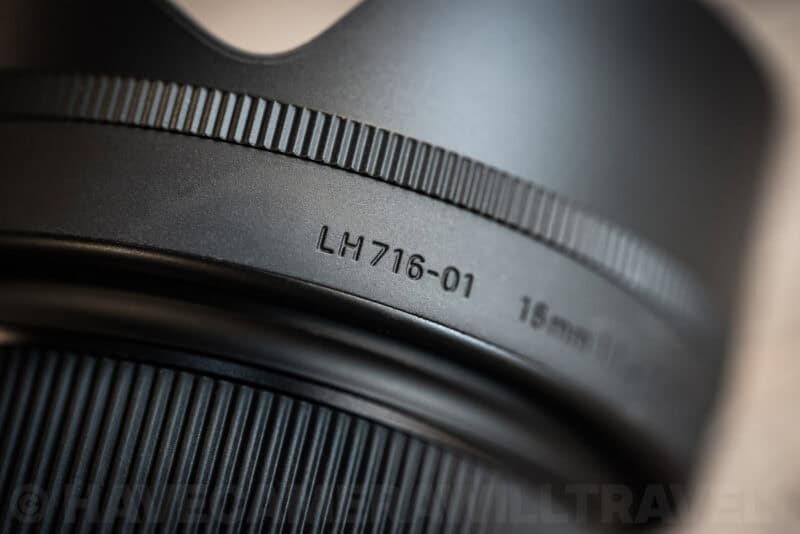
It comes with a lens hood. It’s model LH716-01.
Price & availability
Sigma has priced this very competitively, with an MSRP of $449. That’s a big differentiator from Sony’s 15mm f/1.4, which is priced at $749.
Check the current price at:
Notes & References:
- Sigma has three core lineups for their lenses currently: Sports (for lenses especially suited to sport and wildlife photography), Art (which tends to be their lenses with the highest optical quality), and Contemporary (which are designed for their general purpose and affordable lenses). [↩︎]