Quick Summary
- A teleconverter is a small lens that mounts between your camera and your lens and magnifies the image — a 1.4× turns a 200mm into a 280mm, a 2× into a 400mm — at the cost of light (1 stop for 1.4×, 2 stops for 2×), some sharpness, and sometimes autofocus speed.
- It’s the cheapest way to add real reach without buying a longer lens, and unlike cropping, it keeps all your pixels and full resolution of your sensor.
- It only works with lenses designed to accept one — mostly telephotos — so compatibility is the first thing to check.
Sometimes you might want to get your shot in tighter, but you don’t want to fork out for a whole new lens. Sure, you can crop the image after you’ve taken it, but that’s going to reduce the size (dimensions) of your image.
But there’s another option: add a teleconverter. You might also see them referred to as tele-extenders or just TCs. It’s an optical solution, so you don’t lose any resolution like you would with cropping. And it’s a relatively inexpensive way to get a longer effective focal length.
I’m going to lean heavily on “relatively” here in terms of price. At $500-$700, they’re not what you’d call cheap. But they can be significantly cheaper than buying a new, longer telephoto zoom lens.
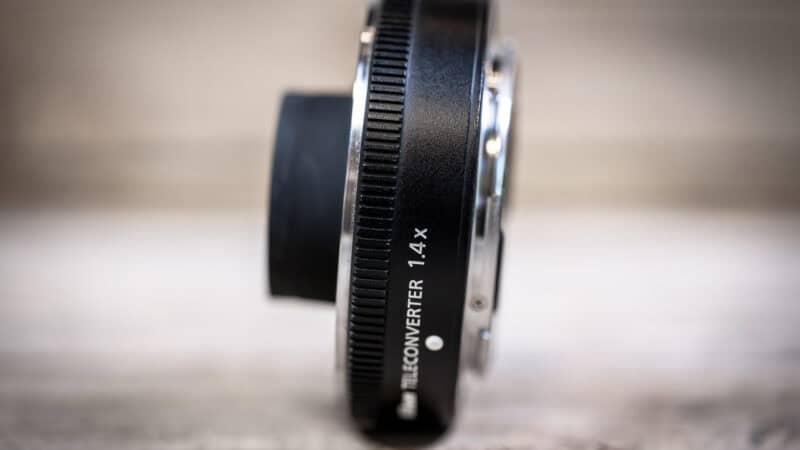
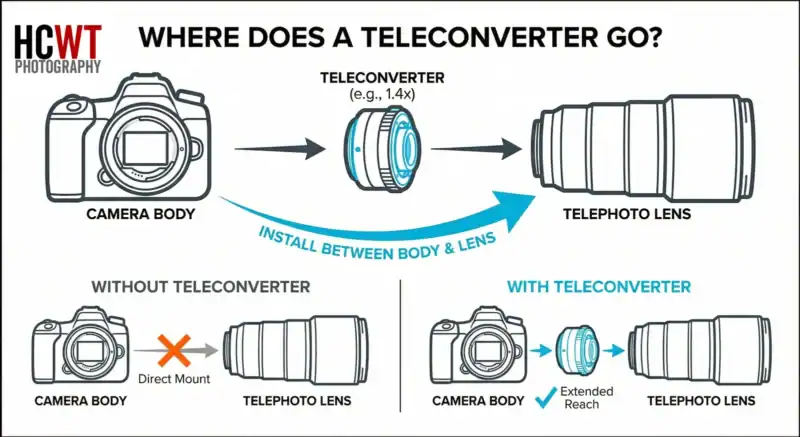
If you’ve never used a teleconverter before — and they’re frankly not all that common — it’s a small lens attachment that sits between your camera and your existing lens and magnifies the image. So, as a practical example, a 1.4x teleconverter would give your 200mm lens the reach of a 280mm lens.
Sounds great, right? But there’s a catch. Or rather, a few catches. Unlike a lens mount adapter or a macro extension tube, a teleconverter has glass elements that do the heavy lifting. And because of that, there are some compromises involved in terms of optical performance. These might not be dealbreakers, but they are something to factor in when using one.
I’ll go into more detail on these below, but the short version is:
- They cost light (that’s not a typo).
- They’re not universally compatible.
- There is usually some negative impact on image quality (especially sharpness).
- They can impact autofocus speed and reliability.
- Not all of them transmit autofocus or EXIF data.
I realize that is a fairly substantial list of negatives. And yet there are times that a teleconverter makes for an attractive choice.
What is a teleconverter & what does it do?
Think of it like a magnifying glass for your lens. Not in a close-up, macro kind of way, but rather one designed for zoom and telephoto lenses.
They’re basically small lenses that mount between your main lens and the camera body. Unlike a mount adapter or extension tube, a teleconverter has glass elements. Which is the root cause of the optics-related negatives I’ve mentioned.
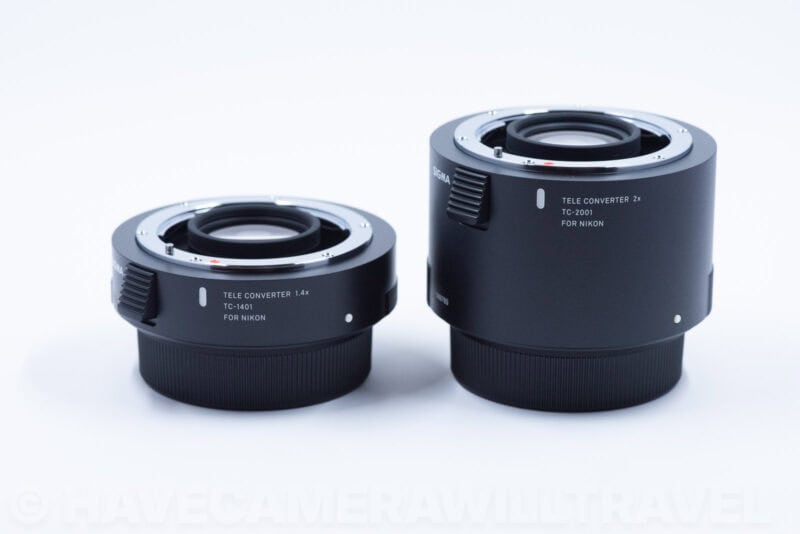
The most common sizes they come in are 1.4x and 2x. Sometimes you might find one at 1.7x, but I don’t see them as often anymore.
This is what the effect of a 1.4x teleconverter’s magnification looks like in real-world terms. These were taken on a 70-200mm lens zoomed to 200mm with a Nikon 1.4x teleconverter.


Those are multiplication factors. For the simplest, 2x, you’ll get double magnification. So it essentially turns a 200mm focal length into a 400mm focal length. Similarly, a 1.4x teleconverter turns a 200mm focal length into a 280mm.
And it’s important to point out here that this is optical magnification. So it’s applied before the light hits the sensor. So it’s quite different to the kind of “magnification” you get when going from a full-frame sensor to something smaller like an ASP-C sensor; that’s cropping.
That makes most sense with telephoto lenses. And some do work with some zoom lenses. But they don’t necessarily work with all lenses, so it’s important to make sure that your lens is compatible with them.
Standard teleconverter strengths
These are the standard strengths you can find teleconverters in.
| Teleconverter | Magnification | Light lost | f/2.8 lens becomes | f/4 lens becomes | Typical cost |
|---|---|---|---|---|---|
| 1.4× | ×1.4 focal length | 1 stop | f/4 | f/5.6 | Smallest sharpness/AF penalty; the one most people should buy |
| 1.7× (Nikon F-era) | ×1.7 | 1.5 stops | f/4.8 | f/6.7 | Middle ground; rare in mirrorless mounts |
| 2× | ×2 | 2 stops | f/5.6 | f/8 | Biggest reach, biggest compromises; AF may be limited on slower lenses |
Trade-offs and taxes
That sounds great, right? A (relatively) inexpensive way to get more bang for your buck from your telephoto lens?


Well, it can be. But there are some significant trade-offs to factor in. And while I don’t want to focus on the negative, these are important to factor in when deciding if and when to shoot with a teleconverter.
Light loss
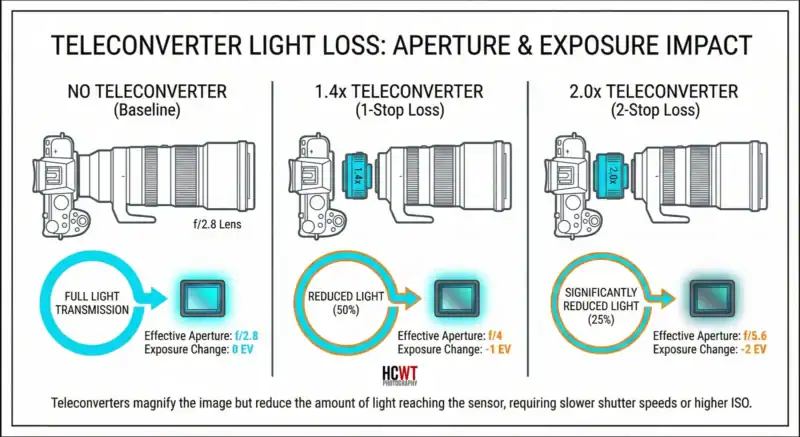
All teleconverters will consume some of the light before it hits the sensor. In practical terms, what that’s going to mean is that the maximum aperture of your lens is going to decrease. How much it decreases depends on the strength of the teleconverter.
That’s an unusual behavior, but it’ll make more sense in a practical example.
Say I’m shooting with a 70-200mm f/2.8 lens.
If I add a 1.4x teleconverter, my focal length is now going to be 98-280mm. But I’m also going to lose a stop of light, so the lens will no longer go larger than f/4. That’s not an abstraction — if you’re using a modern digital-first lens, you won’t be able to change the aperture below f/4 anymore.
If I use a 2x teleconverter instead, my focal length will be 140-400mm, but it will cost 2 stops of light, so the maximum aperture that will be available will now be f/5.6.
With a fast lens like that, those changes might not be a big deal. But if you’re starting with a slower lens that has a maximum aperture of, say, f/6.3, you can find yourself working with a new maximum aperture of around f/11, which isn’t always great in low light for a few reasons. It’s probably going to push you to higher ISOs and slower shutter speeds, and there are maximum aperture thresholds on most cameras where the autofocus will stop working.1
The optical cost
Some loss of sharpness and contrast is normal, especially with 2x converters. You’re adding even more glass between the lens and the sensor, after all.
In my experience, some of the newest teleconverters are actually pretty good in terms of sharpness. Some older ones, not so much. But it’s really going to vary by the model of the teleconverter and how good it is.
The first place to go is usually the edges of the frame. In general, the center of the frame will remain sharper than the edges and corners.
Maybe that reduction in sharpness matters for what you want; maybe it doesn’t. That’s entirely a judgment call.
Autofocus performance may suffer
This one is a derivative of the light that’s lost. By reducing the light hitting the sensor, you’re also reducing the light that the autofocus system has to work with.
That might mean that your autofocus becomes slower and less reliable. And you’ll probably notice it most with exactly the types of shots that you’re wanting that extra telephoto reach for in the first place: the moving subjects of sports and wildlife. For example, I find that 3D AF tracking of fast subjects can become a little less reliable even with the newest generation of teleconverters.
But it can also be more dramatic than that — it can mean that the autofocus actually becomes non-functional.
That’s because most DSLR and mirrorless cameras these days use what’s known as phase-detection autofocus.2 This relies on a certain amount of light and a certain effective aperture width to detect phase differences. When the maximum aperture of the lens/teleconverter combination is smaller than f/8 (say f/11), the AF sensors don’t get enough light and the beam of light is too narrow for reliable phase detection. Exactly where the threshold is depends on the camera model. With lower-end cameras, the threshold might be around f/5.6 to f/8. Higher-end cameras might have it as high as f/11 or even f/16.
I should also mention that not all teleconverters are autofocus — I’m just assuming that you’re using one of the newer ones that are. But for older manual-focus lenses, you can still use a teleconverter, but this whole autofocus discussion will of course be a moot point.
They’re not universally compatible
It’s important to know that you can’t just add a teleconverter with any lens. Not all of them can accept teleconverters. And it’s not just a case of getting the right type of mount (eg. Nikon Z, Canon EF, Sony E, etc). It’s that even within those mount types, teleconverters will only work with some lenses in the range.
In many cases, it’s because they won’t physically fit. That’s especially true of some of the newer teleconverters designed for mirrorless cameras. Some have a deep bayonet protruding that simply won’t go on some lenses.
So it’s crucial to check specific compatibility — it’s not simply a case of the type of mount (eg. Nikon Z, Canon EF, Sony E, etc).
Common questions
1.4× or 2× — which should I get?
1.4× unless you genuinely need the 2× reach and have a fast, sharp lens to feed it. The 1.4× costs a stop and a little sharpness; the 2× costs two stops and noticeably more.
Will a teleconverter work with my lens?
Only with lenses designed for it — generally telephoto primes and zooms from the same maker; wide and standard lenses physically can’t mount one. Check the manufacturer’s compatibility list before buying.
Does a teleconverter affect autofocus?
Often: less light reaching the AF system means slower or hunting focus, and some bodies disable AF beyond f/8 with older lenses. Modern mirrorless bodies cope much better than DSLRs did.
Alternatives
Teleconverters are a good solution some of the time. But there might also be other good solutions worth considering, especially if you’re looking at a low-quality teleconverter.
Use a different lens
Using the native focal length of a lens is the ideal way to go.
If you have the budget to go out and just buy a new lens, more power to you. But there’s a couple of options that are cheaper than that:
- Rent a lens. If your need for that extra reach is short-term, renting is an excellent option.
- Buy used. There is a thriving market for used camera gear, and the savings can be substantial. My go-to places are KEH, MPB, and B&H Used, but there are a plenty of other good places, like eBay, local camera clubs, and so on.
Cropping
If you’re shooting with a high-resolution camera, the simplest might be cropping. That can be simple cropping in post-processing. Or, if you’re shooting with a full-frame sensor camera, you can switch it into APS-C mode. Yes, you’ll lose some resolution, but it’s otherwise basically the same as adding 1.5x the focal length (or 1.6x on a Canon).
Things worth knowing
Stacking Teleconverters. It is technically possible to stack some (but not all) teleconverters, although it’s not something I ever do.3 That’s because you get a double-dose of all those downsides, meaning you get all the light loss and all the optical quality hit. It also increases the risk of issues with autofocus and electronic communication between the camera and lens. So I’d generally recommend avoiding it unless there’s no other option.
Minimum focus distance. Adding a teleconverter does not increase a lens’s working distance, otherwise known as the minimum focus distance. That’s especially important for macro work, but it can also be important for other kinds of shooting where the subject is relatively close to the camera.
Use with mount adapters not recommended. I don’t recommend using them with mount adapters. By mount adapters, I’m referring to things like Nikon’s FTZ adapter or an adapter for using Canon lenses on Sony cameras. In many cases, they’ll be flatly incompatible. But there’s also a high likelihood of focus lag and other issues in the electronic communication between camera and lens. That said, you can the combination of lens, teleconverter and adapter like an FTZ adapter.
In my experience
It’s a package deal. When you’re using a teleconverter, you need to consider the teleconverter and the lens as a combination package. Pairing a poor-quality teleconverter with an excellent lens is very likely to give you poor results. Likewise on the reverse. Ideally, you want an excellent teleconverter paired with an excellent lens.
Use like with like. I have found the best results when using teleconverters by the same manufacturer as the lens. For instance, if I’m using a Sigma lens, I’ve found Sigma teleconverters to work best. Ditto on Nikon lenses (with Nikon teleconverters). That’s less about optical performance than reliability of the electronic communications between camera and lens.
Expect some degradation of autofocus speed and accuracy. The latest generations of teleconverters work very well with the cameras’ high-speed autofocus, but that doesn’t mean you won’t see some effect. I find that even the latest and greatest teleconverters will slightly slow down autofocus and slightly degrade the focus tracking. I notice this mostly when I’m using 3D focus tracking of fast action. But I’m using the word “slight” here deliberately; the newest teleconverters are much, much better in this respect than older ones I’ve used.
Newer ones work quite well with newer zoom lenses. Teleconverters haven’t always worked well on zoom lenses — they’ve tended to work best on prime telephoto lenses. But I’ve had good results with the newest mirrorless lenses (but again, compatibility isn’t universal).
Tips & recommendations
Where to try them
I’ve used many teleconverters over the years, but it’s not something that I use routinely. It’s more of an on-and-off thing. If I routinely need a particular focal length range, I’ll usually aim to get a lens that covers it.
Teleconverters are very often cheaper than buying a whole new, longer lens. But that’s not to say they’re cheap. And if you only need one short-term or rarely, buying one might not be the best option. I recommended the options above for renting or buying a used lens, and those apply even more so for teleconverters.
So one tip I have is to rent them when needed. They’re not that expensive, and it means you can get access to the latest generation of them.
My go-to place for renting camera gear is LensProtoGo, and you can find their teleconverters here. Another good option is LensRentals.com. Your local camera shop, if it still exists, might also have some for rent, but their range is probably more limited.
Another good option is to buy them used. Because so many photographers buy them and find that they’re not using them that much, they tend to be quite easy to find on the used market, often in excellent condition. My go-to places are KEH, MPB, and B&H Used, but there are plenty of other good places, like eBay, local camera clubs, and so on.
Where to buy them
If you decide to buy new, here are some direct links to B&H’s listings for different camera mounts.
Notes & References:
- Regardless of what aperture you’re shooting at, cameras perform their autofocus calculations at the maximum aperture and then change to your shooting aperture when you press the shutter. But if that maximum aperture gets too small (ie. a larger number), then the autofocus won’t work anymore or will be unreliable. The threshold is often around f/8 to f/11. [↩︎]
- Many mirrorless cameras use a combination of on-sensor phase-detection pixels combined with contrast detection. So you might still get some autofocus performance in challenging conditions, but the point stands that it’s going to be degraded. [↩︎]
- It really depends on the design, though. You can’t stack Nikon Z teleconverters, for example, because of their physical design. [↩︎]