
Yes — with two exceptions, every GoPro camera since the HERO5 (2016) is waterproof out of the box, without a housing. Most are rated to 10 meters / 33 feet.
The new Mission 1 and Mission 1 Pro go deeper, to 20 meters / 66 feet; the small HERO (2024) and the two 360 cameras (MAX and Fusion) are rated to 5 meters / 16 feet.
The two exceptions are the board-only variants built for drones and custom rigs — the HERO10 Black Bones and the Mission 1 Pro ILS — which aren’t waterproof at all.
Older models (HERO4 and earlier, apart from the HERO+ and HERO Session lines) need a housing to get wet. For anything deeper than the body rating, GoPro’s Protective Housings take the HERO5 through HERO13, the HERO11 Black Mini, and the Mission 1 cameras down to 60 meters / 196 feet.
That’s the short answer.
Below is the depth rating for every model, then which housing fits which camera, and then the part that actually makes the difference between good underwater footage and blue mush: how to use a GoPro in and around water well.
I’ve been shooting with GoPros in the ocean, in rivers, and lakes, on dives, and in the rain and snow for well over a decade, and most of what follows I learned the hard way.
Related: not sure which accessories are worth it or which ones fit your model? See my GoPro accessories guide.
Waterproof depth ratings for every GoPro model
Ratings are for the camera body alone, with the doors closed and the lens cover on, in fresh or salt water. Treat them as limits, not targets — seals and lens covers wear, and the risk of a leak climbs the deeper you go past the rating.
| GoPro model | Waterproof without a housing | With GoPro’s dive housing |
|---|---|---|
| Mission 1 / Pro | 66 feet / 20 meters | 196 feet / 60 meters / AGDIV |
| Mission 1 Pro ILS | Not waterproof or water-resistant. | — |
| HERO13 Black | 33 feet / 10 meters | 196 feet / 60 meters / ADDIV |
| HERO (2024) | 16 feet / 5 meters | No GoPro housing; aftermarket only |
| HERO12 Black | 33 feet / 10 meters | 196 feet / 60 meters / ADDIV |
| HERO11 Black | 33 feet / 10 meters | 196 feet / 60 meters / ADDIV |
| HERO11 Black Mini | 33 feet / 10 meters | 196 feet / 60 meters / AFDIV |
| HERO10 Black | 33 feet / 10 meters | 196 feet / 60 meters / ADDIV |
| HERO10 Black Bones Edition | Not waterproof or water-resistant. | — |
| HERO9 Black | 33 feet / 10 meters | 196 feet / 60 meters |
| HERO8 Black | 33 feet / 10 meters | 196 feet / 60 meters |
| MAX | 16 feet / 5 meters | — |
| HERO7 Black | 33 feet / 10 meters | 196 feet / 60 meters |
| HERO7 Silver | 33 feet / 10 meters | 131 feet / 40 meters |
| HERO7 White | 33 feet / 10 meters | 131 feet / 40 meters |
| Fusion | 16 feet / 5 meters | — |
| HERO6 Black | 33 feet / 10 meters | 196 feet / 60 meters |
| HERO (2018) | 33 feet / 10 meters | 196 feet / 60 meters |
| HERO5 Black | 33 feet / 10 meters | 196 feet / 60 meters |
| HERO5 Session | 33 feet / 10 meters | Aftermarket dive housing only |
| HERO4 Session / HERO Session | 33 feet / 10 meters | — |
| HERO+ LCD | 131 feet / 40 meters | — |
| HERO+ | 131 feet / 40 meters | — |
| HERO (2014) | 131 feet / 40 meters | — |
| HERO4 Black | Not waterproof. Requires external waterproof housing. | Aftermarket dive housing only |
| HERO4 Silver | Not waterproof. Requires external waterproof housing. | Aftermarket dive housing only |
| HERO3+ Black | Not waterproof. Requires external waterproof housing. | — |
| HERO3 Black | Not waterproof. Requires external waterproof housing. | — |
| HERO3 Silver | Not waterproof. Requires external waterproof housing. | — |
| HERO3 White | Not waterproof. Requires external waterproof housing. | — |
| HD HERO 2 | Not waterproof. Requires external waterproof housing. | — |
| HD HERO Original | Not waterproof. Requires external waterproof housing. | — |
| SD HERO | Not waterproof. Requires external waterproof housing. | — |
But there’s also some key small print that matters:
- The waterproof rating assumes the battery/SD door and USB door are properly closed, and their seals are clean and undamaged, and on the HERO9 onward, that the removable lens cover is twisted on fully.
- The HERO10 Black Bones is a bare board for drones and isn’t water-resistant at all.
GoPros are built for use in places that most cameras can’t go, which makes them a fun and interesting choice to take on your next travel adventures.

Have Camera Will Travel Newsletter
Practical field notes, hands-on gear tests, and the fun of exploring the world with a camera in hand.

That’s especially true in and around water.
And while most GoPros are ready to shoot in wet conditions right out of the box, especially most of the newer models like the HERO13 and HERO12 Black, here are some tips that can help you get better shots.1
Some of these are things to do. Some are things to know. And some are things to get. Some are potential showstoppers, and some are small conveniences.

Using your GoPro in and around water: General tips
Here are some general tips for using your GoPro in and around water. I’ve got some more specific tips below related to types of activities. I’m focusing mainly on swimming, snorkeling, and diving here, but much of this applies to anywhere in and around water.
Check the seals
This is the most important tip on this page: check the seals on your camera’s doors.
GoPros are designed to be waterproof out of the box, but their waterproofness is only as good as the seals on the doors. The seals are small rims of rubberized plastic around the edges of the doors. If grit gets stuck in there, or they get small cracks or cuts in that seal, water might seep in, especially when the camera is under pressure underwater.
So make sure that the rubber seals around the trapdoors (the battery/SD card compartment and the USB port door) are free of grit and have no nicks or tears. If they’re damaged, swap the doors — you can buy them as spare parts.
Also, make sure that the lens cover is securely in place. On models like the HERO13, 12, 11, 10, and 9, the lens cover is removable and replaceable. If it isn’t twisted on fully and flush, water can get in.
There’s a limit to what you can do about poor seals when out on the water, so this is something worth checking before heading out. Because water getting in won’t just ruin the shot — it could quite easily ruin the camera.
Add a float & strap
GoPros sink. And they sink fast. I’ve found this out myself too many times.
They’re also small and grey, making them hard to find and recover from the bottom of the ocean. Adding some kind of float greatly reduces the risk of losing your camera.
There are several different ways to tackle this problem. Each has pros and cons for certain situations and preferences.
Generally, my preferred method is to use a floaty grip. That also gives you something to hold on to when underwater, especially if you’re wearing dive gloves.
You can also get floating wrist straps or floaty casings. Any of these will work to help reduce the risk of losing your camera. And if you’re not holding it by hand, the same applies, but if possible, use a tether in place of a strap. I also like foam floaty cases; they’re a bit bulky, but they work well.
A simpler option is to just use a wrist strap without the floating part. Obviously, that doesn’t solve the sinking problem, but it at least tethers it to you directly and makes it less likely that the camera will end up at the bottom of the sea.
I’ve found GoPro’s own Sleeve + Lanyard to be a good option, although there’s nothing especially groundbreaking about it, so you can probably find good aftermarket alternatives.
I’ve put together a more detailed rundown of ways to keep a GoPro afloat.

Lock the orientation
When you’re swimming with a GoPro, the camera isn’t going to be staying level and right-way-up all the time. If you’ve got the automatic rotation enabled, it’s easy to have the orientation shoot at vertical when you want horizontal.
That’s more of an inconvenience when shooting video than when taking photos, but for the sake of simplicity, it can be useful to lock the orientation and save yourself some post-processing hassle.
I have a more detailed guide on how to do that here.
Lock the screen
While you can’t use the touchscreen underwater, it can still work above the surface even with water drops on it. But a damp screen is not always as reliable, and you can find yourself fighting it to get the screen to do what you want to do.
And sometimes splashes of water can be registered by the screen as touches. So it might put the camera into the settings screen or change the shooting mode. It doesn’t happen all the time for me, but it does happen.
A way to prevent this is to use the screen lock (swipe down on the rear screen and tap the padlock icon). It’s not essential, but it does reduce the risk of unwanted shooting mode changes, and it’s one of the things I now do anytime I’m using my GoPros around water.

Touchscreens, wireless controls & GPS don’t work underwater
It’s a good idea to have the shooting options set up how you want them before entering the water. If you’re using the camera in the rain or where it’s easy to take out of the water, there’s much less of a problem. But changing some shooting settings underwater can be a challenge or even impossible.
Newer GoPros let you change the shooting mode (e.g., between video and photo) with the buttons, but they won’t let you change settings like Protune, resolution, or frame rates. To change those, you need to either use the touchscreen on the back or the mobile app, but neither of those works underwater. So it’s best to set all of that up how you want it before you get wet.
GPS also doesn’t work while the camera is submerged underwater.
Using a GoPro at the water’s surface
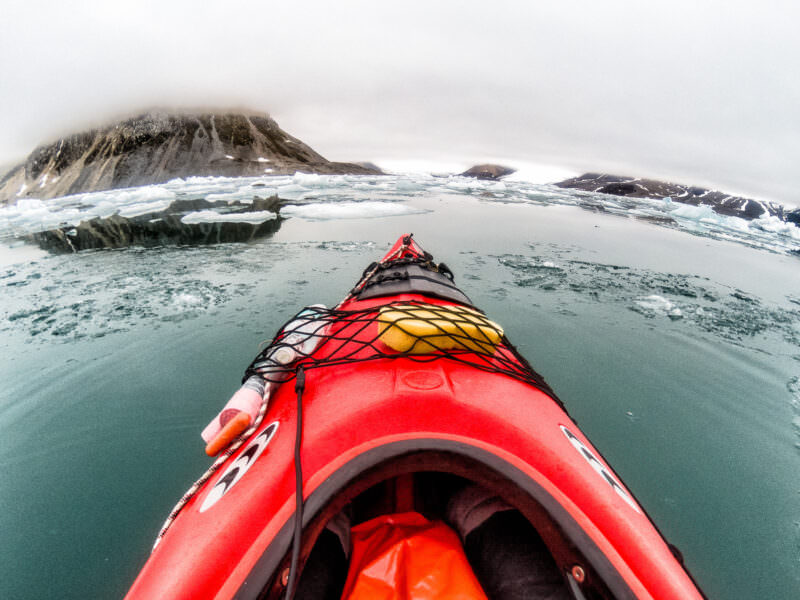
Here are some tips for shooting with GoPros in places where they’re going in and out of water. Some examples might be in the rain, surfing, swimming, or kayaking.
Water drops on the lens
Water drops on the lens can ruin an otherwise great shot. And the lens port on GoPros is so small that even small drops of water can have a big effect.
This isn’t an issue when shooting underwater. It only comes into play when you take the camera out of the water, and it’s still wet.
There are a few different ways to try to prevent this. I’ve yet to find the perfect solution, but here are some approaches that can reduce the risk of water drops on the lens.
Spit on the Lens. Yes, spit. It’s an old SCUBA diving trick to spit in your mask, smear the saliva around, and then give the mask a quick rinse. It works surprisingly well to prevent your mask from fogging up. I don’t know the science behind it, but it’s free and quick. If you find this approach a bit icky — and some people do — you might be more interested in the commercial spray alternatives below.
Anti-Fog Spray / detergent (ideally, biodegradeable). If you don’t like the idea of spitting on your camera, you can get commercial sprays that do much the same thing. Many of them can work more effectively and for a longer time.
There are several different versions of anti-fog and water-repellant liquids, ranging from the well-known RainX that you might have used on your car’s windscreen to ones that are marketed specifically for GoPro cameras.
Hydrophobic Lenses & Filters. Newer GoPro models (HERO9, 10, 11, 12, and 13) come with a protective lens cover that has a hydrophobic coating applied from the factory. This encourages water to pool and roll off easily. However, this coating can wear off over time. The good news is that on these models, the lens cover is replaceable — you can just twist it off and buy a fresh one.
For older models like the HERO8 (which has a non-replaceable lens cover) or HERO7, you can buy small hydrophobic films that attach to the outside of the lens port. On the HERO5, HERO6, and HERO7 Black and the HERO (2018), the lens cover itself can be replaced, too: here’s how.
A related problem that you might run into if you’re shooting in saltwater conditions is dried salt on the lens. As the water droplets dry up, they can leave behind a salty residue that can create a smeared look to your shots and catch any direct light in unattractive ways. And it isn’t necessarily self-evident when you’re just looking through the small back screen. So it’s worth watching for it to minimize the risk of getting an unpleasant surprise when you go to download your photos and look at them on a larger screen.
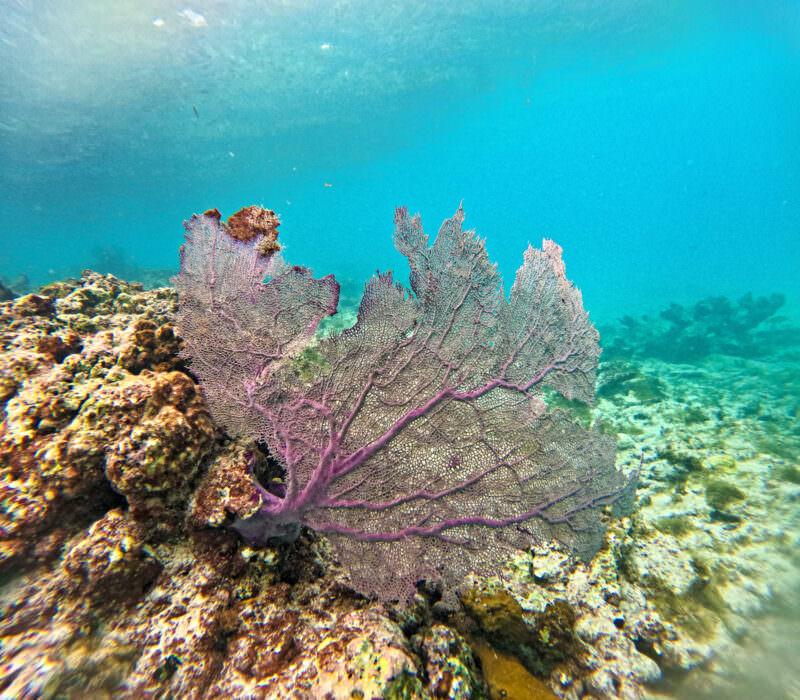
Using a GoPro underwater when SCUBA diving or snorkeling
If you’re shooting with the camera fully submerged and through water, you have some extra considerations.

The field of view is narrower underwater
When you start shooting through the water, you’ll find that the GoPro’s super-wide angle of view isn’t as wide anymore. That’s because of the refraction that happens through the water.
If you want to dive deeper into the ins and outs of refraction through water, here’s a detailed explanation of the calculations and variables, but most users will find it enough to know that the wide-angle isn’t going to be as wide when using the camera underwater. So that fisheye perspective that you get above the water will be transformed into something much more normal.
An underwater filter will make things less blue
If you’ve ever shot underwater, there’s a good chance your photos came out blue. It gets worse the deeper you go. That’s because the longer wavelengths of light, such as red and orange, don’t travel as well through the water as the shorter wavelengths such as blue. They therefore don’t penetrate as deep through the water. And that’s why even brightly colored coral and fish often look like they’re some variation of blue until you shine a flashlight or strobe on them. So you can often end up with photos or video footage that ends up being just shades of blue.
(For the half-above, half-below “split” shot at the surface, the tool is different: a dome port. I have a separate guide to how they work and which dome fits which GoPro.)
An underwater filter will help boost the amounts of red and orange in the light relative to the blue and make the image look more colorful and natural. The filters are usually red or orange, with slightly different tints depending on what kind of water you’re shooting in (eg. tropical ocean water is a different color than polar lake water, for instance).
With the newer GoPros, the best approach is to use some kind of snap-on filter over the outer lens port.
My favorite ones are the BackScatter Flip system, which I’ve covered in detail before, but that’s also one of the more expensive solutions and is probably overkill for light uses.
PolarPro also offers a simpler and less expensive option with their Aqua filters.
Note on Housing Compatibility: Many filters (like the Backscatter Flip) are designed to attach to a dive housing, not the camera directly. You need to make sure your filter matches your setup. For the HERO9 through HERO13, the dive housing is called the “Protective Housing.” For the HERO5 through HERO7, it was called the “Super Suit.” The dimensions are different, so filters for one won’t fit the other.
Underwater filters won’t magically eliminate the problem of different lighting underwater, but they do help.
Use a dive housing if you’re going deep
The specific depth ratings vary for individual GoPro models, but most modern ones (HERO5 through HERO13) are rated to 10 meters (33 feet). That’s good for anything at or near the surface, including swimming, surfing, or snorkeling.
But if you’re Scuba diving, there’s a good chance you might go deeper than that. In practice, you might be fine at 12 meters or even 15 meters, but the deeper you get beyond the rated depth, the greater the risk of the camera’s seals leaking.
If you’re going deeper than 30 feet, a safer bet is to put the camera into a dedicated dive housing. These provide extra protection against water pressure.
Which housing do you need?
- HERO13, HERO12, HERO11, HERO10, HERO9 Black: Use the GoPro “Protective Housing + Waterproof Case” (Model ADDIV-001). It is rated down to 60 meters (196 feet).
- HERO8 Black: Uses a specific housing unique to the HERO8 design.
- HERO7, HERO6, HERO5 Black: Use the “Super Suit” housing.
Other third-party aftermarket manufacturers also make some, but quality control and pressure testing on those vary, so it’s well worth testing for waterproofness as thoroughly as you can before putting the camera in and taking it down on a dive. One good way to detect leaks is to put a tissue inside the housing and submerge the housing — any water that gets inside will be quickly visible on the tissue.
| GoPro camera | Compatible protective housing | Housing depth rating |
|---|---|---|
| Mission 1 / Mission 1 Pro | Protective Housing (for Mission 1) (AGDIV) | 196 feet / 60 meters |
| HERO11 Black Mini | Protective Housing (for HERO11 Black Mini) (AFDIV) | 196 feet / 60 meters |
| HERO13 Black | Protective Housing (for HERO13/12/11/10/9) (ADDIV-001) | 196 feet / 60 meters |
| HERO12 Black | Protective Housing (for HERO13/12/11/10/9) (ADDIV-001) | 196 feet / 60 meters |
| HERO11 Black | Protective Housing (for HERO13/12/11/10/9) (ADDIV-001) | 196 feet / 60 meters |
| HERO10 Black | Protective Housing (for HERO13/12/11/10/9) (ADDIV-001) | 196 feet / 60 meters |
| HERO10 Black Bare Bones | Not compatible with protective housing. | — |
| HERO9 Black | Protective Housing (for HERO13/12/11/10/9) (ADDIV-001) | 196 feet / 60 meters |
| HERO8 Black | Protective Housing (for HERO8) (AJDIV-001)* | 196 feet / 60 meters |
| HERO7 Black | Super Suit | 196 feet / 60 meters |
| HERO7 Silver | Protective Housing (for HERO7 Silver/White) | 131 feet / 40 meters |
| HERO7 White | Protective Housing (for HERO7 Silver/White) | 131 feet / 40 meters |
| HERO6 Black | Super Suit | 196 feet / 60 meters |
| HERO (2018) | Super Suit | 196 feet / 60 meters |
| HERO5 Black | Super Suit | 196 feet / 60 meters |
| HERO5 Session | Aftermarket Dive Housing | — |
| HERO Session | Aftermarket Dive Housing | — |
| HERO4 Session | Aftermarket Dive Housing | — |
| HERO4 Black | Aftermarket Dive Housing | — |
| HERO4 Silver | Aftermarket Dive Housing | — |
Defogging
Just as glasses can fog up in humid and damp conditions, in some circumstances, camera lenses can also fog up.
With GoPros, this mostly happens if you’re using a separate housing that allows air to be trapped inside. The problem is if the lens port fogs up when you’re out filming, there’s no easy way to fix it — you can’t just wipe the lens, because the fogging is on the inside of the lens port glass.
In other words, prevention is by far the best course. There are two ways to do it.
The first is to seal your camera in the housing in the cool and dry comfort of your air-conditioned hotel room or cabin. That then traps dry rather than moist air in the housing.
A second option is to use anti-fogging inserts in the housing. These will help soak up moisture from the small amount of air caught inside the housing. While the anti-fogging inserts are designed to be slim and small, there’s no guarantee that they’ll fit in the housing, so it’s worth testing ahead of time. And other than being small and slim, there’s nothing specific to GoPros about these — you can use them with other cameras in housings or even use them as silica gel in your camera bag (they’re reusable — dry them out to refresh them).
Shoot photos in RAW
When shooting still photos, I try to shoot in RAW whenever possible. Shooting in RAW gives you much more leeway with color correction in post-processing.
It’s not available in every still photo mode on GoPros — it’s not when using the various enhanced photo modes, for example — but it is available for standard still photos and many of the burst and time-lapse modes. In short, there are many good reasons to shoot photos in RAW anywhere, not just underwater.
But when you’re shooting underwater, there’s a particularly strong argument in favor. And that is that it gives you much better control over white balance. It’s for the same reason as using underwater filters — to be able to correct to some extent for the lack of red and orange light underwater.
You can adjust the white balance of JPG files too, but it works much better with RAW files, and you’ll get better results.
Ration battery life
GoPro battery life is less than stellar at the best of times. If you’re shooting in cool water, it will be even less. I find that a battery will barely last me for a typical morning outing of two dives when I’m only shooting photos.
You’ll burn through more juice if shooting video. And, almost inevitably, that surprising highlight moment will come towards the end of your dive.
So you’ll want to maximize battery life by turning off any features you’re not using. Prime candidates include wireless and GPS, and reducing the on-time for the back screen. I also make sure the camera is off during the break between dives.
Ration SD card space
This is mostly an issue when shooting video, but if you’re trying to capture a whole dive at one of the high-bitrate video modes, battery life isn’t the only thing you’ll have to keep an eye on. Those modes burn through a lot of storage space.
Starting with a large-capacity SD card such as 256GB or 512GB (or even 1TB on newer models like the HERO13) is a good first step. I’ve put together some suggestions here.
Stabilizing handles when shooting video
Traditional stabilizers don’t work underwater, but one simple way to get smoother footage underwater is to use a handle frame.
It gives you a much broader two-hand grip that helps minimize small movements. If you’re shooting video when diving or snorkeling, it can make quite a difference. You can even add floats to the frame to make the rig neutrally buoyant. And if you’re wearing dive gloves, they give you something more substantial to grip. And if you decide to add a video light or two, you can attach them to the frame.
Adding lights
Underwater lighting is a whole topic unto itself, and a complicated one at that.
There are many situations underwater where adding lights can add complications or even make things worse. There are also some times when they can give a big improvement. So it’s not a one-size-fits-all solution, because lights work better in some scenes than others. They work well for close-up shots, for example, but they don’t work as well the further you move away from the subject. There are a few reasons for this, the main ones being the lights’ lack of power to penetrate the water, the width of the lights’ beams, the problem of backscatter reflections off particles or bubbles in the water, and the challenge of balanced lighting on close and distant objects or parts of the frame.
Underwater lighting is something worth easing into, starting with a simple, single video light. As you get used to it, you can add a second light, put them on extension arms, and upgrade to more powerful lights.
Underwater video lights run the gamut of prices, running well into the thousands. But you don’t have to start that high. You can start with small and basic, something like this and upgrade later once you narrow down your preferences and underwater shooting styles. Another excellent option is to rent some lights.
Common questions
Can I take a GoPro in the pool or the ocean without a case?
Yes, for any model from the HERO5 onward (and the HERO+, HERO Session, and HERO (2018)). Close both doors, check the seals for grit, make sure the lens cover is on, and you’re good to the body’s rating: 10 meters for most models, 20 meters for the Mission 1 and Mission 1 Pro, 5 meters for the HERO (2024), MAX, and Fusion. Rinse it in fresh water afterward, especially after salt water.
How deep can a GoPro go without a housing?
10 meters / 33 feet for the HERO5 through HERO13 Black and the HERO11 Black Mini; 20 meters / 66 feet for the Mission 1 and Mission 1 Pro; 5 meters / 16 feet for the HERO (2024), MAX, and Fusion. For scuba depths, use the Protective Housing (60 m / 196 ft).
Is the HERO (2024) as waterproof as the Black models?
It’s waterproof, but to half the depth: 5 meters / 16 feet versus 10 meters for the Black cameras. Fine for swimming, snorkeling, and surf; not for diving.
Does salt water damage a GoPro?
Not if you rinse it. Salt crystals left to dry in the door seals and around the lens cover are what cause trouble. A soak in fresh water after each salt session and a dry before you open the doors is the whole routine.
Can I open the doors when the camera is wet?
Dry the outside first, and never open them underwater or with water pooled around the door. Water that gets past the seal ends up on the battery and SD card contacts, and that’s the end of the camera.
Wrap up
GoPros are built for the water, and you can get some wonderful shots with them. There are limits, of course, such as GoPros’ ho-hum performance in the kind of low-light conditions that you’ll get if diving deep. But in good lighting, they’re hard to beat for the convenience, ease-of-use, and just plain fun when things get wet.
Notes & References:
- There are exceptions that are not waterproof, such as the HERO11 Black Bare Bones, a specialized FPV drone version that does not have a waterproof casing. [↩︎]


