Nikon doesn’t have any of their own Z-mount fisheye lenses yet, but some third-party manufacturers have stepped up.1
Aftermarket Chinese brands like Laowa, 7Artisans, and AstrHori are some of those who have stepped up, and I’m reviewing those separately. The one I’m focusing on here is by TTArtisan. These are all natively Z-mount lenses, manual-focus, manual-aperture, full-frame in both sensor coverage and in the fisheye sense of filling the frame (as distinct from a circular fisheye that only fills a circular area in the middle of the frame).
About this review: My objective here isn’t to do clinical lab tests. Rather, after being out shooting with this lens, I’ll try to give a sense of what it’s like to shoot with, what kind of results you might expect from it, and whether it’s worth your time and money to try it yourself.
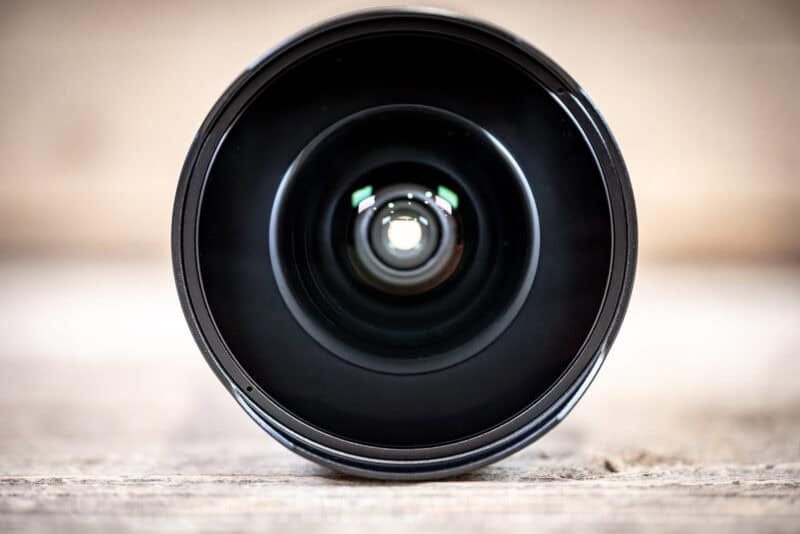
Meet the TTArtisan 11mm f/2.8 fisheye lens
This is an old-school analog lens. There are no electronic components — it just uses physics, no electronic wizardry. That doesn’t mean it won’t work on digital cameras (it will), but there are some practical implications to factor in. You’re getting manual focus, manual aperture, and no EXIF communication with the camera.

But after shooting with it, I like it. While I haven’t found it perfect to use — more on that below — I have been happy with the images that I get with it. They’re sharp and bright, and the fast maximum aperture (f/2.8) is useful for on-the-go shooting. It’s also smaller and lighter than some of its competitors.
This is a full-frame fisheye, and I mean that in both senses that are relevant to fisheye lenses. Firstly, it is designed for cameras with full-frame sensors. There are versions for both Nikon Z and Nikon F mounts; I’ve been testing the Z version on a Nikon Z8. Secondly, it’s a full-frame fisheye in the sense that the image covers the whole frame, not just as a circular area in the middle of the frame.
If TTArtisan sounds a lot like 7Artisans, that’s not coincidence. While the details are a bit murky, as far as I can make out, following a disagreement between the original founders of 7Artisans, one of them spun off and formed TTArtisan as a separate company. TTArtisan was established in 2019 and is located in Shenzhen, China. They’re one of several Chinese companies making interesting and often inexpensive lenses that aren’t simply cloning what the big manufacturers are doing – they’re often reviving vintage designs or trying something different, which is why I’m in the process of trying out as many of them as I can.
Build & handling
As soon as you take it out of the box, you’ll notice that this is quite a heavy, solid lens more in keeping with older mechanical lenses than the newer plastic-dominated lenses. It’s made of metal and glass in an old-school kind of way, certainly heavier than many of the newer mirrorless plastic lenses.
That said, it’s not especially large, so it doesn’t take up a lot of space in your camera bag. Because, let’s face it, a fisheye it usually a plus-one kind of lens rather than a core lens that stays on the camera much of the time.
At 15.38 oz / 436 grams, it’s much smaller and lighter than the AstrHori 12mm f/2.8 fisheye (27.2 oz / 757.5 grams), which I was shooting with alongside this and which is a notably large and heavy lens. The TTArtisan lens is positively petite in comparison, and it doesn’t unbalance the camera in the kind of front-heavy way the AstrHori does. It’s not the only relevant fisheye around this size — the one by 7Artisans and the Nikon AF-D 16mm f/2.8 + FTZ adapter are both in the same ballpark, for example.
Since this is a manual-focus lens, you use the focus ring on the lens itself to focus. However, my least favorite thing about shooting with this lens is how heavy the focus and aperture rings are. What I mean by that is that they’re surprisingly stiff and hard to turn. That makes fine-tuning focus more difficult than it should be. This is the opposite problem from the AstrHori fisheye, where the focus ring was almost too light and easy to move.

The aperture is also manual — you use the lens’s aperture ring to change settings from f/2.8 to f/16. You can’t change the aperture in the camera, which also means that automatic or some semi-automatic shooting modes like P and S (shutter priority) won’t work effectively. You can still use A (aperture priority) mode or full manual exposure. The aperture ring doesn’t have any click stops – it just rotates freely (if rather stiffly). Because the camera doesn’t control the aperture, what you see is what you get in terms of lighting. If you step down the aperture to, say, f/8, it’s going to darken the view through the viewfinder and live view back screen.

The lens cap is a metal cap that slides over the built-in lens hood. It’s metal, which is a good thing (unless you’re shooting in a marble interior somewhere that’s supposed to be quiet — ask me how I know!). Like most fisheyes, you can’t use standard screw-in filters – there are no filter threads, the front element isn’t flat, and the ultra-wide angle poses big problems with vignetting.
Sample images
Here’s a handful of sample images I’ve taken with this lens. I’ve posted a larger collection separately.
All were taken with a Nikon Z8 and shot in RAW. They were lightly processed in Lightroom, but I haven’t applied any of Lightroom’s optical corrections to these (and there’s no built-in lens profile even if I’d wanted to). Because no EXIF data is communicated between lens and camera, the aperture of each of these was unrecorded.
You can click on each image for a full-size version for a closer look.





Things worth knowing
- As with all fisheye lenses, the lens distortion is a feature, not a bug. If you don’t want that distortion, you’ll be better off getting a rectilinear lens that has aspherical elements, something like the Laowa 10mm f/2.8, for example. Laowa (Venus Optics) is a Chinese lens manufacturer established in 2013 that focuses on very wide-angle and macro lenses, known for creating unique and innovative designs. I’ve previously reviewed Laowa’s 10mm f/2.8 autofocus, which I found to be a very effective and interesting lens with similar coverage to this one but in a rectilinear and autofocus format. 7Artisans has a new 10mm that looks interesting, but I haven’t tried that one yet. That said, it is possible to digitally correct for the distortion in post-processing in good image editing apps like Lightroom, Capture One, or DxO Photo. Their lens profile and distortion correction tools (in this case, manual corrections, not automatic profiles) can often do a good job, though you will lose image real estate from all around the frame.
- The minimum focus distance is 6.69 inches / 17 cm, and the optical design uses 11 elements in 7 groups with 7 aperture blades.
- There’s no image stabilization – you’re relying on the camera body’s stabilization (IBIS) if it’s available.
- Nikon doesn’t have a native Z-mount fisheye (yet). They do have a couple of fisheyes in their F-mount range: the Nikon 8-15mm fisheye and the Nikon 16mm fisheye (they also had an APS-C 10mm, but it was discontinued several years back).
- The lens doesn’t communicate any EXIF information to the camera. That means there won’t be any lens EXIF information in the image metadata. In Lightroom, for example, it’ll just show up as
0.0 mm f/0.0. On the Z8 and Z9, you can use the non-CPU lens data feature to manually input the lens name for informational and organizational purposes, though this doesn’t help with the lens profile aspect.2
Specifications
| Specification | Details |
|---|---|
| Focal Length | 11mm |
| Maximum Aperture | f/2.8 |
| Minimum Aperture | f/16 |
| Lens Mount | Nikon Z (also available in Nikon F) |
| Format Coverage | Full-Frame |
| Minimum Focus Distance | 6.69 in (17 cm) |
| Optical Design | 11 Elements in 7 Groups |
| Aperture Blades | 7 |
| Focus Type | Manual Focus |
| Image Stabilization | No |
| Weight | 15.38 oz (436 g) |
Is it any good?
Pros:
- Compact and relatively lightweight for a fisheye
- Solid metal construction
- More reliable focusing than some competing manual fisheyes (my experience, anyway)
- Available for multiple camera mounts
- Fast f/2.8 maximum aperture
- Metal lens cap
Cons:
- Stiff, difficult-to-turn focus and aperture rings
- No click stops on the aperture ring
- Manual focus and aperture only
- No EXIF communication with the camera and therefore not saved in image metadata
- No built-in lens profiles for automatic correction and adjustment (but can still make manual adjustments)
- No filter thread compatibility (that’s normal for fisheye lenses)
Despite the stiff focus and aperture rings, I found this lens more reliable for achieving sharp focus compared to the AstrHori 12mm f/2.8 fisheye I was testing alongside it. While the heavy focus ring makes fine-tuning more difficult than it should be, it’s at least predictable and doesn’t suffer from the overly sensitive focus issues that plagued the AstrHori. And there’s less play in the distance focusing, meaning that there was a little less room to get things wrong. In practical terms that translated to more in-focus shots with this lens than with the AstrHori.

That this is even an issue is in large part because modern mirrorless cameras, quite understandably, prioritize autofocus lenses. They do have tools to help with manual focus; on the Z8, those include focus peaking and a split view. But their effectiveness isn’t great with this type of lens. Focus peaking isn’t very precise when you’re focusing close to infinity, especially with wide-angle and fisheye lenses. And split view isn’t well suited to handheld photography — it’s much better suited to fixed, tripod-style shooting.3
Overall, I’ve found this to be a pretty good lens, and I’d choose it over the AstHori (which is probably made by Samyang). It’s sharp where it needs to be (a bit less so around the edges, as expected). It’s relatively small and packable even for a non-core piece of kit.


There are two more full-frame Z-mount fisheyes I’m trying out: one from Laowa and a new one from 7Artisans. I can’t yet say how they compare, but they look like interesting options, too. And there are plenty of Nikon F-mount manual-focus fisheyes on the used gear market that could also be an attractive alternative, especially if you already have an FTZ adapter.
Price & availability
The TTArtisan 11mm f/2.8 fisheye is available in versions for Sony E, Canon RF, Canon EF, Leica L, Nikon F, and Nikon Z mounts. I’ve been using the Nikon Z version. The MSRP is very attractive at $235, making it a pretty low-risk proposition to try out.
Check current price and availability at:
Notes & References:
- There are some Nikon F-Mount fisheye lenses that will work in combination with an FTZ adapter, albeit with some possible feature limitations. For example, I’ve used the Nikon AF-D 16mm f2.8 fisheye on the Nikon Z8, but it becomes a manual-focus lens (but with the advantage of the rangefinder focus indicator on the screen). I assume the Nikon AF-S 8-15mm f3.5-4.5E ED works well, but I haven’t personally used that lens on this particular camera yet. [↩︎]
- With regards to the EXIF information, there’s a partial, manual workaround if you use the camera’s non-CPU lens feature. Basically, you can manually enter a template of EXIF information that will be embedded in the image metadata at the time the file is originally captured. But the emphasis here is on manual; you have to manually enter the information and remember to manually choose the correct lens information when you attach it to the camera. I have a detailed guide to using the non-CPU feature separately. [↩︎]
- With Nikon AF-D lenses on a Z-mount body, you don’t get autofocus and they become manual-focus only, but you do get the benefit of having the on-screen range-finder focus indicator working. The lens that’s directly relevant here is the Nikon AF-D 16mm f2.8 fisheye. [↩︎]