I really enjoy shooting with fisheyes. Whether it’s the immersive look you get with action cams or the detail and dramatic perspective you get with a larger camera with a fisheye lens attached (that can generally handle the challenging lighting of interiors much better than an action cam), it’s a style I find fun. Sure, it can be overdone, and it definitely doesn’t suit everything, but it can also create images that are a bit out of the ordinary and packed with drama.
I’ve been shooting with fisheyes for years, but recently there have been quite a few new third-party lenses that I’ve been wanting to try out.
They’re particularly of interest because Nikon doesn’t itself make a Z-mount fisheye yet.1
I’ve recently tried out the TTArtisan fisheye and written about it here and posted sample images I’ve taken with it here. And also one from AstrHori.
Laowa 8-15mm f/2.8 FF Zoom Fisheye lens
The one I’m focusing on in this review is the Laowa 8-15mm f/2.8 FF Zoom Fisheye.
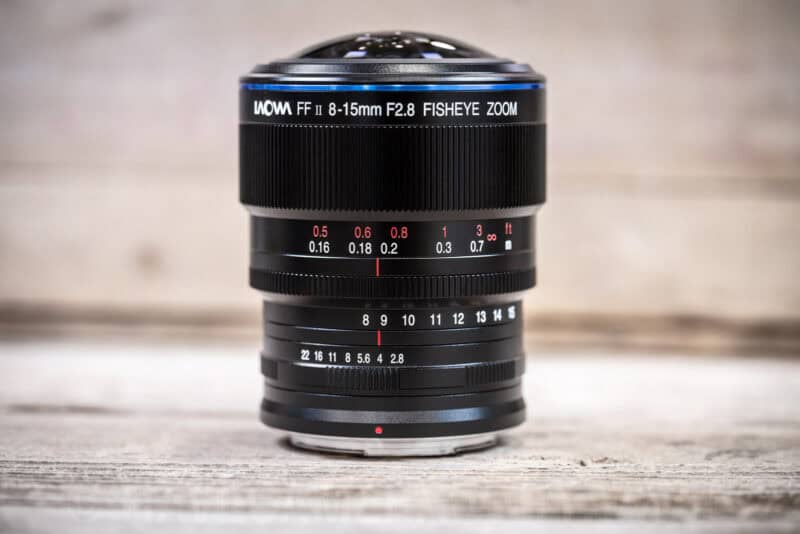
It’s a manual-focus lens that sells for $699, making it one of the more affordable options for a zoom fisheye (though more expensive than some prime fisheyes like the TTArtisan), and it’s one I’ve had my eye on for a while.
If the brand doesn’t ring any bells, Laowa is one of the newer Chinese lens manufacturers that’s been putting out third-party camera lenses at competitive prices. Many, but not all, are manual focus, and they often use older lens designs to minimize R&D costs. But manufacturing these days is massively better than it used to be, and the quality of some of these lenses can actually be very good (not all of them, mind you). Laowa has been specializing in wide-angle and macro lenses, and I’ve used a few of them now and been impressed.
This one is both a zoom — and I have more on that below — and also a full-frame.
When it comes to fisheyes, the term “full-frame” can mean two things. The obvious one is that it’s designed for cameras with a full-frame sensor rather than a cropped sensor like APS-C or M43.
But the other is that it projects an image across the whole frame, filling the frame with an image rather than producing a circular fisheye effect. So you end up with the usual rectangular image output (and it’s sometimes referred to as rectangular fisheye), just with the exceptionally wide angle of a fisheye and its distinctive distortion. That distinguishes it from a circular fisheye, which produces a circular image in the middle of the frame surrounded by black. Of course, that’s a little muddied in this case because it’s a zoom fisheye, which is more unusual, and on a full-frame camera, you can actually get both a frame-filling rectangular image or a circular fisheye image (or something in between, for that matter).
Build & handling
With its metal and glass construction, it feels solid to shoot with. But it’s not particularly heavy or beefy (unlike the AstrHori). It weighs approximately 650g (22.9 oz) and measures 94.5mm in length with a diameter of 76.4mm (3.7 x 3.0 inches) for the Z-mount version.
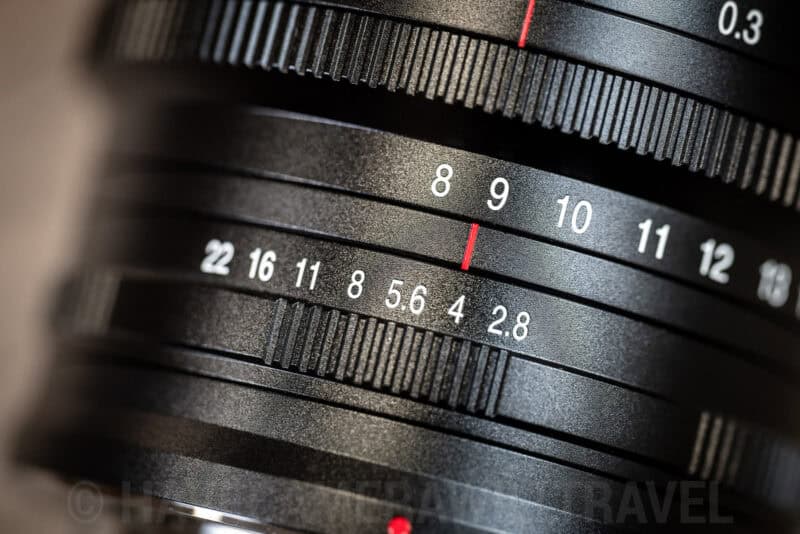
The zoom, focus, and aperture rings all rotate smoothly. When you zoom, the central lens barrel protrudes slightly in and out of the outer barrel, but it’s not much and unlikely to be much of an issue in most situations (a possible exception might be a tight fit in a dome port of an underwater housing).
There’s no lens hood at all on this lens. That’s not really an issue in terms of image quality because the reality is that a fisheye lens’s hood is so small because of the massive field of view that the hood has little to no effect on preventing stray light from hitting the front glass element. But it does mean that there’s nothing there to offer physical protection to the front element. So you need to be even more careful than usual about putting the lens down with the front element facing down.
The lens cap is quite distinctive — it’s more of a cover than cap in that it wraps over the lens. There’s a knob on the side to tighten it to keep it in place. It works well, although it’d be a pain to try to replace it if you lose it, because I don’t see it available as a parts accessory on the Laowa website.

The lens features 13 elements in 9 groups, with a 9-blade aperture that ranges from f/2.8 to f/22. The angle of view is 175° to 180°, and the minimum focusing distance is 16cm (6.3 inches) with a maximum magnification of 0.23x.


Shooting with it / working with manual focus on mirrorless
When it comes to shooting with it, everything is pretty straightforward in a back-to-basics analog kind of way.
This is a non-CPU lens. That means there’s no electronic communication at all between the lens and the camera. That’s in both directions. The most obvious is that the camera can’t control the lens for focus or aperture.
But it also means that the lens can’t communicate with the camera. That includes EXIF information about the lens embedded in the image metadata. If you want some basic information included, you can use your camera’s non-CPU lens data feature, if it has it. That will embed some basic lens EXIF information into the image metadata. Also, if your camera has in-body stabilization (IBIS), the data you enter here will make it more effective. (In Nikon’s implementation of this feature, you can only enter one focal length in the non-CPU lens data, not a zoom range. So it’s recommended that you use the widest, which in this case is 8mm.)
And while manual focus lenses can be excellent and create opportunities that might not be available with autofocus offerings, it does require some adjustments to shooting methods. Today’s mirrorless cameras are generally designed with an emphasis on autofocus lenses. That’s not to say that you can’t use manual focus — you definitely can. And many cameras come with focus-assist features to make it easier.

But I still don’t find it as precise or intuitive as the old split-screen focusing screens on my old manual SLRs. The Nikon Z8, for example, has two manual focus-assist features: focus peaking and split-screen. For a fisheye, the focus peaking is probably the most useful. But it’s still a bit limited. Even with the focus peaking setting set to narrow, it tends to give an overly generous indication of where the focus is, which is exacerbated exponentially in the superwide perspective and inevitably busy scenes of a fisheye lens. Not just with this lens, but also with others, I’ve had many manual-focus fisheye shots at wide apertures be out of focus. So when shooting with this type of lens, I’ll often stop down the aperture or bracket shots with a slight adjustment to focus between shots, or both. It’s just a tricky kind of lens to shoot with.
Something I like about the manual focus of this lens is that its focus is weighted close. What I mean by that is that most of the rotation of the focus ring is geared toward very close distances. For “normal” distances further from the camera, there’s actually not much rotation needed. (On cine lenses, we’d be talking here about focus throw.) And the practical effect of that is that it actually makes the focus much more forgiving and more likely to be accurate.2 I’m thinking here as a comparison with an AstrHori fisheye I reviewed recently, which was weighted in the other way, and I really struggled to get focused.
The zoom feature
A zoom fisheye is relatively unusual. They do exist, and I’ve reviewed Nikon’s own AF-S 8-15mm fisheye before (plus sample images). The zoom part of it has two features.
Firstly, on a full-frame sensor camera like the Z8 I’m using it on, you can choose to use it as a circular fisheye (circular frame surrounded by black) or a full-frame coverage fisheye where the whole frame is filled with image. Or anywhere in between, of course, since it’s a zoom, not a toggle. I usually use the full-frame view.

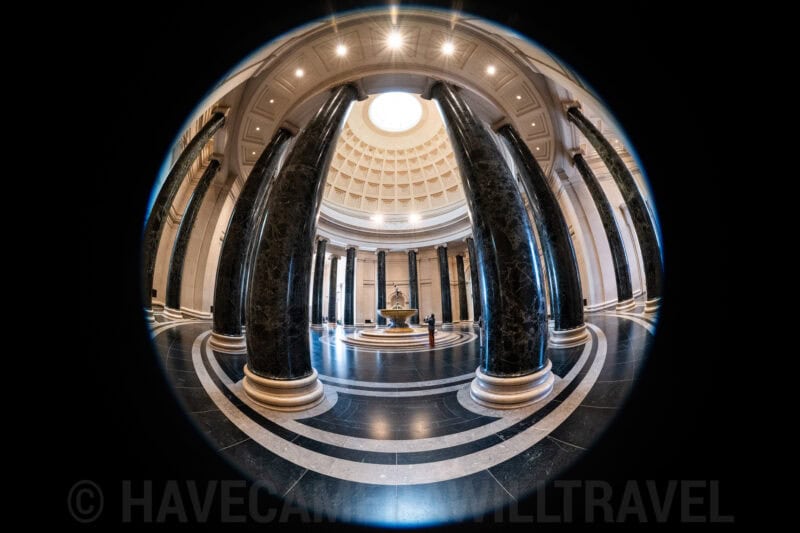
Secondly, on an APS-C (DX) cropped-sensor camera, you can use the 8mm end as a frame-filling fisheye. In this way, the 8-15mm adds versatility because it’ll work well on both cropped-sensor and full-frame sensor camera bodies (and saves the lens manufacturer from creating separate lenses).
Sample images
I’ve posted a larger selection of sample images separately, but here’s a short selection.
These were all shot handheld on a Nikon Z8 in RAW and lightly processed in Lightroom Classic. I haven’t applied any of Lightroom’s optical distortion corrections here. Because the lens is a non-CPU lens, it doesn’t report any aperture information back to the camera to embed into the image EXIF, but most of these were shot at either f/4 or f/2.8.
You can click on each image to open a full-size version for a closer look.


Conclusions
Having tried a few different Nikon Z-mount fisheyes lately, I quite like this one. For the style of shooting I’ve been doing with it — on-the-go travel-style shooting — I’ve found it to work well.
Overall, I’ve found this lens to be sharp. As with any fisheye or ultra-wide, there’s certainly some softness around the edges of the frame. But for how most photographers will be using a fisheye like this, in most shooting scenarios, that’s unlikely to be a practical problem. I’ve been pleasantly surprised with how sharp it is.
However, closely related but less favorable: I’ve found getting sharp photos out of it wide open at f/2.8 to be challenging. But a key part of that is more method than the actual optics of the lens. This would likely be less of an issue when shooting with a tripod, where you can take more care in locking in the focus. But when shooting handheld, the manual focus can be tricky to nail down at the widest apertures (I found it much more reliable at f/4).
The problem is exacerbated on most modern mirrorless cameras because they’re really optimized for autofocus lenses. Many do have tools to assist with manual focus, but I don’t find them as reliable as an old-school optical split viewfinder on an analog camera. I use Nikon’s focus peaking feature, but it’s an imperfect tool with an extremely wide-focus lens like this because its precision is thrown off with a large volume of contrasty lines in a frame.
Things worth knowing
Compatibility Notes. The lens is available in multiple mounts: Sony E, Nikon Z, Canon RF, L Mount, Fujifilm GFX, and Hasselblad XCD. Note that for GFX and XCD mount lenses, the image circle may not fully cover the sensor even when set to 15mm.
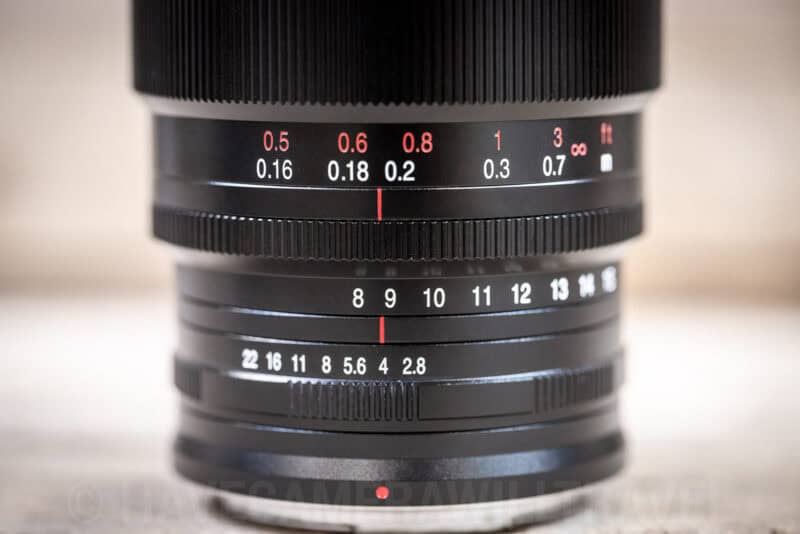
Focus Throw and Operation. The lens has a 70° focus throw, 75° zoom throw, and 42° aperture throw. Those put it pretty squarely in the stills photo category (cine lenses often have a much higher focus throw for smooth and more precise tracking). The focus scale features dual markings for convenience. It’s a pretty straightforward lens to shoot with overall.
Optical Design. The 13 elements in 9 groups are arranged to provide the characteristic fisheye projection while maintaining relatively good sharpness across the frame. The 9-blade aperture diaphragm helps with the bokeh when you’re shooting close and wide open, though that’s not typically the primary use case for a fisheye.
Technical specifications
| Specification | Details |
|---|---|
| Product Name | Laowa 8-15mm f/2.8 FF Zoom Fisheye |
| Format Compatibility | Full Frame |
| Focal Length | 8-15mm |
| Aperture Range | f/2.8-22 |
| Angle of View | 175°-180° |
| Lens Structure | 13 elements in 9 groups |
| Aperture Blades | 9 |
| Focus Throw | 70° |
| Zoom Throw | 75° |
| Aperture Throw | 42° |
| Focus Scale | Dual Scale |
| Minimum Focusing Distance | 16cm (6.3 in) |
| Maximum Magnification | 0.23x |
| Focus Mode | Manual Focus |
| Dimensions (Z-mount) | 94.5mm x Ø76.4mm (3.7 x 3.0 in) |
| Weight | ~650g (22.9 oz) |
| Available Mounts | Sony E, Nikon Z, Canon RF, L Mount, Fujifilm GFX, Hasselblad XCD |
Alternatives
Several other fisheye zoom lenses are available, though the market is fairly limited.
For Nikon Z-mount users specifically, the Laowa offers native Z-mount compatibility without needing an adapter, which is an advantage over the Nikon F-mount option.
Another natively Z-mount fisheye that I’ve tried and quite like recently is the one by TTArtisan (the TTArtisan 11mm f2.8 fisheye. It’s a prime fisheye, so no zoom. And it’s significantly cheaper than the Laowa. But I found it sharp and good to shoot with; you can read my review here and see the sample images I’ve taken with it here.
If you broaden the field to Nikon F-mount with an FTZ adapter, there’s a bunch more options available, including two more recent ones from Nikon. The one I have and have used for many years is the Nikon 16mm f/2.8. The advantage of this one is that, although you do lose the autofocus of the lens, it has rangefinder focusing with the camera body, which is a better and more reliable method than relying only on focus peaking or the split-focusing (which is better for tripod-mounted and macro work). It’s a discontinued lens now, but you can pick up copies on the used market. Nikon also has an F-mount 8-15mm f/2.8 fisheye, but that’s at a very different price point and seems surprisingly hard to track down now that’s it’s also discontinued.
But something to consider is that you are paying here for the zoom feature. And the reality is that that’s not a high priority for me because I rarely have any need for circular fisheye shots. For that reason, I’d probably choose the TTArtisan prime over this one. It’s a lot cheaper and smaller. I struggled to get consistently focused shots out of the AstrHori for this style of shooting, so that wouldn’t make the cut for me.
Price & availability
The Laowa 8-15mm f/2.8 FF Zoom Fisheye is priced at $699 and is available in Nikon Z, Sony E, Canon RF, L Mount, Fujifilm GFX, and Hasselblad XCD mounts.
Imports from China are a bit unclear at the moment, so price and availability might fluctuate. Check current price and availability at:
Notes & References:
- They do have an F-mount version — also an 8-15mm zoom fisheye — that’s designed for DSLRs and features autofocus. But that one doesn’t work natively on Z-mount cameras without the FTZ adapter. The Laowa that I’m focusing on here, on the other hand, is available in native Z-mount (along with several other mount options), though it’s manual focus only. [↩︎]
- On this, like most lenses, a full rotation of the lens until it stops isn’t actually the perfect infinity focus. They’re actually designed with a slight bit of give to account for both manufacturing variance and also for environmental variance, especially temperature, which affects the materials that the lens is made of. [↩︎]