
Taking a tripod with you when you travel isn’t always convenient. Some of them can be big, heavy, and incredibly cumbersome to strap to the side of a backpack. But thanks to the combination of affordable carbon fiber and reverse-folding leg designs, today’s travel tripods can be very sturdy yet fold up into a surprisingly small package.
In my experience, a travel tripod has to strike a very specific balance: it needs to be light enough that I don’t hate carrying it through an airport, but strong enough that I trust it to hold my gear in a stiff breeze.
To see how it measures up to those standards, I spent some time doing hands-on field testing with a unique model from 3 Legged Thing, a small British company that specializes in travel supports. I’ve reviewed and tested several of their tripods before. Following their tradition of giving their products boys’ names, this one is called the Leo.
The Leo is the smallest in 3 Legged Thing’s Equinox series. Like the others in the lineup, it is made of carbon fiber and uses twist locks for its leg and center column extensions. And they all share a distinctive color scheme that stands out next to the sea of boring black tripods on the market, featuring bulging bronzed twist locks that remind me of furry leg warmers.

It folds up into a small, travel-sized package but still manages to boast an unusually high load capacity. So it manages to combine genuine portability with the usefulness required for holding larger, heavier camera setups (though that is relative, of course — it’s still a lightweight travel tripod, and there are physical limits to how still it can hold heavy loads in high winds).


Legs & angles
The legs feature a manual ratchet lock at the top shoulder joints that can lock them into one of three shooting angles: 23°, 55°, and 80°.


The traditional tripod stance has the legs at a 23° angle. That gives you the maximum potential height, but the narrower footprint also means that the center of gravity is more critical when loading up heavy gear.
You can broaden the stance to a mid-level 55° angle. For ultra-low-level macro shooting or forced perspectives, you can remove the long center column entirely and splay the legs wide at 80°. In this configuration, you get a ton of stability and a vantage point just a few inches off the ground.
With five extending sections, the Leo gives a maximum shooting height of 51.5 inches (131.1 cm) or drops down to a minimum height of just under 5 inches off the dirt.
The feet are detachable, so if you want to swap the default rubber ones out for steel spikes when shooting on ice or soft earth, you easily can. You can also replace the rubber feet if they ever become damaged from heavy travel use.


Center column & monopod mode
One of the distinctive things about several 3 Legged Thing tripods is that they add more extension sections directly into the center column. On the Leo, there are two distinct sections, each with its own twist lock.

Monopod Conversion: As with a few other premium travel tripods, you can also use the Leo as a monopod. The central column pulls completely out, and one of the tripod legs unscrews from the shoulder joint. Connect them together, and you end up with a fully functional monopod. You can use it with or without the ballhead attached — just screw the quick-release clamp directly to the post if you want to use it bare.
Head options for the 3 Legged Thing Leo
The Leo is available bundled with either the lightweight AirHed Switch ballhead or the heavier-duty AirHed 360 ballhead, which is more robust and adds a smoother panning rotation. Another option is to simply buy the legs alone and attach your own preferred head.

The one I used during my field tests — and the one pictured in these shots — is the AirHed Light. There’s a very similar version with a lever-style locking mechanism, the AirHed Switch. It is compact but impressively strong, boasting a load capacity of up to 88 lbs (40 kg). It uses a single large knob to clamp down on the ball.

3 Legged Thing products have always been designed to play nicely with Peak Design gear. The AirHed ballheads are fully compatible with Peak Design QR plates, which are themselves designed to be Arca-Swiss compatible.
Core specs
- Maximum Height: 51.5 in (131.1 cm)
- Minimum Height: 4.75 in (11.9 cm)
- Folded Length: 13.75 in (34.8 cm)
- Weight: 3.2 lb (1.45 kg)
- Legs Made of: Carbon fiber
- Leg Sections: 5 (Twist Locks)
- Quick Release: Arca-type
- Warranty: 5-Year Global Warranty
Load Capacity (By Leg Angle):
- 23°: 66.1 lb (30 kg)
- 55°: 44.1 lb (20 kg)
- 80°: 22 lb (10 kg)
3 Legged Thing Leo vs. Albert
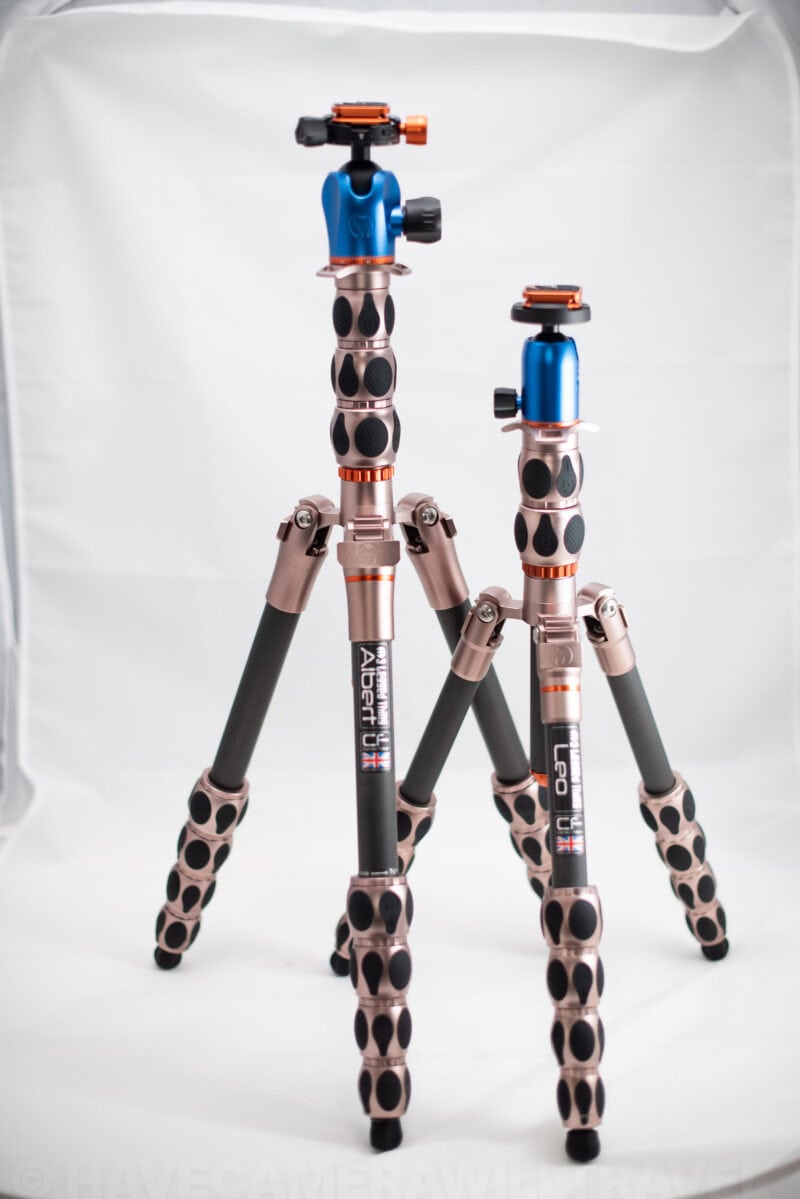
Another popular tripod in the Equinox series is known as the Albert. It is much taller and a little longer when folded up.


I’ll be posting a dedicated review on the Albert soon, but in the meantime, here are some side-by-side comparison photos I shot so you can judge the sizing for your own pack.


More detail photos


Final thoughts & verdict
I’ve found all of the 3 Legged Thing tripods I’ve tested to be incredibly well-made and thoughtfully put together. Once again, the company has gone for distinctive, loud styling, which ultimately comes down to a matter of personal taste.
Without the center column extended, the legs provide excellent stability for a DSLR or heavy mirrorless setup — with the usual real-world qualification that a small, light tripod like this simply won’t provide the same rock-solid base as a big, heavy studio beast. Extending the center column does increase the likelihood of movement with the shutter or in the breeze, something that will become much more pronounced the heavier your load gets.
The standout feature of the Leo is its unusually high load capacity. The rating is at its absolute highest when the tripod is in its most upright stance and reduces significantly when the legs are splayed wide, but its maximum load capacity of 66 pounds is significantly higher than many other tripods in its weight class.
Folded, it compacts down to a size that rivals several of its main competitors.
However, when fully extended, it comes in on the short side of many of those same competitors. With a maximum height of a little under 52 inches, it is not going to be a comfortable choice if you’re tall and hoping to shoot standing up at eye level all day.
Overall, I found the Leo to be a fantastic, highly portable travel tripod that easily holds its own on a par with several other premium tripods on the market.
Price & availability
Update: The 3 Legged Thing Leo 2.0
Since I originally tested this tripod, 3 Legged Thing has discontinued the first-generation Leo and replaced it with an upgraded model: the Leo 2.0. The core DNA of the tripod remains the same — including the massive 66-pound load capacity and the loud bronze styling — but they made a few significant changes to the design.
Here are the key differences you will find in the Leo 2.0:
- It is significantly taller: The biggest complaint about the original Leo was its short maximum height. The Leo 2.0 fixes this, bumping the max height up to 57.7 inches (from 51.5 inches).
- Three detachable legs: While the original Leo had one detachable leg to form a monopod, all three legs on the Leo 2.0 can be unscrewed. This allows you to attach optional rubber footwear directly to the canopy, instantly converting it into a heavy-duty tabletop tripod.
- Slightly larger footprint: To accommodate the extra height, the Leo 2.0 is slightly larger when packed down. It folds to 14.7 inches (up from 13.75 inches) and weighs 4.1 lbs with the new AirHed Pro Lever ballhead attached.
If you are looking to buy this tripod new today, the Leo 2.0 is the version you will get.
There are several buying options for the new Leo 2.0: you can purchase the legs alone, or bundled with one of 3 Legged Thing’s upgraded ballheads. Make sure you’re getting the specific combination you’re after.



I got a 3LT Leo with the Airhed LIght last year and only use it on long distance trips where I fly (I just throw it in my suitcase). Overall, I am happy with the tripod even though I have to bend over a bit to take photos (I am tall). I would suggest if you are tall, get the Albert. The huge problem I had was with the Airhed Light. I only used the tripod on three trips, 10 days total, out of the last year and the blue base ring with the degree markers became slightly separated from the main casing (do to stress, I assume, but I only use a D7100 with a mid-range tele-zoom so weight should not have been a problem). During my whole last photo trip, the camera rocked on the tripod and I had a horrible time recomposing to compensate. Plus, I had to shoot on timer to be hands-free. I’m told these Light models had some design problems, which is probably why they no longer sell them. They are instead shipping me an Airhed Switch. We’ll see how that goes.