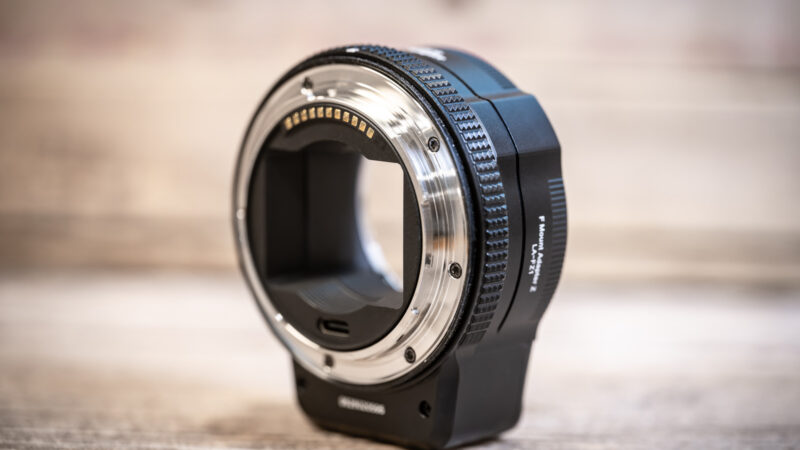
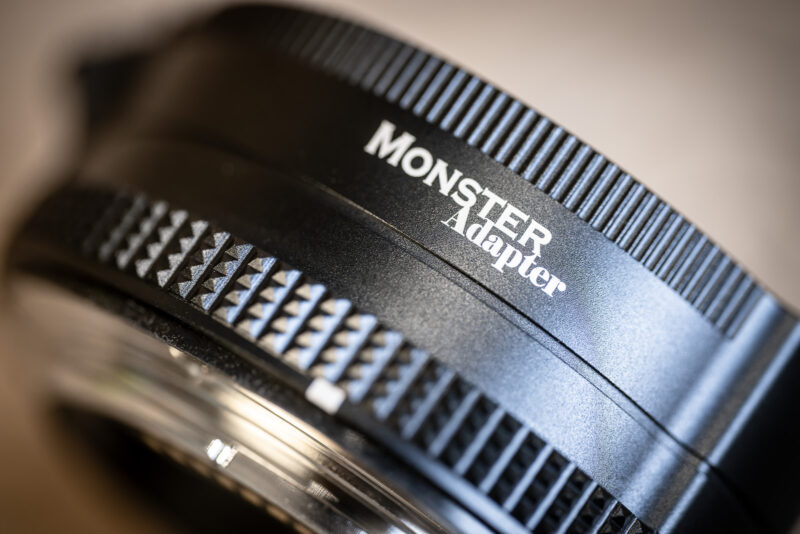
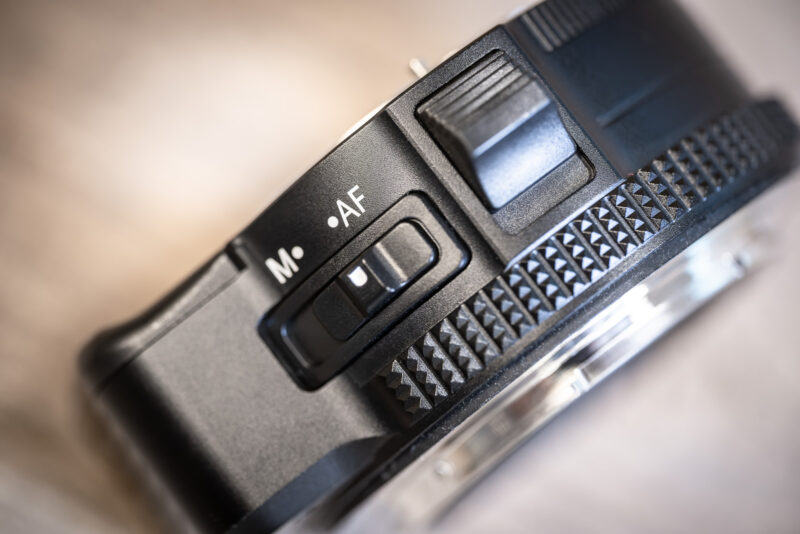
The MonsterAdapter LA-FZ1 is an F-to-Z lens adapter with its own autofocus motor built in.
It brings autofocus back to Nikon’s older screw-drive AF and AF-D lenses on Z-mount cameras, something Nikon’s own FTZ and FTZ II adapters can’t do.
I’m so pleased I found this!
Is it perfect? No, it’s not. But does it solve the problem I was looking to solve? Yes!
In that respect, it’s kind of a one-trick pony. But if you need that trick, it’s very handy.
At a glance
- What it’s for: Nikon AF and AF-D lenses (and a few screw-drive G lenses) that focus using a motor in the camera body.
- What it doesn’t do: autofocus with AF-S, AF-P, or AF-I lenses, E-type (electromagnetic) apertures, or in-lens VR. Use Nikon’s FTZ II for those.
- Aperture: controlled from the camera, like the FTZ II.
- Firmware: updated through the USB-C port on the adapter. Performance has changed a lot between versions, so update it first.
- Price and weight: USD 359 on MonsterAdapter’s own store; about 192 g (6.7 oz).
Why Nikon’s FTZ can’t autofocus these lenses
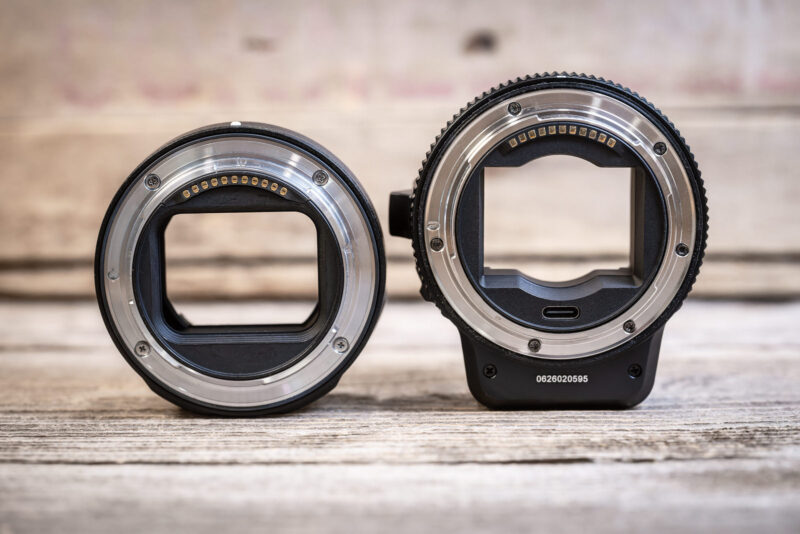
Nikon makes its own FTZ adapter, which lets you put F-mount lenses on Z-mount cameras. That adapter does two things. It adds the extra spacing between the lens and the sensor to make up for the difference in flange distance between the F-mount and Z-mount systems. And it passes electronic information between the lens and the camera.
What it doesn’t have is a focus motor. Neither do any of Nikon’s Z-mount cameras. And that’s where the LA-FZ1 comes in.
To be clear, most modern Nikon lenses don’t need that motor, because the autofocus motor is built into the lens.
That includes Nikon’s AF-S and AF-P lenses. But a whole generation of Nikon autofocus lenses, the AF and AF-D lenses from 1986 onward, were designed without their own motor. They use a screw-drive system: a small screwdriver-shaped coupling in the lens mount, turned by a motor in the camera body. Nikon’s DSLRs (at least the ones with a built-in focus motor) drove them that way.
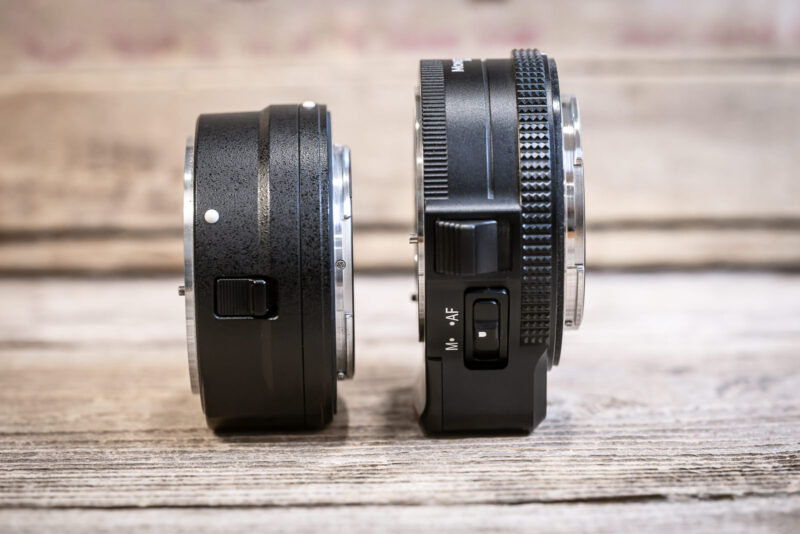
Mirrorless Z cameras have no such motor. So if you put those lenses on an FTZ adapter, you lose the autofocus. They’ll work, and you can still control the aperture from the camera, but they’ll be manual focus.1
The LA-FZ1 has a motor in the adapter itself, and it uses it to turn that screw-drive coupling. As far as I know, it’s the only adapter that does this for Nikon Z.
What I’ve tested it on
To be clear, I’ve only tested this on the AF-D lenses I have here, which isn’t many these days. Precisely two, actually. (I purged many of my F-mount lenses a while back.) So I’m not claiming comprehensive compatibility testing, and I’ve heard of some users getting mixed results with some AF-D lenses. So I’d definitely recommend testing it before heading out with it on that once-in-a-lifetime trip. You can find MonsterAdapter’s compatibility information here.
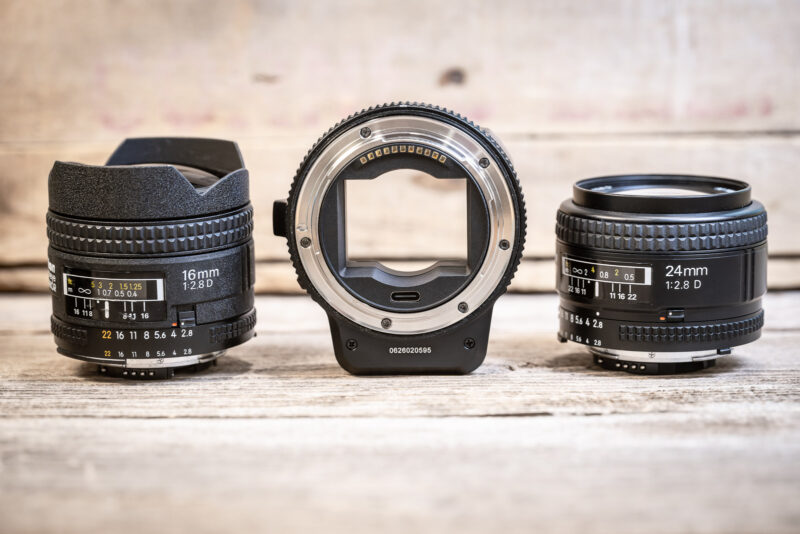
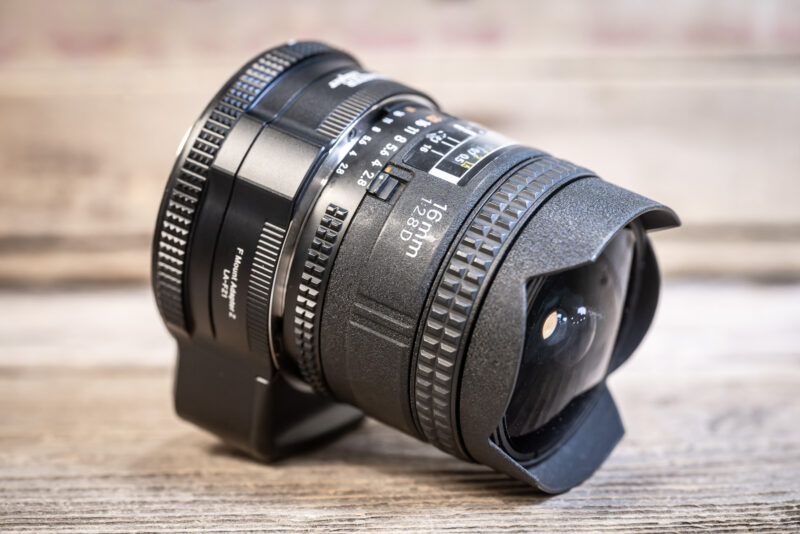
On those two lenses, it has worked well. They’re the Nikon AF Fisheye-Nikkor 16mm f/2.8D and the Nikon AF Nikkor 24mm f/2.8D wide-angle. Both are on MonsterAdapter’s own list of supported lenses.


And it solved a real pain point I’ve been running into: manual focus with fisheyes is tricky at large apertures, and in interior spaces you’re probably going to want large apertures. It also makes a very compact little 24mm much more practical. I like to pack it simply because it’s so much smaller and more convenient than the 24mm f/1.4G.
I’ve also tested it on a DX camera, the Nikon Z50 II, and it works just fine. That’s worth saying, because MonsterAdapter doesn’t publish a camera compatibility list on its product page, and most of the hands-on testing published so far has been on the Nikon Zf. One thing to keep in mind on a DX body: the 1.5x crop means a lens covers a narrower view than it does on full frame. The 16mm fisheye, for example, has a full-frame equivalent focal length of about 24mm. It’s still a fisheye, though, so the view is wider than a regular 24mm lens and keeps the curved lines. What you lose is much of the full-frame fisheye sweep.
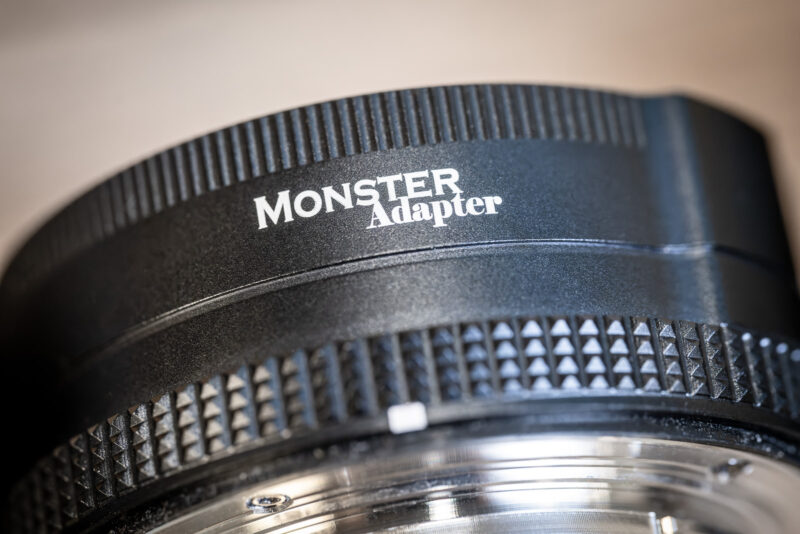
Like Nikon’s FTZ II, it gives you control over the aperture from the camera on these lenses. The adapter has its own small aperture motor for that. On lenses with an aperture ring, like both of mine, set the ring to its smallest aperture (and lock it there, if the lens has a lock), then set the aperture with the camera’s command dial as usual.
Why I wanted autofocus on a fisheye
I should explain why I was even bothering with this in the first place. It was mostly because, as much as I love shooting with fisheyes, using a manual-focus fisheye on a modern mirrorless camera is much trickier than you might expect.
Modern digital cameras, and even many late-model film cameras, are really designed for autofocus first. They have focusing aids for manual lenses, but they’re somewhat half-hearted.
The Nikon Z8, which is the camera I use most at the moment, has a focus peaking display. That can work really well at longer focal lengths. But it works on contrasting details, and with a fisheye it’s just not as precise as it needs to be. You end up with too many false positives, and too much latitude that doesn’t actually correspond to tack-sharp focus.
So why not just set it to infinity and use a smaller aperture? That’s the action-cam approach. But with an interchangeable-lens camera, it’s less practical, for two reasons.
First, you can’t just turn the focus ring all the way and expect tack-sharp focus. I’ve explained it more fully elsewhere, but the gist is that lenses are deliberately designed with some tolerance at the end, to allow for things like temperature changes and manufacturing variation. So turning the focus ring all the way to infinity actually goes past the point of infinity focus. And yes, I realize that sounds ridiculous on its face (you can’t go beyond infinity), but we’re not talking mathematics here. It’s a deliberate mechanical design decision.
Second, I like to shoot in low light, often hand-held. So shooting at f/8 all the time comes with real downsides in ISO and shutter speed.
Update the firmware before you judge it
This matters more than with most gear. The LA-FZ1’s autofocus has changed a lot from one firmware version to the next. The early v1.1 firmware was widely reported to barely work in low light. The v1.2 update in January 2026 was a big step forward. The current version, v1.3, improved things again.
You update it through the USB-C port on the side of the adapter. That port is for firmware only, not charging; the adapter runs off the camera’s battery. And MonsterAdapter seems quite active in issuing updates, which can add support for more lenses.
The product page names the latest version, but the update files haven’t always been easy to find. v1.3 first went out through a download link in 35mmc’s review, not through MonsterAdapter’s own news posts, and the official European distributor was still offering v1.2. Units can sit in stock for a while, so if you buy one, don’t assume it’s current. Check the installed version and update before forming an opinion.
The downsides
I mentioned up front that it’s not perfect. There are a few things going on.
For one, it’s quite noisy. Not in a particularly bothersome way, but it’s certainly not as quiet as a typical modern Nikon lens with its own motor. That’s partly the technology: screw-drive autofocus was never quiet, even on DSLRs, because a motor is physically turning the lens’s focusing mechanism through that coupling. For what I’m using it for, that’s not much of an issue. But if you’re shooting wildlife or performances, it might be a factor.
For another, it has a tendency to pulse when it’s searching for focus. That’s not ideal for moving subjects, like wildlife or sports in particular. Other testing backs that up. In 35mmc’s review series, testing on a Nikon Zf with the earlier v1.2 firmware, it kept a dog running toward the camera in focus in about 20% of frames, against about 80% with a modern native lens on the same camera. The v1.3 firmware is better. In 35mmc’s follow-up, the 180mm f/2.8 went from the worst performer to dependable enough for event shooting, including 3D tracking of someone walking toward the camera, though still not good enough for fast sports. But these are still 30-year-old lens designs. The LA-FZ1 makes them usable, not fast.
It also seems to chew through the camera’s battery more quickly. That doesn’t come as a surprise, since the adapter has two motors (one for focus and one for the aperture), and both run off the camera’s battery. I haven’t measured exactly how much more, and I haven’t found anyone who has. I usually carry a spare battery anyway. If yours seems to drain unusually fast, check the firmware: one of the fixes in v1.2 was for the aperture motor running continuously at wide apertures in some cases.
Those are the biggest things I’ve come across on lenses it works with. There is, of course, the rather large problem that it doesn’t work with every lens. MonsterAdapter’s supported-lens list is all Nikon screw-drive lenses. It also names a few that don’t work (non-CPU manual-focus lenses, the AF 80mm f/2.8, the AF 200mm f/3.5, and the TC-16A teleconverter). And it flags two that may not focus properly in some conditions: the AF Micro-Nikkor 200mm f/4D IF-ED and the AF Zoom-Micro Nikkor 70-180mm f/4.5-5.6D ED. I haven’t independently tested all of those.
Oddly, both of those also appear on MonsterAdapter’s supported-lens list. So read the warning as a known problem with lenses that are otherwise supported, not as a sign they won’t work at all. The list also isn’t an exclusion list. MonsterAdapter says a lens that’s missing from it just hasn’t been tested, not that it can’t work. You just can’t return the adapter if an unlisted lens doesn’t behave.
It also doesn’t support in-lens VR stabilization. Mine don’t have it, but at least one screw-drive lens does: the AF VR Zoom-Nikkor 80-400mm f/4.5-5.6D ED. It’s on MonsterAdapter’s supported-lens list, so it will autofocus, but its VR won’t work on this adapter. In-camera stabilization (IBIS) still works fine, if you’re using a camera body that has that.
And while I found it to work well for my purposes, based on online reviews, not everyone has been as happy with it. So it’s worth double-checking compatibility with your lens first and keeping an eye on their firmware updates — they seem quite responsive.
A lens it didn’t rescue: the Sigma 15mm fisheye
Out of curiosity, I tried it on a non-Nikon lens that I thought it might still work on: the Sigma 15mm f/2.8 EX DG Fisheye.
It’s another F-mount (or at least, there’s an F-mount version, as well as versions for other DSLR mounts) autofocus fisheye from a similar generation to Nikon’s.
It’s one I’ve been using basically interchangeably on Nikon DSLRs and even my Nikon Z8 (as manual focus only). And it has much the same problem on a Z-mount body with the FTZ II adapter: it becomes a manual-focus lens.2
It initially sounded promising, because you can hear the somewhat shrieky focus motor whirring. But in practice, it’s completely haphazard and unreliable with this combination. So my hopes of using this lens with it were dashed, unfortunately. MonsterAdapter’s list only covers Nikon lenses, and it’s clear that an unlisted lens might not work. This one didn’t.
Build and size
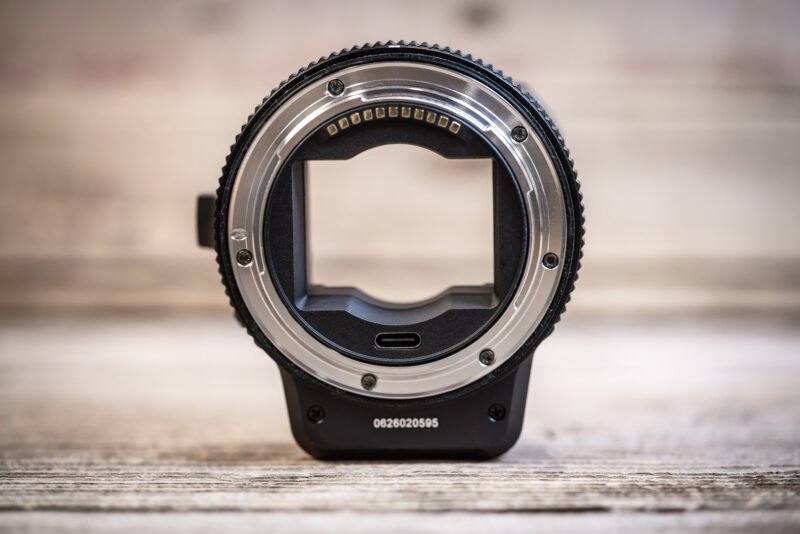
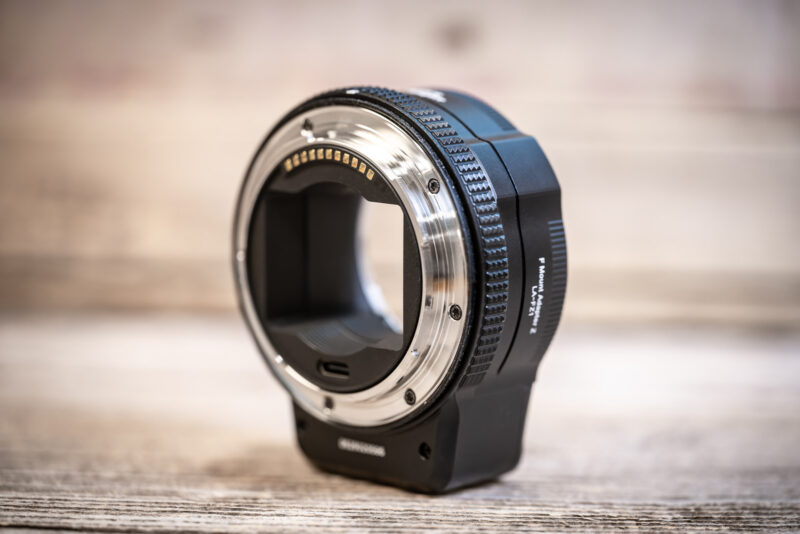
Like Nikon’s FTZ II, there are no optical elements in this. That is, no glass. It’s simply a mount adapter, with electronic pass-through contacts and, in this case, a couple of motors.
It adds the same spacing as the FTZ II. That makes sense, since the whole point of these adapters is to make up for the difference in flange distance, the distance between the lens mount and the sensor, between a Z-mount mirrorless camera and an F-mount DSLR (or film SLR, for that matter).
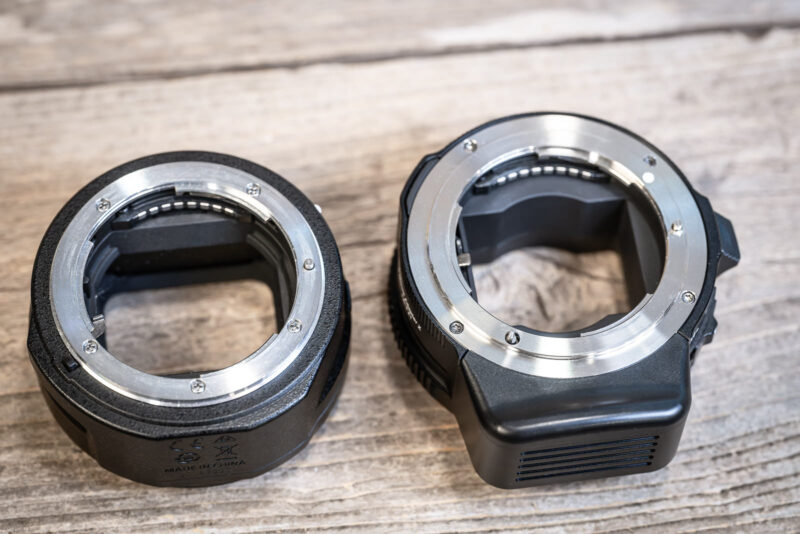
It does have a bulge on the bottom. That’s presumably where the motors and electronics are (I haven’t opened it up to confirm, but it would make sense). So in shape, it’s more like Nikon’s original FTZ adapter than the newer FTZ II. One practical result is that the camera won’t sit flat on a table with the adapter attached. That bulge might also create issues with some lens-mount tripod attachments, as the original FTZ adapter did (which is why Nikon changed the design for the FTZ II), but I haven’t tested that specifically or run into it with the lenses I’ve been using.
Is this a replacement for the FTZ?
No, it’s not. The LA-FZ1 is really only suitable for screw-drive AF and AF-D lenses. The two adapters complement each other: if you have a mix of F-mount lenses, you’ll want both.
Nikon’s own FTZ II is much better for anything with a motor in the lens. So if you’re using an AF-S, AF-P, or AF-I lens, you’ll get better results and compatibility with Nikon’s adapter. That includes AF-S lenses that also have a D in their name (yes, it’s confusing, but an AF-S lens with a D is different from an AF-D lens: it has its own motor; I’ve decoded Nikon’s lens abbreviations here). The FTZ II also supports lenses with electromagnetic (E-type) apertures and in-lens VR, which the LA-FZ1 doesn’t.
Things worth knowing
- It seems to drain the battery quite a bit. I don’t have specific numbers on it, so it’s only anecdotal. But it makes sense given the motor that’s in it. I usually carry a spare anyway, but I have found myself reaching for that spare more often when shooting with this.
- Sometimes the lens release can become a bit sticky. Some gentle wiggling separates it, but it’s not as smooth as it should be.
- Like some other third-party lenses and accessories these days, it comes with a USB-C port (data transfer only) for updating firmware. There have been a few firmware updates since the adapter was originally released, signaling that they’re doing a pretty good job of expanding compatibility. So it’s well with checking for the latest firmware. Oddly, I haven’t been able to find a consolidated page with all the firmware updates, but you can find the individual announcements in MonsterAdapter’s press release archive.
Is it worth it?
At $359, the LA-FZ1 costs more than some of the lenses it revives.
AF-D lenses are cheap on the used market, partly because they lost autofocus on mirrorless cameras. So if you only have one AF-D lens you use now and then, a modern native Z lens might be the better way to spend the money.
But if you have a drawer of AF-D lenses you still like, or one particular lens you’d really miss, like my 16mm fisheye, it’s a genuinely useful piece of kit. Because there’s nothing else that does exactly this job.
- With Nikon’s own AF-D lenses, you do at least keep the electronic rangefinder, Nikon’s name for the focus indicator in the viewfinder that shows whether you’re in front of or behind the focus point. That’s a significant step up from not having it, but it’s still a manual-focus lens. [↩︎]
- I say “much the same” problem because there’s a subtle but important difference. The Nikon fisheye on a Z-mount body with the FTZ adapter loses autofocus, but it keeps the electronic rangefinder, which is a step up in usefulness from focus peaking alone. With the Sigma, I don’t get that; it’s only the focus peaking display. [↩︎]