Quick Summary
To check your Fujifilm X100V’s firmware, put a memory card in, then hold the DISP/BACK button while you switch the camera on. To update, copy Fujifilm’s firmware file to the card, and do the same thing: hold DISP/BACK and switch on.
- You need a memory card in the camera to see the version number. Without one, nothing shows.
- Use a fully charged battery, and a card formatted in the camera.
- The file goes on the top level of the card, not in a folder, and it must be named exactly
FPUPDATE.DAT. - Don’t switch off or touch anything while it updates.
Camera manufacturers release firmware updates to patch software bugs or unlock new features, but they rarely stick to a predictable schedule. I highly recommend getting into the habit of checking your camera periodically.
You can always find the latest official firmware for the Fujifilm X100V directly on Fujifilm’s support site.
Checking your camera’s firmware
- Turn the camera off, and check there’s a memory card in it.
- Hold down the DISP/BACK button and switch the camera on.
- The screen shows the installed firmware version. Note it, then switch off.

Nothing showing? Fujifilm’s manual says the camera only displays the firmware version when a memory card is inserted. If you get a normal start-up screen instead, put a card in and try again.
Check that number against the latest version listed on Fujifilm’s website. If the numbers match, you are already running the latest software. If the website shows a newer version, proceed with the update below.
Updating the Fujifilm X100V’s firmware
Note: If you use a Mac, Fujifilm has issued specific guidance regarding a macOS compatibility bug. You can read the workaround here.
There are a few strict prerequisites I always follow before starting a firmware update:
- Charge the battery fully. If the camera loses power partway through, it may stop working properly. That’s the one real risk here, and a full battery removes it.
- Pre-format your memory card. I stick to the golden rule of formatting the card in-camera before putting the update file on it. This ensures a clean directory structure and prevents the camera from getting confused by existing files. If you aren’t sure how to do a deep clean, see my guide on how to format SD cards. (If you accidentally format a card that still has unsaved photos on it, stop shooting immediately and run a recovery tool to recover your deleted photos before attempting the firmware process).
- Download the file on a computer. It’s on Fujifilm’s X100V firmware page. Read the release notes there; they say what each version changes.
Check the file name. The camera looks for a file named exactly FPUPDATE.DAT. Rico Pfirstinger points out that if an older firmware file is still in your downloads folder, your computer may rename the new one (to something like FPUPDATE (1).DAT), and the camera won’t find it. Rename it before copying. He also notes that if Fujifilm’s page doesn’t show a new version you know exists, your browser may be showing an old cached copy of the page; reload it.
The safest and most reliable way to execute this process is using a computer and an SD card reader to manually move the file. Here is my exact workflow:
- Step 1: Insert the formatted memory card into your computer’s card reader. Copy the downloaded firmware file directly to the root directory (the top level) of the card. The file must be named exactly FPUPDATE.DAT.
- Step 2: Eject the card and insert it into the camera. Ensure the camera is powered OFF.
- Step 3: Hold down the DISP/BACK button and switch the camera ON.
- Step 4: The firmware update screen will appear. Press the MENU/OK button and follow the on-screen prompts to confirm the update.
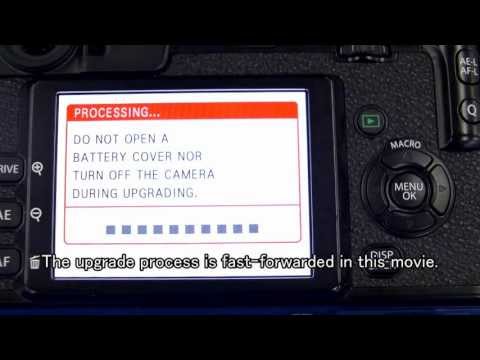
- Step 5: Wait. Do not touch any dials, press any buttons, or open the battery door. The screen may go blank momentarily. It usually takes a minute or two, but don’t worry if it’s slower: Fujifilm’s manual for the newer X100VI says a large update can take up to about 10 minutes. Once finished, the LCD will display “Firmware Upgrade Completed. Turn off the camera.”
- Step 6: Power the camera off, then repeat the DISP/BACK check above to verify the new version number is actively running.
Updating from your phone
The X100V manual lists firmware updates among the things Fujifilm’s phone app can do. It names FUJIFILM Camera Remote, which Fujifilm has since replaced with FUJIFILM XApp. The card method is quicker and doesn’t depend on the phone connection, which is why I’d still use it.


Things worth knowing
I cannot stress this enough: do not interrupt the update process. It is quick, but breaking the connection while the camera rewrites its operating system is disastrous.
If you encounter an error message during the installation, Fujifilm has a dedicated error response page that outlines troubleshooting steps.
If you prefer a visual guide, Fujifilm has an official walkthrough video. Note that it covers their entire interchangeable lens lineup, so parts of it (like updating separate lens firmware) won’t apply to the fixed-lens X100V, but the core body update steps are identical.
Updating an X100VI too? The process is nearly identical: see how to update the X100VI’s firmware.
macOS compatibility bug
There is a known bug affecting several Fujifilm X and GFX series cameras — including the X100V — that triggers under very specific folder conditions. If you save more than 4,000 files into a single folder on an SDXC card and then mount that card directly via macOS, any file after the 4,000 mark may become inaccessible. You can read Fujifilm’s official bulletin on the issue here.
Updating your firmware to the latest patched version applies a fix that limits the number of files written to individual folders to prevent this directory error.
FAQ
How do I check the firmware on my Fujifilm X100V?
Put a memory card in, then hold DISP/BACK while you switch the camera on. The version appears on the screen.
Why doesn’t my X100V show the firmware version?
There’s no memory card in it. Fujifilm’s manual says the version only shows when a card is inserted.
How long does an X100V firmware update take?
Usually a minute or two. Fujifilm’s manual for the newer X100VI says a large update can take up to about 10 minutes, so don’t switch off until the camera says it’s done.
Fujifilm X100V price & availability
The Fujifilm X100V was released in February 2020. Despite launching right at the beginning of the pandemic, it gained massive viral popularity and became notoriously difficult to find.
Fujifilm eventually replaced it with the X100VI in early 2024, but the original V remains a highly capable camera if you can track one down on the used market.
Buy new
Because the camera has been succeeded by the X100VI, finding brand-new stock of the V is incredibly rare. However, it is occasionally worth checking at:
Buy used
Since a newer model has superseded it, the used market is absolutely your best bet. Here are the places I typically check for reliable used gear: