The Ricoh GR III’s Sleep Mode is a battery saver: after a set interval (1 minute by default) it drops into a hibernation standby that shuts down the screen and other power-hungry functions, at the cost of a moment’s wake-up delay. The setting lives under Setup > Power Supply Settings > Sleep Mode; details below.
Fundamentally, the Sleep Mode on the Ricoh GR III is about preserving battery life.
The GR III has a small battery, and it doesn’t offer particularly stellar battery life anyway. And because the back screen is one of the camera’s largest consumers of battery power, tweaking the time setting on it is one of the most effective ways to save precious battery power.
Basically, Sleep Mode turns off the back screen.
The reason that presents such an important battery-saving opportunity is for the simple reason that the back screen is among the most power-hungry features. That’s something that’s true of all modern mirrorless cameras that don’t rely on an optical viewfinder (or have both).
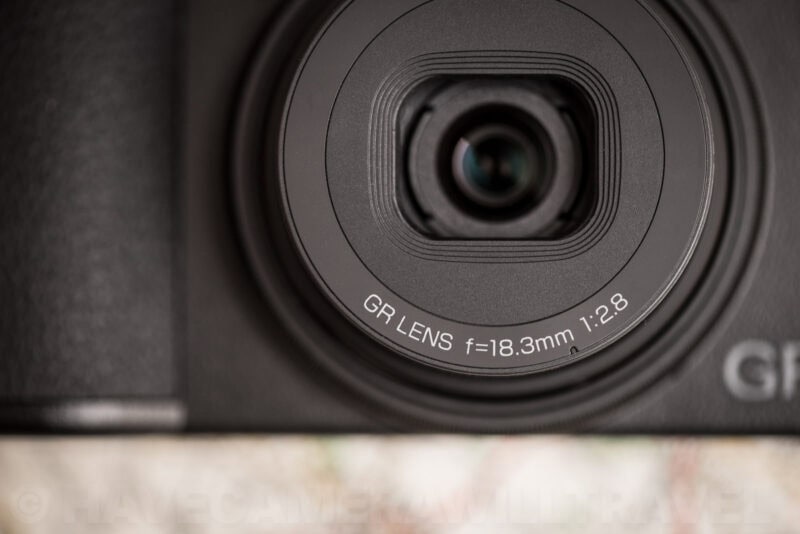
The lens stays out and the LED indicator lights stay on (if you have the lights enabled in the settings).
I’ve been shooting with the Ricoh GR III since it was released in 2018. You can see some of the photos I’ve taken with it in these posts:
– Ricoh GR III Sample Images (a general collection of photos taken under various conditions)
– Ricoh GR III High ISO Sample Images (focusing on photos taken at high ISOs in low lighting)
– Ricoh GR III ISO Range Sample Images (sequence of images taken throughout the ISO range for comparing image quality at different ISOs)
– How to Shoot Macro Close-up Photos with the Ricoh GR III (specifically on using the GR III’s macro feature)
It puts the camera into a hibernation standby mode that shuts down power-hogging functions like the back screen, focus tracking, and exposure calculations.
The catch is that it takes an extra moment for the camera to wake and be ready for shooting.
The default setting is 1 minute.
You can make this longer, or even turn it off. You can find this setting under:
Setup > [7] Power Supply Settings > Sleep Mode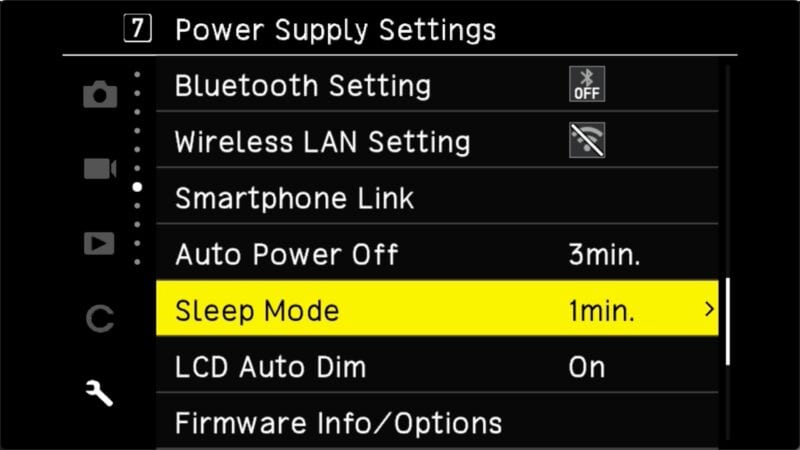
If you’re here reading this, there’s a good chance you find that the screen turns off too quickly on the default setting, and you’d like it to stay on longer.
The available choices are:
- 1min. (default)
- 3min.
- 5min.
- 10min.
- 30min.
- Off
There are two other settings that are closely related to this:
- Viewfinder Dimming
- Auto Power Off
These three settings work together and are designed as battery-saving measures.
Viewfinder dimming
This one is pretty self-explanatory: it dims the back screen. That makes it a kind of half-step to the Sleep Mode setting (which turns the screen off completely).
It’s a pretty simple equation. A brighter screen consumes more power; a dimmer screen uses less power.
The setting for dimming the viewfinder doesn’t give you any options on duration. The feature is either on or off. The default is On, which makes sense in most circumstances.
You can find the setting on the GR III’s menu at:
Setup > [7] Power Supply Settings > LCD Auto Dim
Auto Power Off
Obviously, if you want to save maximum power, the best way to consume no power is to have the camera powered off.
The cost is in terms of convenience. With the camera powered off, it takes a moment for the lens to extend and the camera to initialize. That delay might mean you miss a fleeting shot.
The default setting for this is, again, 1 minute. Which is a good setting for maximizing battery power, but it’s too brief for my tastes. I prefer to have it set to something like 3 or 5 minutes. That way, when I’m focused on a shot or trying an alternate version from a different perspective, I can really focus on the shot and not worry about whether the camera is ready to go.


You can find this setting under:
Setup > [7] Power Supply Settings > Auto Power Off
The available options here match those for the Sleep Mode:
- 1min. (default)
- 3min.
- 5min.
- 10min.
- 30min.
- Off
Wrap up
In summary, the Ricoh GR III provides users with a variety of power-saving options to optimize battery life. This is especially important considering its small battery capacity and how quickly it can run out.
Adjusting the Sleep Mode timer, toggling the Viewfinder Dimming, and setting the Auto Power Off are crucial steps in striking the right balance between convenience and battery conservation.
While the default settings are designed for maximum power savings, they might not be ideal for everyone, especially those who need uninterrupted shooting experiences and need the camera to be ready right away.
After all, in photography, sometimes it’s not just about capturing the best shot, but also having the right settings in place to ensure you don’t miss that shot. And running out of battery power or having the camera powered off can both fall into that category.
Of course, every photographer’s shooting style and preferences are different, so it’s a matter of striking the right combination that works best for your style.