There are two ways to format memory cards in Nikon DSLRs like the D850, D810, D750, and D610. One requires navigating the digital menu interface. The other relies on physical buttons on the camera body.
In the field, I rely exclusively on the physical buttons. It is vastly faster, and once you build the muscle memory, you can wipe a card without ever taking your eye away from the action. Here is how both methods work.
Method 1: The standard menu
This is the obvious way to format a card, but it requires taking your attention off your subject to look at the rear LCD screen.
- Press the
Menubutton on the back of the camera. - Navigate to the
Setup Menu(the yellow wrench icon). - Select
Format Memory Card. - Choose which card slot you want to format (if you have two cards inserted) and confirm.
Method 2: The two-button quick format shortcut
Nikon built a dedicated physical shortcut to bypass the menu entirely. To use it, you need to locate two specific buttons on your camera body. Look for the small, red “Format” labels printed next to them.
Button 1: The Top Panel
- On the Nikon D850, D810, and D800, it is the
MODEbutton. - On the Nikon D750 and D610, it is the
Metering Modebutton.
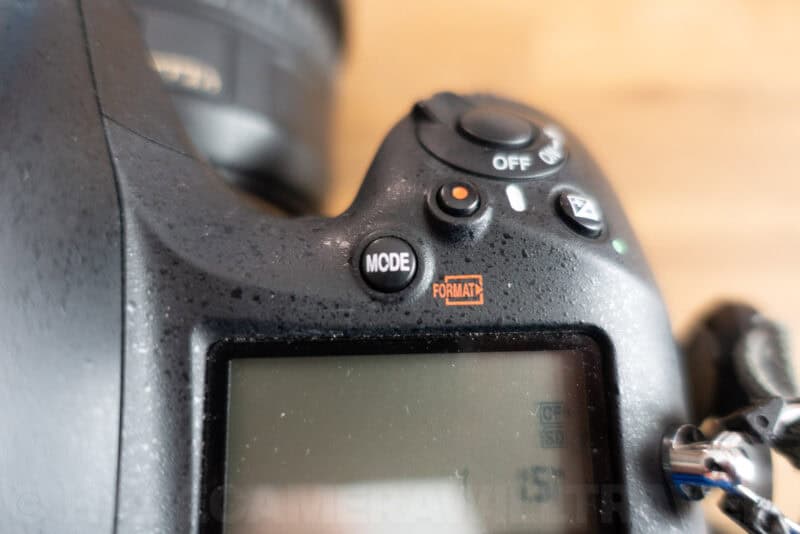
Button 2: The Back Panel
On all of these models, the second button is the Delete button (marked with a trash can icon) located on the top left of the rear panel.
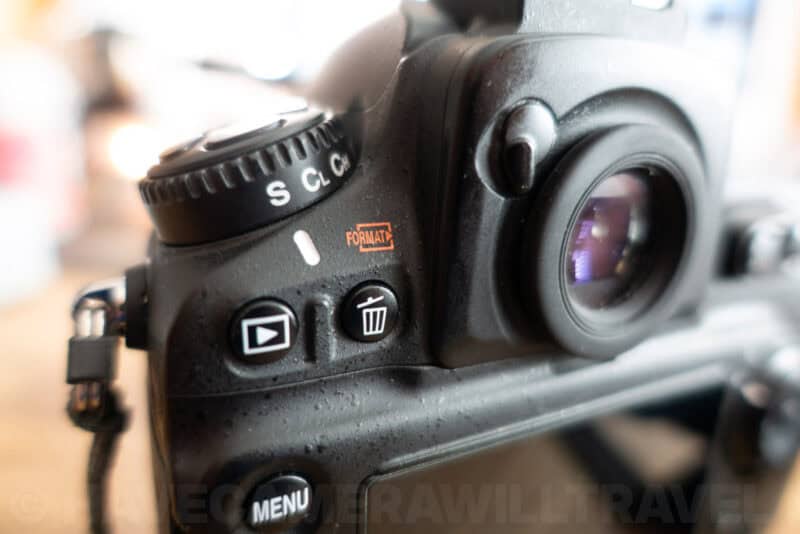
How to execute the quick format
To prevent accidental deletions, the shortcut requires a very specific sequence:
- Press and Hold: Press both of the red Format buttons down simultaneously and hold them for about two seconds.
- Wait for the Flash: Look at the top LCD screen. A blinking “For” (format) will appear. The memory card slot indicator will also begin blinking to show you which slot is currently selected.
- Select the Slot: Release the buttons. If you have cards in both slots, you can switch between them by rotating the main command dial on the back of the camera. The blinking icon on the top LCD will jump between the slots.
- Confirm: Once the correct slot is selected, press the two red Format buttons simultaneously one more time. You do not need to hold them this time; the camera will execute the format immediately.
If you trigger the flashing “For” prompt but change your mind, simply lightly press the shutter button or wait five seconds, and the camera will cancel the process.
Formatting best practices & troubleshooting
This quick shortcut works with all memory card types supported by these cameras, whether you are using an SD card, an older CompactFlash card, or a modern CFexpress Type B card.
Always format in the camera: It is best practice to format your memory cards inside the camera rather than using your computer. This ensures the file system is built exactly how Nikon’s processor expects it, which drastically reduces the risk of file corruption. If a card starts throwing read/write errors and simply reformatting it in the camera doesn’t fix it, you may need to connect it to your computer to run a full format instead of a quick format using a dedicated utility tool.
Accidental formatting: The two-button safety mechanism makes it difficult to accidentally format a card, but mistakes happen. If you format the wrong card, immediately pull it out of the camera. As long as you have not taken new photos and overwritten the memory sectors, you can usually recover your deleted photos using recovery software like Stellar Photo Recovery, Disk Drill, or Photorec.